I thought that yesterday's news about the rebound in the current account was an indication that the first quarter GDP growth would be better than it was in 2007Q4. I thought wrong:
Real gross domestic product (GDP) edged down 0.1% in the first quarter
of 2008, its first quarterly decline since the second quarter of 2003.
The economy, which had started to lose momentum in the second half
of 2007 as exports declined, stalled in the first quarter due to
widespread cutbacks in manufacturing, most notably in motor vehicles.
In addition, weather disruptions hampered economic activity in the
quarter. Economic output contracted 0.2% in March. Final domestic
demand advanced 0.6% in the quarter on the strength of consumer
spending. Inventory accumulation eased considerably in the first
quarter, after two quarters of large build-ups.
The release makes note of three things that appear to be one-off events: bad weather (it was a brutal winter), an auto parts strike, and a rundown in inventories. And since exports have been flat throughout this cycle, I'm not getting too exercised by the slowdown in exports. So there's reason to hope that these last two quarters are an inflection point, and that growth will resume – especially if the US manages to avoid a recession.
But the thing that makes me a bit nervous is the slowdown in domestic demand, since that's what has been driving this expansion: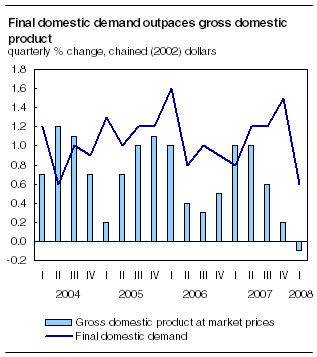
Employment and real wage growth have been holding up pretty well over the past few months, so maybe this is just another one-off blip.
At what point does a sequence of unrelated one-time events become a trend?
Update: I just came across this passage from the Globe and Mail story:
Analysts in Canada have recently focused less on real GDP and more on
nominal GDP, which doesn't adjust for rising prices. That's because
even while economic output stagnates, much of Canada's prosperity is
coming from the money earned from rising commodity prices. Nominal GDP
rose 4.6 per cent at annualized rates in the first quarter, and
personal disposable income also surged.
Huh? If someone can extract meaning from this, please explain it to me in the comments.


 Worthwhile Canadian Initiative
If someone can extract meaning from this, please explain it to me in the comments.
The author is saying he doesn’t understand economics at all but that he doesn’t see that as a reason to stop blathering nonsense.
Off topic:
In tomorrow’s NY Times Greg Mankiw argues for reducing, or even abolishing, the (US) corporate income tax and replacing it with an increase in the gasoline tax.
Sound familiar anyone? When a conservative US economist and a liberal Canadian economist both advocate the same tax changes, it just may be that they are on to something.
“Sound familiar anyone? When a conservative US economist and a liberal Canadian economist both advocate the same tax changes”
I’m not a liberal!
Oh.. you were talking about someone else… carry on… 🙂
The nominal GDP is pertinent for those interested in the governments finances. As a rule of thumb, governments receive taxes as a share of the nominal GDP. Suppose that the economic forecasts are 3% reel growth and 2% inflation and the governement have planned the public spending based on that. If what happens is 1% reel growth and 4% inflation, that’s bad news for the citizens but the governement won’t go into deficit. (think GST, tax bracket creeping, oil company profits,…)
In the last six month, it was the first time for a while that some analists feared that the federal government could fall into deficit. That’s the only reason I can find for “Analysts in Canada have recently focused less on real GDP and more on nominal GDP”. But the whole paragraph is just bad journalism.
instead of:
“much of Canada’s prosperity is coming from the money earned from rising commodity prices”
You could write:
“lately, a large part of Canada’s relative prosperity is coming from the rising of the reel prices of commodity”
But this is not to be confused with the nominal GDP.
They may mean: total quantities of oil (and other commodities) produced aren’t increasing, but the price we get for it has shot through the roof, and we’re net exporters, so we’re clearly better off. But (1) if this is a terms of trade story, nominal GDP is still the wrong measure (as Mercure pointed out); and (2) it shouldn’t matter if it doesn’t flow through to real incomes and real final demand, I wouldn’t think. And as you note, the last at least isn’t looking too rosy. Bottom line: no real meaning.