Today's edition of the National Post offers up two variations on the same clanger, namely that the upcoming deficits are due to a ramp-up of spending.
expansionism and continued spending increases. Spending has been rising
at twice the rate of population growth and inflation, an unsustainable
trend.
This is accompanied by an op-ed from the Fraser Institute's Neils Veldhuis.
startling. Over the past five years (2003-2008), average annual
increases in government program spending ranged from a low of 3.6% in
Prince Edward Island to an astounding 11.4% in Alberta (the federal
government averaged 6.2%).
Over this period, every Canadian
government — federal and all 10 provincial governments — increased
spending at substantially higher rates than what was needed to
compensate for inflation and population growth. Put differently, every
government significantly increased per-person program spending after
adjusting for inflation over the past five years.
Even more
worrying, most governments increased program spending faster than the
rate of economic growth (GDP)…
All of the above examples make it
abundantly clear that Canadians need constitutional protection from
profligate governments. That protection is best provided by tax and
expenditure limitation laws.
Pretty scary stuff. Except that the entire argument is based on the hoary statistical trick of choosing a base year – in this case, 2003 – that best fits the story you want to tell. Readers are expected to assume that the world began in the base year and that what happened before the base year is not relevant.
But it is. Here are a couple of graphs from this recent post on the history of federal government expenditures and revenues:
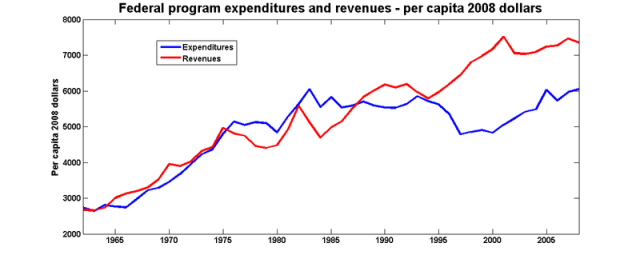
If you look at the data starting in 2003, then you do see an increase. But if you look at the entire sample, real per-capita program spending is the same as it was 25 years ago.
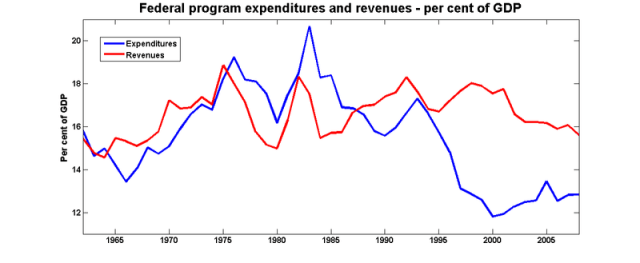
This graph tells the same story. Yes, as a share of GDP, federal expenditures have been rising, but from a very low base. Expenditures as a share of GDP are still below levels that Diefenbaker's government saw.
I have a feeling I'm going to have to bang this drum a little harder in the next few months.
Update: Especially now that Andrew Coyne seems to have bought this line as well: "[T]his has very little to do with the state of the economy and everything
to do with years of runaway spending. Had spending been kept under the
slightest semblance of restraint, there would have been ample margin
for even the worst downturn." Sigh.


 Worthwhile Canadian Initiative
That second graph is especially surprising.
Your link to your previous post doesn’t work, BTW Stephen.
“All of the above examples make it abundantly clear that Canadians need constitutional protection from profligate governments”
Reminds me of a not too clever acquaintance who, many years ago, was marveling at the wonders of email. “Next thing you know, you’ll be able to talk to people halfway around the world!”, he said. Apparently he was unaware of the existence of the telephone.
Maybe he and Neil Veldhuis should get together and invent the election.
That protection is best provided by tax and expenditure limitation laws.
Didn’t BC and Alberta enact and then quickly abandon laws like that.
I read the Corcoran article this morning – he seems to imply that the home reno tax credit is to blame for most of the deficit and that issues like a massive cyclical fall in income tax revenues are, at best, an excuse. He also fails to mention the contribution of cutting the GST.
So, um, where would the new forecast put us on the first graph? I mean, I’m assuming the spending line needs to go considerably higher than the revenues line to account for the deficit, no?
These are program expenditures; they don’t include debt payments.
Ask California how Proposition 58 is working for them.
Wait, Terence Corcoran wrote something that was worse than useless? Stop the presses!
But in seriousness, please keep pointing this out. I’m not sure it’s bad economics as much as it is ideology trumping reality, although I guess history suggests those are far from mutually exclusive categories…
Indeed. I wouldn’t have bothered if there wasn’t also the other piece.
A rather elegant rebuttal, well done.
Of course, these arguments are always means-driven in the first place. Economy good? Cut taxes and spending! Economy bad? Cut taxes and spending! It’s the solution for everything!
(Well, yes, they’re ends-driven in a way. But it isn’t ever the end its proponents claim it is.)
Well, if those who believe that government spending as a share of GDP should be declining, then the recent years of “runaway expenditures” surely work against that objective.
Did not program expenditures increase at a faster year-over-year rate under the Harper Conservatives than they did under Martin Jr or Chretien Liberals?
In passing, it is curious that the Harper Conservatives are running negative attack ads against Ignatieff by warning the audience that Ignatieff may levy carbon taxes or increase the GST value-added consumption tax.
Here’s the irony. The attack ads probably don’t work in Quebec. But supposedly they will work with the Harper Conservatives’ core consituency particularly in western Canada, where folks are supposed to be fiscal conservatives!
But what really appears to unite western Canadians in a sense of common purpose is the rush to ‘get-rich-quick’, i.e., encourage the rapid privatization of social wealth. That outlook fits with a shrinking role for government though even there it is not clear that the Harper Conservatives have been that successful. Seems like the true fiscal stance ultimately takes a back seat to other priorities.
westslope : “But what really appears to unite western Canadians in a sense of common purpose is the rush to ‘get-rich-quick'”
That’s not at all true and rather mean spirited. I could write a long post explaining why, and my observations as someone who has lived in both Central and Western Canada (grew up in Quebec I’ve lived in AB for 7 years now), but I suspect you know that your statement is rubbish so I won’t bore everyone.
Patrick, Did I say that [some] western Canadians are “eaters of children”? I guess I did. Sorry to hurt your feelings.
Expressed in less inflammatory, more neutral language: Western Canadian provincial governments fail to manage resource exploitation for maximum social gain. The priorities of aggregate growth and natural wealth privatization inevitably jeopardize collective wealth potential.
Of course, the principles that guide western mismanagement of collective resources are found right across Canada. For example, British Columbia is by no means the only province to consistently favour the maximization of inputs as opposed to net puts in the forest sector.
None of them oppose annual, year-in, year-out EI wage subsidies for some of the workforce.
westslope: In Alberta, the gov’t doesn’t really manage resources at all. They regulate (lightly), and the regulator is clearly captured. The people of AB don’t like it, but the politics of the province preclude a change in gov’t so nothing changes. The ‘normal’ political cycle in AB is for the ruling party to rule for a VERY long time, and eventually they self destruct and a new party replaces them. The Liberals and the NDP will never, ever form the gov’t. Never.
At least in AB, my own opinion is that restoring property rights is the only politically viable means for tackling environmental issues. The Riverkeepers have shown tort law to be a powerful tool for environmentalists, when it hasn’t been eviscerated in favour of corporations. In AB any top down approaches – especially if they originate in Ottawa – inevitably get labeled with ‘NEP’ and the electorate instinctively oppose it.
Another example: I am not a lawyer, but I suspect that the way to get action to reduce GHG in AB is to show the ranchers and farmers that their kids won’t be able to ranch or farm because once the glaciers in the Rockies all melt there won’t be any water in the summer for irrigation. Then give them the right to sue Canadian companies pumping GHG into the air and thus contributing to the destruction of their farms and ranches. It’s basic trespass, and the burden of proof is not complicated; you’re doing something that deprives me of the use of my property in some way, so you have to stop. My bet is that it wouldn’t take long for us to hit our Kyoto targets.