It's now a short-term problem.
I spent the morning doing interviews on CBC radio morning shows in Corner Brook, Victoria and nine places in between. (For those of you who caught it, yes, I really do speak that quickly. I try to slow down when I'm on the air, but sometimes I forget.) One of the talking points was the PBO's concern that an aging population was going to slow economic growth and make it even harder to get rid of the deficit.
We've been talking about the problems associated with what happens when the baby boom generation retires for so long that it's become just part of the background noise in many policy discussions. Four years ago (one of my holiday reruns), I wrote
[E]veryone knows that the baby boomers are also approaching retirement,
so the relative size of the working-age population is going to be
decreasing. And it's going to happen soon: according to Statistics
Canada's projections, the number of people between the ages of 15 and
64 will peak in about 5 or 6 years, and will then decline sharply. That
extra 0.25% in growth is not only going to disappear, it's going to go negative: the decline in the size of the labour force will reduce per-capita growth rates by about 0.4%
Those projections were generated in 2005, and they may have been a bit optimistic. Here is a graph of the working-age population expressed as a share of the total:
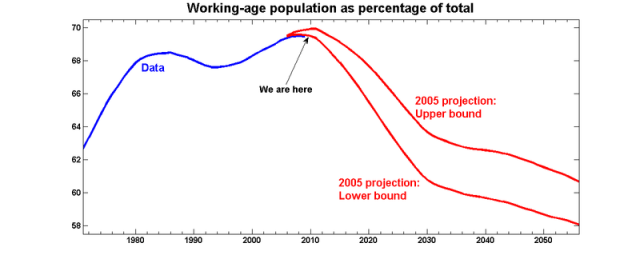
Since 2005, the data have tracked the lower end of the 13 scenarios that StatsCan ran.
Yikes.


 Worthwhile Canadian Initiative
Nick’s post said: “Plus, Stephen (and I) are coming at this from a long run aggregate supply perspective, where real income is determined by the supply side, and output=income must fall if there are fewer workers available.”
And there is the problem with almost all economists because they are still “living” in their post WWII world that IMO does not exist anymore. IMO, the “worldwide” economy is NOT running out of workers. Maybe china can make all the tradable goods the world needs by itself?
I also like this question. What happens if about 3 billion workers can provide everything about 6 billion people need, but about 4 billion need/want jobs?
Too much Fed: That’s given me the idea for a new post. Still mulling over the title: “Of horses and men”? The demand for horses’ labour has almost disappeared; how come the demand for human labour hasn’t?