The minimum wage in Ontario went up today, and Jim Stanford thinks that it's cause for celebration. I'm not sure why. I'm guessing that he – as does the editorial board of the Toronto Star – believes that a higher minimum wage will help reduce poverty.
Sadly, this belief is mistaken. As I noted earlier when discussing this study, recent research using data from Ontario finds that the intersection between those in poverty and those who earn low wages is remarkably small:
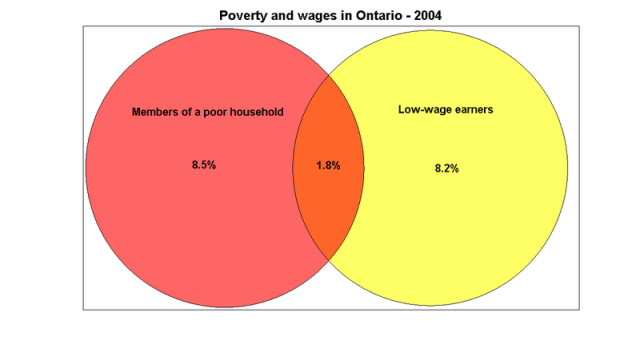
From that previous post:
Even under the assumption that there are no employment effects, "only 10.66 percent of total wage increases accrue to workers belonging to poor households." Given that 10.3% of households are in poverty, increasing the minimum wage is only slightly more effective as an anti-poverty measure as would be distributing money at random across households.
Not really cause for celebration, is it? I've said it before, and I'll say it again: if you want to help people in poverty, give them money.


 Worthwhile Canadian Initiative
Interesting reference to Singapore. This was of the countries (in addition to the US) that Roger Martin suggested Canada should emulate in terms of developing an innovation strategy at the Liberal gabfest. My quick Google search picked up this summary:
The tax system was also attractive to foreign companies, often giving lower tax rates for foreign investment than for local residents.
One of the keys to Singaporean development was the upgrading of infrastructure, streets, roads, an airport, port facilities. The upgrading was financed not primarily by borrowing but by a special infrastructure tax.
Lee Kuan Yew was not infallible. His ideological background was the social democratic Labour Party. His intention was to raise income levels of Singaporean labor and when his program for attracting foreign employers was proving successful he announced an increase in the minimum wage levels. This produced a serious recession. The higher wages were a discouragement to foreign companies considering Singapore relative to other locations, but probably the most serious effect was the signal that Singapore might be like other Third World governments that would encourage investment and then change the rules when companies were vulnerable. Lee Kuan Yew learned his lesson and took a different strategy for raising Singaporean incomes.
The strategy was to improve the training of Singaporean workers through government training institutes. A typical training program would meet twice a week for three-hour sessions over a two year period. The training was voluntary and free and it was geared to the needs of the companies operating in Singapore at that time.
http://www.sjsu.edu/faculty/watkins/singapore.htm
I think Singapore is a net importer of oil. That and the recession might explain any recent declines in real wages.
Patrick, I admire your optimism. It took me more than just one undergrad course to ‘get’ wage = marginal product of labour. You have lofty expectations.
Do you think lay folks would understand the following?
know-how (human capital) —–> economic productivity ——> higher real per capita incomes
Minimum wage hikes cannot increase productivity, unless they pull workers back from malnourished subsistence levels. Having some modest minimum wage in place is probably not a bad idea because it allows the state to closely monitor for sweat shops.
Do you think lay folks would understand the following?
know-how (human capital) —–> economic productivity ——> higher real per capita incomes
Perhaps if you also acknowledged that there are other ways to become more productive – eg working harder; working smarter; working longer.
When I took an accounting course (only needed one) I quickly realized that many accounting conventions (rules for allocating overhead – fixed costs, for example) had been developed when manual labour was a very significant part of a product’s cost. Not really relevant today when things are highly automated and/or in knowledge based industries.
I often wonder if many economic theories/principles were also developed in that era and suffer from the same irrelevance today. That thought occurred to me when Nick wrote the following commenting on Frances’s blog Human Capital: literal truth, fairy tale or myth?:
But formal economic theory has been able to handle that, at least since 1871, when we discovered marginal analysis. In team production, the marginal product of a worker is not the same as the average product, in general…
But, as a lay-zee folk, I didn’t bother posting the observation, then.
“I will say this though – I’m impressed that anyone can suggest with a straight face that 2007-2009 was a great time to be a worker in Ontario.”
If I were his employer at the CANADIAN AUTO WORKERS UNION, I would be seriously concerned about the quality of the economic advice I was getting if I thought he believed that.
Doubtful any CAW member has seen anything close to min. wage. I wouldn’t be surprised, however, to find some union wages are pegged/negotiated relative to the min. wage.
One should equate wages to the marginal productivity of the work, not that of the worker. This is why raising the minimum wage can increase productivity; it can induce the investment necessary to do so. This is not without cost, and there are limits to what it can achieve, but this is a better reason to support it than helping the poor.
I’m really struggling to see what the issue is here. Housing costs in much of Canada are so high that it’s extremely difficult for a person earning minimum wage to form an independent household. The fact that people earning the minimum wage aren’t in poor households is a consequence of the inadequacy of wages relative to living costs.
As a general rule: One or no wage earners=poverty, two or more wage earners (children in parental basements, roommates living together) = not poverty.
I really don’t see how giving money to people avoids the issue of giving funds to people who are not in poor households. Steve, how much of the GST credit goes to people (like my daughter) who are not in poor households?
Plus cash transfers simply have different efficiency costs in that they raise marginal effective tax rates at some part of the income distribution, and they have to be financed somehow. I don’t see a compelling efficiency argument here for cash transfers as opposed to the minimum wage as an anti-poverty instrument.
“it is the exception that proves the rule”
Which is another way of saying “data that contradicts my theory, which I will now proceed to dismiss on the grounds that I dislike it.”
Incidentally, “the exception that proves the rule” doesn’t mean what you think it means.
http://en.wikipedia.org/wiki/Exception_that_proves_the_rule
westslsope wrote: Do you think lay folks would understand the following?
know-how (human capital) —–> economic productivity ——> higher real per capita incomes
And Just visiting from MacLeans responded: Perhaps if you also acknowledged that there are other ways to become more productive – eg working harder; working smarter; working longer.
westslope continues: Productivity is usually measured as follows: a measure of output divided by a measure of input. Working harder and working longer increase the denominator, and thus for a given level output, decrease productivity.
The notion of working smarter is included in the know-how or human capital variable.
Big question for everybody: In the context of a resource-levered, rent-seeking economy where non-productive rent-seeking enjoys wide social acceptance and support, should Canadians simply give up on improving Canadian economic productivity? Maybe we are just a society of takers?
It is not intelligent at all to suggest, no demand, that competition raises prices. Competition always pushes prices down!! As is, the price floor, that is the minimum wage, pushes prices up, while competition pushes all prices down, and these TWO forces working together brings you to a marginal product. You are demanding that the house will remain firm without a foundation.
As for Singapore, do you deny that their real wages have been falling over the last 3 decades? Singapore became very rich between 62 and 75, and everyone there shared in the prosperity. Since then it has become almost a communist state, with the rulers holding all means of production and the wage earners struggling in poverty. Sure, the city state is wealthy, but most of that wealth is in the hands of the few, and the commoner struggles daily to make ends meet with his paycheck constantly dwindling. Wages will not go up on their own, and I do not misrepresent the history.
Productivity is usually measured as follows: a measure of output divided by a measure of input. Working harder and working longer increase the denominator, and thus for a given level output, decrease productivity.
Again, you are stuck in the 1871 paradigm of manual labour getting paid an hourly rate. Take two salaried individuals. Input = same. Output can differ depending on how hard they work and for how long. Just look around wherever you work/have worked for examples. They’re not hard to find (without resorting to comparing cultural norms between countries re: sick time off, vacation time taken etc)
Frances makes an interesting point.
Allan: “Competition always pushes prices down”
That makes absolutely no sense. Ever been to an auction? Examples: CEO pay? Professional athletes salaries? Or consider less rarefied fields of endeavour like software engineers during the dot com boom, skilled tradespeople in Alberta today (who can earn $100K +), etc …
Gah! I was deleting a spam comment, and I mistakenly deleted some others – don’t know how or why. In particular, there was a long one from jj that I am really sorry to have deleted.
My apologies, everyone.
Oh, man – it looks like I deleted all comments made after the spam. I really am very sorry, everyone.
omg, you did! That’s an “oops”!
The thing that you guys seem to be missing is that there are no good arguments against minimum wage
hikes. Not to say there are no arguments, but none of them hold any water. I’ve been arguing against the group "abolish the minimum wage" for the last three years, and I think all those arguments were just nailed shut
Allan, I don’t have an economics degree – I have no formal training in economics whatsoever – and I can pick apart your arguments in my sleep. Above, you seem to deny that resources are scarce. On another thread, you actually claimed that a business requires a fixed number of employees and therefore, a business has no choice but to pay its workers a higher wage if required to do so by the state.
I’m not trying to insult you. I’m sure you know plenty about lots of things, but economics isn’t one of them. Your position is so poorly reasoned and so ill-informed that frankly, if you weren’t so persistent I’d be absolutely convinced that you were an aspiring satirist.
Frances, it seems to me as though you`re talking about the problems associated with poverty, not the minimum wage. In that StatsCan thingy I linked to earlier, adults working full-time are minority of those who earn minimum wage – and only something like 4% of people earn minimum wage in the first place. And most minimum wage earners are part-time workers.
“On another thread, you actually claimed that a business requires a fixed number of employees and therefore, a business has no choice but to pay its workers a higher wage if required to do so by the state.”
Business employs the number of people that it requires for its operations. It pays the least it can get away with. The requirement to pay more does not mean that it can employ less people.
The thing is, business is not a consumer of laborer, but a marketer of labor services. It is the consumer that pays for labor and it is the consumer that is employed as labor. In the macro, it is in fact the labor that pays for the labor, with the business taking off a share. It is extremely liberating to the economy to limit somewhat the share that the business takes for itself.
We could use more information on the poor that don’t earn the minimum wage, retired, disabled, unemployed/unemployable, employed at higher wages but seasonally or limited hours, students, single parents, large families. Just as low wage may be a poor measure, poor may be as well.
After that last whopper from Allan I’m throwing in the towel. He won’t even try to meet us halfway. There is none so blind as those who will not see.
I was where you are when I came out of business college. It took me years and years to come to a realization that everything I had been taught in economics was phoney propaganda. You want me to stick my nose in the shit again?
Adam Smith did not write an intellectual investigation, but a brilliant piece of propaganda, designed to explain why big business should be allowed and even encouraged to get bigger. Smith promoted the powerful, and so was powerfully promoted, and his doctrine became foundation to a systematic indoctrination through the universities.
You don’t think that labor pays for labor?? You throw in the towel because there is nothing that I state that you wouldn’t know is true if you would just stop and think about it!
Allan, you have reached a point where you are stringing together nouns, verbs and other parts of speech into sentences that are grammatically correct but convey no meaning. Please stop, it’s a bit embarrassing.
If you have been at all involved in conventional economics you should be embarassed by what I tell you. As for your mental block which completely denies the meaning of what I am telling you, that is an issue between you and your God.
“We could use more information on the poor that don’t earn the minimum wage, retired, disabled, unemployed/unemployable, employed at higher wages but seasonally or limited hours, students, single parents, large families. Just as low wage may be a poor measure, poor may be as well. ”
This is a good point in looking at any sort of data. How was it compiled? What did the definition mean of a “low-wage earner?” What is the definiton of someone who is poor?
And for those of you that are reading allan’s writing, he has been saying the same things on facebook and other areas. He types out the same arguments.
The excess supply one bothers me because rising prices would then make no sense. Prices only rise when demand goes higher than supply in a free market. But according to Allan, supply ALWAYS exceeds demand. So rising prices must happen some other way. Therefore, I can conclude that rising prices for anything has come from the government. Health care, oil prices, food, etc. We pay more for goods all because of the government. It is the government’s fault we have high health care prices, not because of the way insurance is structured.
“Thirdly, Ontario industries have been severely crippled by the global deflation, and yet Ontario’s economy has remained relatively strong, and I say that this is directly because of the annual increases to minimum wage.””
Global deflation? So in that case, your fellow canadians would argue then that prices for goods have been dropping? The purchasing power of your currency has been increasing? So people earning the same amount of money are able to buy more goods. Actually, deflation would argue that you can buy more goods with the same amount of money. That is the power of deflation. Economists argue that deflation is worse than inflation simply because of debt issues. It’s harder to pay off that debt when less money is circulating.
Xevec: Under monopolistic competition (where sellers have market power, and so set price above marginal cost) there is a sense in which supply exceeds demand in equilibrium.
I really wish we taught macro with imperfect competition more. I can (in principle) build a model that makes sense of all of Allan’s assumptions and observations, about output and hence employment being demand-determined. But is still gives normal conclusions at the macro-level. Minimum wages don’t help employment.
So a rise in minimum wage neither increases cost nor reduces demand for unskilled labour? Sorry, Allan, I just don’t see it. I work for a firm that employs quite a number of such workers, and the recent increases in min wage have been one of the driving motivations to increase productivity, that is, revenue per labour hour. That won’t be achieved by rapid top line growth either, so that leaves one parameter.
Funny thing is, increasing productivity calls for more skilled workers to design and implement better processes. Good for the much smaller number of skilled workers, not so good for the unskilled and jobless.
“Rising prices are a direct result of the minimum wage, but not, as most believe, due to the increased cost. Prices are not fixed on cost, but set according to what the market will bear. Therefore, as minimum wage gives more money to more people, more people are able and willing to pay more, and so prices rise.”
This is the dumbest statement I’ve ever heard. saying “what the market will bear” is economist speak for dumb-ass. No, it doesn’t explain anything, yet you use it. And I thought you hated economist talk.
Rising prices are not a direct result of minimum wage. You are going to argue that for oil? After katrina hit, oil prices increased. So I guess that particular oil spike was not because of hurricane katrina, but instead of a secret minimum wage hike that the government placed that we did not know about. Prices are determined by BOTH supply and demand. It isn’t one or the other. It is both. If supply goes out, then prices start to rise. That is why prices rose during the 1970’s and the oil crisis. OPEC cut off supply, and prices started to rise. We had a shortage because of it, but that was more due to the price control that kept the prices low. But it is hard to say that it was NOT in due to OPEC cutting off supply. It had it share in the problem. So Allan, saying that minimum wage is the SOLE cause of rising prices is silly.
“Work is not provided by the largess of a business, but is demanded by the spending of the consumer.”
The spending of the consumer funds the business to fund the consumer. Do you not see this circular logic? The consumer funds the business which funds the consumer which funds the business……etc.
“The prices on most things do not fall off very quickly. The prices that are most responsive to the real value of the cash supply are those on the stock market, where millions of vendors and millions of buyers are constantly doing very transparent exchanges.”
Sure they do. Things can drop and rise in price quite quickly. I’ve seen oil prices do this. In a one month time span, I saw oil prices drop at least $2. A lot of products are constantly being bought and sold at the same time, not just stuff on the stock market. The Company 3M does millions of transactions a day. Same thing goes with newspapers, who deals with millions of advertisers each day. So prices can change dramatically in a day. The stock market is just a really good visual representation of it.
“>Funny thing is, increasing productivity calls for more skilled workers to design and implement better processes. Good for the much smaller number of skilled workers, not so good for the unskilled and jobless.<
So are you promoting the idea that increased technology and industrialization creates unemployment?? See, yes, increases to the minimum wage DO promote increases to technology and industrialization, but this does NOT promote unemployment!”
You can’t read, can you Allan. He never said that increased tech creates unemployment. He is right that it requires more “skilled” workers. It makes those “unskilled” workers have to move towards other areas. My god, you want to attribute minimum wage to everything Allan, which is simply not the case. Yes, minimum wage cured the depression, it creates employment, it resurrected jesus, etc. And bullcrap Allan, you were telling me a while ago that increased technology does harm ourselves. Increased technology does create unemployment, but it does not create a NET loss of jobs. It does however, does create loss of jobs. Because of DVD’s, there is no longer a need for people to create VCR’s. So all VCR manufacturers lost their jobs. That is a job loss. But that doesn’t mean a NET job loss overall.
“Yes they do! Work is not provided by the largess of a business, but is demanded by the spending of the consumer. Giving the laborer (consumer) more money can not result in a shrinkage of the labour market. This point is proven every time there is a minimum wage hike anywhere. ”
Then please provide evidence of this Allan. Show us where a minimum wage hike has given an increase in employment. And then also explain any of our attempts of other factors contributing to employment increases. Cause it seems according to you, ONLY minimum wage can increase employment, nothing else.
I expect I ought to do a post on this, and build a little formal model which captures Allan’s view of the world (output and employment is determined by aggregate demand, and aggregate demand is an increasing function of wage income, so an increase in the minimum wage will increase aggregate demand), but which nevertheless shows that an increase in the (real) minimum wage will cause employment and output to fall.
Sounds totally contradictory, but that’s what happens. It’s one of those paradoxes of macro with imperfect competition (New Keynesian stuff). The reason is that aggregate demand determines output and employment for a given price level, but the position of the Long Run Phillips Curve determines output and employment when prices are allowed to adjust. And an increase in the (real) minimum wage shifts the LRPC adversely. (Assume individual firms set prices as an elasticity-determined markup over marginal costs, and let wages be a prime determinant of marginal costs).
It’s exactly the sort of question I spent my late 20’s and early 30’s thinking about.
But I need to motivate it.
A question: who else (apart from Allan) argues that an increase in the minimum wage would be good for employment because it increases workers’ incomes and so increases demand for goods? Is this a widely-held view? Can I point to some group and say “this is what these people believe, and here’s why their argument doesn’t work”?
Worth doing?
Of course, I’ve also got to grade 350 exams! Aaaargh!
It’s one of those paradoxes of macro with imperfect competition (New Keynesian stuff)
I don’t profess to understand macro theories to the same level as a good number of readers here, but it seems to me “imperfect competition” of some form is more the norm than the exception. This is how fortunes are made, and how one company figures out how to get competitive advantage over another and flourish while others flounder.
So, as a layperson, understanding/discussing why the real world may deviate from the ideal I personally would find of merit.
Allan: you have to distinguish between marginal cost and average total cost (not sure which of these your “unit cost” refers to).
But, much more importantly, you have to distinguish between the individual firm experiment, and the macroeconomic experiment. First, because an individual firm buys many of its inputs from other firms, so while labour may be a small percentage of the costs to an individual firm, it’s about 70%(?) of GDP. Secondly, because the supply curve of inputs facing an individual firm when it expands output will be very different from the aggregate supply curve of inputs facing all firms in aggregate when all expand output. This can mean that the individual firm’s MC curve can be horizontal (or even downward-sloping), while the MC curve for the economy as a whole can be steeply upward-sloping (or, indeed vertical if nominal prices are on the vertical axis).
In general, it’s this confusion between micro and macro that is at the root of so many mistakes in macro.
“>Allan: you have to distinguish between marginal cost and average total cost<
There is a difference? Not in my book”
You’re kidding right? You’re saying that the cost curve is a perfectly straight line?
Nick : The most common argument I hear for minimum wage revolves around power imbalances and limiting exploitation. Occasionally I come across people who think that (presumably evil) executives can just pay themselves less and the workers more (good luck with that). The macro argument you present above is way too sophisticated for most people (I know I’m still puzzling it out).
What’s ironic is that the first crude macro model with imperfectly competitive firms I built (published in 87, beating Blanchard and Kiyotaki by a couple of months, IIRC, though theirs was of course much better) was so very similar to the model in the back of Allan’s mind.
It had excess capacity (unemployed resources) in equilibrium; Marginal Costs and Average Total Costs were the same; actually MC and ATC were both zero, until you hit full employment. I didn’t put minimum wages in the model, but it would be easy to do so. I could make an increase in minimum wages increase the Aggregate Demand curve, if I wanted to make that assumption. So very much like Allan’s world.
Yet, an increase (rightward shift) in the Aggregate Demand curve would have no effect on unemployment. And an increase in minimum wages would nevertheless cause output to decrease and unemployment to rise.
Allan: “I am saying that all firm’s MC are down sloped, and so no, the economy as a whole can not be steeply up sloped.”
Oh yes it can. The individual firm’s MC curve is drawn holding other firms’ prices and outputs as given. When all firms increase output and/or raise prices together, this can and will cause an upward shift of each individual firm’s MC curve. In fact, if nobody suffers from money illusion, so they aren’t fooled by a proportionate rise in all prices and wages, then the MC curve for the economy as a whole, with the nominal price level on the axis, must be vertical, regardless of whether the individual firm’s MC curve slopes up or down. It’s back to the difference between micro and macro.
Patrick: Here’s intuition: some people (including Allan?) argue that an increase in minimum wages will increase aggregate demand and therefore increase employment. What they forget is that an AD curve by itself cannot determine the level of output and employment. You need a second curve in {P,Y} space, to tell you whether an increase in AD (a rightward shift in the AD curve) will cause Y to increase or P to increase. (This was a very costly lesson that economists learned in the 1970’s). And in the long run, unless prices are permanently sticky, or people suffer from permanent money-illusion, that second curve will be vertical. So an increase in AD only affects prices in the long run. And if an increase in minimum wages shifts that second curve to the left (which it generally will), it causes output and employment to fall, regardless of Aggregate Demand.
(That second curve, by the way, is often called a “Long Run Aggregate Supply Curve”, but it isn’t really a supply curve. A Long Run Phillips Curve, maybe.)
“You’re kidding right? You’re saying that the cost curve is a perfectly straight line?”
Allan believes that MC is a downward sloping line. That the more product you produce, the cheaper it is. But that is assuming TOTAL COST is constant. Yes Allan, assuming total costs stay constant, as quantity produced increases, marginal cost decreases. Marginal cost = change in total cost / change in quantity. But since you are increasing the quantity, you are also increasing total cost. The total cost is simply fixed + variable. But saying as you constantly increase, costs get lower. No, that is not true. Total costs will constantly increase because variable costs are increasing. Fixed costs may increase as well, if you need to buy a new plant, new vehicles, etc.
But Allan has now admitted that minimum wage is the ONLY way employment increases. So job increases can ONLY be attributed to minimum wage. Then how do you explain China’s surge in jobs in the 90’s when no minimum wage existed? As you said, ONLY minimum wage can increase employment.
Xevec: close, but not quite. If TC is fixed (i.e. does not increase when q increases) then MC=0, and ATC decreases with q.
For a monopolistically competitive firm in equilibrium, locally the ATC curve must slope down (though it may slope up further out). The MC curve could slope up, down, or just go sideways. Sideways is not a bad assumption, until you really start to hit capacity constraints, but for most firms that usually happens only in a boom, would be my guess.
I just remembered something really paradoxical!
Suppose you believe, as Allan does, that the individual firm’s MC curve slopes downwards. Then, under reasonable “benchmark” assumptions, an increase in the nominal real wage will cause the real minimum wage to fall. So even those workers that keep their jobs will be worse off.
Remember that MC=W/MPL, where W is the nominal minimum wage, and MPL is the marginal product of labour. So if MC slopes down, and W is exogenous for the individual firm, that means that MPL must be increasing as the individual firm’s employment and output increases.
Profit-maximising firms choose a point on their demand curves where MR=MC.
Assume that elasticity of demand for an individual firm is a constant. That means that the individual firm will set a price as a fixed markup over Marginal Cost. So P=(1+m)MC=(1+m)W/MPL.
Rearranging, to solve for the real minimum wage, we get W/P=MPL/(1+m).
Assume a crude Quantity-Theoretic AD curve: MV=PY (or Y=MV/P)
Start in equilibrium, with unemployed workers. Now cut the nominal minimum wage W. Say you cut it by half. At existing levels of output, firms’ (nominal) Marginal Costs are also halved, so they cut prices in half. For a given MV, Y will now double. But if all firms double output (I’m assuming there are enough unemployed workers to allow this to happen) then MPL will rise. So P will fall further still (since P=W/MPL, and MPL increases if Y rises). So the real minimum wage, W/P will rise.
Now, I admit I’ve cheated a bit, by ignoring the possibility that the real wage cut might reduce aggregate demand (I have implicitly assumed that Velocity and therefore aggregate demand is independent of the distribution of income between wages and profits). And that might make the original equilibrium unstable, if that effect were strong enough. But that possibility could always be fixed by an appropriate monetary policy in any case.
This is actually fairly close to my view of the world. If we could weaken union (and other influences) that tend to push up nominal wages, it is quite possible that both employment could rise (fairly standard view) but that real wages could rise too (which is definitely a non-standard view)!
Just to give some more intuition for my previous comment: If we assume nominal wages are fixed, we normally get an upward-sloping AS curve, in {P.Y} space. And equilibrium is where the downward-sloping AD curve intersects the AS curve. And a 50% cut in the nominal wage will cause the AS curve to shift vertically down by 50%. And so P will fall by less than 50%, so W/P falls, even though Y increases.
But if the individual firm has a downward-sloping MC curve (because MPL increases as employment and Y increase), then the AS curve for a fixed nominal W will slope down. (Equilibrium is still stable provided it’s not steeper than the AD curve). So a 50% cut in W will cause AS to shift down by 50%, and cause P to fall by more than 50%, so W/P rises.
Nick: “If we could weaken union (and other influences) that tend to push up nominal wages, it is quite possible that both employment could rise (fairly standard view) but that real wages could rise too … ”
Are there any natural experiments to test the hypothesis? The US vs. Canada seems like one possibility. If memory serves, real wage growth in the US has been pretty miserable over the last decade or so (I assume the same is true in Canada), though until recently employment levels where better in the US overall…
Ugh .. were better.
Patrick: Good question. I don’t know. Ireland? But then we so rarely get clean natural experiments.
Stability of equilibrium can be a bit tenuous in this sort of world, though.