Before the recession hit, the overriding concern for the Canadian macroeconomy was our poor record of productivity growth. As the recovery progresses, we can expect this discussion to move back to the forefront of policy debates.
When we talk about the importance of productivity, the point is invariably made that increasing output per worker is the only sustainable way of generating long-run gains in real purchasing power. But it turns out that it is possible to have extended periods of time – decades, even – in which increased productivity isn't sufficient to generate real wage gains. And sometimes, it's not even necessary.
Here is a graph that explains why we're so concerned about productivity:
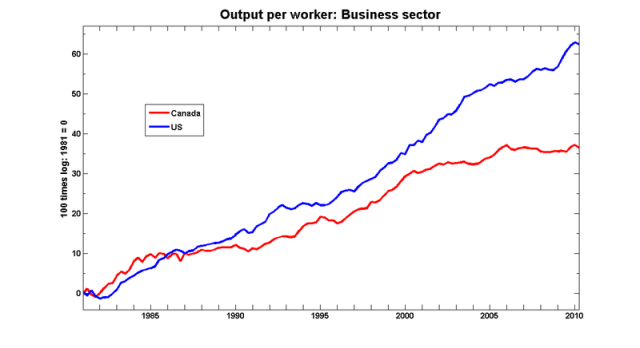
Canadian productivity growth has averaged just over 1% per year in log terms, and has increased barely at all in the last decade. Meanwhile, output per worker in the US has been growing almost twice as fast. One percentage point per year may not seem like much, but the cumulative effect over a span of decades is a very big deal indeed.
(I should hasten to add that higher US growth rates are not a problem for Canada per se: their gain is not our loss. But it raises the question of why an economy that is so similar to ours in so many ways can produce consistently higher rates of productivity growth. Wouldn't it be nice if Canadian output were 30% higher than it is now?)
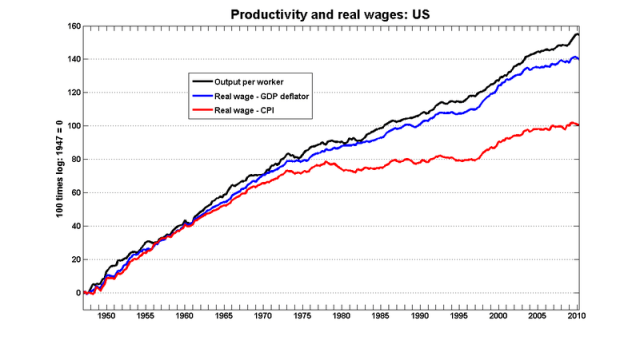
It seems difficult to reconcile the US record of strong productivity growth with the widespread narrative of stagnant real wage growth over the past few decades. Standard theory of the firm would predict that real wages would track marginal productivity (which is proportional to average productivity in the widely-used Cobb-Douglas model), and the data seem to track this prediction reasonably well. So why do workers feel as though they aren't progressing?
The explanation is the choice of the price index used to calculate real wages. As far as the firm is concerned, the relevant price is the output price, but workers would measure their buying power in terms of the consumption goods they can purchase. At the macro level, it is convenient to characterise this distinction as being the difference between the GDP deflator and the CPI. It turns out that using the GDP deflator generates a real wage series that tracks productivity fairly well, but using the CPI to calculate purchasing power yields a very different pattern:
The corresponding graph for Canada is quite different, and not just because it's noisier:
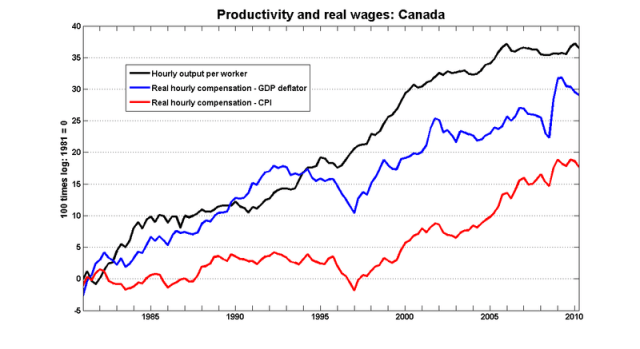
After an extended period of essentially no growth, real wages (in CPI terms) have been tracking productivity for the past 10-15 years in Canada. In fact, the buying power of Canadian workers has been growing faster than that of American workers over the past 10 years, notwithstanding the significantly more rapid growth in US productivity.
There are any number of stories to be told here, and most of them would involve oil prices and exchange rates. But for the purposes of this post, these graphs illustrate the importance of the ratio of the prices of production and consumption goods. This ratio is rarely mentioned in macro (and is usually assumed to be equal to 1), but from what I gather, the development literature calls this the 'labour terms of trade'. Movements in this ratio can accentuate, attenuate or even reverse gains due to increases in productivity.
Here is a graph of the Canadian and US labour terms of trade:
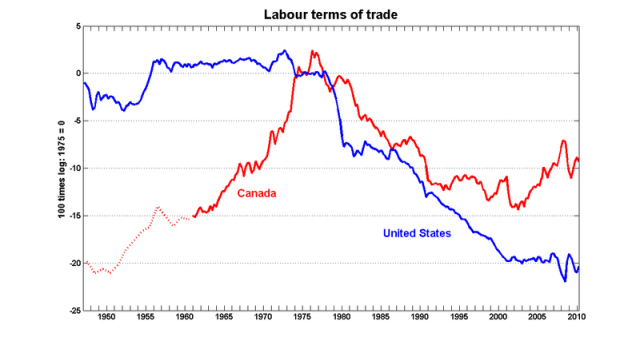
I don't know what was happening to Canadian productivity before 1973, but even if there was no growth in output per worker, the increase in our labour terms of trade would have induced significant gains in real wages. (The Canadian data before 1961 are not directly comparable to those in the main sample, but they suggest that the pre-1973 trend goes back until at least 1950 or so.) And the story in the US is especially stark: the net effect of the post 1973 deterioration in the labour terms of trade was to reduce workers' buying power by some 20% in log terms.
So yes, it's important to focus on productivity. But it's also important to remember that it's hard to translate productivity gains into increased purchasing power when producer prices are growing more slowly than consumer prices.


 Worthwhile Canadian Initiative
Some info :
http://www.energy.alberta.ca/OurBusiness/1062.asp
Click to access OilSands_Projects.pdf
Click to access StratWest_OSProjects.pdf
http://www.alberta-canada.com/about-alberta/inventory-of-major-projects.html
World wide list of oil megaprojects:
http://en.wikipedia.org/wiki/Oil_megaprojects
Does anyone know of a source where they keep track of oil sands projects and when they’re supposed to start production?
Why is that relevant? It begs the question: How are you measuring productivity in the graphs presented? I assumed it was measured output/measured input.
If you are simply dividing GDP (or whatever)/hours worked why would all the hours spent by engineers, support staff, contractors, workers not already be included in the graphs before the oilsands operation comes into effect? They add value, reflected in their firms profits/taxes, and I presume are already reflected in the graphs presented.
Can you explain? Thx
Yes they do add value, and they are in the GDP numbers. But the infrastructure they’re building will increase output even after they’re finished.
Well, if you’re going to single out the oilsands sector, then you would need to also take into account conventional oil/gas production – which is declining and increasingly more costly to produce. So, a decrease in productivity?
At best, a shift in “productivity” gap of a few months when the impact of the delay is factored into the overall Canadian economy. And only if the accelerated investment in oil sands has been recent – which is not the case.
The thing we’re remarking on is the relatively long delay between when the investment expenditure is made, and when it becomes a productive asset. Same as if (say) GM were building a new assembly complex that takes years of investment spending before a car rolls off the line.
But, if you adopt a fundamental cornerstone of economic thought (I will reserve judgment) that all investment eventually converges to the world rate of return, why single out a particular industry?
Oil sands investments should not be any different than any other. Say investors require 15% Rate of return. If it takes five years of upfront development (with its attendant inflated costs) and purchasing of equipment for an oil sands development, then the higher GDP in upfront costs will be offset by higher returns later on to investors, to give them the 15% return ,time value of money etc,.
It all evens out, if you assume world rate of return to investors, irrespective of the time profile of expenditures/revenue.
Sure. But in the short run, timing issues can make the output/worker ratio fluctuate before it gets to the long-run trend. In the very short run, we see lots of people working, and little oil produced. Later, fewer workers, and more oil. In the long run, these do average out.
It’s not the oil sands per se. It’s just the timing of investment and output.
-Noise that validates the relevance of moving averages.
I’m all for tax changes that improve efficiency, so cutting corporate tax rates seems like a good idea. But unless the intention is regressive taxation, it needs to accompanied by offsetting adjustments.