My latest post at the Globe and Mail's Economy Lab talks about the distinction between the net changes in employment reported by the Labour Force Survey and the gross flows in and out of employment. In preparation for that post, I looked up the data from the US Job Opening and Labor Turnover Survey (JOLTS) and noted some things I hadn't been aware of previously:
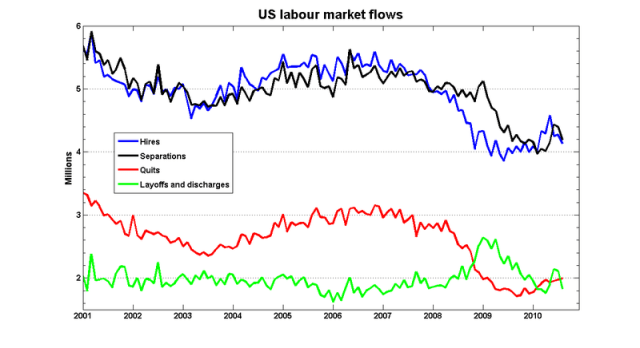
As is generally the case during recessions, the employment losses through 2008 were largely driven by a reduction in hires while the separation rate held steady: the increase in layoffs was offset by a fall in quits.
Employment eventually stopped falling in late 2009, but not because of a rebound in hiring. Instead, separations – both quits and layoffs – fell to match hires. Lower quit rates may have helped keep employment stable, but it's hard to interpret this as good news. Staying in a job because of fears of being unable to find a better one is not an ideal situation.
Both hires and quit rates have started to recover in the past few months, but labour market activity – measured as the sum of gross flows – is still some 15% below pre-recession levels.


 Worthwhile Canadian Initiative
I like the way you’ve presented the data Stephen; you’re right to point out that the recent changes in the rate of quits (and terminations) seems to be the big factor in stabilizing the employment rate.
And while that is true, is not number of quits in turn dependent upon the number of hires? I would imagine that most rational employees do not consider quitting until they are reasonably sure that they can find another job. If that job is not available, then the employee is unlikely to quit.
The quits number reflects job availability, and although it is starting to improve, it is still at a relatively low number.
I do wonder if the periodic upkicks in the termination number (the green line) hold additional information that I’m not considering? For instance, when the green line is high, separations outpace hirings (and unemployment rises). Since Quits ~ Hires, maybe the termination rate drives unemployment?
I agree that the fall in quits can be largely explained by the fall in hires. I guess the point was more that if the turnaround in employment is being driven by fewer quits and not more hires, then it’s not surprising that the recovery has been so sluggish.
Stephen wrote if the turnaround in employment is being driven by fewer quits and not more hires, then it’s not surprising that the recovery has been so sluggish.
That’s a good point. Earlier I has suggested that quits ~ hires, but undoubtedly this relationship changes over the business cycle. I like your idea that at some point quits could decrease wrt hires, and this might help stabilize or improve employment.
Did you create your chart from the raw data? Could you post a link to the data? I’d love to do some plots of my own.
The link to the JOLTS is in the post.
ooooh I like this graph. very helpful.
The Labor Force Survey is currently unavailable from StatsCan.
I think I saw an announcement on the StatsCan site saying that it would be down for maintenance on the weekend.
Stephen, thanks for pointing out the link to the data. I wanted to follow up on your idea that in 2009, quits fell to match hires by looking at the equivalent Beveridge curve for quits and hires. What I’m seeing is that not only did quits fall to match the drop in hires, but that the number of quits fell further than one would expect assuming a linear relationship between quits and hires.
I’m including a figure to show you my resutls. In the chart below I’ve plotted Quits versus Hires over the Dec 2000 – August 2010 period, and I’ve split the data into two groups. The pre-crash period from Dec 2000 – Oct 1, 2008 is plotted in black and the Nov 1, 2008 – Aug 1, 2010 data is plotted in purple. I calculated the regression over pre-crash period, and plotted this regression in blue.
Assuming the linear regression is an accurate description of the relationship between hires and quits, the number of quits, post Nov 1, 2008 have fallen below what would be expected by the number of hires. Echoing what you said earlier, I’m not sure if this is good news, but it likely has helped unemployment from rising higher.
I do wonder about the significance of the drop in Q/H in this past recession. Or perhaps a linear model is not appropriate?