I've noticed a couple of recent media stories on the plight of youth ([1],[2]), and I have to say that I've seen worse.
Here is a plot of unemployment rates for people between the ages of 20 and 24:
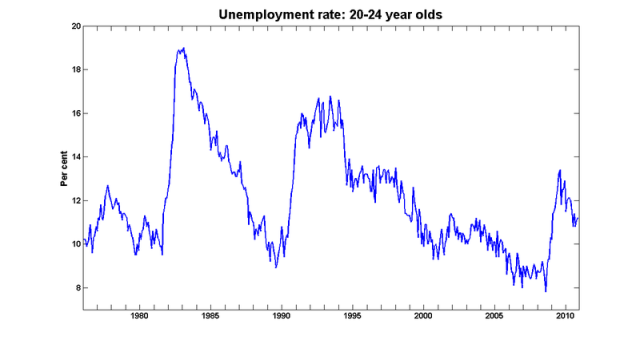
For those of us who happened to be born in the early 1960's – this group is very large, and includes two WCI bloggers – unemployment rates of 13% would have been the stuff of fantasy; youth unemployment rates in the recession of the early 1980's reached 19%, and were an important factor in my decision to go to graduate school. The recession of the early 1990's wasn't quite as bad, but still worse than anything today's youth saw in the most recent episode.
More generally, the outlook for today's youth is pretty bright. Scarce resources can expect to command a certain amount of bargaining power, and so an aging population means that young workers can pretty much dictate their terms in the labour market.
If you're looking for people to pity, spend some time thinking about the sad fate of a member of Generation X (I was born in the same year as Douglas Coupland) reduced to sounding like one of these guys.


 Worthwhile Canadian Initiative
I think you’d be better off using some sort of financial stress ratio. Perhaps average student loan debt/unemployment rate. You try to convince old professors that things are different now…. and they won’t believe ya.
Is this the unreal “Unemployment” number that comes off EI? If it is then it’s not worth the time it took to write. Unless it includes discouraged workers then it’s irrelevant.
I looked at employment rates as well. Same story.
And the next time you feel like telling me that something I wrote is ‘not worth the time to write’, I would kindly invite you to STFU.
Unemployment numbers come from the StatsCan surveys anyway. Nothing to do with EI numbers.
The next time you choose to write such patronizing pap I kindly invite you to think before you type. These ill-considered “it was worse in my day” stories show nothing about the duration of unemployment nor financial stress. The Beveridge Curve would be far more useful.
The grandstanding you just did here has characterized your coverage in most recession-related posts here. The arrogance just drips from the screen.
The R8 series is far more illustrative and useful than the hackneyed EI-based “Unemployment” figure.
By the way, why on Earth is graph of 20-24 year olds being claimed as “youth unemployment”? Grad School? This age band covers post secondary education, period. Many people won’t show up in it, and won’t exit the stage they entered at 24 until much later. Push it out to 28 if you want a real picture. A graph of time from graduation to first employment, or better yet first “career” job (therefore not underemployed) would be far more relevant. This isn’t the first recession-metric post which had such analysis errors.
Earth to Ivory Tower, come in Ivory Tower….
http://www.theglobeandmail.com/report-on-business/theres-jobless-and-officially-jobless/article1244217/
The Globe and Mail illustrating my point on the usefulness (or lack thereof) of the LFS Unemployment figure.
So show us what the real data are, and tell us how they contradict what I said.
Oh look. R8 data start in 1997, and the most recent recession brought R8 unemployment back to the dark days of 1998.
Would that I had the money. One of those whiney young’uns lookin’ fer a job y’see.
Got the R8 series for 20-28 year olds?
Though there was the time I went for an interview, drove three hours to get there, and at the end was told “we like you, we want to hire you, but our customers overseas have no money because their banks are calling their loans, so we can’t hire you.” That was October 2008.
People wonder why discouraged workers get discouraged.
Ah. My apologies if the OP made it seem as though things were peachy for everyone under 30. The point was that they have been worse in the past, which is not the same thing. And if it’s any comfort, many/most of us who traversed these bad times ended up more or less okay. Good luck.
Dudes. Save a little vitriol for the xmas family row. 😉
Stephen, how do you square this with the concerns you’ve voiced in the past about Canadian demographics and productivity? The old will retire, won’t be replaced, will consume less and cost more (pensions, medical). Productivity lags, taxes rise, AD shrinks, employment shrinks, youth can’t find work, lather rinse repeat.
Apology accepted.
On a serious note, as the Globe article shows, the R8 definition is far closer to my view of unemployment than the LFS model. The fact that it only goes back to 1998 is regrettable, but it does show that perhaps 1998 wasn’t so rosy for youth either. An R8 unemployment rate of 18% as the graph shows is a deplorably high number.
Patrick: There’s no real conflict. The young will do relatively well, but that’s just because there are so few of them. The aggregate picture – the one that includes the not-young – remains dicey.
Determinant: “The next time you choose to write such patronizing pap I kindly invite you to think before you type.”
Yes, it is really tough for people entering the labour market now – I worry about my kids and their futures. A lot.
This isn’t supposed to be some Four Yorkshiremen type sketch when people compete about how hard things were back in the day.
Unless you’ve live through it – and from what you’ve said in earlier comments I deduce that you didn’t – it’s hard to understand the desperation that characterized that 1980s labour market.
Breaking Away is a movie that captures it. Douglas Coupland’s Generation X is the bible.
But Stephen Gordon’s numbers also tell the story.
As a ‘discouraged youth’ gone back to university, I thank you for this post.
Also, is it just me, or is Macleans really going down the tubes in terms of quality? Their youth article left so many things out.
This is wandering slightly off-topic, but: David Andolfatto had a post recently on breaking down the flows between Employed; Unemployed; and Not in the labour force. http://andolfatto.blogspot.com/2010/12/is-deficient-demand-hypothesis.html
He was looking for the “signature” of deficient demand vs structural shifts theories of unemployment.
Nick’s hypothesis: if structural explanations are correct, there should be a smaller effect on youth unemployment. Because youth is more flexible. They can travel more easily, and also have less job-specific human capital, than older workers. But if deficient demand explanations are correct, the effect should be bigger for youth unemployment. Because firms stop hiring.
Not sure if that’s clear.
I know (at least, I think) that youth unemployment is always higher. But does it rise more in recessions, proportionately? And is there any difference in that proportion between this recession and past ones?
Nick, there’s a labour market institutions story that goes like this:
– big shock hits the economy
– firms change their employment offers
– because of their inability to fire workers/renegotiate contracts, keep on existing workers at old terms/conditions
– hire new workers – mostly young workers, immigrants – at new terms/conditions.
E.g. look at what’s happening in universities, both north and south of the border – despite the recent hiring spree, it’s still true that a lot of the expansion over the past 20 years/30 years has been made possible by hiring instructors on part-time/temporary contracts for much lower wages than those enjoyed by current incumbents.
So structural changes can hit youth hard.
Frances: Yes. I haven’t thought this through properly. I’m not even sure if I should have said “proportional”, or “absolute change” in the above. But somehow, if it were structural changes causing the recession, it ought in some way disadvantage youth less, just because they are more mobile, in both senses. I can’t find a good test.
Nick: there’s two questions.
1. Given two job seekers, an old one and a young one, who is more likely to be hired?
Your answer is: if it’s a structural shock, the young one; if it’s a non-structural shock, both are equally likely to be hired.
One problem with this as a test is that, since productivity generally decreases with age (see my first-ever blog post on human capital: myth, literal truth or fairy tale), and an older employee (like a used car) might be a “lemon”, employers will usually prefer young over old job seekers, regardless.
2. The second question is: given a recession in the economy, which age group is expected to experience a higher unemployment rate?
The answer to that question depends upon how firms lay off workers, and that depends upon labour market institutions, e.g. the degree of unionization, labour legislation etc. Those things will cause younger workers to experience a higher unemployment rate than older workers for both structural and demand-type shocks.
3. Back in the 80s, the rational strategy for a laid off older worker who’d spent a lifetime in manual labour e.g. working in mines, construction etc. was to go on CPP disability, which will affect the measured unemployment rates.
Frances: maybe. In my comment on David’s blog, I was arguing that a laid-off older worker might get the lower-paid job that would otherwise have gone to a younger worker, leaving school. Everybody who gets laid off just shuffles one step down the ladder, leaving no room for the new entrants to get on. Your lemons story says the opposite, but also makes sense.
I suspect Nick is right that laid off workers with experience are displacing young workers in lower paid entry level jobs – those are the job postings you mainly see in centres serving unemployed workers. And we know that the rate of turnover is much greater at the bottom of the job maket.
Frances:
I may not have lived through it, but there is plenty of desperation going around right now. Firms have stopped hiring up and down the value chain, from labourers to entry-level grads (accountants, engineers…). I could see the job ads literally disappearing. The lists just kept getting shorter and shorter.
I have seen firms who just wanted to hire “a few good people” (engineers in this case) get swamped with hundreds of prospects. I really would like to see a time graph on the Beveridge curve. It is impossible to talk to HR people. They don’t answer their phones, most resumes are simply stuck in a drawer. In my opinion and experience, this is a case of deficient demand.
Socially the impact is going to be significant. We are having a long recession right at the time when the baby-boom generation is considering retirement and the echo generation, their kids, want in. Except the boomers won’t retire because of insecurity and insufficient retirement savings, and firms don’t have the money and the will to expand. The echo generation can’t get on the job ladder. We have the worst of all possible employment results happening right now.
Of course a good many boomer parents simply can’t get their mind around firms not hiring based on insufficient demand. They grew up in a world of jobs and expansion. If you can’t get a job, it must be your fault. They can’t get their minds around the games that firms and their HR people play. It’s a horrible discussion that is playing out all across Canada right now.
This recession isn’t a short, sharp shock. It’s a long, drawn out constant torture that wears you down.
Just want to point out that the situation is not too bad in Canada as far as my experience goes (I’m 26). My friends and I have generally found work after graduation (class of 2007), although it generally took time and the opportunities are generally below what was promised to us (except if you can go for a long series of unpaid or low-pay internships). I had to work in another field for over a year, but it was still stimulating work. I can say that debt might become a big burden for a lot of 20-somethings should interest rates start rising. Plenty of friends who didn’t attend university are in much better positions (contruction, restaurants, small business, etc.) are in better positions, but might be hit harder if the economy deteriorates.
The situation in other countries is much more dire. Participation rates and unemployment are reaching records for young people. Europe has been bad for a long time (talk to young Frenchmen about why they come to Québec…) but is getting worst, not just for the periphery. The US seems to be in an unprecedented place for young people, just look at this Mike Konczal post: http://rortybomb.wordpress.com/2010/12/10/employment-population-ratio-young-people-a-potential-lost-generation-of-young-americans/
I graduated way back in 2008 and still haven’t been able to find relevant employment. I think anyone who graduated in 2008 or 2009 and didn’t have the foresight to make sure they got themselves either an engineering or accounting degree is pretty much not going to have much of a career what-so-ever.
maybe Determinant’s winning personality is holding back his employment prospects.
The ad-hominem is always a mistake, Brendon.
Even engineering isn’t a guarantee. The market is saturated and without credit and a lax US economy (no exports, no demand), the outlook for engineering is very grim.
Determinant: “It’s a long, drawn out constant torture that wears you down.”
Yup. And the thing is: some generations get lucky. Some don’t. And it sucks if you’re born in an unlucky generation. But what can you do?
People who are born at better times often mistakenly think that their success is due to their winning personalities. Sure, personality helps you get ahead, but it only gets you so far.
“the boomers won’t retire because of insecurity and insufficient retirement savings”
Or because they just don’t feel like it.
My opinion of such people is not fit to print.
when did these comments turn into a therapy session for some unemployable engineering graduate? Pedantry is always a mistake, Determinant.
In every hiring decision I’ve been a part of, personality was the key factor. If you made it to the interview we assumed you had the technical qualifications, after that it was all about fit.
Nope, just sharing experience. If Frances is right, Brendon, then you’re part of a Better Times generation.
I’m glad your judgment of character is so acute that a few posts on a blog can give you an accurate portrayal of a person :rolls eyes:
What, are you hiring exotic dancers, Brendon? I’ve made lots of hires. The interview is when you find out if all the stuff on the cv means anything at all. Then you do another one with even more technical grilling. And bring in more technical experts and do another interview. Sure you have to like the person, which you start to find out after a few hours of interviews. But technical skills, and creative thinking only get discovered after extensive grilling.
My institution, by the way, instated a hiring freeze two years ago which is still in place. Just random, tragic bad luck for those who were born a couple of years too late.
I do have some advice for those who have some means of support (living with or supported by a parent or something): Take big risks. Try to start a business, or oversell yourself for a job that you really don’t know that you can do. Never again in your life will you have so little to lose. I came out of grad school and into the workforce in a very difficult employment environment in the early nineties and so started a technology company with an equally inexperienced group of friends. The timing turned out to be good and It worked out, but even if it hadn’t, entrepreneurship and willingness to take risk would have been seen as a huge asset for future employers. I got very lucky and I did have some support from a working fiancée. But I do think there is some general value in taking significant risk at that point in your life.
I wish! Sadly we were hiring economists.
Stephen’s original point, though, is not that it isn’t bad for 20-24 year olds today, but that it was even worse for 20-24 year olds in 1983. And sure there must be discouraged workers today. But there must also have been discouraged workers in 1983. Same for 1993. (I dread to think what 1933 was like.)
And I haven’t seen any arguments here that contradict that point.
You can all attack me, if you like. I’m one of those lucky mid-boomers, born 1955. Hit the job market in 1981.
Comparing my own generation with that of my children (in their early-mid 20’s), and purely anecdotally, I notice two big differences:
1. Their material expectations are in many ways much higher now. Stuff like electronic gizmos, new furniture, clothes, eating out, etc. They are much better off, and treat it as normal. (I could go on and on in this vein, with or without a Yorkshire accent, about how total crap 1970s/80s cars were compared to today, and how I only got cable TV/internet 2 years ago, etc., etc.,)
2. But in terms of the basics, like getting onto the ladder of career-path jobs and buying a house, they are worse off.
Weird thought (though one that maybe violates natural rate theory): I wonder how many of us geezers are staying on in our jobs, just so we can support our kids. But, because we are hanging onto our jobs, our kids can’t get them, and so need our support? In other words, we might want to give our (own) kids our jobs, so we could retire.
But all this strikes me as very short-term thinking. Given the demographics (one of Stephen’s posts a few months back), there’s going to be a labour shortage when we properly exit this recession. So us geezers had better keep on working, because there just ain’t enough of you young’uns around to support us all.
Nick – on working until your kids are well established. Yes, people do this. Especially those with youngish children from second marriages (if you have kids at 25 those kids are usually well established by the time you’re 65, though I do have friends/family (born in the early 60s) still reliant on parents into their 40s).
But retirement – and the associated lack of status, lack of structure, etc., – is a pretty traumatic experience for a lot of people. I personally think there’s academics who won’t retire because if they did, they’d have to clean out their offices, and they have nowhere at home for their books.
As for all of that stuff about finding fulfillment as a volunteer – overrated.
“I personally think there’s academics who won’t retire because if they did, they’d have to clean out their offices, and they have nowhere at home for their books.”
Must propose this to the BOG: we build a load of offices and rent them out to retired faculty to cover the mortgage. Win-win.
Nick, it could still be a win-win even if the offices were luxurious, well-appointed and heavily subsidized!
“I may not have lived through it, but there is plenty of desperation going around right now. Firms have stopped hiring up and down the value chain, from labourers to entry-level grads (accountants, engineers…). I could see the job ads literally disappearing. The lists just kept getting shorter and shorter.”
I have no doubt there’s truth to this, but as a business owner when I meet with other business owners, one of the three big topics* that comes up is how difficult it is to find good-entry level employees. I guess it depends which side of the fence you’re on.
* The other two topics being taxes/regulation and the Canadian dollar.
Mike: Please expand. Is it harder now (last 2 years) than it used to be?? What is it employers are looking for that they can’t find? (What does “good” mean?). Because this goes right against my own “Unemployment is high because there’s a deficiency of aggregate demand” story. This is a structural unemployment story.
Nick:
As I am not that much younger than you, I feel obliged to join you in “old geezer mode.”
Comparing my own generation with that of my children (in their early-mid 20’s), and purely anecdotally, I notice two big differences: 1. Their material expectations are in many ways much higher now. Stuff like electronic gizmos, new furniture, clothes, eating out, etc.
This is true, I think, and perfectly natural for an economy that grows its wealth over time. Still, it is interesting to see how little correlation there appears to be between the level of material wealth and measures of “happiness.”
2. But in terms of the basics, like getting onto the ladder of career-path jobs and buying a house, they are worse off.
I don’t think the statement applies in general. And I’m not sure why the young should be worried about buying a house. The housing stock must pass from one generation to the next (supply will create its own demand). 🙂
Finally, I want to share my own weird thought with you. We teach the young that there are no jobs because of deficient demand (something beyond their control). So the young give up; they wait for the deficient demand to go away. But it might not go away for a long time. Their passivity–the belief we encourage that their destiny is beyond their control–leads them into a self-reinforcing poverty trap. In this way then, deficient demand might indeed become a self-fullfilling prophesy…though perhaps not for the reasons imagined by Keynes.
Mike:
If by entry-level you mean two to three years solid experience in the field, then that’s not entry-level. That wasn’t entry level when the boomers were going through the same career stage. If it is now, then it seems to me that business has developed unrealistic expectations about work experience and training.
David:
Your point about Say’s Law is far off the mark. Do we really need to revisit Keynes again? You have also committed the Mortality Fallacy. The average life expectancy of Canadian today is 80 years. It isn’t unusual for todays twenty-somethings to have had great-grandparents. My grandmother will be a great-grandmother in a few months. If you want to wait for housing stock to pass from boomers hands, you’re going to have to wait another two decades. They are still far from that stage of life. But the next generation is already into their marriage and househunting years. Your assertion is out by about two decades.
Going to respond to Nick’s point (it’s pretty lengthy). But in the meantime, RE: “If by entry-level you mean two to three years solid experience in the field, then that’s not entry-level.” No, I mean entry level. Why on earth would you think I meant otherwise? Entry-level meaning straight out of high school, college or uni or changing careers entry-level.
Nick: Is it harder now (last 2 years) than it used to be??
This is all anecdotally, but no, it isn’t. In my personal experience it is marginally easier, but only marginally.
Because for many employers, “entry-level” has morphed into that meaning.
“Because for many employers, “entry-level” has morphed into that meaning.”
Well, it hasn’t for our company or my colleagues, but like I said, it’s all anecdotal.
“What is it employers are looking for that they can’t find? (What does “good” mean?).”
I’ll try to keep this short. Before I begin, I just want to say that I have the absolute best staff in the world – but they’re the exception, not the rule. And again, this is all anecdotal and should not be used in the place of a rigorous study.
In my experience (and those of the other small- and medium-business types I discuss this with on a regular basis at Chamber of Commerce type events) is that it’s really difficult to find ‘good’ entry-level employees. By entry-level I mean fresh out of university or community college. By “good”, the skills we find that are lacking are the following:
1. Written communications. Finding someone who can write well is remarkably difficult.
2. Problem solving and ‘purposeful’ creativity. Finding workable solutions to day-to-day problems.
3. Attention to detail (this could be items 3 through 10). For instance, a full 1/3rd of all job application letters I get spell my name wrong. They’re instantly thrown in the round file. I know my surname has a somewhat unusual spelling, but there’s no reason you can’t double check to make sure you got it right.
4. Punctuality. I would estimate about 20-25% of the people we interview for entry-level positions either show up right at the last second or a few minutes late.
5. Expectations. In the past we’ve posted ads for entry-level full-time positions that asked applicants to post their salary expectations. You would be shocked how many kids with a Sociology degree expect $75,000 coming out of school.
I’m sure there are all kinds of reasons for this and I don’t think a ‘kids these days!’ attitude is all that useful. Two (of many) might be:
1. Societies focus on credentialism. Yes, it’s nice that you spent two years on the Honour Roll, etc., but what we care about is what you can do, what skills do you bring to the table. Most small- and medium-business owners aren’t impressed by pieces of paper – the most successful business owner I know is a Grade 12 dropout. The problem is, the link between pieces of paper and skills is somewhat tenuous. I would say somewhat, because I imagine students who score well on ‘attention to detail’ would do well in university.
2. Testing mechanisms in universities. IMO, there is far too much use of multiple choice and short-answer tests in schools, which do nothing but test a student’s ability to memorize a bunch of definitions and facts. It does nothing to test items 1 through 3. A curriculum that was more heavily weighted on writing essays and other creative work would go a long way in assisting items 1 through 3. Of course, it comes at higher grading cost.
Again, it’s all IMO – would love to read more careful studies. But when I’m at the golf club with other business owners, we don’t spend a lot of time talking about a labour surplus.
And my experience is similar to Brendon’s, in that the interview is all about personality. We wouldn’t bother bringing in anyone for an interview that didn’t at least meet the minimum qualification(s) for the position. It may be a bit different if you’re hiring non-entry level, in which case there may be more resume/CV type questions to ask. But if it were me, I’d get that information from job references first, if at all possible, before bringing in the person for an interview.
“Given the demographics (one of Stephen’s posts a few months back), there’s going to be a labour shortage when we properly exit this recession.”
Just like in Japan?
Mike:
That was really useful. A few months ago I was talking to someone who hired a lot of entry-level economists, and was trying to persuade him to write a blog post on what he was looking for in a job candidate. So far he hasn’t accepted my suggestion. But I think this topic is worthy of a post. (But I’m not the right person to write it, of course).
Just like in Japan?
It’s not clear they properly exited their recession.