Some images to capture the holiday spirit…
These are all taken from Google Trends, and represent the frequency with which words are searched on Google in Canada. The letters A,B,C etc represent news stories that I won't trouble you with. Only look at the top half of each graph – the bottom half represents news volume and that's of less interest.
In the blue: Santa. In the red: Jesus.

(includes non-Christmas related and non-religious searches such as Santa Cruz, Jesus of Suburbia).
In the next picture, blue represents searches for turkey, red searches containing the word diet (for non-Canadian readers, the first peak is Canadian Thanksgiving, which occurs the second Sunday in October). Because google trends only samples about one day per week, the height of the "turkey" spike varies depending on whether the data is from December 23rd, 25th, or 27th, say.
Blue=turkey, Red=diet.

And now another dimension of holidays – stress. The lead-up to Christmas is a stressful time, but once Christmas arrives people stop typing stress into search engines.
Searches containing the word stress:
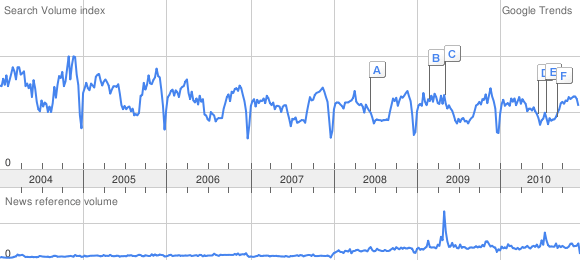
The downwards trend in this graph is not conclusive evidence that Canadians are becoming less stressed over time. Google trends shows the relative frequency of various search terms. It could be that an increase in searches for, say, lolcats has decreased the relative importance of searches for stress: "Trends scales the first term you’ve entered so that its average search traffic in the chosen time period is 1.0; subsequent terms are then scaled relative to the first term. Note that all numbers are relative to total traffic."
And now one with economic significance – job search:
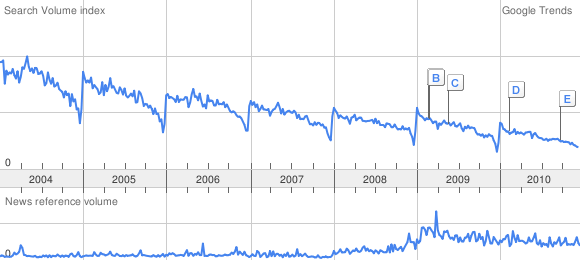
Notice how strongly seasonal it is, with a predictable mini-peak in April when university ends, and then a steady easing off through the fall as students go back to school and retail work picks up. Then in January job search picks right up again. (The same seasonality appears when other job-related words are used such as "jobs" or "resume" or "job interview").
People might step up their job search because they have lots of bills to pay, or because they make bold New Year's Resolutions. But part of the explanation is lay-offs, as can be seen from the late December/early January spike in searches for EI (Canada's employment insurance program is known as EI).
Searches containing the term EI:
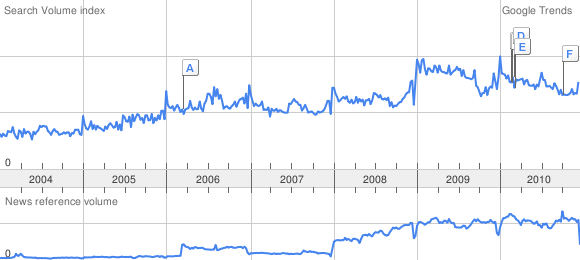
Google says, "you probably wouldn’t want to write your Ph.D. dissertation based on the information provided by Trends." I don't know though – it's a pretty neat way of picking up seasonality, and provides up-to-date data on economic conditions much more quickly than the Labour Force Survey.
So enjoy your turkey and your temporary respite from stress and job search – and have a happy holiday.


 Worthwhile Canadian Initiative
Wow, I never realized how bad of a month January was to be unemployed. In Canada it must be even worse (as you can’t even go outside and enjoy nature while you have a surplus of time).
Thanks for the last year of thoughtful and interesting posts. WCI is a really nifty site and I have enjoyed reading it a lot.
Joseph, thank you for your words of appreciation.
I had no idea there was a January 1 spike in lay-offs either until I started plugging semi-random terms into google trends – knowing in the abstract that employment data is seasonally adjusted isn’t quite the same thing as seeing that sharp January blip.
I can waste hours playing with Google Trends.
Do Canadians eat turkey at Easter? There seems to be a small ‘turkey’ spike that lines up with the ‘Jesus’ spike in spring.
Thomas – interesting question. Some do, some don’t. I just did some further analysis comparing turkey, ham, beef and lamb. There is a ham spike at Easter, but it’s smaller than the turkey spike, and the other two don’t do much.
I suspect that the answer to the question ‘why is the turkey spike at Easter so small’? is that some people don’t celebrate Easter in any way other than buying chocolate – Canada is a less religious country than the US.
Also, bear in mind that people who are searching the internet trying to work out how to roast turkey are by definition not digging the time-honoured recipe out of the recipe box (I use my tried-and-true New York Times cookbook recipe, along with tips from friends). So turkey searchers may be more likely to be immigrants/new Canadians and thus less likely to celebrate Easter.
Happy holidays, and thanks for all of the great posts this year! I really like this blog (and I’m not even Canadian). A
p.s. I’m not sure how it turned out, but I hope your crusade against the NK model’s spurious microfoundations is going well! Perhaps you guys should make up over christmas.
The Santa/Jesus trend amuses me to no end.
That’s fun! If you’d like longer time series, take a look at Google’s Books Ngram Viewer, where you can compare the relative frequencies of the appearance of words or phrases in published books since at least 1820.
A, iron troll, thanks for your warm wishes and kind comments.
Armchair, that is a totally awesome link, and will be incredibly useful for a paper I’m working on. Thank you for that Christmas present!
Frances, you want to be careful with that. the ocr used is substantially less than perfect. Of note is the canonical NSFW search. The historical long s gets confused with f creating errors in particular with the word “suck”. Sampling would conceivably deal with false positives, but how do you deal with the false negatives? Sample all the plausible error words?