January 17, 2011 2:37 pm
This post was written by Simon van Norden of HEC-Montréal.
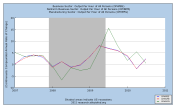
Here is a quick graph from FRED of US economy-wide vs manufacturing employment growth:
One of the questions that I've had is whether the more rapid productivity growth in aggregate was the result of (a) faster productivity growth across lots of sectors, or (b) concentrating the contraction on the sectors with lowest productivity growth, or (c) concentrating the contraction on those sectors with the lowest productivity levels, or (d) all of the above. Now, I don't know where to get a good sectoral breakdown of productivity figures, but I know that most macro people focus on non-farm business (NFB) and the manufacturing sector. My first take on what I see in the graph is that the upturn in manufacturing productivity is bigger than that in the economy-wide measure. That suggests to me that construction is not the most important part of the story. It also shifts my priors a bit towards (a).
I also suspect manufacturing was particularly hard-hit by the recession; perhaps there is something to the recession-severity/productivity rebound link that you mentioned.
Posted by wciecon
Categories: Productivity, Stephen Gordon, The 2008-9 recession
Tags:
Mobile Site | Full Site
Get a free blog at WordPress.com Theme: WordPress Mobile Edition by Alex King.
Just a reminder: read the credit at the top of the post.
By Stephen Gordon on January 17, 2011 at 2:38 pm
During your search you may have noticed that productivity measures for government operations ae distinctly missing. When I see something like that, I start looking there. I suspect that we would find a drop in productivity across total government operations, otherwise why would government hide their productivity measure?
By Matt Young on January 17, 2011 at 4:29 pm
It’s very hard (and usually impossible) to measure productivity in the government sector, because there’s no price for their output, and even quantities are hard to measure.
By Stephen Gordon on January 17, 2011 at 4:34 pm
Government is too hard to measure. Likely the problem as government comprises about 50% of the economy.
By Matt Young on January 17, 2011 at 6:03 pm
Stephen, what is the policy about deleting posts?
By Too Much Fed on January 18, 2011 at 9:37 pm
We don’t really have a fixed policy; each author has the discretion to delete comments after her/his post. But I can tell you that it’s poor blogosphere form to make multiple, successive posts in the same thread and/or to hijack the discussion. Doing so repeatedly will irritate even the most congenial blogger to the point where comments end up being deleted.
By Stephen Gordon on January 18, 2011 at 9:45 pm
“One of the questions that I’ve had is whether the more rapid productivity growth in aggregate was the result of (a) faster productivity growth across lots of sectors, or (b) concentrating the contraction on the sectors with lowest productivity growth, or (c) concentrating the contraction on those sectors with the lowest productivity levels, or (d) all of the above.”
It seems to me that the areas with the highest price inflation (health care and education) and the lowest productivity growth fared the best.
By Too Much Fed on January 18, 2011 at 9:49 pm
“But I can tell you that it’s poor blogosphere form to make multiple, successive posts in the same thread and/or to hijack the discussion.”
What’s the difference between that and trying to take postings, comments, and postings from other people/blogs to try to make points that standard economic models/assumptions need some modifications?
Here is an example. How many economists/public policy makers would even consider the idea that positive productivity growth could cause a recession?
By Too Much Fed on January 18, 2011 at 10:12 pm
Simon: If I understand correctly, the chart plots labour productivity from 3 US aggregate sectors, not employment growth as suggested in your introductory sentence.
Thanks for posting the chart. In a few years, it will be interesting to see how multi-factor productivity (MFP) growth indices performed during this period.
FWIW, I suspect that measured US productivity–labour and multi-factor–grew post-financial crisis for many sectors, but not all sectors. Now if IT is an influential driver of productivity growth I would expect to see similar productivity growth rates across many sectors.
By westslope on January 19, 2011 at 2:17 pm
Anyone have any ideas about the increased manufacturing productivity yet?
From what I’m reading operations researchers have their own stochastic models to estimate demand when working on their supply chain management, still looking for some relevant articles.
Can inventory reductions,eg free space on lots improve productivity? How exactly is it measured? From the Macleans convo in washington, the woman during question period representing manufacturers, said she and her members were pretty stoked about the future.
Do we have Spanish and Irish manufacturing productivity increases?
By edeast on January 22, 2011 at 12:19 am