I'm trying to keep this as simple as possible, so it's accessible to second-year economics undergraduates.
Many theoretical papers I read are full of impenetrable (to me) thickets of math. So I reverse-engineer the model. I try to figure out what the underlying model must be in order for the paper's conclusions to make sense.
Many Modern Monetary Theory posts I read are full of impenetrable (to me) thickets of words. So I have reverse-engineered the model (with the help of Steve Randy Waldman's blog post and Scott Fullwiler in comments on that post). I think I have figured out what the underlying model must be in order for MMT's conclusions to make sense.
I don't think my model is a straw man. It is a stick-figure. A very simple caricature that shows only the bare bones, but is still recognisable.
Start with the standard textbook ISLM model:
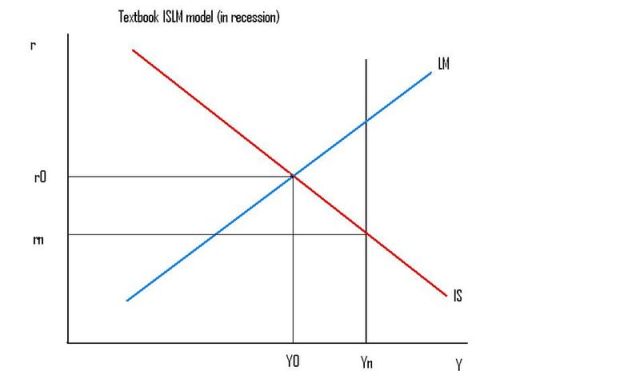 In the background, off-camera, is a Phillips Curve. The Long Run Phillips Curve is vertical, at the natural rate of unemployment. Yn represents the natural rate of output associated with the natural rate of unemployment. It is sometimes (misleadingly) called "full-employment output".
Where the IS curve crosses the vertical "full-employment" line determines the natural rate of interest rn. That's the (real) rate of interest at which desired savings equals desired investment at "full employment output".
I have assumed for simplicity that expected inflation is zero, so I don't need to insert a vertical "expected inflation" wedge between the IS and LM curves. Nominal and real interest rates are equal, and the equilibrium {r0,Y0}is where IS and LM intersect.
I have drawn this equilibrium where Y<Yn and r>rn. The economy is in recession. The central bank should increase the money supply to shift the LM curve right, lowering r to rn, and get the economy back to full employment. Or, the government should use fiscal policy to shift the IS curve right, raising both r and rn, and making them equal at full employment.
Also off-camera is an AD curve. The AD curve slopes down, because a fall in the price level increases the real money supply and shifts the LM right.
Now look at the New Keynesian (or Neo-Wicksellian) version:
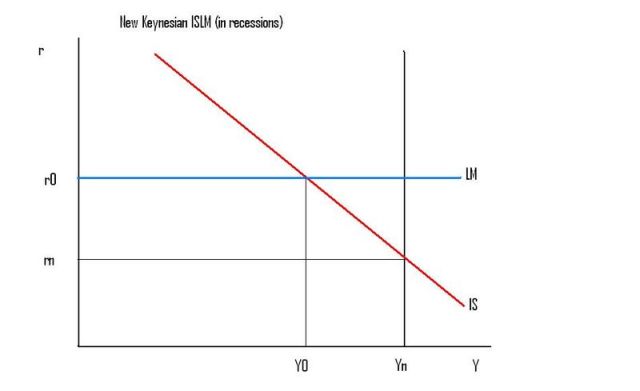 The only difference is that the central bank is now thought of as choosing the rate of interest, rather than the money supply, so the LM curve is horizontal. The supply of money is perfectly interest-elastic at the rate of interest chosen by the central bank.
I have drawn this equilibrium where the central bank has set the rate of interest above the natural rate, so the economy is in recession. The central bank should shift the LM curve down and reduce the rate of interest to equal the natural rate. Or fiscal policy should be used to shift the IS curve right to raise the natural rate of interest to equal the rate set by the central bank.
Off-camera, the AD curve is vertical. A fall in the price level will reduce the demand for money, but the central bank will accommodate by allowing the stock of money to fall proportionately, to keep the rate of interest constant.
This vertical AD curve means that the central bank must actively adjust the interest rate to keep the price level determinate. If it keeps the interest rate permanently above the natural rate, output demanded will be less than full employment, and the result will be accelerating deflation. If it keeps the interest rate permanently below the natural rate, output demanded will be above full employment, and the result will be accelerating inflation. On average, the central bank must set an interest rate equal to the natural rate (plus target inflation, to allow for the difference between real and nominal rates of interest).
Finally, look at the MMT version:
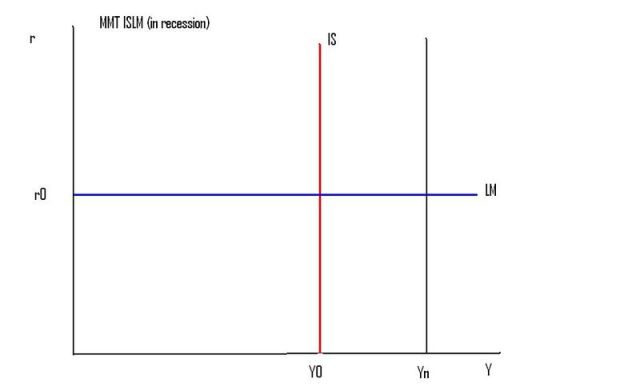 It's exactly the same as the New Keynesian version, except that the IS curve is vertical. The IS is assumed vertical because the rate of interest is assumed to have no effect on either desired savings or desired investment.
There is no natural rate of interest in the MMT version. It's undefined. If the IS curve lies either to the right or to the left of full-employment output, there exists no interest rate such that desired savings equals desired investment at full employment output. If, by sheer fluke (or by skillful fiscal policy) the IS curve is exactly at full employment, any rate of interest will make desired savings equal desired investment at full employment.
The MMT AD curve is vertical. A fall in the price level will not increase the real money supply and reduce the rate of interest (just like in the New Keynesian version, unless the central bank responds actively). But even if the rate of interest did fall, it would not increase output demanded. So, the AD curve is doubly vertical.
Monetary policy has no effect on AD. Fiscal policy can be used, and must be used, because this model, with its vertical AD curve, has no inherent tendency towards "full employment" output. The price level is indeterminate, unless active fiscal policy makes it determinate.
Since monetary policy has no role to play in determining AD, the central bank can set any interest rate it feels like setting. Indeed, it might as well set a nominal interest rate near zero, since this reduces the transactions costs of people converting between currency and bonds to try to avoid the opportunity costs of holding zero interest currency. (This is Milton Friedman's "Optimum Quantity of Money" argument in a new setting, except the central bank can set a 0% nominal rate even if positive inflation means that the real rate is negative).
The rate of interest plays no allocative role in savings and investment. It does not coordinate intertemporal consumption and production plans of households and firms. It merely re-distributes wealth between borrowers and lenders.
In a standard model, the government has a long run budget constraint. The present value of taxes must equal the present value of government spending (plus the existing national debt). The government can't borrow, and borrow to pay the interest, indefinitely, because the debt/GDP ratio would grow without limit. But this long run budget constraint only applies if the rate of interest on government bonds is above the long run growth rate of output. If the nominal/real rate of interest is less than the growth rate of nominal/real GDP, the government can run a stable Ponzi scheme. It can borrow, then borrow again to pay the interest, and the debt/GDP ratio will still fall over time, because the debt is growing at the rate of interest, which is lower than the growth rate of GDP.
If the central bank can set any interest rate it likes, it might as well set a rate of interest below the growth rate of GDP. So the government debt becomes a stable Ponzi scheme, and there is no long run government budget constraint in the normal sense. The only constraint on fiscal policy is that if the government runs too big a deficit and/or allows the debt to grow too large this would cause the IS to shift to the right of full employment output, and so causes accelerating inflation.
Actually, the ISLM framework is overkill in this context. The whole point of the ISLM framework was to reconcile two competing theories of the rate of interest: loanable funds ("the rate of interest adjusts to equalise desired savings and investment"); and liquidity preference ("the rate of interest adjusts to equalise the demand and supply of money"). IS shows the loanable funds answer, and LM shows the liquidity preference answer, and the ISLM model show that both answers depend on the level of income. So both are partly true. (Except in the long run where income is determined by full-employment, so only loanable funds determines the natural rate of interest). But if savings and investment are both perfectly interest-inelastic, we might as well revert to the simple Income-Expenditure Keynesian Cross model to show the underlying MMT macro model.
MMTers have a liquidity preference (LM) theory of the rate of interest, and a loanable funds (IS) theory of the level of income.


 Worthwhile Canadian Initiative
I remain puzzled as to how one should distinguish between MMT and “Keynesian economics” in its original form (i.e. The General Theory). Your caricature resembles the caricature of Keynesian economics that I learned in Ec 10 circa 1980, and in both cases it will be acknowledged that the caricature is not quite accurate: neither Keynes nor the MMT people believe(d) that the IS curve is literally vertical (just as Milton Friedman didn’t believe that the LM curve was literally vertical). MMT seems to prefer to talk in terms of financial variables, whereas Keynes perhaps preferred to talk in terms of real variables, but I don’t see much difference in the substance. And Jamie Galbraith, who is usually associated with MMT, has on at least one occasion classified himself as an “Old Keynesian.” Is MMT merely an attempt to “dot the i’s and cross the t’s” accounting-wise on the ideas in The General Theory?
Andy: I lean towards agreement with your comment. (Except I would say that Keynes in the GT had income in the money demand function, and the rate of interest in the investment function; all that was missing is that he failed to complete the circle by relating the two in simultaneous equilibrium, as Hicks did in ISLM. Ms and Md determine r, and r determines I, and I and S(Y) determine Y, with the feedback from Y to Md left out.)
It is very much like the ECON 101 model, with more accounting and institutional detail, and focussing more on financial flows. In 1950’s and 1960’s British Keynesianism it was referred to as “elasticity pessimism”. They didn’t literally believe the interest elasticities were zero. Just too small to rely on.
Interesting!
One comment: changes in interest rates matter to the extent the propensities to consume differ between borrowers and savers.
And with the govt a net payer of interest, that adjustment needs to be made as well.
And let me also add that the islm model is a fixed exchange rate model.
Warren Mosler
http://www.moslereconomics.com
Thanks Warren. And welcome to WCI!
“One comment: changes in interest rates matter to the extent the propensities to consume differ between borrowers and savers.”
Understood. And if borrowers have a higher marginal propensity to spend than lenders, that would tend to make the IS curve slope down a bit.
“And with the govt a net payer of interest, that adjustment needs to be made as well.”
And, (unless you believe in Ricardian Equivalence, which would be very un-MMTish) that would tend to make the IS curve slope up.
Both effects of course ignored in my very simple model.
If the IS curve did slope up or down through those effects, it might, in some sort of sense, be possible to define a “natural rate of interest” if that IS curve cut full-employment output. But, since it would be so very different from the usual sense, I would hestitate to do so. And if the IS sloped up, monetary policy would need to be conducted in the opposite direction to the standard New Keynesian way. If the central bank wanted to reduce AD, it would need to lower interest rates. Which would make me even more hesitant to use the natural rate concept, because the standard savings/investment loanable funds model would have an unstable equilibrium.
Forgot to add: “And let me also add that the islm model is a fixed exchange rate model.”
I would prefer to say it’s a closed economy model, because it may or may not be possible for the central bank to set the rate of interest and the exchange rate independently, depending on the BP curve. So let’s think of this as my version of the closed economy MMT model.
“Is MMT merely an attempt to “dot the i’s and cross the t’s” accounting-wise on the ideas in The General Theory?”
That’s probably accurate. I don’t think there’s anything in the MMT canon that’s truly at odds with the GT. If I recall correctly, Keynes was aware of chartalist thought and wrote of it approvingly.
From Warren Mosler’s comment:
“changes in interest rates matter to the extent the propensities to consume differ between borrowers and savers….And with the govt a net payer of interest”
Really, those are the only ways in which interest rates matter in the MMT model? You don’t allow for anything like the marginal efficiency of investment? I can sort of buy the argument that MEI may not be very empirically important, but I think it would be hard to argue empirically that distribution effects of interest rates are important enough to consider while MEI is not. Surely if you raise interest rates enough, it renders a lot of projects unprofitable that otherwise would be profitable, regardless of the other effects on aggregate demand. Can you seriously rely on distribution effects to explain how US monetary policy was able to drive the world into recession in 1981-82?
To be fair, I am trying to think of how I would caricature myself in this framework. If I get out of bed on the monetarist side, I could be caricatured as believing the IS is horizontal and the LM vertical!
How about we start with there is no such thing as a limit to loanable funds since we’re off the gold standard and Bretton Woods. Now there’s something Keynesians and MMT (which is post-keynesian) disagree about.
Also worth noting there’s descriptive MMT (accurate description of how money works) & prescriptive MMT (policy recommendations)
I don’t know how you cannot intuitively grasp MMT through their blog posts. I have zero background in economics and it makes perfect logical sense. Unlike all these “curves” that are not curves at all. I broke down mostly Bill Mitchell’s posts into bite size pieces for the layman (hopefully).
So how can someone with an economics background not get it? I don’t get that at all.
Beyond that Warren has all ready made the point I was initially going to make.
What determines the price level in this model? (Note, I’m not asking what determines the rate of change in the price level, I’m asking what determines the level of the price level.)
I thought MMT was a subset of Minsky post-Keynesianism. In which case this exposition is nothing to do with the theory. It suffers from the over-aggregation problem. One of Minsky’s critiques of Keynesian macro was its failure to take account of the complex inter-relationships of balance sheets across myriad entities. Casting it into Hicksian framework is “bastard post-Keynesianism” to echo Joan Robinson. Surely you’ve got to exposit the theory in a stock-flow consistent framework as laid down by for example Godley-Lavoie or its not worth doing at all.
Time, plus the rate of change of the price level, determines the price level at any point in time. There is an initial degree of freedom at the start of the world.
I think the biggest conceptual difference between the stock flow consistent models and the equilibrium models is how they embed the economy in time. IS-LM has only a single stock — the stock of money. But if the (current period) IS curve is not just a function of the short rate, r, but also of dr/dt, or of {capital goods prices}x{the quantity of capital goods}, then it’s not that they believe the curve is vertical, but rather you don’t have enough information to describe the curve, and the missing variables — e.g. dr/dt, wealth, etc — may dominate the short rate over the periods of interest.
this question might not make sense, but where is the connection to the idea that deficit spending creates (and taxation destroys) private sector financial assets, which I thought was important to MMT?
Senexx: are you sure you understand MMT? “Also worth noting there’s descriptive MMT (accurate description of how money works) & prescriptive MMT (policy recommendations)”
What about explaining how the economy works? There’s more to any economic theory than descriptive accounting. For example, how would the explanation of how r and Y are determined change if desired S and desired I depend on r? Do you understand the difference between desired and actual S and I, and why it matters? Do you understand the relevance of whether r is less than or greater than the growth rate of Y for the government budget constraint?
Nobody ever understands their own theories as well as they ought. Try reading an intermediate macro text, and you would learn useful stuff about those “curves”, and get some alternate perspectives as well.
Scott: hope you are enjoying your well-deserved blogging sabbatical!
If P and W were perfectly flexible, the price level would be indeterminate in my MMT model, just as it would be indeterminate in the Neo-Wicksellian model. Because the AD curve is vertical, so there’s no intersection of the vertical AD and vertical LRAS. P is only determinate if P adjusts slowly to excess demand/supply, and the fiscal authorities adjust AD more quickly (just as the monetary authority has to adjust i more quickly than P to make P determinate in the Neo-Wicksellian model).
pcle: I disagree. First you have to understand the interaction between r and Y, which is what this simple model does. Later you can disaggregate and add the stock of bonds and capital as things that shift the position of the IS curve, if you wish.
RSJ: OK. They are not going to go to the wall in defence of the proposition that the IS is literally vertical. I treat the vertical IS as a working assumption that gives the basic flavour of the model.
Luis: the IS curve implies S-I=G-T (closed economy version). So the growth of net private financial claims on the government must equal the growth of net government financial liabilities to the private sector. That’s true in any model. Divide the economy into any two sectors — say men and women. What men owe women must equal what women are owed by men. But that accounting identity doesn’t get you very far. You need to add some behavioural assumptions too.
“The only constraint on fiscal policy is that if the government runs too big a deficit and/or allows the debt to grow too large this would cause the IS to shift to the right of full employment output, and so causes accelerating inflation.”
I think that approaches what they may think of as the limiting case, although the size of the debt would be viewed as a secondary effect, with the primary focus being aggregate demand associated with fiscal stimulus.
“MMTers have a liquidity preference (LM) theory of the rate of interest, and a loanable funds (IS) theory of the level of income.”
My impression is they have neither. They believe monetary policy as normally constructed is ineffective, and by implication that liquidity preference is a near useless concept. They reject loanable funds theory as a relic of the gold standard.
They believe aggregate demand is a function of income rather than money, and that fiscal policy is required to manage the level of income and demand.
They doubt the effectiveness of monetary policy because of its ambiguity – possible tightening effects of higher rates based on differing borrower/lender propensities but possible stimulative effects due to increased income on net financial assets held by non government. Both you and Mosler have alluded to that ambiguity here.
Their concept of a “zero natural rate of interest” accords with institutional evidence for the operation of governments, central banks, and the monetary system. Declaring ground zero for rates cleans the slate for managing aggregate demand entirely through fiscal policy, without conventional monetary policy at all.
You can reverse engineer this to ISLM, but you’re reverse engineering something that is implicitly and fundamentally a rejection of that engineering framework.
JKH:
“I think that approaches what they may think of as the limiting case,..”
Not sure I understand what you mean here.
“They believe monetary policy as normally constructed is ineffective, and by implication that liquidity preference is a near useless concept.”
The liquidity preference theory of the rate of interest says that the rate of interest is determined by, and adjust to equalise the demand and supply of money. Anyone who says that the central bank (as supplier of money) can set the rate of interest where it chooses is, to my mind, someone who accepts the liquidity preference theory. That does not imply that the rate of interest affects desired savings and desired investment. On the contrary, if you believe that desired savings and investment do not depend on the rate of interest at all, it is much easier to advance a pure liquidity preference theory of the rate of interest. That is one of the things my post was supposed to be showing.
“They reject loanable funds theory as a relic of the gold standard.”
They reject the loanable funds theory as a theory of the rate of interest, sure. Rather, instead of S and I determining r, S and I determine Y. (My calling that a “loanable funds theory of the level of income” was a bit of wordplay).
“They believe aggregate demand is a function of income…”
Desired consumption is a function of income. That relationship is already built into the standard textbook IS curve. It’s the old Keynesian multiplier.
“Their concept of a “zero natural rate of interest” accords with institutional evidence…”
I know that Warren has talked about the natural rate of interest being zero. I read his paper. I think that terminology just confuses things. Instead he could either say:
‘There is no natural rate of interest, and so the central bank can set any rate it wants permanently, and I think it should set it at 0%.’
Or he could say:
‘The natural rate of interest depends on fiscal policy, and fiscal policy should be set to keep the natural rate at zero, so the central bank can also set the actual rate at zero.’
I agree with pcle | April 16, 2011 at 01:29 AM
I also think that the fixed exchange rate anti-analogy is counterproductive. Post Keynesians have described those regimes in detail and their description is nowhere close to the IS/LM/BP description.
Nick .. you should make an attempt to distinguish between MMTers and Post-Keynesians in general. You won’t then (hence) have the doubts which Andy has raised.
this strikes me as off target
why is a model the basis of a functional finance mechanism ??
well because not all methods are equally efficient or costly
right ??
but the mmt thesis is really about a zero real cost to cedit creation …no ??
elaborating systems of equations
ie hicks and after
are irrelevent in a clinical science like
macro management
its an empirical question an observational question that keynesian policy raised no ??
and we hve our answer and have had it since the question was raied and the obsrvations “noticed”
by increasing the fiscal deficit you can raise real ouput and job hours
eqally by pinning the policy rate in conjunction with a full employment fiscal budget
and spontaneous firm produced inflation
you can adjust the real rate of interest
the method becomes not an a priori model
but trial and error
do it and if after we do it we see it works grea keep doing it
fine it
sure see how well various combos work
obviously the real output performance is what counts
that and the number of job hours purchased by firms
the various nominal rates and levels ..well to hell with em
if they’re veils or if the problem is sub optimal sticky
blow off the stickiness
or if mltipliers aren’t as potent as one had anticipated
without fear of peak debt you plow on right ??
so why not fear peak debt ??
nick
has your stick model answered that question ???
mmt is far more bold then GT
because it essentially sez
the long run debt number is of no deep matter
like any nominal levels the real value is subject to macro adjustments
that can be made costlessly in terms of real output
that is
if the macro system has no concern about price levels and why should it ??
price level targets are fetishize the veils
peak debt ?? some b/p * ????
well so long as the macronauts can fiddle up the p level
why worry
interest rate ?? again only the change in p makes that real
and the monetary authority can set any nominal rate it chooses to set
and again since macro can raise the price level u can set the debt to NI ratio
where ever you want right ?? tis just y/p with both nominal and ths policy controlable
as with
m/p
b/p
err but its not the level its the rate of change that can go out of control short of real ouput effects no ??
the point
mmt lacks one big tool
control over the rate of change in p level
well that’s where economy wide mark up markets enter
just as they should have in the late 70’s
we need another instrument besides a policy rate a fed borrowing rate
we need a price level control mechanism
if we had only one ouputie no relative prices ..no big whoop
but we do have lots of different ouputs different q’s
jumping a few obvious steps
so how do we remove the firms disregard of the effect of their own absolute prices
on ther firms absolute prices ???
restated:
what can be done
when only relative prices matter to the allocation system and
execessive or inadequate price level change is a macro hazard
under the present free range firm level price setting regime
and
imposition of frankenstein like price controls has no long run viability
obviously we need a way for firms to trade required mark up warrants
and why the need for such a mechanism to regulate the price level’s movements doesn’t
fall directly out of front line macro policy discussions
is the biggest failing of our post 70’s era
instead of lerner we got volcker
and that is a crime against the bulk of toiling humanity
that is unless you are so comfortable with using the spontaneously emergent
reserve army mechanism to regulate wages and prices
you’d never bgive it up no matter what
yes now we have self concious reaerve army macro management no ??
rationalized nairu guided credit and budget policy
that can induce the equivalent wage “moderation”
of the spontaneous system with less fuss and fury and loss of output
or of your pro profit class or pro rentier class
and you don’t want to entertain any sublationary moves to a higher system
that might crimp these bulwarks of free enterprise
ttttttttttttttttttttttttt
Ramanan: “Post Keynesian” can mean a lot of things. There are only so many models that can be distinguished with 2 curves. To me, Abba Lerner’s viewpoint on the financing of government deficits is one of the key distinguishing features of MMT. And my very simple model shows how that Functional Finance perspective fits within the MMT model.
Probably one of the things I should have said, right up front in this post, is that I’m not just trying to build an MMT model. I’m trying to show how it differs from the textbook and New Keynesian models. (My “New Keynesian” model above is also a stick figure, that leaves a lot of stuff out.)
If you start by doing what I have done above, you have a basis from which to begin comparing MMT and other approaches. Otherwise, everyone just keeps talking at cross purposes and nobody gets anywhere.
Nick, I enjoyed this post, this is macro I can understand. Congratulations on all those facebook likes – according to Steve Gordon, last month 9% of WCI traffic came to the site via facebook.
Thanks Frances! I can’t understand all those Facebook likes. (Not that I really understand Facebook and “likes” in any case.) I have never got anywhere near that number before, and this isn’t an especially good post. My only guess is that this post is very accessible to undergrads, and undergrads use Facebook??
the key to lerner
and i’m glad to see randy and you see abba as a rushmore figure in this area
is the state capturing the demi urge role away from private “own bottom” firms
whether merely budget constrained or more refined and rational
profit guided outfits
firms can’t run a smooth output max operation on anything like a steady macro basis
even as a closed system
but ….the state can …even in an open system
with their part whole co ordination firms
their reliance on voluntary transactions
their poorly mediated meta-less
system of interacting but incomplete markets etc etc
yes this can be seen also as problems created by firms r lack of universal default insurance
and the deeply interconnected payment system based on an equally unco ordinated
rationed based ie constrained credit availibility system
well to shut up and sum up
the notion of a sudden agent arrival with the ability to run an indefinite ponzi
nicely caputures the game changer gubmint is
in this market mediated set of producing and exchanging outfits
something tells me
the fact i refuse to play baby graphics leads to a by pass
well i submit you basically swallowed the is/ ml by the end of your stick figure run
in effect once all is either vertical or horizontal
the chosen relations are useless
its as if you were trying to rake off possible clogs to functional finance flo9wing without blockages and leaks
i say so what the substance flowing is pure opportunity cost
and once it is looked back at as a past set of flow vectors
its systemically sunk costs that one regrets and real value on going
of these nominal obligations
is so elastic forget about it
it is only as household wealththese assets become signifigant
—btw households are irrelevent really
whatever provides final demand will be what it needs to be given the gubmints unconstrained transfer and spending capacity
households only exist in models to motivate a welfare function different from the income total
and constrain demand to factor earnings plus the credit flows factor earnings can attract
at any rate
after all macro is about getting somewhere
not defining where somewhere ought to be …but that’s for another thread —
“The liquidity preference theory of the rate of interest says that the rate of interest is determined by, and adjust to equalise the demand and supply of money. Anyone who says that the central bank (as supplier of money) can set the rate of interest where it chooses is, to my mind, someone who accepts the liquidity preference theory. That does not imply that the rate of interest affects desired savings and desired investment. On the contrary, if you believe that desired savings and investment do not depend on the rate of interest at all, it is much easier to advance a pure liquidity preference theory of the rate of interest.”
There is a terminology problem here, in that folks mean all sorts of things by “rate of interest”. Money has a convenience yield over other assets, and this yield is obviously affected at the margin by changes in the money supply: in this sense, the central bank can “set the rate of interest”. OTOH, one can still posit that the yield of assets more generally is set by equilibrium between desired saving and desired investment, i.e. the market for loanable funds.
the credit system is a rationing system like the job system
markets hardly clear
the rate of interest no more can “…equalise the demand and supply of money”
then the wage can equalise applicants and opennings
the point of both is to set a rate subject to filter and viewed as a reward
this hicks nonsense
is well…
talk about faulty micro foundations
the market system requires a chronic shortage of demand
the soviet system proves what happens when supply chronically eceeds demand
in fact one problem with a working mark up market is the re emergence of
structural chronic shortages
much here to harvest ..maybe too much
hicks himself
long recognized the limits of his tight litttle system of functionalizing k’s
largely diffuse verbal GT
why this became the macro model of choice for college courses post war
i suspect had a gret deal to do with this introduction of this r to become a second variable to y
that well brought back much of the old school nonsense about the rate of interest as a price
just like the doak price for the days catch of fish
to clear the market for loanable funds
andprovide a way to variablize investment I(r) without introducing y as in I(y)
ie the accelerator
but that’s superficial
a deep narrative of the causal pttern
behind our wave of post war college text books and their choice of models
exists somewhere i’m sure but not in my head
i doubt history will look back on macro as taught 1948 thru 1978 with much more favor then
as taught from 1978 to 2008
I found this attempt to fit MMT into a standard framework very helpful. It also reminded me very strongly of the sort of macroeconomics that I was taught as a Cambridge undergraduate in the late 1960’s, so there is a clear link with at least one version of the ‘Cambridge Keynesian’ oral tradition. In particular, the assumption that private expenditure depends purely on income, and not on either the interest rate or the stock of private sector assets, is consistent with the way in which some of my teachers (for example, Joan Robinson) dismissed the IS-LM model as a misguided attempt to reconcile Keynes with classical macroeconomics(they also rejected the two-equation IS-LM model in favour of one in which goods and money markets were essentially separate, with causality going from effective demand to income to money).
In this framework the IS curve was vertical (though we were not actually taught about it in these terms). Any influence of interest rates on expenditure was rejected on the basis of Keynes’s arguments in the General Theory (for the consumption-savings decision) and the pre-war Oxford surveys (for investment). Any effect of asset stocks on expenditure was also rejected (partly because to accept the existence of such effects would open the door to Pigou/Patinkin real balance effects, and thus endanger what was seen as the key message of the General Theory).
One additional feature of MMT which seems baffling to me is the argument that the level of Government debt does not matter because Governments have the monopoly of money creation. Even if the Governmemt can borrow at an interest rate less than the growth rate, and thus run a stable Ponzi scheme, this does not imply that deficits do not matter. To see why, assume that the growth rate and interest rate are equal. Then the Government can finance its interest payments on outstanding debt by further debt issue, and still maintain a constant debt to GDP ratio (whatever the initial level of debt). But if it also runs a primary deficit the debt/GDP ratio will continue to rise: the beneficiary of the stable Ponzi scheme (who should perhaps be called the Madoff) cannot take an unlimited amount out of the scheme for consumption without endangering the stability of the scheme. The only circumstances in which deficits would truly not matter would be those where the private sector was willing to hold an infinite amount of Government debt, and where additionally the size of their holdings did not affect private sector expenditure in any way. But it is very hard to justify this assumption. Incidentally, MMTers cannot justify it by adopting the quasi-Ricardian line that private holdings of public debt are not net wealth because of the expected future tax liability, since (because this is Ponzi finance) there is no such liability.
A further (historical) point. After World War II the UK attempted to follow what in some ways looks like an MMT-inspired policy – nominal interest rates were pegged at very low values, so that the real interest rate was close to zero. One motive for doing this was the high debt/GDP ratio (the result of war expenditure) and the wish to minimise interest costs. But it was also an attempt to place the economy on the horizontal section of the LM curve: since the low interest rate on bonds balanced out the prospective capital loss if interest rates rose, the speculative demand for money would be large, and deficits could be financed without danger of inflation. Investment and consumption were subject to physical controls, and set at levels which would ensure full employment. Since capital movements were also controlled, there was no need (even given a fixed exchange rate) to maintain interest parity with other countries. Most historians do not think that this experiment was a resounding success.
@ peterson. not ponzi scheme because gov’t does not have to borrow
http://www.nakedcapitalism.com/2011/03/scott-fulwiler-paul-krugman%E2%80%94the-conscience-of-a-neo-liberal.html
This post is great, but does anyone have a link to a purpose-built MMT model with equations and graphs – one that expresses the concepts using those traditional tools in addition to a bunch of text and a few pictures showing accounting relationships?
Nick,
(@ April 16, 2011 at 10:16 AM)
Yes its true “Post Keynesian” is a very general word and even Paul Samuelson called himself a Post Keynesian! I am referring to the Horizontalists who describe the monetary policy and also describe how New Keynesians view it.
The “Descriptive/Prescriptive” language was used recently by John Taylor on his blog on his rule.
For the case in hand, MMT Prescriptive – zero CB rate looks sophomorish to me.
Nick, MMT’ers seem to reject the idea that MMT can adequately expressed through IS-LM, along with most other Post Keynesians, so I dount that inquiry along these lines will illumine understanding of MMT.
“Post Keynesian economics has no need for, and rejects, the IS-LM model of Hicks, the Phillips curve, and the empirically unsupported notion of the liquidity trap (Davidson 2002: 95).”
http://socialdemocracy21stcentury.blogspot.com/2011/01/overview-of-major-schools-of-economics.html
See Randy Wray, “The Endogenous Money Approach”
Click to access WP17-Wray.pdf
___________, “Keynes’s Approach to Money: What can be recovered?”
http://tinyurl.com/3g9hsds
If you are looking for a diagram, MMT’ers are more encouraged by the Krugman cross as a simple diagram of sectoral balances.
Robert Parenteau, “Employing Krugman’s Cross. Farewell, Mr. Hicks?”
http://neweconomicperspectives.blogspot.com/2009/07/employing-krugmans-cross-farewell-mr.html
Bill Mitchell, “Nobel prize winner sounding a trifle modern moneyish”
Scott Fullwiler, “The Sector Financial Balances Model of Aggregate Demand”
http://wallstreetpit.com/8568-the-sector-financial-balances-model-of-aggregate-demand
Nick, I’m fine with the assumption of sticky prices, but that doesn’t tell me what determines the price level. I want to know what in the model explains why the price level isn’t 100 times higher, or 100 times lower. Are prices proportional to total government debt, or something analogous?
I believe the term is “nominal anchor”. What’s the nominal anchor in the model?
According to Warren Mosler:
the price level is necessarily a function of prices paid by govt when it spends and/or collateral demanded when it lends.
Warren Mosler:
A Note on Pricing
The State is effectively the sole issuer of its currency. As Lerner and Colander put it, “if anything is a natural monopoly, the money supply is” (1980, p. 84). This means that the State is also the price setter for its currency when it issues and exchanges it for goods and services. It is also price setter of the interest (own) rate for its currency (Keynes, 1936, ch. 17) The latter is accomplished by managing the clearing balances and securities offered for sale….
http://moslereconomics.com/mandatory-readings/a-general-analytical-framework-for-the-analysis-of-currencies-and-other-commodities/
see also:
“Monopoly Money: The State as a Price Setter” by Pavlina R. Tcherneva
Click to access Pavlina_2007.pdf
BTW, MMT suggests using the ELR as the nominal price anchor.
Bill Mitchell: Moreover, central banks use the pool of underutilised workers as a price anchor. But given that the effectiveness of this strategy depends on the “condition” of the unemployment pool, we argue that a more effective buffer stock option lies in a public employment program, which we term the Job Guarantee (JG). 2 We show that the JG not only anchors the price level to the price of the buffer stock labour but also produces useful output with positive supply side effects.
We thus contrast the current NAIRU orthodoxy (unemployment buffer stock) with the JG alternative. The JG approach represents a break in paradigm from the NAIRU-buffer stock approach but also traditional Keynesian analyis. The difference is a shift from what can be categorised as spending on a quantity rule to spending on a price rule. Under current policy (and generalised Keynesian expansion), government generally budgets a quantity of dollars to be spent at prevailing market prices whereas under the JG, the government offers a fixed wage to anyone willing to work and lets market forces determine total government spending.
“Why public sector job creation should be fashionable”
http://tinyurl.com/3ger92b
Nick,
thanks. this is what confuses me – the thing about how net financial assets are created/destroyed seems to me, when I translate it into terms I understand, as a perfectly unremarkable restatement of text book macro. But (some) MMTers portray it as an insight (we know how the monetary system really works!) so I must be missing something.
the jg
is a erious error
in time
a gulag
and in further time
the next “we must end welfare as we know it” type target
a wpa forever has a certain dynamic to it in a system
founded on
corporate voluntary hires
the pub sec job gulag will become just that an onerous punitive corvee
hence the need for a control mechanism for th corporate pricing system itself
a cap and floor warrant trading ystem
for aggregate price movements both up and down
that this topic gets so reified summner has to demand in the model an anchor
only demonstrates the reactionary pro free range corporate roots of most academic model building
go un noticed for what they are
an implicit demand for nominal wage control
wp
perhaps won’t read this
but u needed to change a couple things
its not a pri sec willing to hold infinite pub debt
its unlimited pub debt ie no peak nominal deby load
as to real debt
the price level for current ouput can be used to regulated the real value of existing debt no ??
the old cambridge school of robinson et al wasin essence a thermostat model as meade and lerner saw right away and went toward automatic stablization mechanisms
ie allgorithms of the transfer systems textraction and pay out mechanisms in meade’s case
and a more general declaration by lerner of gubmint full employment maintenance empowerment
the problem of the interaction between price evel of ouput and real value of existing public obligations in an open system
does require additional instruments
but they have been drafted
by weintraub colander and many others
we simply would need to have a manhattan project to
begin constructed and prolly a value added tax system to
ease the institutionalization whether of atax or cap and trade system here
the externality of a price move by a firm has its obvious parallels to other
instances and forms of social micro decisions and their unintended cnsequences
in macro behaviour
letus consider moving from the anchor spontaneously emergent historically
from our ever nore dominant credit driven production system
ie
the business cycle with its variable purgatory of the reserve army of theunemployed
paine: I agree that market economies look like they are in excess supply in most (output and labour) markets nearly all the time. (And command economies like Cuba are the exact opposite). I think that observation is very important. I think that puzzle is resolved by replacing perfect competition with something like monopolistic competition. I see that as one of the biggest strengths of New Keynesian macro, because it did just that. I have done half a dozen posts on that subject. Search on “excess supply” in WCI to find them.
But I would get more out of your comments if I didn’t have to reverse-engineer them. That’s why I usually by-pass them.
William Peterson: I generally agree with your comment. It reminds me too of the British (especially Cambridge) Keynesianism that I remember being taught and influencing policy in my UK youth. (And how close is the Radcliffe Report to MMT? My memory of RR is too hazy to answer that.) Also, I detect hints of the ex post-ex ante savings investment confusion. Some British Keynesians: “The rate of interest cannot adjust to equalise savings and investment, because they must be equal by definition”. They might have added “to the penny!”. They misunderstood the role of accounting.
A couple of comments on your paragraph beginning: “One additional feature of MMT which seems baffling to me is the argument that the level of Government debt does not matter because Governments have the monopoly of money creation.”
1. Since money (currency anyway) does not pay interest, there is no government budget constraint on money-financed deficits. The only limit is too much aggregate demand and inflation. And, if you accept the MMT framework, so that the central bank can set r less than g, it’s the same for bond-financed deficits too. True, there is the limit you describe — if the stock of bonds gets too big people will want to spend too much. But all this means is that AD is too big relative to LRAS. And the MMTers (Abba Lerner) do allow that inflation is the (they say only) constraint on deficits. So they don’t disagree with your point there.
tjfxh: OK. Listen up guys, this is important:
Read Robert Parenteau’s post for example, that tjfxh links to:
http://neweconomicperspectives.blogspot.com/2009/07/employing-krugmans-cross-farewell-mr.html
1. Robert Parenteau, if I understand him correctly, is saying that the “Krugman Cross” is a good way of representing MMT thought.
2. The Krugman Cross is formally identical to the Keynesian Cross model.
3. The Keynesian Cross model is formally identical to a vertical IS curve.
I conclude from that:
1. My stick figure model with a vertical IS curve is a good way of representing MMT thought, and is acknowledged as such by MMTers.
2. MMT is a special case of ISLM.
3. When MMTers reject the ISLM, I really begin to wonder if they understand their own model and understand ISLM.
Scott: there is no “nominal anchor” in the model. Just as there is no nominal anchor in the Wicksellian framework. Think of the price level as being a heavy ball on a flat surface. If the surface is perfectly level, the ball will either stay wherever it is, or keep rolling wherever it is already rolling. The monetary (in Wicksellian models) or fiscal (in MMT models) authority must keep tilting the table up or down to try to stop the ball rolling off.
The current price level is determined solely by its own history, and its direction of change is determined by history plus current policy.
tjfxh:
There are two ways you can interpret the MMT Jobs Guarantee policy. And MMTers consider both.
1. As an automatic stabiliser that replaces standard fiscal stabilisation policy. This is theoretically very interesting. In principle, it can provide a nominal anchor to the system. It’s just like the old Gold Standard, theoretically, except that government purchases of labour at a fixed nominal price replace government purchases of gold at a fixed price. There are practical difficulties I won’t go into here, but labour is not homogenous like gold.
2. As a voluntary(?) workfare system that does not replace standard fiscal stabilisation policy. Much less interesting theoretically. No different from any other policy to recommend workfare. Maybe good, maybe not.
Nick,
Yes, the resemblance to Cambridge Keynesianism (of “New Cambridge”) is tight.
And the reason is straightforward – the late Wynne Godley (who was the head of the Cambridge Economic Policy Group (CEPG) and a close associate of Nicholas Kaldor) moved to the US in the 90s to the Levy Institute. He was the champion of the sectoral balances approach, and an accounting framework with emphasis on maintaining stock flow consistency at every stage of the analysis – and has had a strong influence.
Hence the connection to Radcliffe Committee also. Kaldor was associated with it (mentioned in his book The Scourge Of Monetarism in 1982). He was the first person to call the money supply horizontal and authors who were fans of Kaldor (Basil Moore / Marc Lavoie) were strong vocal advocates of Horizontalism.
The New Cambridge however pinpointed to the balance of payments constraint economies face and hence wouldn’t argue that government debt don’t matter. In fact they had a special attachment to stock/flow norms (ratios). Thus even though they perfectly understood demand management, they were arguing that demand management options in free market determined open economies have limitations.
luis: “thanks. this is what confuses me – the thing about how net financial assets are created/destroyed seems to me, when I translate it into terms I understand, as a perfectly unremarkable restatement of text book macro. But (some) MMTers portray it as an insight (we know how the monetary system really works!) so I must be missing something.”
Same here. Apples bought must equal apples sold. Financial assets bought must equal financial assets sold.
Ramanan: that makes sense. And I well remember the recurring “balance of payments crises” in the UK of my youth. With a fixed exchange rate system, an excess of AD tends to create a loss of foreign exchange reserves, as opposed to the inflation it creates under flexible exchange rates or in a closed economy.
nr
i appreciate your replies
to unknowns
it shows a true pedagues spirit of universal intruction
as to reverse engineering my prose
i agree pretty tedious affair mostly
but a few iterations usually removes the typos mis spells etc
and leaves only the residue of undigested mentation
the key point oi plug in these waters is the mark up marketnotion
invented by colander ad adopted by lerner and my mentor wild bill vickrey
–also colander’s mentor btw –a few years earlier—
the mmt fad out of kc (m) strikes me as an un finished bucket
not much better then none at all
if not provided with the missing bottom
the price level
and when you go open system
the other instruments required
like balancing the trade product sectors
which may — i submit must —
require an overt industrial policy
with border price adjustments emergency quoota auctions etc etc
besides simply the universal daisy cutter
of a currency exchange ratio adjustment
that is if a ntional production system
desires to avoid the de facto de industrialization process
open throttle inter border arbitrage encourages
paine: “the key point oi plug in these waters is the mark up marketnotion
invented by colander ad adopted by lerner and my mentor wild bill vickrey
–also colander’s mentor btw –a few years earlier—”
Didn’t Joan Robinson beat the lot? (She and Chamberlain). That’s the model underlying New Keynesian macro.
nr
“I think that puzzle is resolved by replacing perfect competition with something like monopolistic competition”
that knocks several balls into called pockets eh ??
example
stigilitz talks about the wrong micro foundations
in main stream post lucas /barro /sargent macro models
and yet the key to functioning market systems
once credit flows freely seems to emerge
from mmt demands colliding with firm level fully autonomous
pricing systems
ie
precisely where as you suggest lras < ad
—that is where lras is the nairu line
ie not really physical bottle neck points —
but free range firm pricing then requires credit rationing
nd credit rationing de links interest rates from credit flow rates
as the admissions system so to speak shifts
from tight to losse and visa versa
the I(r) function becomes meaningless
where as I(Y) retains the relation between default rate and income level and thus some traction as an “inductive ” policy instrument
Nick:
Some British Keynesians: “The rate of interest cannot adjust to equalise savings and investment, because they must be equal by definition”. They might have added “to the penny!”. They misunderstood the role of accounting.
I don’t see why they’re wrong. In fact I don’t see how there is any coherent concept of savings (except as another name for investment) in a monetary economy. In a barter economy, any act of saving would itself be an act of investment. In a monetary economy, there is no such thing as an “act of saving” in the sense of an act where the intent to save results directly in savings being created. Rather savings are created (necessarily and sufficiently) by acts of investment. If the interest rate adjusts, it does so not to equalize savings and investment but to change the level of savings and investment — both in the same direction. When there are slack resources, it is desirable that there be more output produced, so that there can be either more savings or more consumption. Ideally, the interest rate will fall, which will result in either more savings (i.e., more investment) or more consumption. In the former case, the fall in the interest rate results in more savings, not less; in the latter case, it has no effect on the level of savings or investment.
The concept of “loanable funds” is an incoherent attempt to conflate real variables with financial ones. It is a failed metaphor. “Funds” in the literal sense are “loanable” only before they have been loaned. The loanable funds model creates the fiction that all funds get loaned instantaneously as soon as they become loanable. But it’s impossible to tell a coherent story where such simultaneous saving and lending takes place. Funds, in the literal sense, are a stock, and we are concerned with flows into and out of that stock. In order for the loanable funds model to work, there needs to be a constraint that forces inflows to equal outflows, but there is no reason to assume that such a constraint exists.