I'm trying to keep this as simple as possible, so it's accessible to second-year economics undergraduates.
Many theoretical papers I read are full of impenetrable (to me) thickets of math. So I reverse-engineer the model. I try to figure out what the underlying model must be in order for the paper's conclusions to make sense.
Many Modern Monetary Theory posts I read are full of impenetrable (to me) thickets of words. So I have reverse-engineered the model (with the help of Steve Randy Waldman's blog post and Scott Fullwiler in comments on that post). I think I have figured out what the underlying model must be in order for MMT's conclusions to make sense.
I don't think my model is a straw man. It is a stick-figure. A very simple caricature that shows only the bare bones, but is still recognisable.
Start with the standard textbook ISLM model:
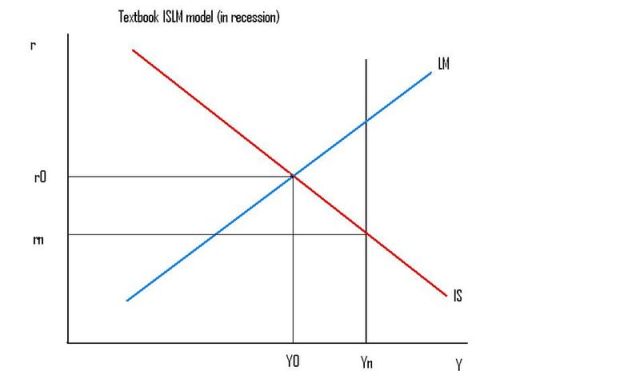 In the background, off-camera, is a Phillips Curve. The Long Run Phillips Curve is vertical, at the natural rate of unemployment. Yn represents the natural rate of output associated with the natural rate of unemployment. It is sometimes (misleadingly) called "full-employment output".
Where the IS curve crosses the vertical "full-employment" line determines the natural rate of interest rn. That's the (real) rate of interest at which desired savings equals desired investment at "full employment output".
I have assumed for simplicity that expected inflation is zero, so I don't need to insert a vertical "expected inflation" wedge between the IS and LM curves. Nominal and real interest rates are equal, and the equilibrium {r0,Y0}is where IS and LM intersect.
I have drawn this equilibrium where Y<Yn and r>rn. The economy is in recession. The central bank should increase the money supply to shift the LM curve right, lowering r to rn, and get the economy back to full employment. Or, the government should use fiscal policy to shift the IS curve right, raising both r and rn, and making them equal at full employment.
Also off-camera is an AD curve. The AD curve slopes down, because a fall in the price level increases the real money supply and shifts the LM right.
Now look at the New Keynesian (or Neo-Wicksellian) version:
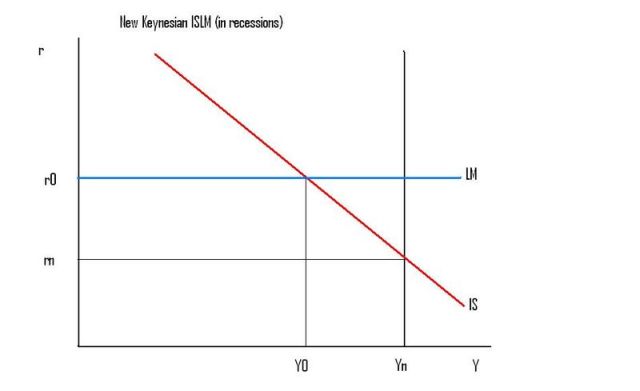 The only difference is that the central bank is now thought of as choosing the rate of interest, rather than the money supply, so the LM curve is horizontal. The supply of money is perfectly interest-elastic at the rate of interest chosen by the central bank.
I have drawn this equilibrium where the central bank has set the rate of interest above the natural rate, so the economy is in recession. The central bank should shift the LM curve down and reduce the rate of interest to equal the natural rate. Or fiscal policy should be used to shift the IS curve right to raise the natural rate of interest to equal the rate set by the central bank.
Off-camera, the AD curve is vertical. A fall in the price level will reduce the demand for money, but the central bank will accommodate by allowing the stock of money to fall proportionately, to keep the rate of interest constant.
This vertical AD curve means that the central bank must actively adjust the interest rate to keep the price level determinate. If it keeps the interest rate permanently above the natural rate, output demanded will be less than full employment, and the result will be accelerating deflation. If it keeps the interest rate permanently below the natural rate, output demanded will be above full employment, and the result will be accelerating inflation. On average, the central bank must set an interest rate equal to the natural rate (plus target inflation, to allow for the difference between real and nominal rates of interest).
Finally, look at the MMT version:
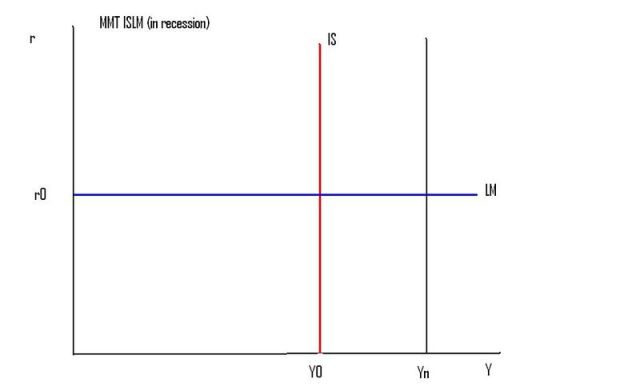 It's exactly the same as the New Keynesian version, except that the IS curve is vertical. The IS is assumed vertical because the rate of interest is assumed to have no effect on either desired savings or desired investment.
There is no natural rate of interest in the MMT version. It's undefined. If the IS curve lies either to the right or to the left of full-employment output, there exists no interest rate such that desired savings equals desired investment at full employment output. If, by sheer fluke (or by skillful fiscal policy) the IS curve is exactly at full employment, any rate of interest will make desired savings equal desired investment at full employment.
The MMT AD curve is vertical. A fall in the price level will not increase the real money supply and reduce the rate of interest (just like in the New Keynesian version, unless the central bank responds actively). But even if the rate of interest did fall, it would not increase output demanded. So, the AD curve is doubly vertical.
Monetary policy has no effect on AD. Fiscal policy can be used, and must be used, because this model, with its vertical AD curve, has no inherent tendency towards "full employment" output. The price level is indeterminate, unless active fiscal policy makes it determinate.
Since monetary policy has no role to play in determining AD, the central bank can set any interest rate it feels like setting. Indeed, it might as well set a nominal interest rate near zero, since this reduces the transactions costs of people converting between currency and bonds to try to avoid the opportunity costs of holding zero interest currency. (This is Milton Friedman's "Optimum Quantity of Money" argument in a new setting, except the central bank can set a 0% nominal rate even if positive inflation means that the real rate is negative).
The rate of interest plays no allocative role in savings and investment. It does not coordinate intertemporal consumption and production plans of households and firms. It merely re-distributes wealth between borrowers and lenders.
In a standard model, the government has a long run budget constraint. The present value of taxes must equal the present value of government spending (plus the existing national debt). The government can't borrow, and borrow to pay the interest, indefinitely, because the debt/GDP ratio would grow without limit. But this long run budget constraint only applies if the rate of interest on government bonds is above the long run growth rate of output. If the nominal/real rate of interest is less than the growth rate of nominal/real GDP, the government can run a stable Ponzi scheme. It can borrow, then borrow again to pay the interest, and the debt/GDP ratio will still fall over time, because the debt is growing at the rate of interest, which is lower than the growth rate of GDP.
If the central bank can set any interest rate it likes, it might as well set a rate of interest below the growth rate of GDP. So the government debt becomes a stable Ponzi scheme, and there is no long run government budget constraint in the normal sense. The only constraint on fiscal policy is that if the government runs too big a deficit and/or allows the debt to grow too large this would cause the IS to shift to the right of full employment output, and so causes accelerating inflation.
Actually, the ISLM framework is overkill in this context. The whole point of the ISLM framework was to reconcile two competing theories of the rate of interest: loanable funds ("the rate of interest adjusts to equalise desired savings and investment"); and liquidity preference ("the rate of interest adjusts to equalise the demand and supply of money"). IS shows the loanable funds answer, and LM shows the liquidity preference answer, and the ISLM model show that both answers depend on the level of income. So both are partly true. (Except in the long run where income is determined by full-employment, so only loanable funds determines the natural rate of interest). But if savings and investment are both perfectly interest-inelastic, we might as well revert to the simple Income-Expenditure Keynesian Cross model to show the underlying MMT macro model.
MMTers have a liquidity preference (LM) theory of the rate of interest, and a loanable funds (IS) theory of the level of income.


 Worthwhile Canadian Initiative
The hairless on strikes at a fluxy spot with this line
About investment and savings moving in the same direction with rate changes
That pretty nicely demolishes the usual marshal cross applications eh
AS and AI rising together and falling together
Andy also raises the what in he’ll is money besides medium of exchange measure of exchange value and store of wealth
Well as means of payment ie the basis of a credit system the disjunction between recipt of product and recipt of money
And of course the simpler lending of money ie injection of medium of exchange into the transaction system
None of this gets us very far by itself
Except it points out clearly the only real saving is storage
And the storage of a pure medium of exchange is a peculiar form of storage
That in a closed system is hardly providing a future real consumable product for exchange
Like laid up corn ala Joseph and the pharaoh
The building of production machines revolutionizes this world
Now u can make provision for future production not just future products
Andy: Let’s clear the decks. Closed economy, no government, and no investment either. The only produced good is backscratches. The only other good is a bond, which promises to pay (1+r) backscratches next period.
Actual savings is always zero, since backscratches cannot be stored. But desired savings are not equal to zero, except in equilibrium.
If this is a barter economy (“you scratch my back and I’ll scratch yours”, there cannot be unemployed backscratchers. Two unemployed backscratchers will scratch each others’ backs. But, if desired savings depends on the rate of interest, there might be an excess demand for bonds if r is above the natural rate of interest. Each agent wants to give a backscratch and get a bond in return. That’s an excess supply of “loanable funds” corresponding to an excess demand for bonds and desired savings being positive. Equivalently, desired consumption is less than full-employment output. So, if r is stuck too high, we get all these things.
But if this is really a barter economy, the unemployed backscratchers, who want to sell backscratches for bonds but can’t (because everyone wants to do the same), will revise their optimal plans subject to this quantity constraint. And they will swap backscratches as a second-best. So there’s no unemployment in a barter economy, even though desired savings is positive (with r stuck too high for some reason).
Now switch to a monetary exchange economy. You can only sell backscratches for money, because I can’t reach your back while you are scratching mine, so we need a Wicksellian triangle. Now an excess desire to save (in the form of money) will cause unemployment.
The harness man
Hits lots of points
The system uses credit to connect producers with available capacity
And it works gropingly well
When the source of credit is un spent money
A kind of rough and ready crimp on AD is set by the money stock if it has no elasticity thru
Fract.tonal storage mechanisms etc
It do get complex t.oo fast to get much mileage out of these
just so tales
of ally oop o comics
why do you respond to Harless, whose point is about macro saving and investment, with that tired old backscratch example, where there is no macro investment?
Nr
I think we may be on different wave lengths
Jr indeed explored less then perfect market systems b4 she was swallowed whole by Keynes
But here I’m talking about map
The learner colander
Market anti inflation plan
That involves warrants to increase prices
I think some one may have referenced their pamphlet of 1980 on same
And tootled. Same
Ie MAP
It really is av memory holed affair
Colander himself rarely speaks of it
The roaring price levels of the 70’s led to several plans to deal with rogue price levels
In ways that would go beyond the simplex of controls and freezes
Used since commodity exchange wore short pants
Abba learner had been on this kick since the post war period
Only he in his usual astute way focused only on wage control
Politically less then acceptable
In the 70’s weintraub had come up with an inflation pigou tax
Lerner no fan of weintraud jumped on colanders alternative
A cap and trade
One can review the pollution control debate to se the features of each approach
I come down strongly on the colander side here
Because certainty about the price level is the whole game here
Unlike say carbon emission
Where cost is a serious counter factor one might rather make certain then amount
At any rate
I m like a child crying in the wilderness since the era of price level tameness
In product prices
Of course assets like equities and lot values were hardly moderate
At any rate
The fear of inflation
as say made into concrete shoes for an economy with stuff like the Nairu bugaboo
PS
Your example is one of saving at the level of sector financial balances – where each of the backscratchers is effectively a sector with a financial balance. But there is zero investment. That’s not what the (appropriately discredited) loanable funds theory is about.
“Let’s clear the decks. Closed economy, no government, and no investment either. The only produced good is backscratches.”
Wouldn’t an enterprising entrepreneur just invent a backscratcher that could be used by each individual thereby implying autarky as the natural evolution of the economy? (By the way Nick, I am not being serious, just antagonistic.)
Nr
There you go with your hyper abstractions
I love em
But I think they are badly off course
The notion that intertemporal exchange is corn only type economy explicable is dangerous
In fact all these just so stories only serve to confuse
Then you get into a pure service system and from there
Why not read some paleo ethnology here
Yes lock might have needed to create a primeval fantasy society but not you anymore
Then Rousseau
Now I love these gadget systems more then most
But I think you can’t get at the system by simplification only by abstraction
And with a healthy dose of anti reification pills
Which is what I think the harmless guy is after
The false concreteness of most notions of a loan market where suppliers of loans are savers themselves and demanders of loans are machine builders and storage speculators
anon: I used the “tired old backscratch example” for simplicity, obviously. If we can’t get this straight when I=G=T=X=iM=0, we don’t have a hope in hell of getting it straight in a more complex example. Why do you resist simplicity so? Are you just trying to run off and hide in anonymous thickets of words, institutional detail, and accounting identities?
Paine: yes, I figured you might be talking about MAP, or TIP. You and I may be the last people alive who remember it. In principle, MAP would work in NK macro models. And Abba Lerner was right too to say the same thing about the labour market. But yes, politically unacceptable (from both ends of the spectrum). Also, totally impractical too? See my old post http://worthwhile.typepad.com/worthwhile_canadian_initi/2011/02/we-are-all-paid-too-much.html
On LRAS vs bottlenecks, see the two LRAS curves in my: http://worthwhile.typepad.com/worthwhile_canadian_initi/2010/01/macroeconomics-with-monopolistic-competition-in-pictures.html
Nick, That’s what I thought, but I could never understand the attraction of that sort of model. The QTM can explain why Japanese prices are roughly 100 time higher than US prices. The various interest rate-oriented models cannot. That’s a deal breaker for me. The are two main goals of monetary economics–explaining the price level and explaining the business cycle. If you try to explain changes in the price level without being able to explain the level of the price level, the model will be highly susceptible to the Lucas Critique.
For instance, it will be almost impossible to explain why Britain had a much higher trend rate of inflation over the past 50 years than Germany. When I return I’ll do a post on what determines the price level.
totally impractical too?
we have room here for debate
i read the link to your ad flatline micro neg slope post
and it certainly underlines the key
part whole fallacy and the system co ordination problem
when you have many pricers “free to choose ” their prices
i’ll duck the TU bashing
its obiously all in good quixotic fun
but i’d certainly would appreciate some one posting on map
somewhere at the intersetion of econ con alley and people’s avenue
why not u ???
I agree with Andy Harless that the notion of “saving” perse is somewhat incoherent, and that the “loanable funds” model has problems. Nevertheless, most economists would agree that the interest rate is dependent on supply and demand for future goods and services. Liquidity effects can affect market interest rates only in so far as folks are willing to accept a compensating differential for holding certain kinds of assets.
anon@12.00 (who is different from the earlier anon, confusingly!):
I agree too that “saving” is a horribly confusing concept. It is defined negatively — as that part of income (net of taxes) you don’t desire to spend on newly-produced consumer goods. OK, so what do you desire to do with it? There are many things you can desire to do with it: desired investment (buy newly produced capital goods; desired purchases of land, used furniture, old paintings, whatever and other old stuff; desired purchases of bonds (i.e. lend it to someone else); and desired additions to your stock of medium of exchange. In my view, it is only when excess desired savings takes the form of desired excess additions to your stock of medium of exchange that it causes a recession. (But that’s getting off-topic, and into my quasi-monetarist peculiarities. I’m trying to pretend I’m a good mainstream Keynesian for this post).
@ Luis,
The paper that started MMT and laid out the basics of the MMT approach to the nonconvertible floating rate system is Warren Mosler’s “Soft Currency Economics.”
http://moslereconomics.com/mandatory-readings/soft-currency-economics/
The interest rate can adjust to make desired savings equal actual savings, by causing either the desired or actual to change. But it’s misleading to say that it equalizes savings and investment. Investment is whatever people decide to invest. Actual savings is determined directly by investment.
Andy: “Investment is whatever people decide to invest.”
No it isn’t. Two counterexamples:
1. An economy in excess demand for newly-produced goods. People might desire to buy investment goods but can’t find a willing seller.
2. Undesired inventory accumulation. If goods are durable, and you produce in advance of output, and you can’t adjust output instantly, desired savings determines actual investment in the very short run.
The underlying truth to the idea that I is determined by Id is that, in an economy in excess supply, the short-side of the market determines quantity traded. Q=min{Qs;Qd}. The Keynesian model assumes goods are always in excess supply, so we are always on the IS curve. So if newly-produced goods are in excess supply Cd determines C, and Id determines I, because Cd+Id is less than Ys.
In economies like Cuba, where goods are in excess demand, and the short side is the supply side, Cd and Id are less than C and I. S determines I. If people decide to save more (consume less) that leaves more goods available for investment. (Though it depends on who gets first call on the goods).
We really would find life easier of we stopped talking about S, and just said that Yd(Y,r)=C(Y,r)+I(r) and Y=min{Yd,Ys)
And the loanable funds theory says that r adjusts so that Yd(Y,r)=Ys=Y where r is the natural rate of interest. And the problem with the loanable funds theory is that (as was understood by Hicks) it only works when Y is pinned down by LRAS (or a vertical LM curve).
And this is formally equivalent to Sd(r,Y)=Y-Cd(r,Y)=I(r) which is the normal way of writing the loanable funds equilibrium condition.
@ NIck” “When MMTers reject the ISLM, I really begin to wonder if they understand their own model and understand ISLM.”

MMT’ers reject ISLM because they see it as monetarist, whereas MMT’ers are fiscalists.
pcle | April 16, 2011 at 01:29 AM, I thought MMT was a subset of Minsky post-Keynesianism. In which case this exposition is nothing to do with the theory. It suffers from the over-aggregation problem. One of Minsky’s critiques of Keynesian macro was its failure to take account of the complex inter-relationships of balance sheets across myriad entities. Casting it into Hicksian framework is “bastard post-Keynesianism” to echo Joan Robinson. Surely you’ve got to exposit the theory in a stock-flow consistent framework as laid down by for example Godley-Lavoie or its not worth doing at all.
See also JKH | April 16, 2011 at 08:16 AM. I believe he has the MMT position right. He concludes: You can reverse engineer this to ISLM, but you’re reverse engineering something that is implicitly and fundamentally a rejection of that engineering framework.
Warren Mosler | April 15, 2011 at 04:17 PM, “And let me also add that the islm model is a fixed exchange rate model.”
This is essentially what Parenteau, MItchell, and Fullwiler are saying in the posts I cited, which is fiscal., whereas ISLM is monetary.
Check out Parentau’s graph of the three sector financial balances.
ss
” If you try to explain changes in the price level without being able to explain the level of the price level, the model will be highly susceptible to the Lucas Critique”
these ahistorical models swallow their own tale models are a quick shuffle fraud
the lucas critique boldly claims
the economic systems demiurge role
for real ouput levels
can not be moved from the partitioned babel like complexity of many firms
independently setting prices and ouput
to the meta level of the state
simply regulating ouput by changing the states intake and ouflow rates
my guess
ss wants
to preserve free range private corporatism’s” profiteering liberties ”
and
for the obvious reasons
even as these reasons delight in going around disguised as
long run social welfare considerations
of course sincere belief by the wearer of the disguise
ie when he/she/they look in the mirror
and see not a special pleader and casuist
but a universal altruist
wht that sure ccn
make the disguise all the more convincing to others
tjfxh: I had a look at Parenteau’s graph you linked to. It is not a model. It is an accounting identity in graphical form. And it is exactly the same accounting identity that is assumed in the standard (open economy) IS curve. Namely (I-S)+(G-T)+(X-iM)=0.
That’s not economics. It’s accounting. What the ISLM model does is take that exact same accounting identity, adds some behavioural assumptions, converts it into a semi-equilibrium condition, so you can use it to (try to) explain the world.
If you take an ISLM model, and make the IS curve vertical, it becomes a pure fiscalist model. Monetary policy does nothing to affect aggregate demand.
My memory of the Radcliffe Report is also hazy (I still have my copy, but I’m away from my office). But my memory was that it argued strongly against ‘monetarism’ on the basis that there is a spectrum of assets of different degrees of liquidity, and that many of these assets are created by private agents (banks etc) and therefore endogenous. Hence Kaldor’s horizontal LM curve: M is determined by demand, but Governments can stiil fix the interest rate. Where MMT seems to go further is the argument that this rate can be whatever the Givernment likes, and in particular can be zero.
On the argument that Government debt doesn’t matter, since Governments can issue debt (money) at a zero interest rate and there is therefore no tax liability. I don’t see how this can work in an open economy (agents can buy foreign bonds) or in an economy where agents can hold real assets (? houses). It might be worth pointing out that what I have argued was an early attempt at an MMT policy (the UK post WWII) was an economy with well-enforced exchange controls, planning-based controls over investment (particularly private housebuilding), controls on the access of private firms to the capital market, and a small private housing sector.
Finally, on the role in MMT of Wynne Godley. Under the pre-72 fixed exchange rate regime a high level of AD led to a current balance of payments deficit, hence to a balance of payments deficit. ‘New Cambridge’ was an attempt to establish a direct link between Government and BoP deficits under these conditions. In this sense it was a purely ‘fiscalist’ theory. But this does not imply that the stock of debt does not matter, even if some MMTers argue that this approach allows the exchange rate to be used as a nominal anchor, and ignore the role of debt. Governments cannot force foreigners to hold money, or other assets which yield zero interest, and therefore (given the preferences of the domestic private sector) they cannot run continuous deficits. So under fixed exchange rates there is a binding BoP constraint (as those who remember the UK in the 1960’s know very well).
If I understand MMT’ers correctly, the BoP constraint vis-a vis the fiscal condition occurs as the ROW’s desire to save in a county’s currency diminishes. MMT’ers view the floating rate system as an effective automatic stabilizer.
William @ April 17, 2011 at 02:13 PM
Not only fixed exchange rate regimes, they – the New Cambridge economists – carried it to the present market-determined economies (which is not just flexible exchange rates, but the whole set of Laissez-Faire arrangements to promote free trade) and argued that in addition to constraints from the supply side, the balance of payments constraint is a supreme constraint.
Perhaps they were misunderstood by everyone including inside Cambridge itself (Richard Kahn and Michael Posner) and they thought they were advocating IMF’s Jacques Polak’s stand (purely ‘fiscalist’). That was I believe because even though were putting forth behavioural models, everyone thought, they were simply stating an accounting identity! But, nobody stopped listening because they got all the problems the British economy was heading to, completely right.
On RR:
The RR was an attempt to figure out how the monetary system works. The Radcliffe Report according to Nicholas Kaldor got it right, but didn’t manage to explain it to everyone.
Here is a Google Books link where Kaldor explains the connections. http://books.google.com/books?id=CyDb8HK_fN4C&lpg=PP1&dq=scourge%20of%20monetarism&pg=PA23#v=onepage&q&f=false
Even draws IS/LM diagrams.
Btw William,
The Neo-Chartalists (MMTers) argue that flexible exchange rate regimes allows nations to get rid of the BoP constraint and Keynesian demand management works.
If you see me in their blogs (commenting), you will find me debunking such claims 😉
Nick: That’s not economics. It’s accounting. What the ISLM model does is take that exact same accounting identity, adds some behavioural assumptions, converts it into a semi-equilibrium condition, so you can use it to (try to) explain the world.
If I understand them correctly, MMT’ers (and other PKE’ers in this line) don’t think that such an explanation works. Tried and failed. See Thomas Palley, “Endogenous Money: What it is and Why it Matters,” Abstract:
Endogenous money is widespread in economic theory. The Post Keynesian contribution is identification of a causal link between bank lending and the money supply. Though driven by macroeconomic concerns, the Post Keynesian debate has reduced to a microeconomic debate over the role of financial intermediaries in the accommodation process. In the ISLM model endogenous money flattens the LM. This misses its substantive significance which is discrediting of monetarist money supply policy rules and monetarist critiques of central banking, its identification of the key role of credit, and its provision of a credit driven theory of the business cycle.
MMT’ers are in the line of Lerner, Kalecki, Kaldor, Minsky and Godley. As JKH says, you can model MMT on ISLM but that misses what MMT is actually about, which is revealed in the understanding of monetary operatons, SFC approach to sectoral balances, and the functional finance response options. Godley and Lavoie lay out the SFC macro modeling in Monetary Economics (Elgar 2007).
I think that Warren’s response sums up your reverse-engineering: Interesting! I would interpret this as saying, you can look at this way if you like, but that is not actually what we are doing — which is clear from their writings.
.. A boom developed in the years 1954-6 which the authorities were quite powerless to control. These troubles were ascribed, however not to the ineffectiveness of monetary policy but only to the ineffective manner in which the policy was operated (whether on account of ignorance or the lack of suitable instruments or institutions.) This was to be remedied by a grand inquiry into the workings of the monetary system – the Radcliffe Committee – whose report is the subject-matter of the lectures reproduced in the first part of the volume.
The unanimous Report of the Radcliffe Commmittee, issued in the summer of 1959, represented a serious set-back to monetarism. For the Report, much to everyone’s surprise and in clear contrast to all previous grand Committees of Inquiry on the subject (such as Cunliffe’s or Macmillan’s), declined to accord any importance to the money supply or its changes, and asserted that ‘in ordinary times’ monetary policy cannot play more than a ‘subordinate part’ in guiding the economy. All this represented a clear break with the classical monetarist tradition of Britain, a total rejection of the ideas of the Friedmanites (who at that time were making a lot of noise and spreading out fanwise from Chicago), and the reaffirmation of Keynesian principles of economic management which continued to dominate the British scene…
-page xxii – The Scourge Of Monetarism, Nicholas Kaldor.
Nick,
“2. Undesired inventory accumulation. If goods are durable, and you produce in advance of output, and you can’t adjust output instantly, desired savings determines actual investment in the very short run.”
In your production-in-advance-of-sale model, investment occurs when the firm produces the good, because at that point it has paid the factors of production but not yet received payment for the sale of the good, so that the rest of the economy has saved.
If there are many firms all placing goods into inventory and selling (previously produced) goods from inventory, and if people decrease their purchases of goods, then the (stock) of inventory does increase, but inventory investment, which is the inflow into this stock, does not increase. Another way you can think about it is that goods not sold but carried over to the next period are not newly produced goods and so are not counted in measures of Y.
Therefore you cannot have unwanted inventory investment in such a model. To have unwanted inventory investment requires the firm to have the option of producing and selling the good in the current period or placing goods into inventory in the current period. And that doesn’t seem plausible, particularly if your model is in continuous time, or the periods of your model are very short. I am big fan of the production-in-advance-of-sale models.
But with regard to your point #1, that has nothing to do with savings demands.
The argument is that there is no “market” in which savings and investment curves cross, determining r. There are obviously money markets in which money is lent out at a rate, but borrowing and lending of money is not the same as saving and investing final output, obviously. The corresponding markets in which “real” capital is bought and sold would be the output market, say the hardware store, and you can apply the short side rule to those markets.
But you cannot apply the short-side rule to money markets. First, these markets have no price-rigidity and they always clear. Think of what happens when the central bank sets a very low rate. If the short-side rule held, then there would be very little lending. But we know that there is a lot of lending when the CB sets a very low rate, so that tells you that the demand curve will determine the amount of lending, rather than the short-side rule.
RSJ: “There are obviously money markets in which money is lent out at a rate, but borrowing and lending of money is not the same as saving and investing final output, obviously.”
A terminological point would really help here. Even though it sounds picky, I really hate the phrase “money market”. In a monetary exchange economy, all markets are “money markets”, in that the medium of exchange is one of the two goods traded. So “money market” is a …. (what’s the opposite of an oxymoron?) a redundancy?
You presumably mean “bond market”, or market for non-monetary financial assets like bonds and shares, etc. Call them all “bonds”.
Now, there is a market for bonds. And you can apply the short side rule to the market for bonds. If (for whatever reason), the rate of interest does not adjust, the quantity of bonds traded will be the lesser of demand and supply.
Where you can’t apply the short side rule is in the market for money. precisely because there is no such market. Or, rather, every market is a money market. There are 2 ways to get more money: selling more other goods; and buying less other goods. And nobody can ever stop you buying less other goods. Which is why we get recessions.
That’s the point at which I’ve been hammering away at for the last couple of years on this blog. The medium of exchange really is special. A monetary exchange economy really is different from a barter economy.
But, ultimately, I sort of agree with you. New Keynesians (for example) say that the rate of interest must adjust to equalise demand and supply of newly-produced goods. Which is another way of saying that the rate of interest adjusts to equalise desired savings and desired investment. And ultimately, I think it’s the real stock of medium of exchange that must adjust to equalise desired savings and desired investment, not the rate of interest on bonds.
Think back to my post on the Pro-Usury party meets the Neo-Wicksellians.
My biggest disappointment with the MMTers is that I see no sign that they take the medium of exchange role seriously. They lump money+bonds together. They say it’s the flow of money+bonds that needs to adjust to ensure AD=AS. And they have what is essentially the fiscal theory of the price level (to the extent that they have a theory of the price level).
But now I have wandered waaaay off-topic. Into my quasi-monetarism.
Reverting to New-Keynesian mode, the central bank must adjust the rate of interest so that AD(r)=AS. Which is to say it needs to adjust r until desired S(r,Y) equals desired I(r) at full-employment Y. Which is to say it needs to set r equal to the natural rate. That reconciles the liquidity-preference theory of the actual rate of interest set by the central bank with the loanable funds theory of the natural rate of interest that the bank needs to set to ensure full-employment.
I’m getting tired. That wasn’t as clear as I wanted it to be.
Scott,
Isn’t the QTM itself an example (perhaps the clearest example) of a theory that fails via the Lucas Critique? Some economist observes that experience seems to confirm the QTM: nominal income goes up and down in parallel with monetary aggregates. So all we have to do, he reasons, is control the money supply, and we’ve solved the business cycle. So the central bank goes ahead and tries to control the money supply, and, lo and behold, the old correlation between monetary aggregates and nominal income breaks down. And the Lucas people are like, “Dude, what’d you expect? Your money demand function isn’t robust to large changes in the interest rate.”
RSJ: and on inventory investment: if people don’t buy the apples and eat them, the stock of uneaten apples increases. That is an increase in the capital stock, and is (undesired) investment, that results from an increase in desired savings.
Nick:
Your MMT model and description of it seems to indicate that if there were an increase in expected productivity or a change in intertemporal preferences these changes would have no bearing on the “equilibrium” interest rate in the MMT model. If this assessment is correct, then MMT is lot harder for me to swallow than I previously thought.
wp
again i suspect u no read this
but beating fixed exchange to death
fails to notice mmt
is for flex exchange systems
by definition
after all fixed rates can bind like a gold fetish binds
notice the poor piigs caught in the german disinflation vice
if macro managers at the nation statte level
obey some exchange rate fixity hocus pocus for whatever reason
its a swindle…like now
the job rationing credit rationing combo
is pure artifact of arbitrary constraints
ie taboo lines
like nairu
itself a nice no go zone
substitute for the hard barriers of exchange fixity
with its BOP jolt
that can pole axe
any tightening job market real wage surge
“I don’t see how this can work in an open economy (agents can buy foreign bonds) or in an economy where agents can hold real assets (? houses). ”
you forget
the full system here has no concern about paper capital flight
the credit system can provide all the funds necessary
there is nolonger any dependence on a private asset holding class
as to houses and house lots
show me your point
bubbles are bubbles they require regulation
but nominal prices have no anchor
in a full sysem that has a price level control mechanism
can move these levels around at differnt and off setting ates as needed
are you afraid this is some sort of perpetual motion hoax ??
it isn’t
the deep secret is this
such a full system could drive private capital to the wall
not only a zero credit but a zero sum profit system
but that’s anoher tier of sublation
this ill add
the instinct to oppose mmt is well founded
if you happen to be into free range private corporate capitalism
a full system neuters the capitalist class
r:
“you will find me debunking such claims ”
show me how my friend
provide a link to you struttin’ yer stuff
nick tries to link saving to storage
i like that attempt
it shows the perverse nature of that link
new storing new production plants or them forcing perfetly useful but older plants into moth balls
is hardly the same as a warehouse full of rotten apples
locke consider money a social contrivance that allowed big men to hold onto value
and avoid the social imperative to pas out perishable products
a right to save but no right to spoil
beckworth is running scared
“no bearing on the “equilibrium” interest rate … then MMT is lot harder for me to swallow than I previously thought”
what
no role for interests rates in regulating investment ??
gad zooks
but becky what if that is already the case ???
outside your model generated wonderland
what if credit markets aren’t like markets for apples or fish or …oil and gold even
i submit the micro of th years 1970 to 1990
pretty much demolished this fisherian simnplicity
about inter tempora preference
and clarkian nonsense about marginal productivity of “capital”
Nick, I think that was pretty clear!
But I don’t think you are being a bit unfair to the MMTers vis-a-vis money, and are not hitting them hard enough for thinking they can set rates to zero 😛 No need to hide your quasi-monetarism.
OK, let me bounce this off you.
Suppose rumors spread that over the next hill, there is a gold mine.
Budding entrepeneurs write IOUs for delivery of gold next period, and they go to stores to purchase shovels, labor, etc, with these IOUs. Will the storekeeper accept the IOUs as payment? Of course! Even if the storekeeper does not wish to save for a year. He will charge a liquidity premium, or discount, that will be the minimum of
{risk that the IOU will decline in price when he re-sells it for present consumption, premium that he would need in order to defer consumption for one year}.
And it’s quite possible — say if the bond is a government bond — that the minimum will be the first term and not the second.
We have examples of this — in the early days merchants had discount desks that discounted Bills of Exchange. The Bills circulated as money, and of course Bills issued by the Bank of England became money, but this does not mean that the privately issued bills stopped circulating as money.
When you accuse the MMTers of viewing bonds as money, just ask, “to what degree are bonds money”, and think of the interest rate as an upper bound on the difference between the bond and money.
Now if there are large fluctuations in the quantities of bonds issued then this will be as if there are large fluctuations in the stock of money. The conversion factor is not 1-1, but nevertheless, the volume of bonds is so much larger than the volume of high powered money that it becomes more important.
Back to our hopeful village, if the storekeeper would charge a 10% discount in order to keep the bond himself, but he plans to consume in one hour, and believes that there is a 2% risk that the bond will decline in price when he tries to sell it in hour, then he will charge a 2% discount and re-sell the bond in one hour for present consumption. If no one wants to save the quantity of IOUs, then they keep exchanging the IOUs for present consumption and the price level rises up until the price of the IOUs divided by the price level is equal to the savings demanded at the 2% rate.
David: I agree.
Nick: re: apples.
Instead of apples, let’s think of something more storable, such as wheat. It’s easier to swallow wheat as capital rather than apples.
The firm has a wheat buffer — storage. It takes 1 year to grow wheat, so wheat produced in period n can only be sold in period n+1. It cannot be sold in period n. But in period n+1, it is no longer newly produced output, it is previously produced output, so it is not counted in period n+1’s measurement of production. This is true whether it is consumed or kept in storage.
Now if in a given period, people eat very little wheat, due to an increased desire to save, then this does not mean that in the same period there is an increase in investment. In every period, investment is the amount of wheat grown.
This means that the capital stock is not the running total of investment, it is the running total of investment – consumption of capital, or of net investment. An increase in savings demands causes an increase in net investment, not gross investment. Gross investment is constant.
All of this only holds under the assumption that it takes one period to produce goods. But you can make your period as short as you want.
Paine,
Just because investment responds in non-linear ways to the short rate does not mean that it is independent of the short rate. Take a look at China to see what happens when you set interest rates too low. You get ponzi investment, in which people expand capacity in order to expand more capacity, all while the consumption share of GDP keeps plunging. I think consumption there is only 1/3 of GDP now. It’s a huge waste of real resources.
RSJ: Forget wheat. Switch to Scotch. 10 year old malt. There’s a constant flow of new scotch distilled. Value is added throughout the 10 years it is maturing in oak casks. Normally its is bottled and immediately sold and drunk at 10 years. But then people save more and stop buying and drinking it. So for the next 10 years the existing stock maturing in casks gets bottled and invested.
This is getting Austrian!
Nick, you have been very fair-minded and kind. How about a post now explaining where and why you disagree with the MMT view? Would be very interested in seeing it because you seem to be one of the rare MMT dissenters that have actually put some thought into the debate. Thanks!
Andrew: thanks. I disagree with the idea that desired saving and desired investment are (even roughly) independent of the real rate of interest. I believe that there is a non-trivial substitution effect of interest rates on both intertemporal consumption and production plans. But I’m just echoing the mainstream there.
I still don’t feel I understand MMT well enough to give a full critique. Plus, there’s MMT, and MMTers. If an individual MMTer gets something wrong (for example gets accounting mixed with economics, as they so often do) it doesn’t mean MMT itself is wrong.
Decades ago I read Abba Lerner’s Functional Finance. It is far from an obviously wrong thesis. It’s a coherent view of the world.
In many ways, (aside from the vertical IS question) MMT is closer to the Neo-Wicksellian orthodoxy than I am to either. I’m the guy out on left (or right) field. So if I were critiquing MMT I would also be critiquing the orthodoxy. I think both miss the essential role of the medium of exchange. For example, in comments on Steve’s blog, Scott Fullwiler said (as a simplification) we could think of money+bonds as being kept in one big chequable savings account on which the central bank sets the rate of interest. That vision is very much in line with the orthodox Woodfordian vision.
LOL
I like the scotch analogy. You are right! Not buying the scotch is investment. But I prefer Rye.
“Scott Fullwiler said (as a simplification) we could think of money+bonds as being kept in one big chequable savings account on which the central bank sets the rate of interest”
I think you’ve misinterpreted somewhere. And I never use the word “money,” at least when I’m trying to actually describe something. Money is always someone’s liability, and I’m always clear about whose liability I’m referring to.
Also, regarding “medium of exchange”:
http://www.levyinstitute.org/publications/?docid=1344
http://www.levyinstitute.org/publications/?docid=1357
Finally, while, as Warren noted, the attempt to reverse engineer is interesting, as JKH suggested it conceals far too much of what is important to MMT–namely, the interaction of the Tsy, central bank, and financial system. We may or may not have a complete theory worked out depending on whom you ask (we are, after all, only about 10 economists; forgive us if our output doesn’t rival the 1000s working out other approaches, even as some MMTers are quite prolific), but what we would say is that if anyone’s preferred model isn’t consistent with how the Tsy, central bank, and financial system actually interact, it is not relevant to the real world.
Nick,
Rob Parenteau (from reference above) on Krugman – and maybe this point reflects why MMTers don’t like ISLM:
“If Paul recalls his reading of Keynes’ General Theory (and he is to be applauded for being one of the few New Keynesians to actually read Keynes in the original), this is one of the reasons Keynes argues incomes adjust to close gaps between intended investment and planned saving. Interest rates do not equilibrate investment and saving – incomes do, in Keynes’ General Theory. Paul has taken a very large step in this direction with his financial balance diagram, which hopefully he will find more powerful than his IS/LM analytics which he employed in the case of the Japanese balance sheet recession.”
Note, he says: “interest rates do not equilibrate investment and saving”
I suppose you could interpret that as a vertical IS curve – or an outright rejection of the ISLM model.
(which reminds me of Mosler’s earlier comment above on ISLM – i.e. that it applies to a fixed exchange rate model)
You cast MMT as the case of a vertical IS curve within ISLM. I believe you’ve explained that a vertical IS curve means monetary policy is without effect. That seems to be the precise logical translation of vertical. But I don’t think that’s precisely what MMT is saying. It’s saying that monetary policy may have effect, but that it’s effect is unreliable – in at least one important sense in that its potential impact may be directionally ambiguous – a point I made earlier above and a point that Mosler made in his comment. MMT does claim I believe that fiscal policy is more effective than monetary policy in closing the employment gap, because it is unambiguous in its income creation effect, without the necessary complication of (ambiguous) interest rate manipulation. This ambiguity is a fairly important point to MMTers. So one might intuit that the IS curve according to MMT may not be vertical – instead it may be some unreliable squiggle, with different compound effects in two different directions in different circumstances. That’s uncertainty more than verticality. And they dislike that uncertainty and ambiguity.
See also Mosler’s comment at http://www.interfluidity.com/v2/1357.html#comment-15730
And Scott Fullwiler: http://www.interfluidity.com/v2/1357.html#comment-15809:
“As Warren explained in his response to Nick, it’s not necessarily the case that MMT sees aggregate spending as completely interest inelastic. That’s one example of why we cringe at such simple models–there are several channels, including the Minskyan links Warren didn’t even mention. That is, the rationale for not manipulating interest rates doesn’t rest on an assumption of (to use Nick’s framework) a vertical IS curve–instead, the rationale is that the effects of manipulating (short-term) interest rates are highly uncertain given multiple channels, and given our Minskyan background, frequently destabilizing. As I said, it’s very hard to put that into a simple IS-LM or similar framework.”
And: http://www.interfluidity.com/v2/1357.html#comment-15810:
“Note that Mosler often describes interest rate effects on aggregates spending that would be more in line with an upward sloping IS curve (e.g., one can find in several places on his site where he suggests that Japan’s zero rate policy might be deflationary). So, again, the idea of a vertical IS as being a representative description of the MMT view of the world is a gross oversimplification.”
Nick, you’ve reverse engineered MMT to a vertical IS curve within the framework of ISLM. That may reduce MMT to an ISLM case, but in doing so it may also oversimplify and possibly distort the reason for MMT’s fiscal preference – as revealed through its distaste for ISLM rather than some assigned niche within ISLM.
OK, looks like you’re talking about this:
“1. bonds vs. money doesn’t matter in terms of inflationary impact, aside from interest differentials.”
If we “miss the essential role of the medium of exchange,” perhaps that just means we don’t accept that holding more deposits as a % of total assets is necessarily going to lead to more spending than otherwise. Treasuries don’t restrict aggregate spending–as just one example–in a world in which there are 20 or more primary dealers with an open bid and the ability to repo out their existing inventory to create the funds to buy more bonds (that is, Tsy’s actually enable greater “money” creation). But none of this has anything to do with whether or not we have integrated the “medium of exchange” role of “money.” We have integrated it as it actually works.
Just a quick response. Because my students write an exam this morning and I have little time over the next few days.
Keynes GT said that Y adjusts to equilibrate desired S and I. But that wasn’t really internally consistent, because he forgot the feedback loop from Y to the demand for money (he recognises that the demand for money does depend on Y) and so to interest rates and S and I. The textbook ISLM says that both Y and r equilibrate S and I. The New Keynesian ISLM says that for given r set by the Bank, Y adjusts to equilibrate S and I. But, in the long run, the Bank must set r equal to the natural rate, and only the natural rate of r equilibrates S and I at the long run equilibrium level of Y.
I repeat my point about Robert Parentau though. The “Krugman Cross” he praises is formally identical to the Keynesian Cross and the vertical IS curve. This is not in any way “Modern”.
(Sure, I understand that nobody believes the IS is literally vertical under all circumstances, and that this is just a simple representation of “it might slope up or down it depends”.)
Let me put it another way. The orthodox New Keynesian view is that Y equilibrates S and I in the short run, given the r set by the Bank. But in the long run, when Y is set at “full employment” Y cannot adjust to equilibrate S and I, so the r set by the Bank must be adjusted to equilibrate S and I.
And the big difference between MMT and orthodox NK, if my simple model here is correct, is that with a vertical IS curve the central bank cannot set an r to equilibrate S and I at full employment Y. Instead, fiscal policy must be used to equilibrate S and I at full employment Y. That’s because there is no natural rate of interest.
If MMTers did believe what my crude model says they believe, then the MMT policy prescriptions make sense. In that sense, my reverse engineering gets the right answers.
“. I disagree with the idea that desired saving and desired investment are (even roughly) independent of the real rate of interest. I believe that there is a non-trivial substitution effect of interest rates on both intertemporal consumption and production plans. But I’m just echoing the mainstream there”
nr
have you really come to terms with credit rationing
our sstem always leaves borrowers desired funds at the going rate
in excess of funds provided
once you add the unliited elasticity of credit
what’s left ???
i know the entire edifice of certain models comes crashing down when
there is no spontaneous unique equilibrium the system drives itself toward ..eventually
but hey there isn’t with granular systems under newtonian law either
lots of “ideal ” physical models lack unique points of balance
thank god or we’d have no history only periodic orbits
which is not to say we just get one damn thing after another
in fact i prefer totally determined models
stochastics is heroin
Scott: thanks for the links. I will try to read them later. But don’t pay too much attention to me when I start going on about medium of exchange stuff. This is my private fight with 95% of the profession. And, from my perspective, “all you horizontalists, orthodox, or unorthodox, look alike to me”. (As the bishop said to the actress).