I'm trying to keep this as simple as possible, so it's accessible to second-year economics undergraduates.
Many theoretical papers I read are full of impenetrable (to me) thickets of math. So I reverse-engineer the model. I try to figure out what the underlying model must be in order for the paper's conclusions to make sense.
Many Modern Monetary Theory posts I read are full of impenetrable (to me) thickets of words. So I have reverse-engineered the model (with the help of Steve Randy Waldman's blog post and Scott Fullwiler in comments on that post). I think I have figured out what the underlying model must be in order for MMT's conclusions to make sense.
I don't think my model is a straw man. It is a stick-figure. A very simple caricature that shows only the bare bones, but is still recognisable.
Start with the standard textbook ISLM model:
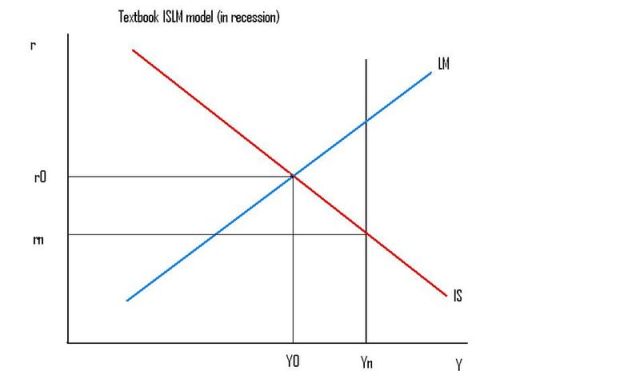 In the background, off-camera, is a Phillips Curve. The Long Run Phillips Curve is vertical, at the natural rate of unemployment. Yn represents the natural rate of output associated with the natural rate of unemployment. It is sometimes (misleadingly) called "full-employment output".
Where the IS curve crosses the vertical "full-employment" line determines the natural rate of interest rn. That's the (real) rate of interest at which desired savings equals desired investment at "full employment output".
I have assumed for simplicity that expected inflation is zero, so I don't need to insert a vertical "expected inflation" wedge between the IS and LM curves. Nominal and real interest rates are equal, and the equilibrium {r0,Y0}is where IS and LM intersect.
I have drawn this equilibrium where Y<Yn and r>rn. The economy is in recession. The central bank should increase the money supply to shift the LM curve right, lowering r to rn, and get the economy back to full employment. Or, the government should use fiscal policy to shift the IS curve right, raising both r and rn, and making them equal at full employment.
Also off-camera is an AD curve. The AD curve slopes down, because a fall in the price level increases the real money supply and shifts the LM right.
Now look at the New Keynesian (or Neo-Wicksellian) version:
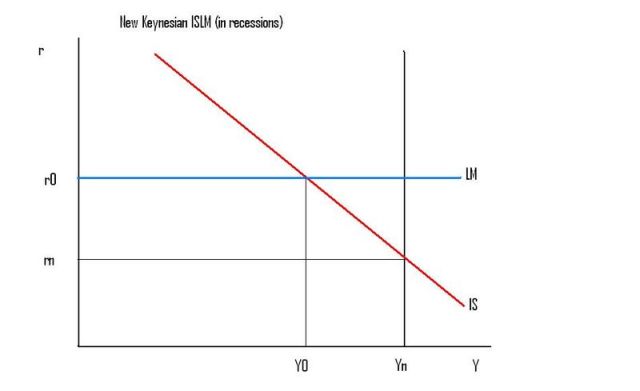 The only difference is that the central bank is now thought of as choosing the rate of interest, rather than the money supply, so the LM curve is horizontal. The supply of money is perfectly interest-elastic at the rate of interest chosen by the central bank.
I have drawn this equilibrium where the central bank has set the rate of interest above the natural rate, so the economy is in recession. The central bank should shift the LM curve down and reduce the rate of interest to equal the natural rate. Or fiscal policy should be used to shift the IS curve right to raise the natural rate of interest to equal the rate set by the central bank.
Off-camera, the AD curve is vertical. A fall in the price level will reduce the demand for money, but the central bank will accommodate by allowing the stock of money to fall proportionately, to keep the rate of interest constant.
This vertical AD curve means that the central bank must actively adjust the interest rate to keep the price level determinate. If it keeps the interest rate permanently above the natural rate, output demanded will be less than full employment, and the result will be accelerating deflation. If it keeps the interest rate permanently below the natural rate, output demanded will be above full employment, and the result will be accelerating inflation. On average, the central bank must set an interest rate equal to the natural rate (plus target inflation, to allow for the difference between real and nominal rates of interest).
Finally, look at the MMT version:
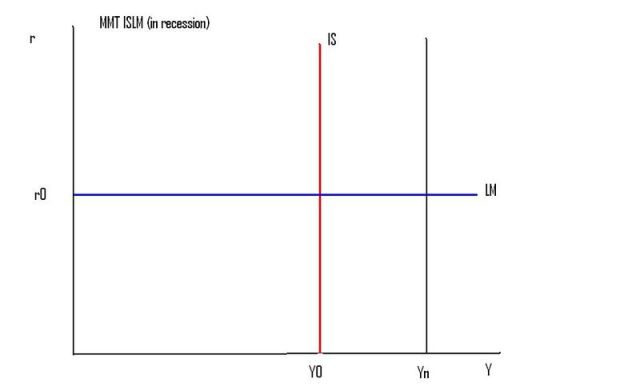 It's exactly the same as the New Keynesian version, except that the IS curve is vertical. The IS is assumed vertical because the rate of interest is assumed to have no effect on either desired savings or desired investment.
There is no natural rate of interest in the MMT version. It's undefined. If the IS curve lies either to the right or to the left of full-employment output, there exists no interest rate such that desired savings equals desired investment at full employment output. If, by sheer fluke (or by skillful fiscal policy) the IS curve is exactly at full employment, any rate of interest will make desired savings equal desired investment at full employment.
The MMT AD curve is vertical. A fall in the price level will not increase the real money supply and reduce the rate of interest (just like in the New Keynesian version, unless the central bank responds actively). But even if the rate of interest did fall, it would not increase output demanded. So, the AD curve is doubly vertical.
Monetary policy has no effect on AD. Fiscal policy can be used, and must be used, because this model, with its vertical AD curve, has no inherent tendency towards "full employment" output. The price level is indeterminate, unless active fiscal policy makes it determinate.
Since monetary policy has no role to play in determining AD, the central bank can set any interest rate it feels like setting. Indeed, it might as well set a nominal interest rate near zero, since this reduces the transactions costs of people converting between currency and bonds to try to avoid the opportunity costs of holding zero interest currency. (This is Milton Friedman's "Optimum Quantity of Money" argument in a new setting, except the central bank can set a 0% nominal rate even if positive inflation means that the real rate is negative).
The rate of interest plays no allocative role in savings and investment. It does not coordinate intertemporal consumption and production plans of households and firms. It merely re-distributes wealth between borrowers and lenders.
In a standard model, the government has a long run budget constraint. The present value of taxes must equal the present value of government spending (plus the existing national debt). The government can't borrow, and borrow to pay the interest, indefinitely, because the debt/GDP ratio would grow without limit. But this long run budget constraint only applies if the rate of interest on government bonds is above the long run growth rate of output. If the nominal/real rate of interest is less than the growth rate of nominal/real GDP, the government can run a stable Ponzi scheme. It can borrow, then borrow again to pay the interest, and the debt/GDP ratio will still fall over time, because the debt is growing at the rate of interest, which is lower than the growth rate of GDP.
If the central bank can set any interest rate it likes, it might as well set a rate of interest below the growth rate of GDP. So the government debt becomes a stable Ponzi scheme, and there is no long run government budget constraint in the normal sense. The only constraint on fiscal policy is that if the government runs too big a deficit and/or allows the debt to grow too large this would cause the IS to shift to the right of full employment output, and so causes accelerating inflation.
Actually, the ISLM framework is overkill in this context. The whole point of the ISLM framework was to reconcile two competing theories of the rate of interest: loanable funds ("the rate of interest adjusts to equalise desired savings and investment"); and liquidity preference ("the rate of interest adjusts to equalise the demand and supply of money"). IS shows the loanable funds answer, and LM shows the liquidity preference answer, and the ISLM model show that both answers depend on the level of income. So both are partly true. (Except in the long run where income is determined by full-employment, so only loanable funds determines the natural rate of interest). But if savings and investment are both perfectly interest-inelastic, we might as well revert to the simple Income-Expenditure Keynesian Cross model to show the underlying MMT macro model.
MMTers have a liquidity preference (LM) theory of the rate of interest, and a loanable funds (IS) theory of the level of income.


 Worthwhile Canadian Initiative
rsj
to suggest the market interest rates don’t determine investment is not the same as saying
investment decisions are made without a time discount of some sort
at least mobilizing in the back of a deciders head
the system can be both determined and its decision makers faced with radical uncertainty
if the agents have their causal reasoning behnd every choice the system is determined
if the deciders lack complete info about everyone elses actions till kingdom come
even secondary uncertainty over lays the primary natural uncertainty
oh it spirals off here
but simple mechanicals jazzed up with a silly randomizer
isn’t the only way
to get results that look like we see out there in the actual marketplaces of earth
nb
when uncertainty is as radical as it is when viewing the prospects for a new plant built here starting tomorrow
then to suggest a criterion for rational choice gets messy and problematical in the extreme
bware
the cone heads that suggest otherwise
are prolly performing a card trick on you
it delights me to see lerner tossed about here
might i urge his perspective
realytics
and why
because now we have the tools of a propr demiurg we can make happen ..more or less…what we want to make happen
its not realying on divine providence or best of all possible worlds spontaneous conjunctions
or the worship of jesus’s miracle of the markets
as described in the lost gospel of saint mammon
in the case of norte amigo lands
the state can make ull employment and stable development partners
without pretending there is a single all rational agency like an over soul behind the micro foundations
as lerner shows us
we need a thermostat to control total output motions
and a cap and trade system to control price level motions
and as to micro
all we need to be liberal legit
is a healthy skill at mechanism design
and hawk eyes looking for pareto improving moves
to guide us thru the stiglitz-ian millions upon millions of small inefficiencies failures incompletenesses
etc that post samuelson-arrow post modern micro theory reveals to us
—1970 -1990 —
hows that for give me a second
to me tell you my plan eh ??
recall the mothers of invention goof ranting :
” Do you think that I’m crazy?
Out of my mind?
Do you think that I creep in the night
And sleep in a phone booth?
Lemme take a minute &
tell you my plan
Lemme take a minute & tell who I am
If it doesn’t show,
Think you better know
I’m another person
“Let me put it another way. The orthodox New Keynesian view is that Y equilibrates S and I in the short run, given the r set by the Bank. But in the long run, when Y is set at “full employment” Y cannot adjust to equilibrate S and I, so the r set by the Bank must be adjusted to equilibrate S and I.”
So r follows rn.
But why is rn not a (partial) function of the path of r?
I.e. why does r not (partially) determine rn?
That would mean rn becomes obsolete as quickly as r (t) changes value to r (t+), and that r is always the dominant force.
“If MMTers did believe what my crude model says they believe, then the MMT policy prescriptions make sense. In that sense, my reverse engineering gets the right answers.”
You may be confusing sufficient for necessary and sufficient.
Nick,
Parenteau’s essay is about the MMT sector financial balances model – to which Krugman’s graph is equivalent (according to Parenteau).
Can you explain simply the connection/equivalence between the Keynesian cross and the MMT sector financial balances model?
Andy, You said;
“Isn’t the QTM itself an example (perhaps the clearest example) of a theory that fails via the Lucas Critique?”
You’re right. I had two other ideas in mind. The QTM can give you a ballpark estimate of the price level–it can explain why Japan’s price level is roughly 100 times higher than the US price level. (Nick says Keynesianism can’t do that–which I see as a huge flaw.) Second, quasi-monetarism (not the QTM) is the best way to model the monetary system. It has a nominal anchor.
Suppose the US adopts Japanese monetary policy. The QTM predicts the US price level will rise by several orders of magnitude. And the Keynesian theory predicts . . . I’m not quite sure what it predicts. What would happen to US interest rates right now if we adopted Japanese monetary policy? I have no idea.
Monetary policy has certain long run effects on nominal aggregates. The short run affect is largely determined by expectations of that long run effect. Thus the QTM explains the long run effect, and quasi-monetarism explains the short run effect.
Scotty seems never to consider the pricing system might determine the money supply in a discrretionary credit based market economy
The rough relationship is produced from the other direction
Output and prices induce the necessary money supply
Not that Beau summoner will respond to masked commenters of unknown pedigree
But Others might notice something to consider
Scotty seems to me mystified by the difference between a dollar based economy and a penny based economy
Summers famous catsup bottle economics
QTM was good enough for Hume so it’s good enough for ……..
I want to see a duel between new monetary theory and modern monetary theory
Mars versus Neptune
Hint
What happens when the size of the money stock is partly endogenous ?
Nr’s mistake
A post that didn’t resort to toy scenarios drew my interest
I promise if he sticks to bake scratchonomics
I’ll stay silent
I don’t claim to actually know the MMT literature, but I think I understand intuitively its critique of the stuff that’s taught in econ grad schools. And I would say that it is precisely the following assumption that is (one of) the problems that MMT seeks to address:
NR: luis: “thanks. this is what confuses me – the thing about how net financial assets are created/destroyed seems to me, when I translate it into terms I understand, as a perfectly unremarkable restatement of text book macro. But (some) MMTers portray it as an insight (we know how the monetary system really works!) so I must be missing something.”
Same here. Apples bought must equal apples sold. Financial assets bought must equal financial assets sold.
Because financial assets aren’t real goods, every financial asset identically also represents a liability. The issue is that some financial assets (bank deposits, money market funds, repos) are also money. And these forms of money are “backed” in the private sector by the countervailing liabilities (loans, commercial paper, etc.) that may or may not have a “true” value commensurate with the value on the banks’ books — or with the amount of money created in exchange for them.
Thus (i) the financial asset “identity” is dependent on the quality of banks’ loan origination procedures, and (ii) the money supply (and its stability) are also dependent on the quality of these procedures and the central bank does not control the money supply, so it’s not so clear what it is that an LM curve represents.
Paine, I think we can all agree that a monetary reform making pennies the medium of account will increase prices by precisely 100-fold (the ketchup example.) The implicit assumption is that all nominal contracts will be revised 100-fold. The more interesting question is what happens when the base increases 100-fold, but nominal debt contracts are not re-adjusted.
Nick,
I am not a card carrying MMTer but let me try my hand at explaining the bond versus cash issue.
1. Insofar as net financial wealth is concerned, bond and cash are similar and unique when compared with other financial assets. All other financial assets are directly or indirectly claims on other physical assets or cash flow from them. Government bonds and currency are not. As such. they are countercyclical–their value relative to other assets goes up during downturns and vice versa.
2. Under boom conditions, lots of financial assets behave as if they are money or close money substitutes, especially if they are short-duration and are nominally fixed claims. For example commercial paper. In downturns, they lose their “moneyness.” In booms you don’t need the government providing the net financial assets because the private sector is working overtime to produce net financial assets (as asset prices go up in relation to the credit that was created to finance and fuel them). However, this process is inherently destabilizing (Minsky).
3. During busts, only the government can provide net financial assets. Whether this comes in the form of bonds or money is distinctly secondary. Once the private sector demand for net financial assets if satified demand for goods and services will take care of itself.
4. Mainstream monetary policy is almost entirely focused on rearranging the composition of money+government bond held by the public. This makes sense in a gold standard world, where government government bonds are “inside” asset as well and gold (and money backed by it) is the only uncorrelated financial asset. So, an increase in the amount of gold (say a new find) would be expansionary. it has no relevance for the fiat world.
5. In the fiat world, although money is technically an “inside asset” in the sense that its value is ultimately underpinned by the society’s productive capacity and the government’s power to tax a significant portion of it, in practice it behaves like an outside asset. In places where this does not hold true–you have Zimbabwe (or name our country). And in the fiat world, government bonds are not really different from money.
6. The exchange property of money (vis-a-vis) bonds is vastly exaggerated. Insofar as pure exchange for mere economic activity (as opposed to financial market and credit activity) as long as you have some concept of money, a system of book-keeping and trade credit is generally sufficient.
7. To Scott Sumer: when money supply is endogenous, the idea that money stock determines the price level is meaningless. It is tautologically true (if you can define the correct money stock to use) but vacuous in terms of understanding the causal forces.
8. The IS curve cannot be seen in isolation of the LM curve–they are not independent. Common variables drive them. A rise in perception of uncertainty will drive demand for money from a portfolio allocation perspective and simultaneously drive down the demand for physical investment (IS).
9. It is not that interest rates have no influence. Rather the influence of interest rates is rather nonlinear, context-dependent, and generally quite uncertain. Other than housing, most investment is not sensitive to cost of capital, at least at the margin. Yes, financial asset prices are sensitive to interest rates but that relationship is obviously not invariant and quite volatile. Besides, if asset price appreciation is your objective why not use fiscal policy to increase net financial assets? At least that is more transparent and perhaps less plutocratic.
JKH: “Parenteau’s essay is about the MMT sector financial balances model – to which Krugman’s graph is equivalent (according to Parenteau).
Can you explain simply the connection/equivalence between the Keynesian cross and the MMT sector financial balances model?”
Let me try.
Let’s start with the Keynesian Cross model (closed economy version):
Desired Aggregate Expenditure (demand for output) is divided into 3 components: desired consumption, Investment, and Government expenditure:
AE=C+I+G
That’s just accounting. Now we add some behavioural assumptions:
C=a+b(Y-T)
where Y is income, T is taxes, so Y-T is disposable income. a is some positive number, and b (the marginal propensity to consume) is between 0 and 1. So the consumption function just says that consumption demand depends positively on disposable income.
Here’s a simple theory of taxes:
T=tY
(taxes are proportional to income).
Assume I and G are exogenous (fixed).
Substitue the behavioural functions into the accounting identity and you get:
AE=C+I+G=a+b(Y-T)+I+G=a+b(1-t)Y+I+G
That’s the AE curve. It has a positive intercept, and an upward slope of less than one. AE (demand for output) increases when income increases.
Now we add the equilibrium condition:
Y=AE
That’s the “45 degree line”. Income is determined by demand for output, and the two are equal in equilibrium.
Where the AE curve crosses the 45 degree line we get the equilibrium level of Y:
Y=a+b(1-t)Y+I+G
Solving we get the equilibrium for Y as:
Y=[a+I+G]/[1-b(1-t)]
OK. That’s the ECON101 macro model, for the last 50(?) years.
Now, let’s take the exact same equilibrium condition:
Y=C+I+G
and play with it. Subtract C from both sides:
Y-C=I+G
Subtract T from both sides:
Y-T-C=I+G-T
Define savings S as:
S=Y-T-C
So we get:
S=I+G-T
Rearrange, we get the MMT equilibrium condition:
S-I=G-T
Substituting in from the behavioural equations for consumption and taxes we can re-write this as:
-a+(1-b)(1-t)Y-I=G-tY [edited to fix stupid arithmetic mistake]
Which (IIRC) are the two curves of the Krugman diagram, with equilibrium Y determined as the intersection of those two curves.
[Funnily enough, back when I was an undergrad we used to use this as our equilibrium condition:
I+G=S+T
We called it the “Injections equals Withdrawals approach”. But we knew it was the exact same model as the Keynesian Cross, just a different way of looking at the same thing.]
Bottom line: what many people think of as the MMT model is mathematically identical to the model I have either taught or been taught for the last 40 years.
I have read Warren Mosler and Ralph Musgrave’s comments on Brad DeLong’s post on MMT.
http://delong.typepad.com/sdj/2011/04/is-modern-monetary-theory-modern-or-monetary-or-a-theory.html
OK guys, confess: who was the blogger that came up with the name “MMT”?
It was maybe a brilliant marketing ploy to attract non-economists. But it has caused no end of confusion for us economists. Especially for those of us who have actually read Keynes’ General Theory and Abba Lerner’s Functional Finance.
Forget wading through the thickets of words and accounting. This is what really matters: this is what I should really have written about:
“Under what conditions would Abba Lerner be right about the long run government budget constraint and Functional Finance?”
That would have been a useful post that could have moved things forward. Instead, I’m trying to hack my way through thickets.
thanks for that, Nick
especially since I just saw the DeLong post and your comment there
🙂
(My impression was Bill Mitchell started using “MMT”, but I guess that’s wrong)
JKH: Sorry :).
You had the guts to ask the question. There must be dozens of others who didn’t know the answer but lacked the guts to say so! So I don’t really begrudge answering it for you.
Keynes coined the term “modern money,” and Wray named his book after that. But we always have used the term neo-Chartalist to refer to ourselves in academic circles. Bill Mitchell started using “modern monetary theory” on his blog a few years ago, and it eventually stuck. I don’t know that the latter has actually been used by any of us to describe ourselves in an academic paper yet, though, and I don’t know if we will.
Regarding Lerner, FF, and the IGBC, they are perfectly consistent with each other if by FF one means a fiscal policy strategy that improves the primary budget balance as the economy nears full employment and continues to do so 1-for-1 with increases in private spending when the economy is at full employment.
Scott (Fullwiler) (2 Scotts commenting here):
Aha! So I will blame Bill! I admit it was a brilliant marketing ploy. But I still am slightly pissed at him for using it! “Functional Finance” is much more descriptively useful. “Chartalist” reminds me of Knapp’s State Theory of Money — one of the worst books I have ever (tried to) read. Abba Lerner is streaks ahead of Knapp. Because you can understand what Lerner is saying, and if he’s right he’s saying something important and substantive.
“Regarding Lerner, FF, and the IGBC, they are perfectly consistent with each other if by FF one means a fiscal policy strategy that improves the primary budget balance as the economy nears full employment and continues to do so 1-for-1 with increases in private spending when the economy is at full employment.”
That would require a very large fiscal multiplier, wouldn’t it? That would make the standard Keynesian Cross equilibrium unstable? MPC greater than one? Or, instead, some sort of “pump priming”/”Kick starting” multiplier where a temporary increase in G gets the ball rolling and causes a permanent (or at least long-lived) increase in Y?
My mind was going in a different direction. It all depends on whether r can be kept below g, for the stable-Ponzi regime to hold. And that depends on the shape of the IS curve and the mix of money vs bond financing (not very MMT). Loose money and tight fiscal (relatively speaking) would do it. My vertical IS assumption would be sufficient but not necessary.
But I haven’t worked it out. Just came up with the idea a couple of hours back.
Nick,
As you’re familiar with Lerner, how would you interpret the meaning of “functional” as in “functional finance”?
(I’m not so familiar)
Nick,
I would go this way:
Start with these from your discussion:
-a+(1-b)(1-t)Y=G-tY
Y-T-C=I+G-T
End here for sector balances with “behavior”:
Y(1-b)(1-t)-a-I = G-tY
The left hand side is desired net saving given Y as defined by MMT’ers. The right-hand side is the govt’s budget stance, again, given Y.
To your point about accounting vs. economics . . .
First, one needs economics to create behavioral relationships, as you did, and would need the latter to solve for Y and get actual net private saving and the govt’s balance.
Second, one needs accounting to ensure stock-flow consistency in building the model (though this model has only flows) consistent with how “score” is kept in the real world. It also aids in interpreting the results–as when one solves for Y with one of your very early equations (the basic multiplier equation from Econ101). With the sector balances equation, we understand that (1) any fiscal policy action “works” by adjusting private incomes via government spending or taxation (raising G or lowering T lowers Y), that is, govt deficits raise net private saving; (2) any monetary policy action “works” by adjusting desired spending given Y (changing I or a), that is, monetary policy is stimulative when it induces the pvt sector to reduce its net private saving. These insights are generally absent from the traditional interpretation of these models, as the effects of stimulate policy are seen as equivalent (in as much as they are seen to actually “work,” which is a separate matter altogether).
Blending the economics with the accounting, MMT’ers along with folks like Richard Koo understand that the non-govt sector isn’t likely to re-leverage on the scale necessary to return to full employment anytime soon. It also makes clear that austerity policies can only avoid worsening the recession if the non-govt sector is ready to releverage, and that if the non-govt sector instead tries to continue deleveraging in the face of austerity policies both the economy and the deficits will worsen. One could get some of the latter these points from a typical IS-LM if one wanted to actually do the math, but it’s rare that someone specifies the balance sheet positions required for either outcome to be true using only IS-LM.
I’ll stop there as I’m being summoned by my better half. Hope that helps out a bit.
“The more interesting question is what happens when the base increases 100-fold, but nominal debt contracts are not re-adjusted.”
But the CB cannot increase the base by 100 times because it doesn’t have that many government bonds to purchase. There must be deficit spending first, and only then the CB can increase the base by purchasing some of those bonds.
I think you are envisioning the CB conducting fiscal policy. I also like to conceptually view monetary policy as something that is expenditure/revenue-neutral for the government, whereas fiscal policy is an adjustment in expenditures and revenues (apart from interest rate effects).
But this ceiling on monetary policy has an interesting side effect (to me). Namely, because the total stock of money — MZM — held by the public is roughly equal to the federal debt held by the public, when the CB purchases a bond for a deposit, then on the margin, the household can sell the deposit back to the banking system in exchange for another bond (or paper, etc.)
Households do not need to spend unwanted deposits by purchasing goods. They can spend unwanted deposits by purchasing financial sector debt, and this pushes the excess base back onto the banks, where it sits as reserves, even as household deposit levels are unchanged. The only thing that changes is the relative price of bonds and deposits. So if the “money” in the money demand function, is deposits and not the base, then the CB has not succeeded in increasing household money holdings.
This would a “monetary pessimism” scenario, in which velocity changes negate the effects of an increase in the base. It’s a lower bound on the effectiveness of monetary policy on the price level, and this is a function of the size of MZM.
An increase in the base does not force MZM — “money” — to increase as long as the size of the base is less than the size of MZM. And historically the growth of MZM has not tracked growth of the base, but has tracked the size of federal debt — MZM moves with fiscal policy, not monetary policy.
But as the CB keeps buying bonds then under our pessimism scenario, once MZM = Base, then an additional increase in the Base must lead to an increase in MZM. At that point, households will have no option but to purchase goods if they want to reduce their deposit holdings. The question is, why would they? As their net-worth has not improved, why would they increase spending? But assume that they do. Then there would be a price effect. But unfortunately, the price effect kicks in only after the critical value, and the critical value is the ceiling on how much the CB can expand the base. Therefore under this pessimism scenario, the CB cannot force prices to rise by increasing the base. Rather, it must accommodate rising prices by expanding the base.
Paine,
I don’t understand what you are trying to say. I don’t think time discounts are particularly important at the macro level. And let’s abstract away from risk, if you like. Still, firms know their cost of capital. They are acutely aware of how many dividends they need to pay, and the rate of increase of those dividends. It has little to do with psychology.
Similarly, shareholders are not going to price the firms based on psychology, but based on arbitrage. They can purchase land, they can purchase bonds, or they can purchase equities, or even foreign bonds or equities.
Psychology is relevant in assigning a weight to risk and trying to determine which asset will outperform the other, but over the long run it is nominal arbitrage and not psychology that rules the roost.
If you pin down bonds to have a very low rate of interest, then you are going to pin down the other assets to have a low rate of interest, too. And then firms will know that their cost of capital has been lowered. They will increase investment and their profitability will (eventually) decline to equal their lower cost of capital.
The whole point is to try to increase investment by lowering the rate. At least over the long run, I don’t see how you can argue that investment will not increase as a result of an decline in the short rate. There are many, many examples of over investment and declining productivity as a result of governments setting rates too low. Low borrowing rates are basically a tax on consumption and a subsidy to investment.
This is the preferred development model, after all, so we can take a look and see what the effects of this model are. You have China and Japan as the shining examples, but also the Latin American nations in the 60s, etc.
The effects are a big expansionary boom followed by a financial crisis and lost decade, and it is hard to then raise borrowing rates as it leads to large liquidation of investments that are only profitable at the low rates, but not the higher rates. Lowering a firm’s cost of capital, encouraging more fixed investment, is asymmetric to raising the cost of capital, requiring liquidation of the fixed investment. An economy can easily increase leverage, but it cannot easily de-lever. You end up stuck in a bad equilibrium.
JKH: “Nick, As you’re familiar with Lerner, how would you interpret the meaning of “functional” as in “functional finance”? (I’m not so familiar)”
I read it 25+ years ago, when trying to get my head around Barro on Ricardian Equivalence vs Buchanan of the future burden of the debt. It was an interesting 3-way fight. Lerner wanted to have it both ways. Unlike Barro, and like Buchanan, Lerner said that bonds are net wealth, and so a helicopter drop of bonds increased demand. Like Barro, and unlike Buchanan, Lerner said there was no future burden. Barro is internally consistent. Buchanana is internally consistent. The only way I can think to make Lerner internally consistent is to assume a world in which a stable Ponzi scheme is possible.
What does “functional” mean (when Lerner says it)?
As best I can remember, it carries two meanings at the same time:
1. Choose whatever level of government borrowing has the best consequences; don’t get hung up on rules of what is legitimate. Like a consequentialist system of ethics, rather than one based on moral duties. “Do what works”. “I don’t care what colour the cat is, as long as it catches mice”.
2. Forget the long-run government budget constraint. Households have one; governments don’t. The only limit on deficit spending is when Aggregate Demand gets too big and you cause inflation.
The second is problematic. Sure, governments can print money and households can’t. But why, precisely, does that matter? (And, actually, MMTers need to better distinguish money from bonds if they want to answer that question properly; and saying that governments have taxing power doesn’t answer that question, because the standard long run government budget constraint already incorporates taxes.)
Edit: I can answer it, BTW. It’s because money, as medium of exchange, is held despite paying a rate of interest below the growth rate. So money is always a stable Ponzi (till we hit Zimbabwe or the ZLB). But bonds may not be a stable Ponzi.
Scott (Fullwiler): Oops! I just noticed my stupid arithmetic mistake (now edited and fixed).
Here is my take on what you said:
1. It is always good to look at the same model from as many different perspectives as possible. Flows of goods, flows of money, and flows of financial assets. We understand it better, We can spot our hidden assumptions better. We can see whether our behavioural assumptions really make sense from all sides, or whether they have some hidden implications we would not agree to if we saw them. OK.
[Quasi-monetarist rant warning: and one of the things that pisses me off about keynesians in general is how so few of them understand that their models only make sense in a monetary exchange economy. Because they have never asked what would happen if goods could exchange directly for goods, labour, and bonds, without needing money.]
2. If there were only one financial asset though, and if it weren’t the medium of exchange, how interesting would this be? If people are net buyers of goods they are net sellers of bonds. Big deal. One is just the negative of the other. With two financial assets it gets interesting. Because the mix of assets may matter.
{Quasi-monetarist warning again: and if one of those assets is the medium of exchange, that means the whole structure of markets is different, because anyone using monetary exchange is both a buyer and a seller of money, so you can’t just look at the net flow of money, even at an individual level.)
srini: thanks for your comment. Each of your 9 points would take me a full blog post to fully respond to. Which I’m not up to doing. But i did read it.
Paine: I do read your comments. They aren’t easy to read, or respond to.
(Many people, like I used to, think you are being deliberately difficult in writing like that. Now, on reflection, I am not so sure. But it’s still difficult.)
“and so a helicopter drop of bonds increased demand”
Well, doesn’t an increase in wealth increase demand? If all of a sudden I went from my current level of wealth to my current level of wealth plus $X in Treasuries, I would spend more.
Scott: In Barro’s world, bonds are not net wealth (in aggregate). You would be richer if the helicopter drops bonds on you alone. But if the helicopter drops bonds on everyone, the present value of future tax liabilities cancels the increased wealth.
Buchanan says you are wealthier, and increase demand, because its the next generation that pays the taxes. So bonds are net wealth for the current generation, but a burden on the future.
Lerner wants to have it both ways. The current generation is wealthier, but there’s no future burden.
The orthodox position (at least among those who have thought it through like Buiter) is that money is net wealth but bonds aren’t.
Or rather: the orthodox position is that money is net wealth and no burden on future generations, but bonds are halfway between Barro and Buchanan. Half net wealth; half a burden on the future.
BArro’s internally consistent only if you assume monetary operations are different from how they really work. That’s the problem with Ricardian Equivalence. Bill Mitchell destroyed it in a blog a few weeks ago.
“The orthodox position (at least among those who have thought it through like Buiter) is that money is net wealth but bonds aren’t.”
I don’t think the argument is about whether something is net wealth or not, but whether deficit spending (i.e. the flow) can prevent a reduction in real wealth that would have otherwise occurred if there was no deficit spending.
I.e. assume that there is a demand for a flow of money, say due to a obligations to meet dividend or bond payments.
You can say that if a single firm can’t meet this demand, then it should be liquidated because it is not earning the real return demanded. However, if all firms can’t meet this demand, then you have a purely nominal income problem.
Now if the government were to just supply all firms with income — then it can give money to the firms, which is passed onto households and then simultaneously sell bonds to households.
It is flushing a clogged pipe.
But this flushing will allow firms to meet their obligations and avoid liquidation, which would be a reduction in real wealth. Then the households can put the bonds into the safe, in expectation of the future tax obligation, while still maintaining their current level of real wealth.
The growth rate of the stock of debt triggers nominal income flows, and if these income flows can prevent liquidation of real assets, then they can prevent a decrease in real wealth even if the level of government debt is not itself net wealth.
But if the level of the stock of debt is irrelevant as the tax liability cancels the bonds, then you don’t care about the level of debt — you might as well pick the right growth rate of the debt level to generate the right nominal income flows. This is how I think of functional finance. It’s hydraulic Keynesianism that has nothing to do with Ricardian Equivalence.
And the risk that I glossed over is that if all firms can’t meet their obligations, then you may not just have a nominal income problem, but an excessively high return-demand problem, in which case Keynesian demand management can then sustain these excessively high profit rates. So there are real risks to these policies that would call for, in the long run, maintaining a stable debt to output ratio. But that is a whole separate issue from the short run issue, and the desire to maintain stable ratios is not due to solvency constraints per se, but again due to a desire to effectively manage the real economy.
Scott: “BArro’s internally consistent only if you assume monetary operations are different from how they really work. That’s the problem with Ricardian Equivalence. Bill Mitchell destroyed it in a blog a few weeks ago.”
Let me explain how I react to a comment like that.
I read the “..how they really work.” and I think: “Oh dear. Do I have to go over to Bill’s blog and wade through thickets of mind-numbing institutional detail to try to figure out what he’s really saying, then find a way to explain simply whether he’s right or wrong?”
And, in economics, nobody really ever “destroys” anyone else’s theory.
And, with no disrespect for Bill, the argument from his authority doesn’t really cut it.
I have read Barro. I understand Barro. I have made up my own views on the extent to which he is right or wrong. Hunderds of other really good economists have done so too, and I have the benefit of their views.
All I hear is that repeated MMT refrain: “really is, is, is, is!” “to the penny!” “destroyed!”, and my mind sinks.
Yeah, meant to retract that. Got pissed off while finishing taxes at the last minute (at the taxes, not you). Should have known better. Back later.
OK, I’m back.
The confusing part for me is the use of the word “wealth” or “net wealth.” Those are accounting terms, and dropping bonds absolutely adds to net wealth in the aggregate, ceteris paribus, by accounting definition. The non-govt sector now owns liabilities of the govt that earn interest.
Barro, though, says that at the same time the PV of all future liabilities has increased by the same amount, so no net wealth.
Both are correct according to their own respective logical constructs.
And with a “money” drop, in accounting terms, net wealth hasn’t changed by any more than with the bond drop, but from Barro’s perspective (and Buiter’s), the “money” drop does not create future liabilities for the non-govt sector and so is net wealth.
Again, both are correct according to their own frameworks.
More later in terms of reconciliation, but have to go to bed now. Thanks for patience and for not ripping me (too much of) a new one above (at least no more than I deserved).
Nick,
“With two financial assets it gets interesting. Because the mix of assets may matter.”
You are still misrepresenting the MMT position here. The argument is NOT that the mix doesn’t matter. The argument is that whether or not the govt sells bonds, this doesn’t stop the non-govt sector from adjusting the mix.
If the CB sets the target rate above the rate paid on reserve balances, then either the CB or the Tsy must offer a interest-bearing liability (that in either case is ultimately the Tsy’s liability) to keep the target rate set. But, if the non-govt sector prefers a different mix, it can demand more base and the mix of Tsy’s to reserve balances will be altered. And if we consider, as just one example, that the non-govt sector can leverage Tsy’s with deposits, there’s all sorts of other mixes it can create beyond just base vs. Tsy’s.
If the CB instead sets the overnight rate equal to IOR, it can select the mix on its own between reserve balances and Tsy’s. But in that case, from the perspective of banks, reserve balances and bills are perfect substitutes, and so they are indifferent to the CB’s chosen mix at least between those two. And, as above, outside of those two assets, all sorts of other mixes can be created. There’s never any operational limit to how many deposits can be created, for example, and so the qty of deposits that can set the mix with reserve balances/Tsy’s (substitutes in this case) is again up to the non-govt sector.
OK, so I didn’t go to bed yet, but going now and will get to Lerner/Barro, etc. tomorrow hopefully.
“Modern Monetary Theory” is certainly a lark, since it’s not modern, they don’t believe in money and claim it’s not a theory!
“And with a “money” drop, in accounting terms, net wealth hasn’t changed by any more than with the bond drop, but from Barro’s perspective (and Buiter’s), the “money” drop does not create future liabilities for the non-govt sector and so is net wealth.”
Govt bonds aren’t net wealth, so a money drop can’t be net wealth either–unless the PV of income increases, i.e. the bonds or money drop are productive.
It makes no sense to imagine, as a general principle, the household sector making itself wealthier by lending itself money, whether through the veil of firms or through the veil of government.
“t makes no sense to imagine, as a general principle, the household sector making itself wealthier by lending itself money, whether through the veil of firms or through the veil of government.”
Except that, in an industrial economy, that is how wealth is created.
I once worked for a firm that had a lead time of 3 years. 3 years of product development and testing before the product shipped and could be sold. They were paying an engineering team that had salaries of about 500 million per year, so 1.3 Billion of wages spent before a dollar was earned in revenues.
The private sector always makes itself more productive by lending itself money, and this is the only way that the private sector can make itself wealthier and more productive.
Unfortunately, sometimes the private sector does not make itself wealthier by lending itself money. Nevertheless, lending money is the only way to gain real wealth, and a reduction in lending always results in a reduction of real wealth.
Nick,
I think the point about ISLM from an MMT perspective is that it’s not a dynamic stock-flow consistent model. You can of course jack-boot the MMT model from a policy perspective into ISLM. And why not? It’s just a model.
But it might help to think about how an SFC model differs from ISLM. It’s a pity that you can’t use subscripts in the comments boxes, or I’d give the whole model (it’s only 11 equations long—I’m looking at the “SIM” model from Godley & Lavoie, 2007).
Consider first the standard Keynesian multiplier analysis. An increase in G does not simply cause a 1-to-1 increase in Y. The equilibrium increase is given by ∆Y = ∆G / (1 – MPC), because the increase in G increases Y, which increases C, which increases Y again.
In Godley and Lavoie’s model, flows add to stocks, and stocks affect flows. A constant increase in G, for example, funded by deficit spending, for a constant increase in Y, implies a national debt going to infinity in the limit, which is impossible. Instead they model the long-run equilibrium of the economy as a stationary steady state in which the levels of all the variables (stocks and flows) are constant. (In a model with growth, the ratios of the variables are constant). In the steady state, the private sector cannot be accumulating public debt, and govt expenditure must equal taxes (and the propensity to consume equal to unity). Therefore, a permanent increase in G continues to act through the model raising Y until it reaches the steady state where there is no change in the stock of financial assets and Y settles on its new long run equilibrium value, equal to the ratio of government expenditure to the tax rate (what Godley and Lavoie call the “fiscal stance”).
“Except that, in an industrial economy, that is how wealth is created.”
I’m talking about sector financial balances. A naive SFB approach goes like this: if the govt runs a surplus, the private sector is running a deficit (assuming a closed economy), and therefore the private sector is somehow “worse off”, because its income is lower or it is dissaving or whatever. And by extension, obviously, vice versa. But households don’t become wealthier when another sector lends them money (and they don’t become poorer when the reverse is true) because they already own all wealth. They lending to and borrowing from themselves.
vimothy, you are merging nominal and real here. The distinction lies in whether bonds are perceived as an addition to one’s financial wealth or, as in the Ricardian story, they are perceived solely as future tax liabilities. The multiplier effect that transforms financial into real wealth is a separate issue. In that sense, deficit spending is at first just that – the household sector lending itself money to make itself feel more wealthy although it has no real wealth to back that feeling – yet. It is in a further step that this perception of wealth is then believed to induce consumption followed by investment, but they are separable and also very much dependent on the distribution of said wealth.
Since private credit is demand led, the same can not be said for bank lending, at least during recessions. During booms, demand for credit boosts investment and asset prices, which leads to the perception of rising wealth, which in turn increases demand for loans etc. But this is pro-cyclical and thus not stable. And, during recessions, this mechanism does not work at all. There is no (or never enough, let alone quick enough) bootstrapping with demand led monetary aggregates according to MMT.
Of course you are right that it makes no sense to imagine both effects as functionally separable. One must follow the other! In fact, such separability would render MMT and all of Keynesianism with it, null and void instantly. But it does make sense to think them through separately.
Oliver
Nick,
Thanks again. That Barro, Buchanan, Lerner dissection is quite interesting.
Just to observe – those alternatives all become accounting permutations at the end of the day.
Scott is right – net wealth is an accounting measure.
Similarly, whether or not there is a “future burden” and whether to give that concept representational substance becomes an accounting system choice.
Exit Nick stage left, screaming?
But before that exit, I’d just say we need a happier marriage between economics and accounting. As I said once before, accounting is not the enemy.
Interesting to me that the CFA program (Chartered Financial Analyst) has a modular structure (or at least it did when I took it) that includes such sections as economics, accounting, equity analysis, debt analysis, quantitative analysis, and ethics. The point being that it is a course of study in which economics and accounting are aligned in parallel to achieve some analytical goal. They are considered distinct but complementary, each essential to the goal. I was quite interested to discover that Steve Waldman is a CFA. It shows a bit in his writing about economics.
MMT comes at economics through monetary operations and accounting. It’s a gateway.
My impression is that you come at accounting with a view that economics supersedes accounting. Perhaps I’ve got that wrong.
But economics is inextricably tied to logical accounting representation of some sort.
Accounting, while not sufficient, is necessary.
Although I don’t think “to the penny” is a particularly good mantra in most cases – accounting systems are also choices, and the most important aspect is consistency, whatever the choice.
In all seriousness, the economics profession has been in a state of intensive self-reflection in connection with its overall role pertaining to the financial crisis. I think the point on the relationship between economics and accounting, and between economics and monetary operations should be part of that reflection. These are more pointed versions of what has been recognized more broadly as shortcomings in dealing with the nature of financial system risk as part of economics.
It is ironic to me that the economics profession has been as public as it has been in its self-flagellation, because some perceive its problem to be one of excessive self-reference in its intellectual framework.
Have you blogged on the “profession crisis” issue yet? I know you’ve fired off a few cannons on some specific issues such as accounting and MMT, but I don’t recall regarding the broader topic.
These observations are not intended to upset you or dismiss what you contribute, particularly through your blog, in such a public way. They are just observations about economics as a not yet perfected system of thought.
Scott: no worries. Paying taxes is one thing. But filling out the damned forms is cruel and unusual punishment. I was once filling out both Federal and Quebec tax returns at midnight, using my daughter’s Mickey Mouse calculator. (Every time I made a mistake, and pressed C, it would play the MM theme tune.) Accountants are well worth the money. Not so much for the taxes they might save you, but because they are cheaper than shrinks.
vimothy: I have some familiarity with the basic idea behind the Godley/Lavoie approach. I see it as an extension of the approach pioneered by Christ and Blinder/Solow and Tobin/Buiter (IIRC) back in the early 1970’s. (Arch-monetarist David Laidler taught it us in MA macro in 77). If the government runs a deficit, the stocks of money and/or bonds are changing over time. And what happens over time (and whether a steady state exists) depends on different people’s marginal propensities to consume out of income and wealth, plus other stuff. Mark is also a semi-colleague (Carleton has a joint PhD with U of Ottawa) so Mark calls me in to act as internal/external supervisor/examiner for his students, most of whom are working on SFC models.
Here are my problems with it:
1. These are very long run models, and yet there’s generally not much at all in the way of a supply-side. Holding P and/or W fixed in that very long run is problematic.
2. The models have a well-defined time-path for future income, and yet this does not seem to affect people’s expectations and current behaviour. Current consumption and investment should depend on expectations of future income and other things.
3. (Something I haven’t yet thought through, but am uneasy about.) There’s something problematic about having two independent parameters: an MPC out of income; and an MPC out of wealth. A bond is just a flow of income (coupon payments) represented by a bit of paper. Why should the fact that a flow of income is represented by a bit of paper (securitised) make any difference to how much a person consumes? That’s not a rhetorical question, because I recognise that the bit of paper means that the flow of income can be sold to another agent, and that option value of a securitised flow of income may matter in some contexts, like when there’s uncertainty. But that is not modelled in any SFC models I have seen. Milton Friedman’s Permanent Income Hypothesis reconciled the MPC out of income and the MPC out of wealth in a consistent way. Agree or disagree with the PIH, but Friedman tackled that question. SFC models (AFAIK) do not. And if they did try to tackle it, it opens up a whole can of worms, like future tax liabilities as unsecuritised negative wealth.
Scott: Yep. If money pays interest, equal to the bond rate, then money and bonds are equivalent in terms of net wealth, as far as I can see. Currency is net wealth, by that way of thinking. Essentially, the net wealth is the capitalised value of the government’s rents (seigniorage) from its monopoly on note-issue.
[Quasi-monetarist mode on: but this whole analysis misses the medium of exchange property of money. And because money is a medium of exchange, people will accept money in exchange for goods even when they do not wish to hold extra money. There is never an unwillingness to accept the hot potato of money, only a willingness to pass it one if there’s an excess supply of money (provided each believes he can pass it on). This means that you can create an excess supply of the medium of exchange in a way you can’t create an excess supply of bonds. The stock of money can never be simply demand-determined in the same way that other assets can be demand determined. Q=min{Qd,Qs} does not work for money in the same way it works for other goods. It is always, in some sense, as if new money is helicoptered into existence. That is not true with bonds. And my argument here is not just with MMT but with the whole “under current monetary policy, the stock of money is demand-determined” Neo-Wicksellian/New Keynesian orthodoxy. If you were preaching this part of MMT to almost anyone else, you would be preaching to the choir.]
JKH: Thanks. A couple of thoughts:
At one level, Barro’s Ricardian Equivalence proposition is pure accounting. And it was an eye-opener for many of us who hadn’t thought through that accounting.
But at another level it isn’t. Behavioural implications of bond-financed tax cuts depend on: whether real people understand that accounting; who gets the assets and who gets the liabilities; distorting effects of non-lump-sum taxes (actions to try to avoid those liabilities by individuals); borrowing constraints; whether the accounts add up in a Ponzi world, etc.).
“Have you blogged on the “profession crisis” issue yet? I know you’ve fired off a few cannons on some specific issues such as accounting and MMT, but I don’t recall regarding the broader topic.”
I haven’t. Can’t really think of anything very exciting or insightful to say on the subject. I could just repeat the usual stuff: the need to integrate finance into macro better; need to think outside the currently-fashionable boxes more; less technique more thinking. We just need to keep plugging away as best we can. Economics is hard. And we need thousands of eyes to keep an eye on everything that might blow up. If there were a magic key to open the door of all understanding, we would probably have found it by now.
And much of the “self-flagellation” isn’t really. It’s some economists flagellating other economists. Which they have always done (at least in macro). This is nothing on the old Keynesian/Monetarist rows.
Oliver,
“vimothy, you are merging nominal and real here”
That’s ironic because I’m trying to be careful to distinguish between the two. I was responding to Scott and Nick’s discussion. Although govt bonds may add to “net wealth” by “accounting definition”, in a non-tautological sense, govt bonds are not wealth, because for a given path of G, Y1 + Y2/(1+r) is unchanged. We know what the optimal solution for the private sector here is; whether it acts like this in practice is, as you suggest, another matter.
What’s more, I don’t believe that rising nominal income is the be all and end all of macro and I don’t believe that guaranteeing a constant rise in nominal income is the same as guaranteeing a constant rise in real GDP. If the demand for money or safe assets rises in a recession then the govt should satisfy this demand to avoid a further painful contraction. But I don’t think this should be mistaken for growth policy, and the initial liquidation and reallocation of “malinvestments” should still be allowed to take place.
Macro aside, there is still a massive gulf between economists and accountants. I can explain in 10 minutes to any bright first year student why assets and liabilities need to be adjusted for inflation to get a true picture of wealth. But when I try to argue this with accountants, for e.g. the University balance sheet, I get precisely nowhere. If I didn’t know they were really bright people, I would think they were thickies. They must have their reasons, and sometimes I vaguely glimpse some sort of rationale for what they must see as protecting the integrity of accounts from scam-artists like me. But I don’t really understand it.
“I don’t believe that guaranteeing a constant rise in nominal income is the same as guaranteeing a constant rise in real GDP. ”
Sure, but writing down f(K,L) does not mean you are saying anything “real”, either. At least for rising nominal income, we have some accounting data. We don’t have any data to believe that anything like f(K,L) is relevant for macro at all.