I'm trying to keep this as simple as possible, so it's accessible to second-year economics undergraduates.
Many theoretical papers I read are full of impenetrable (to me) thickets of math. So I reverse-engineer the model. I try to figure out what the underlying model must be in order for the paper's conclusions to make sense.
Many Modern Monetary Theory posts I read are full of impenetrable (to me) thickets of words. So I have reverse-engineered the model (with the help of Steve Randy Waldman's blog post and Scott Fullwiler in comments on that post). I think I have figured out what the underlying model must be in order for MMT's conclusions to make sense.
I don't think my model is a straw man. It is a stick-figure. A very simple caricature that shows only the bare bones, but is still recognisable.
Start with the standard textbook ISLM model:
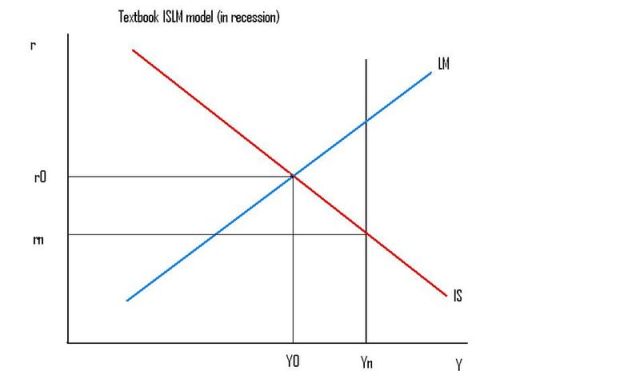 In the background, off-camera, is a Phillips Curve. The Long Run Phillips Curve is vertical, at the natural rate of unemployment. Yn represents the natural rate of output associated with the natural rate of unemployment. It is sometimes (misleadingly) called "full-employment output".
Where the IS curve crosses the vertical "full-employment" line determines the natural rate of interest rn. That's the (real) rate of interest at which desired savings equals desired investment at "full employment output".
I have assumed for simplicity that expected inflation is zero, so I don't need to insert a vertical "expected inflation" wedge between the IS and LM curves. Nominal and real interest rates are equal, and the equilibrium {r0,Y0}is where IS and LM intersect.
I have drawn this equilibrium where Y<Yn and r>rn. The economy is in recession. The central bank should increase the money supply to shift the LM curve right, lowering r to rn, and get the economy back to full employment. Or, the government should use fiscal policy to shift the IS curve right, raising both r and rn, and making them equal at full employment.
Also off-camera is an AD curve. The AD curve slopes down, because a fall in the price level increases the real money supply and shifts the LM right.
Now look at the New Keynesian (or Neo-Wicksellian) version:
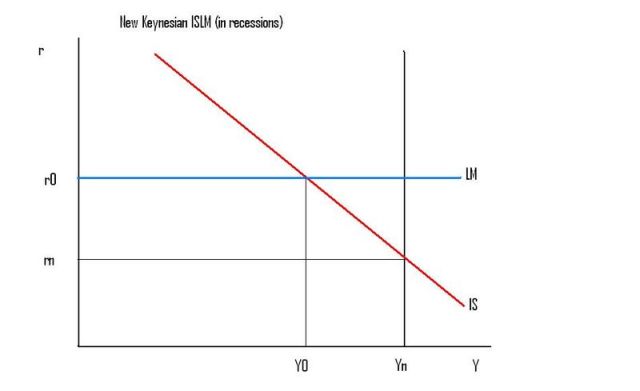 The only difference is that the central bank is now thought of as choosing the rate of interest, rather than the money supply, so the LM curve is horizontal. The supply of money is perfectly interest-elastic at the rate of interest chosen by the central bank.
I have drawn this equilibrium where the central bank has set the rate of interest above the natural rate, so the economy is in recession. The central bank should shift the LM curve down and reduce the rate of interest to equal the natural rate. Or fiscal policy should be used to shift the IS curve right to raise the natural rate of interest to equal the rate set by the central bank.
Off-camera, the AD curve is vertical. A fall in the price level will reduce the demand for money, but the central bank will accommodate by allowing the stock of money to fall proportionately, to keep the rate of interest constant.
This vertical AD curve means that the central bank must actively adjust the interest rate to keep the price level determinate. If it keeps the interest rate permanently above the natural rate, output demanded will be less than full employment, and the result will be accelerating deflation. If it keeps the interest rate permanently below the natural rate, output demanded will be above full employment, and the result will be accelerating inflation. On average, the central bank must set an interest rate equal to the natural rate (plus target inflation, to allow for the difference between real and nominal rates of interest).
Finally, look at the MMT version:
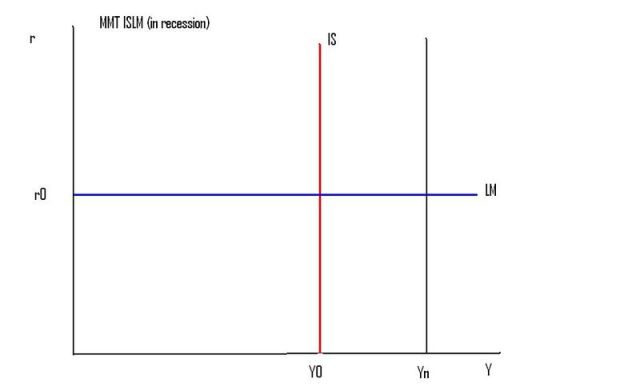 It's exactly the same as the New Keynesian version, except that the IS curve is vertical. The IS is assumed vertical because the rate of interest is assumed to have no effect on either desired savings or desired investment.
There is no natural rate of interest in the MMT version. It's undefined. If the IS curve lies either to the right or to the left of full-employment output, there exists no interest rate such that desired savings equals desired investment at full employment output. If, by sheer fluke (or by skillful fiscal policy) the IS curve is exactly at full employment, any rate of interest will make desired savings equal desired investment at full employment.
The MMT AD curve is vertical. A fall in the price level will not increase the real money supply and reduce the rate of interest (just like in the New Keynesian version, unless the central bank responds actively). But even if the rate of interest did fall, it would not increase output demanded. So, the AD curve is doubly vertical.
Monetary policy has no effect on AD. Fiscal policy can be used, and must be used, because this model, with its vertical AD curve, has no inherent tendency towards "full employment" output. The price level is indeterminate, unless active fiscal policy makes it determinate.
Since monetary policy has no role to play in determining AD, the central bank can set any interest rate it feels like setting. Indeed, it might as well set a nominal interest rate near zero, since this reduces the transactions costs of people converting between currency and bonds to try to avoid the opportunity costs of holding zero interest currency. (This is Milton Friedman's "Optimum Quantity of Money" argument in a new setting, except the central bank can set a 0% nominal rate even if positive inflation means that the real rate is negative).
The rate of interest plays no allocative role in savings and investment. It does not coordinate intertemporal consumption and production plans of households and firms. It merely re-distributes wealth between borrowers and lenders.
In a standard model, the government has a long run budget constraint. The present value of taxes must equal the present value of government spending (plus the existing national debt). The government can't borrow, and borrow to pay the interest, indefinitely, because the debt/GDP ratio would grow without limit. But this long run budget constraint only applies if the rate of interest on government bonds is above the long run growth rate of output. If the nominal/real rate of interest is less than the growth rate of nominal/real GDP, the government can run a stable Ponzi scheme. It can borrow, then borrow again to pay the interest, and the debt/GDP ratio will still fall over time, because the debt is growing at the rate of interest, which is lower than the growth rate of GDP.
If the central bank can set any interest rate it likes, it might as well set a rate of interest below the growth rate of GDP. So the government debt becomes a stable Ponzi scheme, and there is no long run government budget constraint in the normal sense. The only constraint on fiscal policy is that if the government runs too big a deficit and/or allows the debt to grow too large this would cause the IS to shift to the right of full employment output, and so causes accelerating inflation.
Actually, the ISLM framework is overkill in this context. The whole point of the ISLM framework was to reconcile two competing theories of the rate of interest: loanable funds ("the rate of interest adjusts to equalise desired savings and investment"); and liquidity preference ("the rate of interest adjusts to equalise the demand and supply of money"). IS shows the loanable funds answer, and LM shows the liquidity preference answer, and the ISLM model show that both answers depend on the level of income. So both are partly true. (Except in the long run where income is determined by full-employment, so only loanable funds determines the natural rate of interest). But if savings and investment are both perfectly interest-inelastic, we might as well revert to the simple Income-Expenditure Keynesian Cross model to show the underlying MMT macro model.
MMTers have a liquidity preference (LM) theory of the rate of interest, and a loanable funds (IS) theory of the level of income.


 Worthwhile Canadian Initiative
It’s relevant to our living standards so it must be relevant for macroeconomics.
RSJ: ?!!
No accounting data can explain why nominal income rises. It can only tell us that it has risen.
We do have data that countries with bigger K and L have bigger Y. (And yes, that same data also show there must be more to explaining Y than just K and L.)
Nick,
I think there are distinctions between accounting as a profession, accountants as professionals, and accounting as a generic system of arithmetic logic (including choices involved in system “fine tuning”).
There are contentious issues within the profession about accounting choices, professionals within the profession who range from truly brilliant to dullard (like all professions), and outsiders who appreciate its broad utility in business and economics – in some form – whatever the choices are about how to construct an internally consistent system of accounts.
BTW, I was always intrigued about how the old Brascan was created by this guy, who was obviously more than a pencil pusher:
http://www.canadianbusiness.com/after_hours/lifestyle_activities/article.jsp?content=20061204_83249_83249
Nick,
Re Godley & Lavoie, I mostly agree. The treatment of production and prices is basically non-existent, their definition of wealth is all wrong, there are no microfoundations, “expectations” are just lagged variables, it’s deterministic, etc, etc. I mean, it’s a bunch of assumptions about how aggregate variables behave in a deterministic system heading towards a steady state, isn’t it. (No business cycles)! I don’t see that as radically superior to the neoclassical approach. Can be fun to play about with in EViews though. Incidentally, I remember reading in some paper that stock flow consistency is a precondition of DSGE models, so it’s not like the principle is unique to PKE.
I can explain in 10 minutes to any bright first year student why assets and liabilities need to be adjusted for inflation to get a true picture of wealth.
Maybe I’m not so bright, but I’d say the picture is no truer than if you don’t adjust for inflation, it’s just much easier to follow. A function with one variable suits our (or at least my) limited ability to abstract much better than one with two, god forbid independent, variables. But mapping financial to real is a philosophical, not a mathematical challenge – one that needs to take place in any case, whether there is inflation or not. In the demand led, Keynesian world, this philosophical challenge is left to the individuals who each perform this translation in the privacy of their own preferences, which is of course very convenient for the economists (maybe too convenient?). But aggregating philosophy by mathematizing it, as I see much of economics, doesn’t seem to have helped us much either. I think the prior simpletons at least free more of their mental capacity to appreciate the forest in its beauty without getting too bogged down about the trees.
Where I find MMTers run in to difficulties in their communication with other schools, is that all their talk about accounting is done with one final aim, namely to stop us thinking about accounting and get us to focus on the real side of things, such as employment etc. It’s a bit like telling people not to think about unicorns because, hey, we’ve studied unicorns in great detail and we can assure you they don’t exist. So, whatever you do, don’t think about them! And of course we run out and come up with mathematical proofs that show that we can believe them into existence and that therefore they must exist etc.. Anselm of Cantebury comes to mind. http://en.wikipedia.org/wiki/Anselm_of_Canterbury#Proofs
Nick, the point is, nominal income is measurable and well-defined, whereas F(K,L) is not well-defined. You can of course measure the flow — Y — but you cannot observe F. And what bothers me most is that production is a process, and yet there is no “t” in there anywhere.
You are basically replacing the firm — which has intermediate inputs, cost curves, etc — with a growth theory heuristic that doesn’t have any micro-foundations. Maybe there are micro-roots there, but I can’t see them.
Which is not to dismiss either approach, but I’m criticizing the criticism.
Nick, Regarding your quasi-monetarist comment: I agree that there is the possibility of disequilibrium in money markets but not in bond markets. I explain that with sticky prices; goods prices are sticky, and hence the currency market takes some time to adjust, whereas bond prices are flexible and hence the bond market adjusts instantly to a changed supply of bonds. Is that how you see things? (No obligation to respond if you are burned out with this post.)
Srini, You said:
“7. To Scott Sumer: when money supply is endogenous, the idea that money stock determines the price level is meaningless. It is tautologically true (if you can define the correct money stock to use) but vacuous in terms of understanding the causal forces.”
I don’t understand your comment about it being tautological that the money stock determines the price level. And when things are tautological, it is generally not necessary to find “the correct money stock to use”–it should be obvious.
It’s true that under most policy regimes the money stock is endogenous. But that’s a separate question from determining the causal effect of a change in the money supply. A Keynesian might argue that interest rates have a causal effect on output. Someone could point out that many countries peg their exchange rate, in which case the interest rate becomes endogenous. That observation is true, but has no bearing on the Keynesian claim that interest rates have a causal effect on AD.
I think money is important for similar reasons that Nick does. Cash is net wealth and government bonds are not (as a first approximation.) Having a stock of currency that is useful for transactions produces net wealth to a community. Increasing that stock 100 fold doesn’t change the value of the real transaction services offered by that stock of currency, hence the real value of the stock of currency is unchanged, and hence prices rise 100 fold.
RSJ, Well that’s a pretty weird criticism of the criticism.
Nick,
“The stock of money can never be simply demand-determined in the same way that other assets can be demand determined.”
Since “money” is always someone’s liability (unless it is a commodity money), whose liability is it that is not “demand determined”? This must be aside from portfolio shifts or asset swaps, since that presupposes some other liability that had to have been supply or demand determined (and MMT already fully recognizes that asset swaps don’t have to be “demand determined” as in QE).
This is somewhat OT, but David Friedman has some slides about accounting from an econ perspective (from his course in Analytic Methods for Lawyers).
Some quick thoughts on Ricardian equivalence:
1. MMT models can be Ricardian as long as we allow for multiple equilibria–with deficits making it possible to reach higher equilibria, with higher real and nominal output that justify the government’s original debt. The problem with Ricardian equivalence as formulated conventionally is that money is neutral in the long-run and there no role for the government to affect output, in the short and the long-run. Post-keynesians reject this. Government has the ability to affect output and internalize the fruits of its action through taxation.
2. Ricardian equivalence combined with backward induction (implicit in DSGE) and enforcing of no-default is problematic. Every path must ultimately lead to default (or worthless paper) in the sense that no government is going to last to perpetuity. Working backward, at no point can government debt have value. At the heart of it there is irrationality as conventionally understood or a belief in the “greater fool theory.” Backward induction in games often gives counterintuitive results that generally do not accord with how people behave in reality. The same problem exists with Ricardian equivalence.
3. Scott: perhaps I am missing something. I checked out the price level (GDP deflator) and compared it with the monetary base, M1 and M2–they are not even in the same ballpark over, the past 10, 20, and thirty years. Now, assuming they were, if prices were determined by markup pricing (say) and the Fed accommodated the credit system’s demand for monetary base, then would you say that money is determining the price level or that the price level is determining money?
Nick, Regarding your quasi-monetarist comment: I agree that there is the possibility of disequilibrium in money markets but not in bond markets. I explain that with sticky prices; goods prices are sticky, and hence the currency market takes some time to adjust, whereas bond prices are flexible and hence the bond market adjusts instantly to a changed supply of bonds. Is that how you see things? (No obligation to respond if you are burned out with this post.)
Scott,
I predict Nick will answer yes and no. Yes, sticky goods and services prices create the unique potential for money market disequilibrium but not bond market disequilibrium. But no, that’s not his whole story. Because even if bond markets were sticky (say the government fixed interest rates by law or that asset prices were actually sticky), an excess demand for bonds would not cause demand-recessions, because given a too-high rate people would give up on buying bonds and buy something else. So unless that turns into an excess demand for money, the bond market disequilibrium is non-contagious and thus non-recessionary. But with money, there is no such thing as buying something else.
In his QM “rant,” he was talking about an excess supply of bonds, instead. So rates would be made somehow sticky at a too-low level. In this situation, the excess bonds would simply not be purchased, i.e. the government could not force an excess supply on the market at a stuck price. But with money, it can, because people will buy it even if they don’t want to hold it at current prices (the price level). I know it is silly responding for Nick on Nick’s blog.
srini:
2. No. A 12 month Tbill will be worthless today if we know the world will end in 11 months. But the expected PV of returns is still positive under uncertainty.
3. If the central bank is successfully targeting inflation at 2%, then by rational expectations everything in the bank’s information set must be uncorrelated with inflation at the bank’s forecasting horizon. See my old post on Milton Friedman’s thermostat.
http://worthwhile.typepad.com/worthwhile_canadian_initi/2010/12/milton-friedmans-thermostat.html
Re: “Analytic Methods for Lawyers”
The two excerpts below sound incoherent:
“All probabilities are one or zero. If you will probably have to pay $1,000,000 in damages, liability of one million. If you might but will probably not, liability of zero
”
and
“Compare to tort law
All probabilities are one or zero. Someone sues you for ten million dollars. If probability of guilt is .4, you owe nothing. If .6, you owe ten million
”
Is the fellow for real ?
It would be better if lawyers knew nothing about “probabities” at all, rather than the stuff as delivered in the book, and instead relied on intuition.
vjk, it’s not a book, just a pack of slides. Clearly, what’s meant there is that accounting and tort law work as if all probabilities were one or zero. Which is essentially correct.
anon:
“what’s meant there is that accounting and tort law work as if all probabilities were one or zero. Which is essentially correct.
”
No, it’s not correct and I am familiar with both A and T/L.
“probability of guilt is .4” is a nonsensical expression. Probability of being found guilty given some evidence is arguably not even quantifiable.
“preponderance of evidence” is treated, informally, as being more likely than not. Ascribing a probability of, say, 0.501 is pure charlatanism dressed as respectable math.
“beyond reasonable doubt” is something that you’d better be damn sure of, not p=0.91 or whatever.
There is plentiful academic literature on the subject. Judge Posner seems like one of the saner ones. He, by the way, has an interesting article on torts and probabilities interplay.
I cannot really decipher that: “tort law work as if all probabilities were one or zero”.
The most charitable interpretation might be: “people make binary decisions in some circumstances”, but what probabilities have got to do with that ?
vimothy @ April 19, 2011 at 08:45 AM,
Don’t think you appreciate the spirit – the authors themselves appreciate how economies move non-ergodically in time. Thats PKE tradition.
“The treatment of production and prices is basically non-existent”
Prices are introduced in one of the chapters and the wages and price movements shown in painstaking details. For example, how firms set prices. Not only that, a correct framework for converting nominal and real is given. Don’t think anyone else has done that in such detail and accuracy.
“their definition of wealth is all wrong”
Ha! No, its what National Accountants use. For example the Federal Reserve’s Z.1. So not Wrong 🙂
“how aggregate variables behave in a deterministic system heading towards a steady state, isn’t it. No business cycles)!”
The variables move in a steady state in ordinary models but no such thing happens in complicated ones. In fact the interesting aspect is what happens between two states. As far as Business Cycles is concerned, Wynne Godley has had nice articles from the 90s-2008 about prospects for the US economy. In fact he really knew the difference between textbook models and complications from real policy.
“I don’t see that as radically superior to the neoclassical approach.”
Well, neoclassical economics still lives in the exogenous money world isn’t it ?
“I remember reading in some paper that stock flow consistency is a precondition of DSGE models, so it’s not like the principle is unique to PKE.”
Any link ? The reason the accounting identity NAFA=PSBR+BP is emphasized is that NONE of the mainstream model take that into account. They are just mentioned in the passing (with incorrect interpretation) and how these flows affect stocks and how they feedback is far from achievable.
Ramanan:
“correct framework for converting nominal and real is given”
What’s “correct framework” other than the GDP deflator ?
Just curious, with all the discussion of nominal vs. real.
Ramanan: “Well, neoclassical economics still lives in the exogenous money world isn’t it ?”
No.
Scott (Sumner): sorry. I missed your earlier question.
I agree with what dlr said above in response.
Damn, but dlr has my response pretty well to a T!
Nick Rowe: “Or rather: the orthodox position is that money is net wealth and no burden on future generations, but bonds are halfway between Barro and Buchanan. Half net wealth; half a burden on the future.”
Hmmm. Isn’t it the orthodox position that gov’t deficits should be “financed” by bonds, rather than “printing money”? How so, when money is net wealth and no burden on the future?
Dlr,
“an excess demand for bonds would not cause demand-recessions, because given a too-high rate people would give up on buying bonds and buy something else. ”
The point is not that there is an excess demand for bonds, but when people are leveraging — so that more people are issuing bonds than repaying bonds — then both the supply and demand curve for bonds shift to the right. When people are de-leveraging, then both curves shift to the left.
They may also shift in other ways, but the “horizontalist” view is about co-movements of supply and demand.
When there is aggregate de-leveraging, which could be becasue interest rates were hiked, reducing the desire to take out new debt, whereas the demand to repay debt is contractual, then aggregate demand for goods declines.
Similarly it is possible for everyone to increase leverage and to increase their spending on goods and services, causing aggregate demand to increase.
Desires to increase or decrease your debt burden can have the same effect as desires to hold more or less money, and to the degree that interest rates affect these desires, then you can talk about excessively high interest rates having the same effect as an excess demand for money. But it is not because the bond market is not clearing. It always clears, but it clears via both income and price adjustments.
vjk,
Its not as simple as deflating nominals. There are correction terms which are stocks deflated by inflation loss. I don’t think national accountants do it that way exactly, but I could be wrong.
This is important as in simple models, where a steady state is reached, the government deficit is not in balance but the real government budget balance is.
These things become important when one talks of issues such as government budget “constraint” as according to them in closed economy growth models, no discretionary attempts need to be made to hit a primary surplus whereas economists in general keep advising governments to make attempt to hit a primary surplus.
As in, these technicalities are important to get right when doing such an analysis. In open economy models, there are prices such as import/export, domestic prices etc …
“Ramanan: “Well, neoclassical economics still lives in the exogenous money world isn’t it ?”
No.”
Nick, I really haven’t seen any mainstream model which shows how money is created. For example if the money stock in the economy is 100 now and 120 in two years, what is the process which leads to this etc.
On the other hand G&L models explicitly achieve this by writing a demand-side model with special attachment to maintaining stock-flow consistency. Supply side is introduced slowly, one by one. I see it as a framework where one can play around. For example, what happens if wages change etc.
Nick .. maybe I should say few instead of none .. as in some examples you provide .. Christ, Tobin and then Ott&Ott. But very less clarity.
If I am allowed to go on a tangent in a discussion that is well above my head, I’d like to make some points on MMT vs. mainstream.
It must be somewhat puzzling and even frustrating for many economists to see the large following MMT blogs garner especially among non-economists like myself. They must think: look at this bunch of dilettantes who think they now understand economics by reading a couple of blog posts! Which is fair, I admit. What they miss is that the mainstream economics totally failed to educate the hoi polloi.
For example, Nick Rowe says:
“So the growth of net private financial claims on the government must equal the growth of net government financial liabilities to the private sector. That’s true in any model”
and Luis Enrique echoes with
“the thing about how net financial assets are created/destroyed seems to me, when I translate it into terms I understand, as a perfectly unremarkable restatement of text book macro. But (some) MMTers portray it as an insight (we know how the monetary system really works!) so I must be missing something.”
Ha! Now, guys, please, step out of your ivory towers and do a survey on the street and find how many laymen understand this. I vouch that it’s somewhere in the vicinity of 0%. When MMT foot soldiers state the supposedly unremarkable truth of sectoral balances (Government Deficit = Non-Government Surplus) this is literally like bombshell for most people (and, frankly, looks like even a lot of economists don’t really understand that at a conscious level either.)
So, if you’re puzzled at the appeal of MMT, maybe some introspection is in order. I know that real economics is much more complicated than Warren’s book and MMT blogs. But you cannot eat ISLM curves. Economics is a profession that affects our wellbeing in a much more immediate way than, say, physics: it is OK if most people don’t understand the latter but it is not OK that most people don’t know that government going into surplus must mean the private sector goes into deficit. And for this mainstream economists have themselves to blame.
dlr and Nick, I agree with that answer.
Srini, I should clarify that I focus on the non-interest bearing portion of the base. But even in that case the real demand for base money can vary sharply, as we saw in Japan. Still it’s a useful framework for thinking about the price level. Consider the following: Australia has almost no national debt. Now assume they consider increasing the monetary base by 50% of current GDP. I’d guess the price level rises by at least 10 fold. Alternative 2 is to instead increase public debt by 50% of GDP, and leave the base roughly unchanged. The price level response would be vastly different in case 2, assuming Australia is not at the zero bound (obviously prices wouldn’t rise anywhere near 10 fold). That’s the sort of thought experiment I have in mind.
Peter D. Good comment. point taken.
I’m not going to be responding much (if any) more. 300+ exams to grade, 1 more day at a good conference tomorrow, and also a bit burned out.
But overall this has been a very good comment thread.
Just want to apologize for somewhat huffy and righteous tone of my comment – this wasn’t really my intention (especially not towards any of the participants!). Thanks for the thread, Nick, maybe one day I’ll re-read it and understand more than 10% 🙂
Ramanan, I find it hard to believe that modern mainstream models are stock-flow inconsistent. In the models, agents value stocks as a discounted sum of future flows, so they should be consistent by definition. Can you give an example of a standard general equilibrium model with open economies where the constraint you mention is violated?
Walt,
I believe the IS/LM model itself is stock-flow inconsistent ?
Don’t have another word for inconsistent but the LM curve is a bit mixed up don’t you think ?
In the Tobinesque way of doing it, systematized by Godley, money demand has terms with wealth in addition to terms with income.
Has obtuseness ever been so intelligent?
IS/LM is not a modern mainstream model. I doubt more than a handful of papers using IS/LM have appeared in a top mainstream journal in twenty years. These days, most economists will see the model once, in an undergraduate macro class, and then never again. A modern mainstream macroeconomics model will be an infinite-horizon general-equilibrium model with utility-maximizing agents. These models have got to be stock-flow consistent just because agents will choose stocks in terms of the utility of the accompanying flows. A New Keynesian model will achieve Keynesian effects by assuming that prices are sticky. You can interpret parts of these models in terms of IS/LM (as Nick is wont to do), but if the full models aren’t stock-flow consistent, I would be amazed.
Walt,
I remember a recent Krugman post (maybe last 1-1 1/2 years) where he talks of the ISLM model and how it plays a role in the policy makers’ minds.
I have good knowledge of the PKE literature but less of the New Keynesian ones. If you could point out some models I can then let you know. Its true that there are stocks and flows – that doesn’t mean that stock flow consistency has been achieved.
For example http://www.columbia.edu/~mw2230/BOE.pdf by Michael Woodford, who is a leading NKEist has no talk of interest income on government bonds and also uses the IS/LM analysis – for example equation 1.10 in which money balances are functions of just flows.
Peter
Excellent comment. Dont sell yourself short just because you havent “studied” economics as much as some of the posters here. Sometimes the most insight comes from an outsider, the insiders are too wedded to their incomplete models.
Economics is quite simple. Much time is spent generating models which mainly serve to justify the current state of affairs which sees 99% of the world as moving closer and closer to being “owned” by 1% of the world. Economics could likely be summed up with this; If you are selling you want as high a price as you can get and if you are buying you want as low a price as you can get. Who has the power in the transaction wins. If you are the only buyer you win big and if you are the only seller you win big. We currently are moving towards the same small group of people being the primary seller and primary buyer in the same markets. Great for them, sucks for us….. and our “economists” are doing everything they can to provide cover for them.
MMT has allure because it states in no uncertain terms “It is never a money problem, since money is our invention we can create or destroy as much as WE decide we want to.” Of course the critics act like thats a trivial statement and then go back out and yell about “budget problems” and lack of funding. The system we have was designed this way, it didnt just naturally occur. We can redesign it if we dont like the outcomes. We know what outcomes TPTB like by hearing what they ignore (private debt at over 300% of GDP) and which they say need to be addressed (public debt to US citizens at about 40% of GDP).
MMT says public debt can be used to pay off private debt…… so lets have lots more of it…. and make sure it goes to someone besides PIMCO.
Ramanan, that’s definitely what I would call a modern model, so it makes a good example. But I don’t understand why equation 1.10 makes the model stock-flow inconsistent. It’s a behavioral rule — in the context of the model, consumers aim to hold a certain stock of money. Maybe it’s an implausible rule, but I don’t see how that breaks stock-flow consistency.
Walt,
Maybe I should say that the opposite of “consistency” is not inconsistency but something else.
Consumers aim to hold a certain stock of money but it also depends on the accumulated wealth. Not just income. While its not wrong to say it doesn’t depend on wealth but only income, I believe one can find contradictions to the exclusion of stocks. The reason it may be difficult to see contradictions is that if there is some kind of equilibrium or a steady state one is talking of, a stock equilibrium/steady state is also a flow equilibrium/steady state and vice versa.
Equation 1.10 only holds in equilibrium. Equations 1.4-1.6 are the equations that hold out of equilibrium. These don’t depend on wealth directly, but they depend on future consumption, which is affected by wealth.
Good to see Walt and Ramanan on a productive discussion of this question. Carry on.
Ramanan: sorry for my cursory “No” earlier. I lacked time and energy to give you a proper response. But now Walt’s on to it, I don’t need to.
Damn! My brain is going. Just remembered that my cursory “No” was about endogenous money, not stock-flow consistency!
Here’s a better answer: the widely-used New Keynesian (I call them “Neo-Wicksellian”) models that are very much the mainstream macro models assume the central bank has a nominal interest rate as its instrument. They are very “horizontalist”, to use Post-Keynesian terminology. Usually, the stock of money does not even appear in the model. Implicitly, the stock of money is demand-determined. It’s whatever people want to hold at the rate of interest set my the central bank. The implied money supply function is perfectly interest-elastic at that rate of interest. “Monetary policy” means some sort of Taylor Rule like reaction function for the central bank.
Now, you might say that those models are “New Keynesian” rather than “Neo-classical”. OK. But they are very Neoclassical in most other ways. And they do represent the mainstream orthodoxy.
That doesn’t mean there are no models with the central bank setting M rather than i. And many economists would argue that these are just two alternative ways of thinking about the central bank’s response function, rather than a substantive difference. And that in neither case is either M or i truly exogenous, because the M or i set by the Bank responds endogenously to changing circumstances.
(Nowadays, only quasi-monetarist cranks like me insist that there is still an important sense in which money is exogenous, despite the Bank of Canada’s perceived interest rate instrument.)
Walt,
I believe, when SFC modelers say that they are stock-flow consistent, I mean that they try to include the flows and stocks of every big sector of the economy. They construct models using important flows and stocks like the ones published by national accountants (for example, the Federal Reserve’s Z.1).
The point is not that that a NKE model A or model B is stock-flow inconsistent. The point is that there are simply at least a dozen flows and stocks which are not talked about together at the same time by the NKE.
Also, the attitude is of course completely different. Here is what Basil Moore has to say about PKE: (from his book “Shaking The Invisible Hand”)
The centrality of Keynes’ principle of insufficient effective demand is the major theoretical distinction between post-Keynesian and mainstream New Keynesian, neoclassical, Monetarist, and New Classical macroeconomics. Post Keynesians insist that investment spending concerning the unknowable future is nondeterminate. Expectations are the key element driving changes in AD and driven by changes in “animal spirits.” The autonomy of investment spending from current income and output is the source of the openness and indeterminism of the Keynesian system.
(which shouldn’t be surprising to Nick)
Coming back to Woodford’s model, there are zillions of questions I may ask .. such as where is the household income, where is the wealth, where is the fiscal policy and the average tax rate ? .. as in if the government relaxes fiscal policy, it is generally agreed that it leads to an increase in demand .. but by how much ? and questions such as that …
On the other hand, in PKE models such as G&L models, such questions can be asked .. there are no agents trying to maximise any utility function. The difference between the standard Keynesian multiplier analysis is that the latter is a one period model and stops exactly when things get interesting.
Here is a very simple model you may want to check to see what I am saying http://www.levyinstitute.org/pubs/wp_494.pdf … at each period in time such as one quarter, the stocks and flow have some values and the future depends on these. Doesn’t of course mean that the future is deterministic .. these are kind of “what if” models … what happens if the government increases tax rates etc …
Nick,
I understand the distinction you are making … one may want to say the central bank is reacting to inflationary pressures and hence the rate decisions are not exogenous.
On the other hand I am not sure about M. For it is just a residual.
To give an example … and I think very few people actually understand this … securitization is a huge industry in the US. The amount of loans in the non-bank liabilities is far higher than assets in the banks’ balance sheets. If securitization hadn’t been so popular, the money supply in the US would have been much much higher than what it is now. When a bank securitizes loans and sells it in the market, the amount of deposits in the banking system goes down because the non-banking private sector holds more securitized products in exchange for deposits. The money stock is just a residual of these transactions and events.
I believe that mainstream economists confuse money and demand. I have seen the Chartalists committing the same mistake! As in when they start giving the anti-analogies (“Oh that is Gold Standard paradigm”)
I’m not saying that it’s a good model, but just that’s it’s stock-flow consistent. Of all of the things wrong with mainstream models these days, at least they don’t have that problem. Anyway, I personally find small, unrealistic models that address one question informative, as long as you don’t lean on the unrealistic assumptions too much. Here I think Woodford is trying to address one specific question, which is whether a DSGE model can have non-Ricardian equivalence. There are bigger models that are intended to be more realistic and useful for policy, such as the Smets and Wouters model.
I think actually that the distance between the SFC literature and the New Keynesian literature is smaller than you might think. When someone writes down a NK model, they’ll write down a complicated nonlinear thing that no one knows how to solve. Then they’ll linearize it around a deterministic path, which gives them a linear stock-flow consistent model with rational expectations. Replace rational expectations with a more general behavioral rule, and the model would resemble an ordinary SFC model (I think).
And thanks for the link. I’ll take a look.
I’m trying to edit Walt’s comment, to close the link. And failing!
[Fixed – SG]
Walt,
Thanks for the links and I would need more links as well to see all possible kinds of NKE models on their idea of how the economy works.
I actually think that the distance is big and is quite dramatic – both at the narrative level as well as the modeling level (which in some sense is also narrative but using mathematical expressions).
The reason they may appear similar is that you may see households holding money and bonds… Plus there are similarities such as inclusion of depreciation of capital etc… And wages … though in PKE, they are described as a class-struggle between workers and capitalists and there is negotiation on indexation to inflation.
But … there is no talk on the paper you provided about the amount of bonds .. Bonds in SFC models, for example government bonds come via fiscal policy. In the simplest case, the government sets the expenditures and the tax rate and the deficit is endogenously decided by the private sector. and hence the stock of debt too. The important thing about SFC models are that they are monetary models in which financial variables – such as the ones provided by the Fed’s Z.1 are really important. The stocks and flows of each sector are looked at etc (and other things such as unemployment).
The reason I am saying that there is a dramatic difference is the following. G&L had a model in 2006 on the Euro Zone – it had nothing about wages and inflation and simplest rule about monetary policy or taking interest rates on government debt as endogenous in other cases. http://cje.oxfordjournals.org/content/31/1/1.short
The Euro area balance of payments problem has a tremendous role to play in the whole dynamics. Its here that the three financial balances (NAFA=PSBR+BP, that is the net accumulation of financial assets of the private sector is equal to the public sector’s deficit plus the current balance of payments). In the Euro Zone, the balance of payments constraints have become severe now. So simply by using the game around sectoral balances and a Keynesian demand-side story in mind but with some extra hard work on stock-flow consistency, the two authors (Godley&Lavoie) were able to capture the potential problems of the Euro Zone. So there is indeed a great difference in the kind of stories told by the two sides.
With my poor HTML skills, I have dishonored myself and my family.
New Keynesianism is more of a modelling strategy than a specific story, so you could probably write down a model with the causality you have in mind in such a way that people would accept it as a New Keynesian model.
I side with Walt in his exchange with Ramanan. I just step in to ask in how far eq. 1.4-1.6 in Woodford’s model hold out of equilibrium? In DSGE we have continuous market-clearing, that is, there is no out-of-equilibrium behavior. NEITHER individuals, NOR the system is in disequilibrium, NEVER.
Walt: “Equation 1.10 only holds in equilibrium. Equations 1.4-1.6 are the equations that hold out of equilibrium.”
They hold out of equilibrium in the sense that they only follow from the agent’s objective and the fact that the agent takes prices as exogenously given. If you could somehow take the agents into a laboratory and run experiments where you quoted prices to them and asked them for quantities, their responses would obey the equations.
amv: a minor point. A DSGE model with Calvo pricing (sticky prices that can only be changed at random times) isn’t strictly speaking in continuous market clearing equilibrium, at least not in the normal sense of the term. Monopolistically competitive firms always wish they could sell more at the given (temporarily fixed) price, so in one sense there is always a sort of excess supply of output. Plus, they almost always wish they had a slightly higher or lower price. Those New Keynesian models are very Keynesian in that regard.
@ Walt
D’accord. The equations describe the rational response of agents to any price system, no matter if the price system is market clearing or not. General equilibrium analysis delegates such out-of-equilibrium behavior to stability analysis. However, taking stability for granted, or rather ensuring that stability exists by means of proper restrictions, the motion of macro-variables over time is described as an equilibrium process on individual as well as on aggregate level. I think there is no disagreement between us.
@ Nick Rowe
Sure, Calvo pricing implies a deviation from the optimal path, yet iff the interest-setting authority does not follow an optimal rule. This is the clue of the NK class of models: rigidities account for potential deviations from optimum, yet at the same time it allows the authority to impact real rates of interest and, thus, to control intertemporal consumption decisions. If the real rates are set in accordance with an optimal policy rule, the economy behaves exactly as if all prices were perfectly flexible. In this sense, there is continuous market clearing despite of price rigidities. Is this compatible to your view?