One of my less fun jobs at Nexreg is taking care of payroll. This involves using the Canada Revenue Agency's very helpful Payroll Deductions Online Calculator. My only complaint with the calculator is that it is cumbersome if you would like to play around with the numbers. Suppose I give an employee a $400/mth raise; how will that change her take home pay? I decided to build a very simple calculator in Excel to calculate total income, EI and CPP taxes paid for someone living in Ontario. It wasn't quite as straight forward as I thought it would be, but I managed to get it to work for people earning less than $80,000. Anything above that is off by a few dollars on provincial income taxes – I think there's a problem with how it calculates Ontario's surtax, but I can't figure out where. Even assuming away every deduction under the sun the income tax system is complicated.
In the process, I discovered something I should have been aware of but was not – the Ontario Health Premium tax has some very strange properties.
A chart and explanation of the Ontario Health Premium is available here. It is explained as:
The Ontario Health Premium (OHP) is a component of Ontario's Personal Income Tax system – the revenue generated is applied to health care spending. The OHP is based on taxable income for a taxation year. Taxable income is income after allowable deductions, such as child care expenses, RRSP and pension contributions, union dues and non-taxable benefits (including Guaranteed Income Supplement, Ontario Disability Support Program, social assistance, and workers' compensation).
It is basically an income tax system that runs parallel to Ontario's other income tax system. Strangely, the two systems define 'taxable income' differently, as the provincial income tax takes into account EI and CPP premiums paid to the federal government, while the OHP does not.
The taxes paid per income level looks as follows:
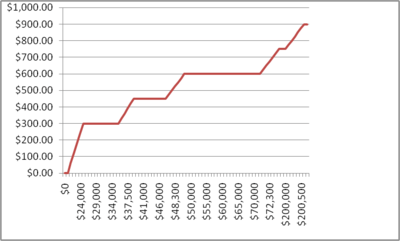
Unfortunately the numbers along the X axis are not proportional – my apologies for that (I was fighting with Excel on this matter and lost). This yields the following marginal tax rate schedule:
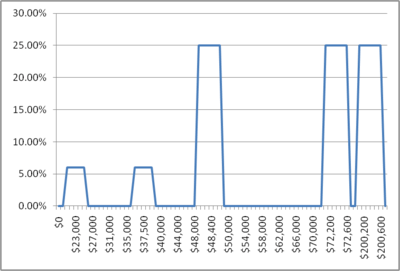
The marginal tax rate for the OHP is largely zero, but there are portions at which the rate is either 6% or 25%. Fortunately the windows where it is 25% are rather small – one exists from $48,000 to $48,600.
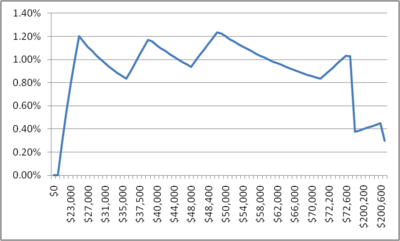
Finally the average tax rate schedule:
Other than politics, is there any justification for having two parallel provincial income tax systems? (Two and a half if you include the surtaxes) More importantly, is there any possible justification for having an income tax with such strange marginal and average rates?


 Worthwhile Canadian Initiative
“Other than politics, is there any justification for having two parallel provincial income tax systems?”
There is absolutely none, the parallel system for the Health Premium is a complete outrage, awful policy. That bottom graph is the product of a mad scientist desperately trying to hide taxes in as many places as possible. And to my mind, the surtax issue means we have three income tax systems, not two and a half.
It’s all about hiding what the true tax rate is.
Re. Excel:
My guess is that you are using a “Line” chart. Switch to an “XY (Scatter)” chart, and it should take the numerical values of your x-axis variable instead of using them as labels.
Hi Kelvin,
Yep – I did it as a line chart. Thanks for the tip! I’ll see if I can get that to work.
Occam’s razor: It’s just badly designed. Looks to me like whoever designed didn’t know what they were doing, so they invented an ad-hoc method with something like the first graph. “hmmm … we’ll give a break to the poor … jack it up around 48K … then again at $71K … Look ma! It’s progressive!”.
Sorry, I don’t quite understand the labels on the first and last diagram. What does “per income level” mean in the first chart? Why does the last chart show the top rate as 1.2%?
Yeah, I didn’t label them too clearly. I can’t seem to navigate Excel 2007 very well.
First chart shows taxable income (X-axis) vs. amount paid in OHP (Y-axis).
Third chart shows taxable income (Y-axis) vs. % of total income paid as OHP. So the third chart isn’t a marginal rate, it’s an average one. At an income level of $50,000 you pay $600 in OHP, so the avg. rate is 1.2%.
None, it’s just another badly designed tax (oops, premium, despite having been original enacted under the Income Tax Act (Ontario)).
They tried something similar in Québec years ago and dropped it. We now have a kind of fixed add-on.
Anyway, funds being fungible, any dedicated tax will diminish what you give that sector from the general fund. A political gimmick for the yockels.
The last rationnal tax system was under Pharaoh Thutmosis the Confused in 3000 B.C. He tried to make it weird but got it ok by mistake.
Mike:
You could try the marginal tax rates at tax tips.ca and see if it fits better.
Here’s the XY graph I created to represent those rates.
The excel sheet used to create the graph is here
As bad as it is now, it was worse when it was introduced: it took a while for the gov’t to figure out that transitions zones where necessary between the various flat rates — so in theory a raise of $1 on a threshold salary could drop your take home pay by $149.00!
This is of course a ridiculous tax; it should be replaced either by an increase in the normal income tax rates, or by an actuarially-sound insurance premium (part of which could be rebated to low-earners). The latter is too open to political abuse to be practical, I suspect.
I think some time back Stephen did a graph showing the overall marginal (and/or maybe average?) income tax rates for Quebec. I’m still hoping someone will do the same for Ontario & the rest of the country. (The internet has conditioned me to wait for others to do such work, rather than expend the effort myself.)
As it stands right now, there’s a tiny number of people -those who earn exactly $50,000, or $70,000, or $200,000 – whose marginal tax rates are increased by the Ontario Health Insurance premiums.
If the Ontario Health Insurance premiums were, instead, added onto provincial taxes, everyone in Ontario would see their marginal tax rates increase.
So, from the perspective of lowering the marginal tax rate paid by the typical person, isn’t the Ontario system perfectly sensible?
Simon: Thanks for the link and graph – that’s a really nice representation!
Frances: Doesn’t it net out on average? It looks here that (roughly) instead of increasing everyone’s income tax rate by 1%, you instead increase 1/6th of the population by 6%.
That being said, I was looking for a reason (other than politics) it makes sense, and that’s the best I’ve heard so far!
The areas of income that face positive marginal tax rates here are:
1. $20,000-$24,000
2. $36,000-$38,500
3. $48,000-$48,600
4. $72,000-$72,600
5. $200,000-$200,600
Groups 3, 4 and 5 are quite small but face 25% marginal rates. Groups 1 and 2 are larger and face 6% marginal rates.
The excess burden of taxation grows as the square of the marginal tax rate. So taxing 1/6 of the population by 6% is worse than taxing everyone by 1%, especially if marginal tax rates are high already.
“Frances: Doesn’t it net out on average? It looks here that (roughly) instead of increasing everyone’s income tax rate by 1%, you instead increase 1/6th of the population by 6%.”
Mike, below $38,500 your argument makes sense. My argument is relevant for people earning over $38,000. Because there the trade off is: 25% increase in MTR for (say) 1% of the population v. 0.5% increase in MTR for everyone.
Basically, for a person with an income of $50,000 a year or $100,000 a year, the health insurance premium acts like a lump-sum tax. It’s completely non-distortionary. The gains from having the health insurance premium acting as lump sum tax for some people might be enough to outweigh the brutally high deadweight loss that tiny group experiences depending upon the shape of the income distribution
Just think of it being like steps rather than a gradual slope. Steps make it easier to climb hills….
Sorry, I meant to say “The gains from having the health insurance premium acting as lump sum tax for some people might be enough to outweigh the brutally high deadweight loss that the tiny group that actually pays the premiums experiences – depending upon the shape of the income distribution
Two hats:
“As bad as it is now, it was worse when it was introduced: it took a while for the gov’t to figure out that transitions zones where necessary between the various flat rates — so in theory a raise of $1 on a threshold salary could drop your take home pay by $149.00!”
Two years ago, I received a $ 10.00 T-5 from my bank and the Fed sent me an “avis de cotisation” for $ 210.00. Turned out they were right…
The Health “Premium” is just an example of our fetishization of low taxes. The government needed more money, they should have simply raised the income tax rates, but they did this nonsense instead.