When Adam Smith wrote the Wealth of Nations, the universe of ideas looked something like this:

Today it's more like this:

But how big is the universe of unanswered questions, how many are interesting, how many are feasible, and how many are both?
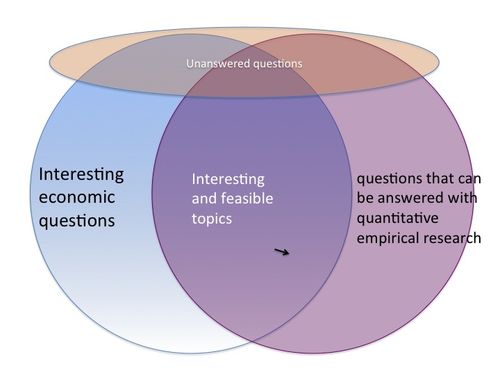
And what, exactly, are those questions?


 Worthwhile Canadian Initiative
Or to ask an even more interesting question: how may people are still trying to provide answers to questions we already know the answers to?
“Little else is requisite to carry a state to the highest degree of opulence from the lowest barbarism but peace, easy taxes, and a tolerable administration of justice: all the rest being brought about by the natural course of things.”…..seems to make much of growth theory already dealt with.
Not an entirely and wholly serious point but not entirely not one either.
Why are unanswered questions also covered by uninteresting ones? Who cares about answers to those?
I think with recent advance there are a lot of interesting unanswered question. There is a reason why people like angrist publish like crazy. It is because he is very good at finding such questions.
Empirical tools like Regression discontinuity help create new opportunity to answer new questions.
Structural people argue that with their tools many question can now be answered (if you believe their assumptions)
If anyone can improve upon these diagrams, just sent me a graphic at frances_woolley [at] carleton [dot] ca and I’ll add it to the post.
Tim “how may people are still trying to provide answers to questions we already know the answers to?”
Ah, but what is the nature of knowledge?
Seriously, I put some thought into the label of the light purple circle: “questions that can be answered with quantitative empirical research.” Adam Smith answered questions through introspection, deduction and casual observation. It’s a different basis for knowledge from quantitative empirical research.
But, yes, the way I’ve drawn the diagram, it looks like a lot of interesting and feasible topics are already answered questions.
Sergei “Why are unanswered questions also covered by uninteresting ones? Who cares about answers to those?’
I think you’ve answered your own question.
John: “I think with recent advance there are a lot of interesting unanswered question”
You can think of this as an expansion of the light purple circle, resulting in a larger intersection/greater number of interesting, feasible, not yet answered questions.
I don’t think i’ve drawn that ‘unanswered questions’ circle quite right.
Sounds like a “Rumsfeld” problem.
– There are known knowns; things that you know that you know.
– There are known unknowns; things that you know that you don’t know.
– But the big problems are caused by the unknown unknowns; things that you don’t know you don’t know.
The good old days when all questions that could be answered with quantitative empirical research were interesting economic questions. 🙂
Simon v N – “things that you don’t know you don’t know”
Yes, that “interesting economic questions” circle needs to be divided into “ones that economists think about” and “Ones that economists don’t think about.”
And perhaps the answered questions part needs to be divided into “ones that we’ve answered correctly” and “ones that we think we’ve answered correctly but have in fact got wrong.”
Simon C – so true…
Oh dear. Epistemology. Has anyone read “The Name of the Rose” then?
My thought was to add a circle on what problems are actually being looked at, either generally by economists or perhaps as a subset what doctoral theses are addressing or are being published. I’m afraid that the answer there is probably close to the second sphere, inculding much that has already been settled, or is uninteresting, and ignoring much that is interesting.
Frances:Did Krugman got his inspiration froom you for his
Euro Venn post of today at 09.53.?