What should you wear for an academic job interview? Ariel Rubinstein suggests casual attire:
I would argue that wearing jeans and a t-shirt is your dominant strategy:
If you are a good student, then a department that will not give you a job because of your "sloppy" appearance does not deserve to have you.
If you are mediocre, then there are many other candidates like you and dressing casually is the only way for you to get noticed.
Shakespeare, speaking through the character of Polonius, suggests buying the most expensive clothes you can afford:
Costly thy habit as thy purse can buy,
But not express’d in fancy; rich, not gaudy:
For the apparel oft proclaims the man;
These two pieces of fashion advice are not as diametrically opposed as they might seem. Both recognize that clothes act as signals. The question "what not to wear?" is asking what should, or shouldn't, a person be signalling.
The first thing to signal is health, energy and vitality.* Whatever else: it has to look good. For men, looking good is about fit, cut, tailoring – cheap suits are my pet peeve. My least favourite look for female candidates is dark suit, white shirt, and no make-up. It's a combination that looks terrible on just about everyone. But replace white with a more flattering colour, and buy some mascara, and the odds of getting a second interview increase significantly.
This might sound sexist, but it's just an acknowlegement of reality: undergraduate programs are largely meritocratic, grad school mostly so, but on the job market, gender matters. A woman who tries to follow the Rubinstein strategy faces a dilemma: ill-fitting jeans are unflattering, but well-fitting jeans, ones that signal health and fitness, risk drawing the hiring committee's attention to the wrong assets. This is not just a paranoid-feminist worry – my favourite moment so far this hiring season was the letter-writer who accidentally penned "she is a great person to talk about".
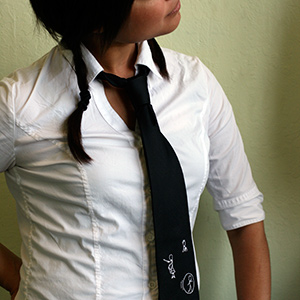
A female candidate must walk a knife's edge. Too many feminine frills and she risks not being taken seriously; too few and she is seen as unattractive. Dressing like a man sends entirely the wrong signal, as the photo illustrates. Unlike male candidates, they face an added challenge: not looking like one of the administrative staff.
But whether you are male or female, it is never easy to produce precisely the right signal of ability. Last year jeans and a t-shirt would have been a way to signal originality and creativity, but now Ariel Rubinstein's let the secret out, all it signals is that you waste time reading internet job market advice. You could try signalling I-am-so-busy-I-don't-have-time-to-shave by simply not shaving, but unless you are already established and successful, that could be misinterpreted as signalling lack of attention to details.
You could wear something like, say, a silk scarf or tie from the Palm Springs Art Museum as a way of signalling erudition and taste. Yet this assumes, first, that the candidate has the time and money to visit art museums. Even more problematically, it assumes that the members of the hiring committee could distinguish a Palm Springs Art Museum tie from one bought at Target. Indeed, this is an issue with signalling strategies in general – they assume the existence of someone with the ability to read signals.
Vintage clothing from the thrift store might signal resourcefulness and entrepreneurial spirit – or poverty. That's a risky strategy, because signalling desperation is to be avoided at all costs. Remember the lessons of Marxist economics: "I don't want to belong to any club that will accept me as a member." Every employer wants to hire a candidate that is just a little bit too good for them. Rubinstein and Polonius's strategies are very different ways of sending out the same signal: I don't need to impress you. I don't need your money. I'm doing just fine.
Sometimes the best solution is a mixed strategy equilibrium – jeans with $300 dress shoes, or a beautifully tailored suit with outrageous mismatched socks. Here is where accessories come in. For a development economist, a "$100 laptop" from one.laptop.org neatly signals "I know Linux, and I know how to get my hands on one of these machines."
Ultimately, the economics job market is a matching game – each candidate and each employer is trying to find the candidate that's right for them. Hence a candidate's signal should be tailored to the type of employer he or she wishes to attract. Jeans and a t-shirt say "I'm not willing to put on a suit just to please students or clients or hiring committees". Since that would be a bad signal to give to a teaching oriented university, jeans and a t-shirt is a way of signalling interest in research. Matching also makes things tricky for female and minority candidates – a candidate who is demographically similar to the hiring committee can aim to fit in, to dress like one of the guys. Others can try, but they are less likely to succeed.
In other words, it's a complete total and utter minefield – everything from your hair to your shoes is a signal, and you could get it wrong. Looking on the bright side, as Amartya Sen once observed, economic man is close to being a social moron.** You might have been the least fashion-conscious and most clued out person in high school, but in a group of economists, you too can be a fashion star. And even if you aren't, the average economist is unlikely to notice.
* The desire to signal health also explains the outdoorsy profile pictures here, here, here, and here
**Yes, I know that wasn't what he meant. But it's funnier that way.


 Worthwhile Canadian Initiative
Patrick, Andrew F – Larry Summers was my contribution to the debate, actually. I think both you guys have good points – Patrick, you’re rightly pointing out that we don’t just have to accept the status quo, Andrew, you’re rightly pointing out that it can be hard to change it.