Between 1695 and 1851, the English government levied a tax on windows.
The window tax was relatively easy to administer. A person's tax liability could be calculated by counting their windows. It had progressive elements. People with higher incomes had larger houses, and more windows, thus paid more in taxes. Houses with fewer than 10 (later 7) windows were exempt from the tax.
Yet if windows become more expensive, people will demand fewer of them. People reacted to the window tax by bricking over their windows. Old homes with bricked over windows can still be seen throughout Britain.
The picture on the left shows a home built in 1592 with bricked over windows on the top floor, and on the right a cartoon depicting people's longing for light. 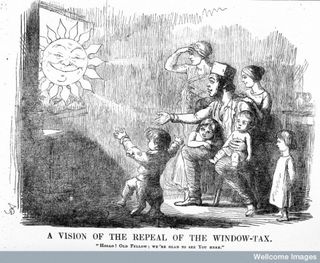
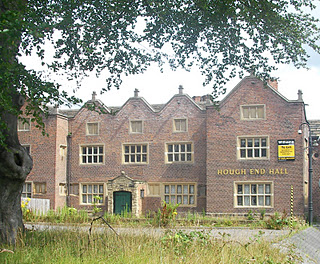 The deadweight loss of the window tax was the reduction in well-being it caused, over and above any loss of income associated with paying the tax – the human costs of living and working in dark rooms with no ventilation. A recent paper by Chantal Stebbings argues that this burden was highest for the urban poor, who typically lived in larger tenement buildings, so did not benefit from the seven window exemption, and were vulnerable to the effects of crowding, poor sanitation and disease. Imagine cooking dinner over a coal fire in an unventilated room, or living with someone with tuberculosis, and being unable to open a window. Even in the dwellings of the wealthy, like Hough End Hall, shown above, the bricked up windows are on the top floor, which was typically the servants' quarters.

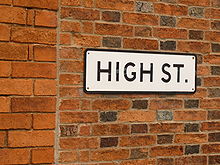 The window tax is perhaps the most famous example of a tax with visible impacts on building construction, but it is far from the only one. In 1784 the British introduced a brick tax of 4 shillings per thousand bricks. Builders responded by turning to other types of construction materials; manufacturers responded by making bigger bricks. The picture on the left shows the impact of the tax; the building with the "High St" sign is made with smaller, pre-tax brick work.
Tax minimizing construction choices can be seen in Canada, too. The snow-covered dwelling pictured on the right is Jones House, built in Ottawa in around 1890. The Second Empire Mansard styled roof provides the maximum possible amount of living space on the second floor, while still allowing the house to be taxed as a one and a half storey dwelling.
When it comes to taxation, the devil is in the details, as the saying goes. When property tax assessments are based on a building's physical characteristics – the number of windows, the number of storeys – people will argue about what counts as a window, or what counts as a storey.
Even something like the size of a building must be carefully defined for tax purposes. Are property taxes based on the interior or exterior dimensions of a building, its size at ground level, or its size including any balconies, overhangs, or eaves? The next set of pictures show what is at stake in defining a building's dimensions.
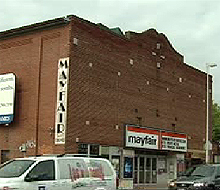
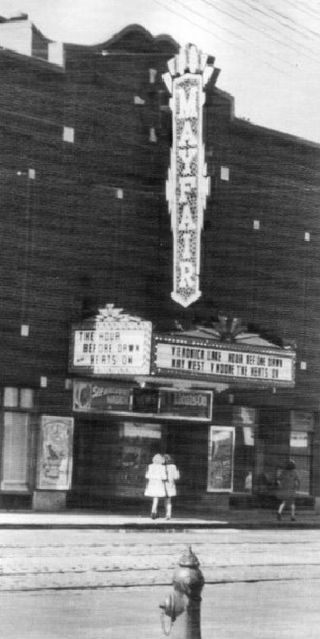 The picture on the left below shows Ottawa's Mayfair Theatre in 1944; the picture on the right shows the same theatre today. In Ottawa taxes are levied any part of a building that overhangs the sidewalk. The Mayfair theatre's marquee was not, in fact, removed for tax reasons, but other marquees were.
 Taxes are still influencing building construction today. Egypt taxes finished buildings at one rate; unfinished buildings at another lower, rate. As a result, developers leave their buildings unfinished, typically with a half-built upper story, as shown in the last picture.
The primary purpose of these pictures is to provide a concrete illustration of the efficiency impacts of taxes, to create a more memorable and meaningful image than a deadweight loss triangle.
Yet these pictures also serve as a reminder the strengths of broad-based income and consumption taxes. The re-introduction of income tax in 1842 made the repeal of the much-hated English window tax possible. Value added taxes remove any incentives to minimize tax liabilities by up-sizing bricks. Good tax policy in four words: broad base; low rate.


 Worthwhile Canadian Initiative
Sigh. Much as I try to be sensitive to political realities and feelings, I wish a politician had the courage to just double the GST rebate and tax food.
Does it matter to a rich person whether you tax food or their business suit?
rsj is stuck in the spam filter.
Determinant,
I think there is a legitimate claim on a basic quantity of food and shelter. I.e. there are some goods for which there is an argument for delivering them “in kind” or the monetary equivalent. Making those goods tax exempt is a (very) partial move in the right direction.
A more fair and efficient solution would be to distribute the LVT revenues as a citizen’s dividend which would generally cover swings in food/shelter costs since those are land value driven.
K: Totally agree on your last posts.
I think we have the begining of a beautiful friendship. But who is Rick and who’s Capt. Renault?
I have no axe to grind on rents, land taxes, property taxes or any other sort of tax like that; GST Rebates are a better means of relief than not taxing food, much as it pains me to say that.
GST Rebates are too-little discussed by the political class.
Determinant: agreed on GST rebates. But to the man on the street, GST rebates are a couple-of-times-a-year events, soon forgotten, while the tax on food is a constant pebble in the shoe.
And anyway, they don’t believe our complicated arguments about general economic efficiency. Tell them insulin works because we have sacrificed a black goat and 80, maybe 90%, of the population will be happy with the explanation.
Frances
Let’s say my house has 10 windows. Taxes are linear in windows and is such that it comes out to 3% per window. I choose to brick over 5 of my windows. Therefore, I have demonstrated that 15% tax + lesser sunlight is better for me than 30% tax and more sunlight.
If you’re saying that 15% lump sum tax and more sunlight is preferable, then that’s of course true. But that’s not the relevant comparison. Does a lump sum 30% tax (which did not even give me the option of bricking over my windows)increases my well-being? My actions in the situation where I had the ‘choice’ seem to imply the opposite.
In fact, can one not make the case that this kind of a non-lump-sum approach actually helped individual people make the correct trade-off on the sunlight/tax frontier and that they each paid as much as tax as they wanted and got as much sunlight as they wanted.
Let’s say that all houses had 10 windows. Some chose to brick over none of them, some completely blocked out the sunlight. The net result was that the government got 18% tax (income-weighted average of 4 windows bricked over). Would aggregate welfare necessarily increase if the government had just taxed everyone at 18% and let the windows be? Isn’t there redistribution from people who prefer cash to people who prefer sunlight?
Frances: One thing to bear in mind, however, is that right now imputed, in-kind income derived from owner-occupied housing is not taxed in our personal income tax system, creating an incentive for people to over-consume housing
Is this not the same for everything else? For example tax on labor means that people will over-consume labor they do in their own free time. So in short they will cook at home or do home improvements themselves instead of eating in restaurants or hiring professionals to do the housework.
As for the broader debate about taxing food or introducing GST (VAT) I have to ask a question to professionals. In my eyes, VAT seems to be very bad for low income people. The point is, that it increases the price of the living essentials for the poorest increasing their propensity to consume – that in turn decreases their chance to save and increase their income from capital. So VAT can be just and working only in the presence of negative tax (subsidy) that exactly covers the basic essentials such as food and basic housing for the person. So that any decision to consume or save is then based solely on the preference of the individual and not forced on her by circumstances.
Or in short, my argument is that VAT is regressive tax that is dynamically inefficient, as it increasingly lowers the capital stock of poorer people compared to the rich ones, which in turns makes the income difference between poor and rich wider – and ultimately it also makes tax collection lower as rich have lower propensity to consume than less affluent.
The last of my arguments against exempting food or other necessities from VAT is that if there are any empirical studies that the inefficiency of redistribution of the tax to poor (in case that VAT has no exemptions) are lower then inefficiencies stemming from loopholes in exemptions from VAT.
rsj: “almost all people except for a few fanatical economists believe that income is the tax base and not “consumption”.”
Well obviously it’s both. And real estate.
“The least distortionary tax would be one in which all forms of income, both investment income (of which capital gains is a subset) and wage income were taxed equally.”
No. A 100% LVT, with the residual on income/consumption would be better. The LVT doesn’t distort at all.
“Land taxes are levied on the stock but paid each year, the rationale being to tax away the “gain” that accrued in that year.”
No, they aren’t. That isn’t how it works. Ideally the LVT would be equal to the policy short rate applied to the land valuation. That way the land value to the owner would be zero. Land would transact at zero price. Economically, it’s equivalent to the owner leasing the land from the state. The short rate is the rent. In practice, since we don’t want taxes swinging too much, we would set it at a relatively stable intermediate value (maybe at a rate equal to the 30-year yield). And since we don’t want people to abandon the land, we would only apply the LVT on, say, 80% of the land value.
J.V. Dubois “Is this not the same for everything else?” It is, hence the slogan: Broad base, low rate.
“In my eyes, VAT seems to be very bad for low income people.”
This is a complex issue and I’d rather not get into the debate – too much like hard work!
What is interesting, though, is that the window tax was regarded by the general public in much the same way that VAT (GST) on food is regarded: that it is morally wrong to tax the necessities of life. Not taxing life’s necessities was thought by many at the time to be a key element of good tax policy.
rsj: “new real investment only occurs if there is a certain belief in significant and long-lasting rents accruing as a result of making the investment.”
And that’s awesome if you a inventing a better doohickey. But “investing” in land doesn’t fall in that category. It produces exactly nothing. Great fortunes were and are made in monopolizing marginal land and waiting for economic growth to yield rents. Land speculation is at best useless and, to the extent that it results in underutilization, unambiguously harmful.
‘Good tax policy in four words: broad base; low rate.’
I see your four and raise you a three: Land Value Tax.
J. V. Dubois:
You would be right except for one thing: rebates. In Canada those with incomes below $40K receive quarterly cheques from the government to compensate for the GST/HST paid by low-income people. As Jacques adroitly pointed out, these are quarterly payments against the constant irritant of paying GST/HST all the time. Personally I look forward to having the HST embedded in the price, something that will happen soon once Ontario agrees, the relevant clauses are already in the Excise Act, ready to be used.
One of the least-noticed but most important changes of Ontario converting to HST was that low-income Ontarians now get full HST rebate cheques on the provincial and federal portions, before there was no PST rebate. This is a very progressive measure in my book.
Speaking of low-income people, I believe the greatest budget item is generally housing, particularly rents. It’s not that food itself is too expensive, it’s that food+housing is too expensive and people have to sacrifice on food to pay for housing.
The answer seems to me to be better housing policies to encourage more moderately-priced/rental rate housing.
Frances
I did a bit more digging on this, since as august a source as The Economist once wrote approvingly of this tax. The Window Tax seems to have replaced the much-disliked Hearth Tax (where owners were taxed according to the number of chimneys). One particular feature of the Hearth Tax was that assessors had the power to enter a dwelling, which the Window Tax avoided. The tax did not affect the really poor – it was not levied on those too poor to pay the church and poor rates (see http://en.wikipedia.org/wiki/Window_tax).
John Brewer in The Sinews of Power makes the point that low, broad taxes were difficult to get through Parliament, which associated them with professional administrations, permanent high taxes and greater independence of the Crown from Parliament. Proposals for a “general excise” were routinely defeated. He also notes that, as debts were raised against specific income streams, taxes were hard to remove in the absence of a secondary market for government debt (which only arrived a few decades after this tax came in).
The Window Tax seems to have been an Exchequer rather than Treasury tax, so assessed and collected by local worthies. It was probably pretty negotiable. Nineteenth century criticisms were justified, but also have to be seen against the background of a campaign for modernisation of the administration. I can’t find, for instance, that it applied to any hole in the wall.
So the lesson might be that the economically desirable is only achievable if the political, social and administrative underpinnings are in place (World Bank and IMF advisors take due note).
Peter T – I agree with you that the window tax worked fairly well in a rural, pre-industrial society – there was no less to worry about access to fresh air, for example, when you could just step outside and breath in great lungfuls of it. It was the interaction of the window tax with industrialization and urbanization that was so problematic. This is perhaps a point I should have emphasized more strongly in the original post.
On holes in the wall being taxed – take a look at the “recent paper” by Chantal Stebbings linked to in the post. In that paper she argues that the law did not define what counted as a window, and e.g. a ventilation hole in a larder to keep food cold could be taxed as a window – though as you say, there was probably some amount of variation in local enforcement.
As to the your concluding point about the economically desirable relying on political, social and administrative underpinnings. Yes, absolutely. See, e.g., the Egypt unfinished building example – and people have been saying in the comments and elsewhere that they’ve seen the same thing in Latin America and Greece.
I note Stebbings cites arguments against the tax only from the 1830s and later – it seems to have been relatively uncontroversial for a century or so. I also note that the tax was replaced with another on house value, rather than by the Income Tax. Buildings unfinished for tax purposes were widely seen in India as well – seems a global phenomenon.
Interesting post Frances.
I learned about this tax recently while reading Bill Bryson’s “At home” book. It has a chapter on the great exhibition of London in 1851, and how this building all made of steel and glass (designed by a gardener — think greenhouse) was such a marvel to everyone at the time and was only made possible because that tax had been repelled and new window making techniques had appeared.