Between 1695 and 1851, the English government levied a tax on windows.
The window tax was relatively easy to administer. A person's tax liability could be calculated by counting their windows. It had progressive elements. People with higher incomes had larger houses, and more windows, thus paid more in taxes. Houses with fewer than 10 (later 7) windows were exempt from the tax.
Yet if windows become more expensive, people will demand fewer of them. People reacted to the window tax by bricking over their windows. Old homes with bricked over windows can still be seen throughout Britain.
The picture on the left shows a home built in 1592 with bricked over windows on the top floor, and on the right a cartoon depicting people's longing for light. 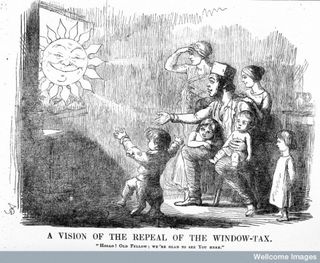
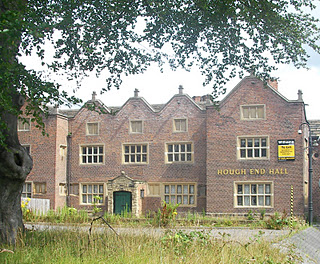 The deadweight loss of the window tax was the reduction in well-being it caused, over and above any loss of income associated with paying the tax – the human costs of living and working in dark rooms with no ventilation. A recent paper by Chantal Stebbings argues that this burden was highest for the urban poor, who typically lived in larger tenement buildings, so did not benefit from the seven window exemption, and were vulnerable to the effects of crowding, poor sanitation and disease. Imagine cooking dinner over a coal fire in an unventilated room, or living with someone with tuberculosis, and being unable to open a window. Even in the dwellings of the wealthy, like Hough End Hall, shown above, the bricked up windows are on the top floor, which was typically the servants' quarters.

 The window tax is perhaps the most famous example of a tax with visible impacts on building construction, but it is far from the only one. In 1784 the British introduced a brick tax of 4 shillings per thousand bricks. Builders responded by turning to other types of construction materials; manufacturers responded by making bigger bricks. The picture on the left shows the impact of the tax; the building with the "High St" sign is made with smaller, pre-tax brick work.
Tax minimizing construction choices can be seen in Canada, too. The snow-covered dwelling pictured on the right is Jones House, built in Ottawa in around 1890. The Second Empire Mansard styled roof provides the maximum possible amount of living space on the second floor, while still allowing the house to be taxed as a one and a half storey dwelling.
When it comes to taxation, the devil is in the details, as the saying goes. When property tax assessments are based on a building's physical characteristics – the number of windows, the number of storeys – people will argue about what counts as a window, or what counts as a storey.
Even something like the size of a building must be carefully defined for tax purposes. Are property taxes based on the interior or exterior dimensions of a building, its size at ground level, or its size including any balconies, overhangs, or eaves? The next set of pictures show what is at stake in defining a building's dimensions.
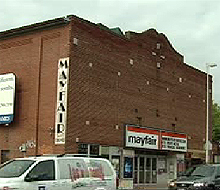
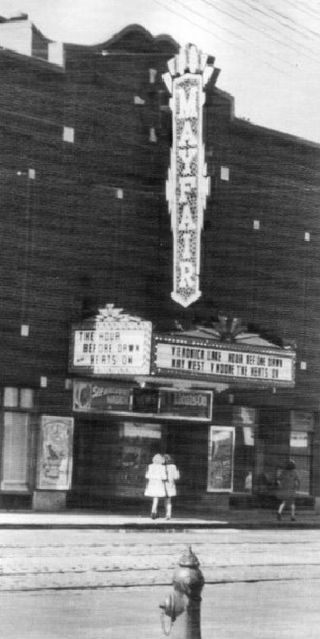 The picture on the left below shows Ottawa's Mayfair Theatre in 1944; the picture on the right shows the same theatre today. In Ottawa taxes are levied any part of a building that overhangs the sidewalk. The Mayfair theatre's marquee was not, in fact, removed for tax reasons, but other marquees were.
 Taxes are still influencing building construction today. Egypt taxes finished buildings at one rate; unfinished buildings at another lower, rate. As a result, developers leave their buildings unfinished, typically with a half-built upper story, as shown in the last picture.
The primary purpose of these pictures is to provide a concrete illustration of the efficiency impacts of taxes, to create a more memorable and meaningful image than a deadweight loss triangle.
Yet these pictures also serve as a reminder the strengths of broad-based income and consumption taxes. The re-introduction of income tax in 1842 made the repeal of the much-hated English window tax possible. Value added taxes remove any incentives to minimize tax liabilities by up-sizing bricks. Good tax policy in four words: broad base; low rate.


 Worthwhile Canadian Initiative
Cool! I never knew about the brick tax. Father told me about the window tax, and would point out bricked-up windows in the village.
Isn’t there some tax in Vancouver that is based on the roof area, and that’s why some buildings have no overhang, and so the rain runs down the walls? (My memory may be wrong on this.)
I wonder what present taxes future generations will be rolling their eyes at?
There are cities in Canada where taxes go up based on the number of bedrooms in a house (amongst other factors), a room being defined as an enclosed space with a window and a closet. Hence, my cousin in Winnipeg finished his basement with two windowed but closet-less rooms. Maybe the wardrobe manufacturers lobbied for that regulation.
Nice post, Frances.
This is why property taxes should be land value taxes (LVT). Land value is a positive externality of all economic activity, and taxing it is essentially distortion free, a basic economic result that’s been known since Adam Smith and Ricardo. Before debating the fine points of CIT vs personal income tax or whatever, we ought to pick the low hanging fruit, i.e. a near 100% LVT.
Isn’t there a province (New Brunswick??) where lots of houses don’t have front door steps, because that would count as finishing the house, and mean a higher tax rate?
I disagree with K. Recognising that taxes cause distortions shouldn’t therefore mean looking for the option with the smallest distortionary effect. Instead, it seems to me, we should look for, and intentionally create, distortions that fit with a public policy goal. We seem to recognise this and accept it when it comes to the traditional sin taxes.
As it applies to property taxes, I’m of the opinion that low density has negative consequences far beyond the boundaries of the lot (reduced density causes increased car dependency leading to increased pollution, traffic, demand for roads paid for out of general revenue, etc.) and so # of households per acre should be a part of any property tax formula.
I always find public policy through the tax code fascinating. It seems that most people over value reductions to their tax bill, so using targeted tax credits seems to be a very cheap way to influence behaviour.
Nick “Isn’t there some tax in Vancouver that is based on the roof area, and that’s why some buildings have no overhang, and so the rain runs down the walls?”
That’s my memory too, so perhaps I told you that story. It comes down to how do you measure the size of a building, i.e. from the outside of the eaves (gutters) or from the footprint on the ground or using some interior measurement. But when I typed “leaky condo” and “taxes” into google I didn’t find anything.
“what present taxes future generations will be rolling their eyes at?” The NHL is a non-profit organization? Fitness tax credits?
K: “This is why property taxes should be land value taxes (LVT).”
The problem with basing property taxes on land values is that it creates incentives for urban sprawl – i.e. people move to where the land is cheaper to avoid paying taxes. I looked on google earth to see if I could actually see the development boom in the x-burbs prompted by the lower taxes just the other side of the City of Ottawa boundary, but it wasn’t clearly visible on the satellite photos.
Shangwen – neat example. In Ontario we have market value assessment, which is supposed to be less distortionary, but people figure they have the assessment formula figured out, and renovate accordingly. I.e. when renovating and installing a new bathroom, a half-bath (toilet, no bathtub) might be a more tax-efficient choice than a full bathroom.
Neil: “Instead, it seems to me, we should look for, and intentionally create, distortions that fit with a public policy goal. ”
Interestingly, this is very much the argument made in Chantal Stebbings paper – i.e. that the realization that taxes, like the window tax, could harm public health led to a greater awareness of the potential for taxes to help public health.
She credits the repeal of the window tax to public health concerns, not to the availability of other sources of revenue. The conditions of the urban poor must have been pretty disgusting – any small hole that would provide even a minimal amount of ventilation was considered a “window” and taxed. Imagine a family of seven living in just a few rooms, no showers, no deodorant, no disposable diapers, no febreeze, manual labour, disease, and no way of letting ‘fresh’ air in.
Also, if the tax per window was at the same rate for a poor man’s hole in the wall and a rich man’s sumptuous glasswork, you can see how this tax would have ended up being regressive.
Thanks for this post, Frances. I try a similar thing to make deadweight loss more tangible to students. I told them about a farmer just on the margin of being able to afford a bicycle for his kid. Suddenly, a tarrif on bikes is introduced and the farmer no longer chooses to buy a bike. The deadweight loss is the lost enjoyment of the bike. We can all draw that diagram. But here is the tangible image: I dare you to deny this boy his bike, tariff-mongers of the world!
Frances: “I looked on google earth to see if I could actually see the development boom in the x-burbs prompted by the lower taxes just the other side of the City of Ottawa boundary, but it wasn’t clearly visible on the satellite photos.”
I used to live on a road that followed the Ottawa-Carleton southern boundary. Most new houses were on the south (low tax) side of the road.
Once an LVT is in place, shouldn’t people be indifferent to whether land prices are high because of the positive externalities, requiring more borrowing, or land taxes are high but the land comes at zero cost?
To deal with sprawl, we can still tax properties on the basis of what it costs to service them.
Kevin, thanks for that link, what a tear-jerker! B.t.w., do you know if BC property tax assessment methods contributed to the whole leaky condo thing? Or is it another example of BC adopting California building standards without really thinking things through?
Hi Frances,
I don’t know anything about property taxes in BC, so I’m afraid I can’t help. The peak of public concern about the leaky condos occured in the 90s before I arrived here. I don’t know that the problem has abated. When your condo increases in value 50K a year, a five digit condo assessment doesn’t bankrupt you and thus doesn’t lead to the same political pressure.
I found the paper linked here on Hawaii’s experience with LVT to be interesting:
http://modeledbehavior.com/2010/10/04/non-cranks-who-support-land-taxe/
Hi Frances:
Had this story recounted to us over the summer in while in England and on a tour of Bath. Interestingly enough, while they taxed windows, they did not tax the pretend windows that some people then painted on the bricked in windows.
Livio – Bath is lovely, isn’t it?
What strikes me as interesting is that a lot of the buildings in Bath are 18th century, so they would have been built after the tax had been in place for some time.
You would therefore expect the tax to be fully taken into account when the buildings were designed, i.e. people would build houses with fewer windows, rather than building houses with lots of windows, and then bricking them up. Perhaps windows were bricked up when homes lost their value, and were rented out to lower income people who couldn’t afford to pay the tax? Or perhaps tax rates changed over time? Perhaps technological change e.g. gas lighting altered the demand for windows?
In Amsterdam, houses were taxed according to width, which gave rise to famously narrow houses that still exist: http://goeurope.about.com/od/amsterdampictures/ss/amsterdam_7.htm.
Frances,
The LVT just replaces the cost of buying land with the PV of the cost of paying the tax. The land transaction value simply drops (to zero in the case of the 100% LVT) by the PV of the tax. It doesn’t distort the untaxed state of urban development in any direction whatsoever, including in the direction of more sprawl. Taxes on improvements do, however, distort land use in favour of less intensive use and therefore more sprawl. If you want less sprawl (and you should since the undistorted market would have less) then you should prefer a pure LVT.
I’m curious to know if many of the people suffering those health effects made a connection between their condition, the tax, and an alternate world prior to or without a window tax–i.e., did people hang out at the pub griping about all the respiratory disease, vitamin deficiency, and eye infections because of the damn window tax? I suspect not. If they had known, maybe it would have spurred innovation in ventilation systems, which I doubt happened.
Interestingly, we now live in a world where new building regulations are sometimes accompanied by overblown claims of health benefits, such as green building codes that exaggerate both the current risks of old standards, and the positive public health externalities of standards like LEED. Here’s a 1999 paper by Hammitt et al.:
A fascinating post.
Nick Rowe,
“I never knew about the brick tax.”
It isn’t apparent here in Scotland and was presumably never relevant apart from in crofts. I’d never heard of it before. Scottish homes have almost all been built of stone. I remember being stunned as a kid when we’d go down to England and there were all these houses made with bricks.
Shangwen: ” If they had known, maybe it would have spurred innovation in ventilation systems, which I doubt happened.”
Take a look at that paper by Chantal Stebbings, it describes the widespread opposition to the tax – people didn’t need to understand the germ theory of disease to work out that it was unpleasant to be in dark, unventilated rooms. Three factors were working against innovation in ventilation systems/change more generally:
– almost any hole was considered a taxable window
– the urban poor had so little economic or political power.
– the fact that social distance allowed the better off to remain blissfully unaware of the situation of the poor. Even a half century or so after the repeal of the window tax, during the Boer, 1st and 2nd world war, country dwellers and/or people in positions of were shocked to discover – when they tried to find healthy conscripts, or when city children were evacuated to the country-side – how unhealthy poor urban Britons were.
Frances,
Great Post!
It’s a tangent, but I’m reminded of a story a historian friend of mine told me about the origins of Forest Hill as the realm of Toronto’s wealthy. Apparently it dates back to the days when Forest Hill and Toronto were separate municipalities, and Toronto imposed a municipal income tax (this was ultimately abolished in the 1930s as part of a bail out by the province). Forest Hill emerged as a tax haven on the boundary of Toronto, where Toronto’s well-to-do could flee Toronto’s income tax without losing many (or any) ammenities of the City (it stands to figure, if you were wealthy enough to be subject to the tax, you were were wealthy enough to buy a car and, if need be, hire a driver).
K,
I hear what you’re saying about a LVT, although I suspect the practical problems make it unworkable. For example, how do you disagregate the value of land vs. the building build on the land? (This is a real problem for our income tax system, where the tax treatment of land typically differs from the treatment of buildings. At least in that context the buyer and seller typically (but not always) have contrary interests (the buyer wants to allocate the purchase price to buildings, the seller wants to allocate the purchase price to land) so the allocation of the purchase price between classes of property generally (but not always)reflects their respective fair market values. That wouldn’t be the case for a LVT). Similarly, how do you deal with the equity issue associated with imposing the same tax on the run-down fixer-upper as you do on the rebuilt multi-million dollar house (located on similar sized land)? (Although I take your point that, once implemented, the cost of the tax will be fully capitalized, so it’s really more of a transitional problem). It’s easy to see how those isses are addressed by a property tax system (i.e., they tax the value of the whole property, and the mansion is subject to a higer tax than the fixer-upper).
Then there are the more general problems associated with property taxes generally, i.e, they don’t reflect current ability to pay and tax a form of wealth that’s fairly illiquid. Given those issues, it’s no surprise that LVT (and property tax, more generally) are typically ignored as a policy tool.
K: “The LVT…doesn’t distort the untaxed state of urban development in any direction whatsoever”
Given the externalities associated with long commutes, isn’t it desirable to distort urban development in the direction of having less urban sprawl?
Frances,
“isn’t it desirable to distort urban development in the direction of having less urban sprawl?”
1) Yes. But here’s a great thing about LVT. Imagine that we build a road to support commuters. The existence of that road will raise land values of the neighbourhoods that it benefits exactly to the extent that they are benefited. Their taxes will therefore increase exactly to the extent that they have received a public benefit. It is the way to internalize the benefits of public investment.
2) Property taxes, to the extent that they are on land improvements (i.e. houses), do exactly the opposite of that. They distort in favour of sprawl. If you want less sprawl, eliminate the property tax and apply a higher tax rate on just the land value portion of the property value.
Bob,
Transaction values in my neighbourhood often differ by as much as 50% from valuations and not all in one direction. There is huge variance in the transaction/valuation ratio. Income and sales and payroll taxes have huge unfairness due to evasion. Real estate related taxes have the benefit of being unavoidable. I don’t think it would be that hard to develop valuation schemes that would be at least as fair as the current property valuations as well as other forms of taxation.
Secondly, property owners could initially be compensated in lump sum based on NPV of the change in their tax payment. Since the efficiency of LVT does not depend in any way on the correct assessment being made on any given lot (so long as it’s not greater than the actual land value), we would get the full efficiency gains going forward.
As far as equity issues between run-down vs fully renovated, I simply don’t get it. Why should I pay more tax because I choose to renovate my house and shift my assets from securities to housing? It can’t be because I’ve increased consumption since I already paid full consumption tax on all labour and materials when I did the renovation. And it can’t be because of externalities of my activities since those are all positive. So what is it? And why should some lucky squatter be allowed to sit on land gains that come from everybody else’s investments in the neighbourhood while they themselves have contributed nothing towards the level of ground rents? There’s only so much land in the world – you can’t just allow those who happen to descend from those who were lucky enough to grab it when it was free, to leave it in disuse forever when others want to put it to productive use. Use the positive externalities from which you benefit (or get off the pot!)
“isn’t it desirable to distort urban development in the direction of having less urban sprawl?”
1) Yes. But here’s a great thing about LVT. Imagine that we build a road to support commuters. The existence of that road will raise land values of the neighbourhoods that it benefits exactly to the extent that they are benefited. Their taxes will therefore increase exactly to the extent that they have received a public benefit. It is the way to internalize the benefits of public investment.
If you want a land value tax that disincentivizes urban sprawl, create a land value tax that disincentivizes urban sprawl. Provide tax credits that increase with the number of dwellings per square-metre of land and the proximity to the city centre. No need to rely on indirect mechanisms.
Mustapha: “If you want a land value tax that disincentivizes urban sprawl, create a land value tax that disincentivizes urban sprawl”
I don’t want that, actually (except to the extent that such sprawl is caused by current inefficient tax schemes). I want a tax that doesn’t distort the free market from being able to equilibrate to the efficient quantity of sprawl; i.e. the highest utility tradeoff between Garage Mahals and the Burj Khalifa. That tax happens to be the LVT. Elegant and efficient.
K:”Imagine that we build a road to support commuters. The existence of that road will raise land values of the neighbourhoods that it benefits exactly to the extent that they are benefited. Their taxes will therefore increase exactly to the extent that they have received a public benefit. It is the way to internalize the benefits of public investment.”
A traditionnal way of shipping out poor people who own desirable land is to convince your cronies on the city council to “improve” the area with a better road or even, in the Southern U.S. coastal areas, the first water and sewer systems. Land value is reassessed, taxes rise, land-rich but cash poor black landholders must sell or face a tax foreclosure. Fortunately, a nice developper shows up. In economic theory, you hold an auction and you get the full benefit of the improvement. Such an auction is so easy to organize if you are semi-literate and don’t understand how the worthless-for-agriculture land your ancestors fled to is now primo-condo , though you know that all developpers are alredy agreed on who will get each plot for whose hotel/condo…
Point of pedantry Frances, but the UK introduced the Income Tax in 1797, not 1842. The First Income Tax was levied in order to pay for the Napoleonic Wars. The UK tried to expand the excise tax system, for instance taxes on playing cards and hair powder, a fashion necessity for that white, long-haired 18th Century look. When the hair powder tax came in, hair powder and wigs promptly fell out of fashion; people started to wear their natural hair.
The First Income Tax eventually had a deduction at source system by 1810 that was very modern. The First Income Tax was repealed in 1815 after victory at Waterloo. It was reintroduced in 1842 to pay for an increasing budget deficit and a persistent erosion of the excise and import duty system.
The famous promise in Canada in 1917 that Income Tax would be a “temporary wartime measure” was actually realistic given British experience in 1815, people didn’t realize the world changed fundamentally in 1918 and would never be like 1913 again.
Determinant, you’re right, it was introduced, abolished, re-introduced, re-abolished, and then re-introduced again.
Jacques,
I now have flashbacks of having had this debate before with you. So here goes again:
Seriously!!?? You are going to throw away trillions of dollars of allocative efficiency over a few billion of ancestral claims, which surely are either
A) perfectly solvable in the presence of a sane political process or
B) unsolvable because of said political dysfunction in which case we’ll surely find a way of screwing them over anyways. Who says we can’t do the same thing with a plain old property tax?
Pay me the efficiency gains of a switch from property to land value tax and I’ll throw in a trillion dollars for an Ancestral Claims Compensation fund to be distributed as you see fit. But honestly, cultural claims don’t give you a veto forever. And truly, the issue of land that’s monopolized (perhaps fairly) by ancestral claims is a joke compared to the land that’s inefficiently monopolized by corporate and wealthy rentier interests (including for example some very “conveniently” located native reserves on the Canada/US border). You are letting a (very small) red herring get in the way of a major part of the solution.
Frances, Determinant: further point of pedantry. Modern shampoo was introduced in England under the reigns of George IV and William IV, thus obviating the need for wigs. Never underestimate the power of technological changes in altering price elasticity. I think I’ll use that in this winter Intro micro.
True, but the modern “Brutus” haircut, without a ponytail and often with sideburns (though that name actually comes from Gen. Ambrose Burnside, a Union General in the US Civil War) dates from 1800. In 1808 the British Army changed its uniform regulations to do away with hair powder and “queues”, instead decreeing a modern short hair style for soldiers.
Shampoo was an innovation driven by the switch to short hair, itself driven the Hair Powder Tax. Beau Brummel, noted London clubber (as we would now think of him) popularized the style. Portraits show the switch by 1805.
K- In most US cities the binding constraint on development is zoning, not taxes. Altering the tax structure would have no effect on density is such cases, since demand at present tax rates still outstrips the zoning permitted supply.
In fact, since the cost of many city services (schools, police, fire, and sanitation) are positively correlated with the number of housing units eliminating taxes on improvements would likely increase political pressure to further restrict allowable development. There are already numerous cases in Massachusetts, for example, where communities have rejected in fill projects because the marginal cost of projected services outstripped the projected marginal tax revenue.
As to the difference in qualitative measures, there is a clear progressivity/regressivity element to taxing the yuppies with granite counter tops and the like the same as the widow next door with shag carpet and avocado appliances. Property taxes were originally intended as a wealth tax, afterll. Granted that can be dealt with using circuit breakers and such, but that adds to the complexity.
K: we’re not talking “ancestral claims”. We’re about guys with title deeds getting forced out legally on the Georgia coast by people who definitely won’t lobby for an efficient taxation system.
OGT,
“eliminating taxes on improvements would likely increase political pressure to further restrict allowable development.”
Are you assuming total tax revenues would go down? I assume they would go up (much higher mill rates). But most painfully so for land speculators who’d suddenly be in a big rush to do something useful other than lobbying for a zoning change (which, if beneficial, would just commensurately raise the land tax).
“Property taxes were originally intended as a wealth tax”
Then why don’t you just impose a wealth tax? Why do you want to tax me more for living in a big house than for owning a lot of stocks? The fact is, these taxes are arbitrary, totally unfounded in fairness or logic, and grossly distortionary and inefficient. And one of the dominant effects is the promotion of antisocial effects like urban sprawl.
Also, why is it a “widow” living on underdeveloped land, rather than a rentier waiting for a zoning change opportunity to flip it? Do we need tax breaks for “widows” and “shag carpets”? If so, why don’t you just say so?
Jacques: “We’re about guys with title deeds getting forced out legally on the Georgia coast”
But last time we talked about this (which must be about two years ago), you brought up the same bunch of Georgians. How common and important is this? And as I said, if they are politically disadvantaged in a corrupt society, they are going to get screwed. Period. The point is not how to implement efficiency in the face of a vacuum of legal justice. You can’t do that. The point is to change the dominant perverse incentives using the modicum of enforceable legal instruments that we do possess. The greater the rule of law, the more optimal results can be achieved with the implementation of fair laws.
I went on a trip to Greece in 2000. If course we landed in Athens. The tour guide pointed out to us on the bus on the road into the city that many Greek homes appeared unfinished. Like Egypt, there was a provision in Greece that incomplete construction/renovation paid lower taxes.
This is probably a case for construction permits. You have to buy a permit to start, which notifies the municipality that you are building. Regardless of what you have done when the permit ends, you are then reassessed for complete work up to that point. The permit is a point of information so that assessment may be completed on a timely basis.
K- I am not assuming total taxes would go down. However, the link between marginal tax revenue of any proposed development and expected new service cost would be broken. Generally speaking more housing units mean more school costs, more public safety costs, and more sanitation costs. In any semi-sophisticated town the city will make some projection of these costs when a significant development is proposed, along with the expected tax revenue.
If a town is limited to a land tax the municipality will be incentivized to further restrict development. I have never seen a development where the town’s numbers were upside down go through.
The key phrase in the yuppie vs little old lady example was “qualitative,” in this assuming zoning is the binding factor on the number of units and a large extent size. The fact remains that consumption of housing services is highly correlated to income.
BTW, most US states used to also tax intangible personal property like stocks, but stopped mainly because of high tax avoidance and I imagine extensive corporate lobbying.
“Transaction values in my neighbourhood often differ by as much as 50% from valuations and not all in one direction.”
That says something about the accuracy of current valuation methodologies, doesn’t it? I don’t know about you, but a tax system that depends on a valuation methodology that routinely over/under-estimates the tax base by 50% strikes me as being problematic, both on equity and efficiency grounds. Moreover, that’s based on a system that can actually look at fair market value transactions and use them to calibrate their valuation (since the fair market of real property transfers will be recorded for land transfer tax purposes). But such data about actual fair market value is typically not available merely for land (and, if it were you can be sure both vendors and buyers, at least in residential transactions, would have an incentive to allocate the purcase price to the building, rather than the land to drive down future taxes and drive up current prices). I think that example proves my point about the (in)feasibility of a LVT.
“Why should I pay more tax because I choose to renovate my house and shift my assets from securities to housing? ”
That might be a reasonable argument, except for two points. First, you’re assuming that the people living in the big houses and the people living in the fixer-uppers are otherwise equal in wealth. In that case, I might agree with you that the equity argument isn’t all that compelling. But I question whether that’s generally the case (in fact, it probably isn’t). Second, if I accept your argument, doesn’t it apply equally to a tax on land? Why should I pay more tax because I choose to build my house on expensive land and shift my assets from securities to land?
OGT: “the link between marginal tax revenue of any proposed development and expected new service cost would be broken”
No. Infrastructure and development create land value. How does that change?? Build roads, sewers, houses. Collect Property tax or LVT. You choose. Use property tax and you’ll get an inefficiently low amount of housing and you’ll get McMansions in the desert. Choose LVT and you’ll get all the same great, efficiently allocated stuff that you would have had without the tax. Plus the tax revenue. And zero land value which means lower mortgages and smaller bank balance sheets. You can’t win more than that.
Frances post is so great because she shows that whatever kind of construction you tax: walls, windows, roofs, you get less of it. That’s dumb. The hidden point of the post is that if you tax walls, windows and roofs you’ll get less of all of those, ie less housing than people desire. But if you tax land you can’t get less of it. It’s a free tax lunch cause LVT changes nothing in the economy.
Bob: “Why should I pay more tax because I choose to build my house on expensive land and shift my assets from securities to land?”
Unlike capital assets, nobody ever created the land so there was never any justification for the first person to claim it for himself. If ever there was a reason to consider it equal property there is a perpetual justification to consider it a public good. Any land value is almost entirely due to a positive externality of other people’s activities. Imagine that it’s publicly owned. You bid to lease it for a while. Then at the end of the lease you bid to lease it again. The value of the lease payment is equal to the LVT. The only justified private claim is to land improvements which are the rightful property of the owner. Since public ownership doesn’t work we permit private ownership but collect a high fraction of the land value as a ground rent.
Somebody, on the other hand, created securities with their own labour and creativity. That fully justifies their claim to them as well as their right to freely exchange them for other securities or goods.
Site value tax was very successfully used in Pittsburgh until 2001 when it was discontinued due to lobbying by real-estate interests. Pittsburgh, as a result, has a much lower amount of sprawl and is far more livable than most midwestern cities.
My reading on the window tax is that it struck a balance between the sensitivity of Georgian landowners to state intrusion and their agreement with the need of the state to raise money to cover the costs of wars. Excise taxes were extensive (and very efficiently collected), but regressive; there was a land tax on middle to large estates, more or less voluntary, and tariffs. As war costs rose, they looked for ways to raise money that would not lead to riots, or alienate the political nation – hence taxes on windows, hair powder and other “luxuries”. Counting windows did not require collectors to enter the house, or owners to keep records or disclose income. The exemption of houses with less than 7 windows meant the poor did not pay (80% of population was rural or small town). Georgian England was a very high tax state, but with a rudimentary administrative capacity (by design – professional administration outside the Navy and the Excise was associated with Cromwell and oppressed foreign Papists).
The tax was a nonsense by 1851, but it made good sense in 1695.
“The deadweight loss of the window tax was the reduction in well-being it caused, over and above any loss of income associated with paying the tax – the human costs of living and working in dark rooms with no ventilation. ”
Doesn’t revealed preference imply that people preferred the extra cash over the well-being?
Thanks Frances for providing a real concrete example of the excess tax burden. I hope some profs and teachers take note and use your examples (or similar ones) in class.
Peter T – “Counting windows did not require collectors to enter the house, or owners to keep records or disclose income.”
The window tax was more invasive for some than for others. For the gentry, the window tax was relatively non-invasive. But in villages and small towns, row (terraced)housing was fairly common. The tax collector might have to walk through a terraced home to count the windows at the rear of the dwelling. Also, the window tax was fairly strictly enforced. Even fairly small openings were taxed as windows. Any temporary grate or board was not counted as “bricking over”. I suspect it wouldn’t be the homes of the gentry that were carefully inspected for small ventilation holes.
Ritwik – but they would be better off still if they could have paid a lump-sum tax, instead of the window tax, and enjoyed a bit of sunlight.
K – I need to think the LVT issue through a bit more carefully. One thing to bear in mind, however, is that right now imputed, in-kind income derived from owner-occupied housing is not taxed in our personal income tax system, creating an incentive for people to over-consume housing. To some extent the existing property tax system corrects this deficiency in our income tax system. This is an argument for having some tax on buildings.
On capital taxes more generally – from a theoretical point of view, it shouldn’t matter whether we tax the stock (capital) or the flow derived from that stock (investment income); what matters (a) is the level of taxes, and (b) which is easier to tax from a practical point of view. It’s easy to tax labour income than human capital; it’s easier to tax the capital value of buildings than the imputed income from owner-occupied housing.
Frances: “imputed, in-kind income derived from owner-occupied housing is not taxed in our personal income tax system”
We are deemed to have “consumed” it when we build it. That’s why we pay GST on new construction. Like you say, it doesn’t matter whether we tax the stock on the flow…
“it shouldn’t matter whether we tax the stock (capital) or the flow derived from that stock (investment income)”
True. But it’s best not to tax it as little as possible, and shift as much taxation as possible onto Land (including physical land and other forms of monopoly rents).
typos 😦 …
“it doesn’t matter whether we tax the stock or the flow”
AND
“But it’s best
notto tax it as little as possible”” But it’s best not to tax it as little as possible, and shift as much taxation as possible onto Land (including physical land and other forms of monopoly rents).
Of course. But the political problem is precisely that the benficiaries of rent are usually those with the most time available for lobbying and rent income can be more easily sacrificed to bribe ( sorry show interest in the economic well-being of the political process). Hence, almost no efficient land taxation anywhere in the world.
In the meantime:
The francophones on the thread will relish this directive from the French department of Finances on the VAT rates for prepared-in-store food for immediate consumption ,with differences whether you stand up or sit down, with an exception for hamburger and pizzas, with an exception to the exception if they are frozen, with the exception to the exception to the exception if there is a micro-wave on the premises. No word on the availability of a convection oven.
Our six-portions-is-a-family-size GST rule is now dethroned into comparative sanity.
http://fr.news.yahoo.com/tva-à-7-chips-yaourts-viennoiseries-fruits-concernés-120334484.html
K: “We are deemed to have “consumed” it when we build it. That’s why we pay GST on new construction. Like you say, it doesn’t matter whether we tax the stock on the flow…”
If the tax base is consumption, then non-taxation of imputed income from housing isn’t a problem, just like non-taxation of investment returns within a TFSA isn’t a problem.
But if the tax base is income, then non-taxation of flows coming from housing assets is a problem – if we’re taxing returns to capital, all returns to capital should be taxed at more or less the same rate.
Jacques Rene – I wish you could have seen Nick laugh at your comment about Allo Police on Mike’s NHL post.
The fact that there are consumption taxes on new housing doesn’t fix the problem of non-taxation of investment income from housing.
Jacques: “Of course.”
We’re on the same side then 🙂
“the benficiaries of rent are usually those with the most time available for lobbying and rent income can be more easily sacrificed to bribe”
Well that, of course, is the political fight we have to fight then.
Frances: “if the tax base is income”
But it isn’t. Just like paying rent with your after tax income is
consumption, so is buying a house (and rent is GST free presumably because the GST was paid on construction). So long as I’m living in it (and not renting it out) I’m consuming it like lunch.
“The fact that there are consumption taxes on new housing doesn’t fix the problem of non-taxation of investment income from housing.”
The capital gains is generally land value. LVT fixes that. The house is a consumption good.
What is and is not the tax base is a political decision. Basically every nation and almost all people except for a few fanatical economists believe that income is the tax base and not “consumption”.
Therefore all forms of income are taxed to one degree or another. Then comes those carving out special loopholes — income of type X should not be taxed. That is considered a loophole, as most of these provisions are qualified based on certain conditions — e.g. mortgage interest cannot be deducted if it is for a second home, you get a reduced capital gains rate if you hold the stock for more than one year, certain types of consumption (e.g. food) are not taxed.
The first order distortions are from these various loopholes that incentivize some behavior over another — e.g. discouraging the purchase of second homes or encouraging holding a stock even though your value assessment is to sell it, etc.
The least distortionary tax would be one in which all forms of income, both investment income (of which capital gains is a subset) and wage income were taxed equally.
Then you can get into a debate about which distortions are positive and which are not. E.g. if there are economic rents, there should be additional taxes levied, e.g. on interest and dividends paid by the financial sector or income attributable to rising land values. These additional taxes should not create income tax loopholes elsewhere (e.g. push all the income burden onto labor and away from investment income), because now you are re-introducing distortions back into the system.
The first problem is, in what productive endeavor in our society is there no economic rent? Of all the goods and services that you purchase, how many are priced at marginal cost of production? The opportunities for taxing rents are endless.
The second problem is, practically speaking we are forced into taxing a little bit of everything — both stocks and flows and both income and expenditures. Land taxes are levied on the stock but paid each year, the rationale being to tax away the “gain” that accrued in that year. But that gain is hard to calculate and as people are cash-constrained, it may be a burden. Alternately, you can tax the full gain on sale of land or transfer of title (e.g. inheritance), but even then the subjective tax assessment — e.g. what percent of the value is attributable to land — becomes much harder under such a scenario. There is already wide discrepancies, with the proportion of value attributable to land being anywhere from 0 to 85% of the total price. And it also creates a lot of volatility for the resulting taxable income stream.
The third problem is that the economy requires rents. In contradistinction to the trading of financial assets, which happens with very small spreads, new real investment only occurs if there is a certain belief in significant and long-lasting rents accruing as a result of making the investment. If you do not have this belief, then just purchase a pre-existing bond, which you can sell tomorrow if you change your mind. Making a real investment is not a frictionless reversible operation like the purchase of a financial asset. It requires making a long term commitment which cannot be reversed — e.g. the scrap value of in-place investments is low. So the levying of earnings taxes on banks will result in a reduction in investment and hiring by these institutions, just as the levying of land taxes will result in a reduction in business and residential investment, and just as a reduction in the legal rents of copyright and patent will result in a reduction in investments in that area. In the former case, this is arguably a good thing, as the real economic value add of new financial products is strongly negative, but in the latter case this is a harm. Whether the harm outweighs the benefit of the tax is an assessment that needs to be justified by the model and cannot be assumed merely because the entity being taxed was earning a rent. And the model you use to justify the tax cannot, of course, assume competitive markets. It must assume an economy populated by cash-constrained, risk-averse iactors operating in incomplete markets and subject to death as well as large uncertainty about the future profitability of their investments. In such an environment, any “guaranteed” or low risk return is going to arise from some form of rent, but without that rent, the income volatility will be much higher and the amount of investment will be dramatically lower.
This is really a trade-off that must be made numerically, and only expect people to pay attention to you when you can convince them that your model is robust enough to predict what the right trade-off should be for real policy use.