One of the (many!) important questions raised by the robocall scandal is whether or not the deceptive calls did in fact achieve their presumed goal of inducing supporters of opposition parties to stay home and not vote.
If you look at riding-level data, there's not much to see. But Simon Fraser University's Anke Kessler has dug deeper into Elections Canada's poll-level databaseand uses information that is available at the poll level. Outcomes at polling stations differ in turnout and in vote shares for particular candidates; this makes each riding look like a smaller copy of a country-wide election. In a first step, she finds that polling stations with predominantly non-Conservative voters generally experienced a decline in voter turnout from 2008 to 2011. In a second step, she asks how the extent of this decline varies with reported robocalls. She finds that it was larger in the former, meaning that in ridings where robocalling was reported, polling stations that voted predomininantly non-Conservative in the 2008 election saw a greater-then-average decline in voter turnout. The paper "Does misinformation demobilize the electorate? Measuring the impact of alleged 'robocalls' in the 2011 Canadian election" is available here.
Here is the abstract:
The paper presents evidence on the effect of voter demobilization in the context of the Canadian 2011 federal election. Voters in 27 ridings (as of February 26, 2012) allegedly received automated phone calls (‘robocalls’) that either contained misleading information about the location of their polling station, or were harassing in nature, claiming to originate from a particular candidate in the contest for local Member of Parliament. I use within-riding variation in turnout and vote–share for each party to study how turnout changed from the 2008 to the 2011 election as a function of the predominant party affiliation of voters at a particular polling station. I show that those polling stations with predominantly nonconservative voters experienced a decline in voter turnout from 2008 to 2011, and that this effect was larger in ridings that were allegedly targeted by the fraudulent phone calls. The results thus indicate a statistically significant effect of the alleged demobilization efforts: in those ridings where allegations of robocalls emerged, turnout was an estimated 3 percentage points lower on average. This reduction in turnout translates into roughly 2,500 eligible (registered) voters that did not go to the polls. The 95%-confidence interval gives a lower bound estimate of 1,000 fewer votes cast in robocall ridings, which is still a sizable effect.
And here is the passage in the introduction where she describes how she was able to extract her results:
The problem with identifying any possible causal effect of the robocalls is that a crucial variable that likely affects both turnout and the selection of ridings that were targeted is the expected margin of victory, which is unobserved. Instead of proxying for the perceived margin of victory by the actual margin (or the margin in the previous election), I employ a different approach that allows for arbitrary unobservables at the level of the riding and instead uses within riding variation for identification. Specifically, the starting point of my identification strategy is that there is considerable variation of outcomes (turnout, vote shares) on the level of the polling station within a riding. On average, an electoral district has roughly 250 polling stations, some predominantly supported the Conservatives in the past election, while others predominantly supported the main opposition parties (Liberals, NDP, Bloc) in 2008. In the 2011 election, turnout at the latter polling stations fell, while turnout at stations with more Conservative leaning voters increased, relative to the district average. This effect can likely be attributed to the failure of the main opposition parties to mobilize their supporters as effectively as the governing Conservatives. Now assume that the instigator behind the robocalls targeted opposition voters evenly within the riding. Because some polling stations have more eligible voters favoring the opposition than others, we would expect those polling stations to have a differentially lower turnout compared to similar polling stations in ridings that were unaffected, assuming the misinformation worked and supporters of the main opposition parties were in fact demobilized. In other words, comparing ridings with robocall complaints to ridings without, the decline in turnout at those polls with more Liberal NDP or Bloc support should be more pronounced in the former. The result suggest that this is indeed the case: those electoral districts that were allegedly targeted by robocalls experienced a (relative) drop in voter turnout. On average, voter turnout was 3 percentage points lower in those ridings from which complaints had been received as opposed to ridings from which no such complaints had been received. Using the average such riding as a benchmark, this translates into roughly 2,500 fewer voters at the polls.
Here is her graph showing the model's predicted turnout rates:

And a bar graph summarising the effect of the robocalls on turnout rates
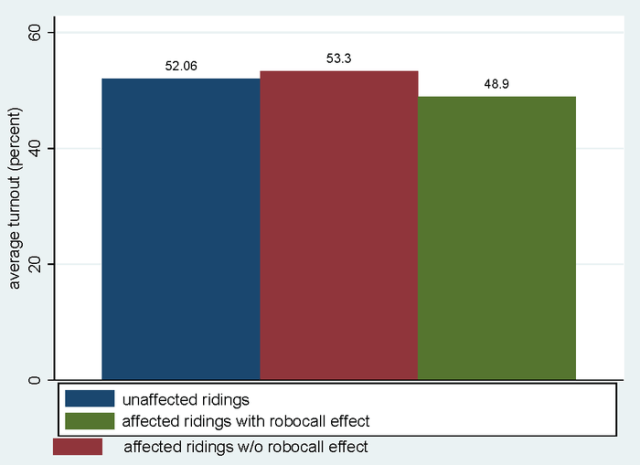
Section 4 of the paper is devoted to robustness checks.
And there are important caveats to be kept in mind when in interpreting these results:
It is important to note that my findings in no way can ‘prove’ whether misconduct or an illegal act has occurred. First, since I can only rely on self-reported incidences of misleading or harassing calls, which are made available through the Canadian media as my data source, there might be a considerable amount of noise present in the data as the actual occurrence of misconduct is obviously not observed. That is, I can only estimate the effect of (the average level of) robocalling in a riding, conditional on the calls being reported, relative to the effect of (the average level of) robocalling in districts where the calls, if any, have not been reported and consequently do not appear on the robocall list. Second, the findings only apply to the artificial construct of an “average” riding, i.e., the interpretation of the results necessitates an electoral district with average characteristics (voter turnout, margin of victory, etc.) which does not actually exist. For this reason, I wish to emphasize that the analysis and the corresponding results are not suited to bring the outcome in a particular riding into question.
This is an important insight into the robocall scandal, and people who are following this file would do well to read Professor Kessler's paper.


 Worthwhile Canadian Initiative
“Are you thinking that these were legitimate live calls? Elections Canada has said under no circumstances do they ever telephone anyone to tell them about a change to the voting location. Live calls of this nature would also be illegal”
Elections Canada doesn’t make those calls, but political parties and candidates (of all stripes) routinely do (according to a recent Forum poll 9% of Canadians reported receiving calls about polling stations in the last eleciton, most of which were not misleading). Live calls (or robocalls for that matter) telling voters about real changes to polling stations (and there were 127 in the last election) or informing them about their polling station are both legal and legitimate (after all, legitimate calls are intended to help voters get out to vote)
Pretending to be from elections Canada is a problem (I don’t know if its illegal, but it would certainly be a bad practice), but according to Ivison’s article, only one person from outside Ontario has reported a call about polling stations claiming to be from Elections Canada. In other words, in this version of events, the fake “Elections Canada” calls were Pierre Poutine inadvertently calling dozens of ridings in Southern Ontario. In any event, this story should be pretty easy for Elections Canada to confirm or deny seeing as it purports to be based on Pierre Poutine’s phone records and the Tory Guelph election database.
“I think it might be fruitless to be searching for a pattern when the underlying data you are working with is highly suspect.It is not necessarily true that ridings that have no reported robocalls did not have actual robocalls.”
Yeah, fair enough (although I note that that hasn’t stopped some people from concluding that there IS a pattern in that suspect data), and I agree that the data is highly suspect, not only might there be unreported robocalls, but some of the reported robocalls may not have been robocalls(people do make mistakes, and human memory being what it is). On the other hand, the Ivison story goes a fair ways to explaining the absence of any coherent pattern in the data we have. It also explains the seemingly low number of complaints reported to Elections Canada – there just wasn’t that many victims.
“according to Ivison’s article, only one person from outside Ontario has reported a call about polling stations claiming to be from Elections Canada”
Ivison’s article is incorrect. Looking at Sixth Estate’s list, there were such reports from Calgary Centre and Edmonton East. Also misdirection in Edmonton Centre though it doesn’t say if the callers claimed to be from Elections Canada. The Edmonton Centre calls appeared to come from Montreal area.
Now I just looked at the first province on the list, which is my own province of Alberta. Go ahead and check all the rest, and you will find more electoral fraud by callers claiming to be from Elections Canada; in BC, Manitoba, etc. So Ivison is dead wrong, and anyone who tries to pretend this nationwide scandal was oonfined to Guelph is a fool or a liar.
And yes, Bob, claiming to be from Elections Canada and misdirecting voters is a criminal act and I damned well want to see the perpetrators jailed for it, including every politician who knew about it and ok’d it.
Most of above arguments are irrelevant. Looking at this legally, I think what’s relevant is:
1. Dominion Controverted Elections Act spells out rules by court ordered byelections. The House has to approve them. This means that absolute terror must be imposed on MPs to ensure that they do not stand against any court-ordered byelections. The commitment to vote for court-ordered byelections against their party/government must be exacted from them now, not later.
2. The standard under that act is “allegations” of “corrupt practices”, not conviction of crimes. Those seeking byelections must do so once ALLEGATIONS emerge, i.e. NOW, and not wait, as there are tight deadlines that apply once the allegations emerge.
3. Conservative Party of Canada knows this and has done everything in its power to drag the process out, knowing that waiting for any kind of certainty diminishes the chance of any court-ordered byelection, thus the political risk of having to vote them down in the House. Certainly it radically diminishes the risk of enough byelections to threaten the majority.
4. Opposition parties have not sought commitment from the CPC to (a) Refuse to oppose byelections on grounds of late filing or doubt of public sincerity in reporting (b) Refuse to appeal court orders even where CPC or MP may have legal right to do so (c) Vote to hold any court ordered byelection without further debate in the House (d) Order byelections to be held together to allow for national campaign. Apparently they do not believe they can win these byelections, or can’t afford them, or aren’t ready to govern, or whatever.
5. CPC was guilty beyond balance of probabilities (civil standard applicable to electoral disputes under the Act and generally in regulatory affairs) in Cadman (judge ruled tape of Harper admission was not altered, though Harper was not prosecuted for perjury despite an eyewitness to his admission), in-and-out (criminal guilt admitted, for whatever reason), and seems also to have pattern of denial of facts until proof appears (e.g. MacKay’s helicopter ride, Clement’s gazebo) and general negligence on facts (Toews’ failure to read his own bill) and plainly false and absurd rhetoric (“with the child pornographers”, etc.). No judge can grant them benefit of the doubt therefore: They are guilty, that is, criminals guilty of obstruction of justice and electoral fraud, until they can prove their innocence. All someone has to do is present that argument in civil court. Why do you think no CPC MPs have sued in Harper-like SLAPP suits? They know their reputation is worthless in civil court and accordingly they cannot sue for any defamation.
6. By handling the evidence itself in Thunder Bay call centre, and not calling in the RCMP and EC and keeping their own people out, the CPC has destroyed the chain of custody and must be presumed guilty of destroying evidence, obstructing justice, and falsifying records during a legal investigation. The obviously false rhetoric that the criminal investigation was confined to Guelph has one purpose: To let the CPC claim in court that they did not know/believe/expect that the call records in general (for every riding) might be subject to investigation.
NDP made a similar disastrous mistake Saturday in failing to release the IP numbers of DDOS attackers immediately to allow for some independent verification and then failure to let unbiased third parties (does PriceWaterhouseCoopers count, if it’s being paid by the NDP to audit?) verify the evidence of deliberate jamming. Immediate followup to those IPs may well have yielded Poutine’s headshot!
In either case, Canadian federal parties are obstructing justice and claiming jurisdiction and control over records on vital public interest matters, that being the integrity of voting. Both parties should be fined and court-ordered never to touch such records once any wrongdoing is alleged, as it has a severe and possibly permanent effect on the faith of the public in the voting system(s).
7. Polls show that the public overwhelmingly wants an objective independent inquiry, which is technically impossible now that suspects (prime suspects, even) have handled “their” evidence. Somewhat fewer want byelections ordered in the most affected ridings. That has been effectively foiled by the lack of any attempt to guarantee that such byelections would be held even if court-ordered, which certainly could have been extracted in the early days of the scandal. However as it unfolds, any belief by sitting MPs that their jobs/credibility is affected, plus the pending election that may be near by that time, complicates that simple debate.
Finally, over 50% of the public, aware generally of the above, have ALREADY concluded that the CPC high echelons were responsible. They have a right to say so publicly, without limit, due to the total lack of reputation that the CPC “enjoys” on electoral integrity and previous attempts to break clear rules (bribing an MP, informing Parliament when obligated to, not denying facts they do know of, not handling evidence in investigations that may point to yourself) and less clear ones (in-and-out, reading your own legislation before smearing others for not supporting it). In this situation it seems impossible to clear the CPC of the “robocon” regardless of what EC or RCMP discover or prosecute.
Similarly, NDP members unhappy with Mulcair can point to the low numbers of interactive participants, possibly suppressed by DDOS, to the hours of difficulty many people reported, and general unreliability of e-voting itself (computer scientists overwhelmingly advise against its use in general elections or important internal votes), and can claim that the Leader of the Opposition lacks legitimacy as well. [This may well have been the CPC’s goal and intent, certainly James Moore during the NDP convention explicitly justified and incited something like a DDOS attack by declaring the NDP “dangerous” and “inefficient” on air – then after the DDOS was known also calling it “hard-left” and “aggressive” without commenting at all on the attack, as if this was somehow not a significant event. Meanwhile CPC operatives heavily exploited the e-voting failure, as if on cue, to far greater degree than Liberals did… none of this looks good and in combination with robocon and in-and-out and Cadman adds up to circumstantial evidence CPC did DDOS as a discrediting/disrupting tactic.]
8. Quebec and First Nations never signed the constitution and thus retain right of appeal to the Crown/Queen and do not recognize the G-G as their only conduit to Her Majesty. In theory they can appeal to the UK government, Her Majesty, the Commonwealth, and the UN, any of which can hear their claim that they are not legitimately represented. Indeed some FN are doing this now on education equity and more will follow suit on Northern gHateway – a racist attack on sovereignty that 100+ FNs have vowed will “never” happen. Quebec, meanwhile, is suing to retain the gun registry and refusing to pay to build prisons for mandatory minimum sentences (courts on their side in this). Accordingly a crisis of federal legitimacy intersects dangerously with any of these standing disputes.
9. A general election seems to be the only solution to restore public trust. The prior GG apparently believed she had no power even to keep Parliament open for a non-confidence vote. The current GG is a Harper appointee as will be future Supreme Court justices and Senators. Accordingly that general election would have to be ordered by a non-confidence vote including some CPC MPs, or by the GG (who won’t do it, period) or Her Majesty (who technically only Quebec and First Nations can appeal to).
10. My prediction: PQ victory in Quebec followed by renewed interest in separation, which can be accomplished without a referendum in circumstances such as this, but would most likely take the form of a carefully timed 50%+1 referendum after some major breach with the Harper “government”. Given Harper/CPC lack of legitimacy and arguments above, France would likely accept ambassador from Quebec, throwing the whole matter to the UN Security Council. I do not expect Her Majesty to realize she is obligated to hear Quebec or FN directly as this is against Cameron’s likely wishes, and the total lack of power of a formal head of state will make the referendum a lot easier for the “Oui” side to win. Especially if they stay within the Commonwealth and argue only to formally cut out the G-G and cooperation with the federal tax/currency system. Quebec on its own would be able to join the deflated Euro, peg to low US$ or start a currency of its own backed effectively by Hydro power demand. Thus the robocon is a cancer that could ultimately destroy Canada as such. So there is some chance of Quebec and Atlantic CPC MPs realizing the danger and turning on Harper, as the GOP turned on Nixon.
I would be interested in the lies, fraud and sneering that CPC supporters can offer re the above. Not because they’ll change minds of any aware person, but because sometimes there are minor admissions of awareness of reality that they can build on to wake up more generally. They’ve been conned. Or should I say “Con-ned.” 😉
NDP as of today alleges over 10,000 IP numbers used in DDOS attack, most within Canada (surprisingly).
This is too large to have been exposed earlier – they were saying 2 IP numbers as late as Sunday.
Accordingly I’ll add another prediction:
11. Extermination of the federal CPC on similar grounds as BC Socreds and Quebec Union Nationale were exterminated, leaving Liberals as the only viable right wing ruling party. I predict it will be impossible to clear them of this interference in NDP internal election, for reasons as above. I feel comfortable saying they planned and carried it out deliberately at some level, and that James Moore gave explicit signalling to CPC supporters that they were to attack or at least not to abort any planned attack. “Dangerous” was possibly a keyword, as in some of bin Laden’s videos the use of specific language was believed to trigger some pre-defined plan.
So, I guess my argument must be that a narrow technical-economic analysis of the “effects” on specific races is, while important, simply not adequate to understand what’s at stake, or how things may unfold from here.
No one alleges, for instance, that the Liberal sponsorship scandal had a huge effect on Liberal Party of Canada election outcomes, but certainly it did seemingly have a huge effect on their fortunes over three elections (2004, 2006, 2008) and arguably continuing into 2011 (when NDP replaced them – and the Bloc – as alternative). Something similar to that decline could happen to the CPC 2012-2015…
On the numbers, though, looking at the assumption that “spread over 50 ridings, there would have been between 416,650 and 2,083,333 recipients of robocalls [or] in 70 ridings that number bumps up to 583,310 and 2,916,690 recipients of robocalls” I don’t believe that in either case “there’d be a heck of a lot more evidence than there currently is. I mean, you call half a million people, and all we end up with is a handful of voicemails?” Entirely reasonable as a careful robocaller would avoid leaving any voice message whatsoever – and leaving no message ‘after the tone’ is an option on almost all outcalling systems.
If “on Kessler’s account 125,000 and 175,000 would-be voters took the message seriously enough not to vote, you’d think their recollection might be a bit crisper on the point – not 31,000 mostly, at least from media accounts, fairly hazy recollections.”
I don’t agree. It takes an astonishing amount of time and money and word of mouth, street signage, etc., even to remind people of the day of the vote and their options. Even providing them with one extra bit of data, like who’s leading in polls in their region and what alternative to Harper has the best chance (however one derives this), is amazingly difficult. Getting the word out about a major electoral fraud involving potentially millions of people programmed to disregard robocalls and especially from political parties, doesn’t happen in a week of intense publicity as we had this winter. It happens over many months. To get to 31,000 reports in a month is amazing but one could reasonably expect an average of 1/3 that many to keep trickling in each month for another year, that is, another 120,000 reports… That’s the nature of the beast. Never more than a sample will hear of the scandal and report it. Especially if the INTENT and PLAN of the robocon was to target voters who are NOT well connected with any activist group or cause, and accordingly far less likely to realize that they are being systematically misled.
In 2008 I called EC myself and got misdirected to a (very inconvenient) incorrect poll. It took me several hours of frustration to find the right place to vote and get there. It had not changed since prior elections. When I mentioned it to municipal officials they strongly discouraged me from reporting it, as if this kind of thing was normal. I have to conclude that reports are suppressed and that civil servants at all levels of government cover for each other’s errors. That said, I didn’t get a fake in-call from EC… not the same type of thing…
Also it counts as an argument FOR a systemic conspiracy that a “fair number of the “robocall” riding are not strategically sensitive ridings (at least for the Tories). Some of them are the safest of the Tory seats in Ontario, while others are ridings where the Tories routinely finish a very distant third. Moreover, we’re not hearing reports of robocalls from some very competitive ridings, where it might make sense to cheat.”
A naive conspirator would hit only the closest Con-vs-not ridings and thus leave the motive plain for all to see. A systematic conspiracy would include calls in to absurd targets (like Harper’s own riding which he had no chance of losing in any analysis) and a few Liberal-vs.-NDP anyone-but-Con ridings. That’s exactly what happened. Crapflood and scattergun tactics – go look those up…
So it takes a pro-Con observer to conclude that this vindicates the CPC – a neutral observer takes it as evidence that the conspiracy had sufficient resources to waste some on coverup/overkill/crapflood and sufficient sophistication to realize that this would give it talking points after the fact.
Unfortunately people who make this claim of vindication by apparent randomness, when some expected-close ridings were indeed targetted, come across looking like apologists for sophisticated crime. Also, those who claim that “Con” is somehow an insult, when there are dozens of pejoratives in regular use (Conjob, RepubliCon, ConArtist, Harpler, etc.), and “Con” is merely the first syllable like “Dem” in “Democrat” or “Lib” in “Liberal”, and calling that in itself evidence of bias, are clearly serving another agenda. To most Canadians “Tory” still means “Progressive Conservative” (very much alive in many provinces, and the party to which two living PMs adhered) and “Con” means Reform, Alliance, or CCRAP (the actual name of the party which it approved bizarrely in a public meeting). To ask people to call a party that favours radical change to every aspect of law and government (warrantless spying, First Nations defined as “radical” or “terrorist”, unlimited gun proliferation, mandatory sentencing for victimless crime, describing a legitimate Westminster coalition as a “coup”, etc.) as a “conservative” party also simply defies the dictionary as it previously existed.
When I want to insult the Cons, I call them Conjobs, fascists, Dirty Oil’s marketing department or (now) Robocons. They’re a form of organized crime, and perhaps the worst form of organized crime that has ever existed in Canada. I don’t expect it to survive them if they manage to keep it together and run Harper again in 2015, much as the US would likely not have survived Nixon serving out his 2nd term.
Federal judges, and ultimately the Supreme Court of Canada, now get to wade in on the “effects of robocalls on voter turnout” etc.. It will be interesting to see if either side refers to any of Kessler’s research in arguments. Some coverage of byelection lawsuits:
http://www.cbc.ca/news/canada/story/2012/03/27/pol-robocalls-legal-challenge.html
http://rabble.ca/blogs/bloggers/karl-nerenberg/2012/03/hill-dispatches-robocall-court-cases-could-mean-elections
http://www.ottawacitizen.com/news/Robocalls%2BActivist%2Bgroup%2Bfiles%2Blegal%2Bchallenge%2Bresults%2Bseven%2Bridings/6362995/story.html
To me what’s most interesting is the plain absurd stall tactics of the Cons. They are clearly going to strongly challenge the suits and refuse to hold byelections using their House majority, and that could well mean the end of the Canadian federal system as such. (Always one of Harper’s goals).
http://www.whitehorsestar.com/archive/story/mp-strongly-condemns-vote-results-challenge/
Alleged Yukon MP “Leef said Tuesday the lawsuit is “an absolutely transparent attempt to overturn the election results they weren’t happy with.
“My opinion is it’s absolutely pre-emptive because Elections Canada hasn’t finished its investigation, and by all accounts probably hasn’t even started it in the Yukon,” he told the Star.
Neil said the Elections Canada investigation is looking into criminal activity, whereas the lawsuit is focusing on overturning election results where interference may have inhibited the right to vote, regardless of who’s responsible.
Leef said he fully supports an Elections Canada investigation into the allegations in the Yukon.
“What binds our democracy together is the fact that we have fair, transparent, legal elections and if someone is suggesting that that wasn’t the case then Elections Canada has the authority and the duty to investigate it. We need to support the investigation, we need to encourage it,” he said.
“When I say we, all of us that were involved in the election, every single party needs to provide all of the information that they have, that’s asked of them, in an effort to expedite Elections Canada’s investigation so we can get to the bottom of it, so we can get find out who did it and whoever that is needs to be held accountable. And that includes anybody that’s providing false or misleading information to spur on an investigation,” said Leef.”
Once again pure distraction and noise from Cons: EC would report too late to qualify for a byelection. Cons have not released all their records as other parties have, and furthermore altered (or “reviewed”) them in Thunder Bay without EC or RCMP supervision… This kind of tactic by Leef screams guilt. He’s a criminal and criminal accomplice and setting the tone for other MP belligerence.
If he’s read the Acts, it sure doesn’t seem he understood them: EC alters processes and levies fines, RCMP lays charges, and civil courts order byelections. That’s how it works, the standards of evidence are different. Leef can apply to delay any ruling until EC issues a report, but, that means he gets to vote on budgets etc. and force old people to keep working at manual labour at 65 and 66… while he, an MP, retains pension and many upper middle class (retirement income closer to $100K than $50K) continue to draw OAS at the direct expense of the poor.
Judges are directed to act very expeditiously in these cases, in the law itself, and the loser has automatic right to appeal to the Supreme Court of Canada, so this may be Flaherty’s last budget… He may be facing those angry old voters a lot sooner than he thought.