An average person, asked to explain the impact of cutting taxes, might well reason:
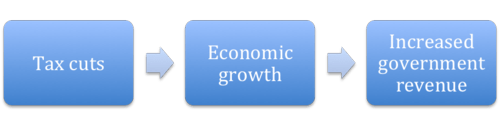
I have represented this argument in flow chart form to give it a spurious air of logical coherence. Yet any flow chart is only as good as the reasoning that underlies it. In this case, that reasoning is seriously incomplete.
A tax cut has two immediate impacts on government revenue. First, less revenue is raised from the existing tax base, from the firms, consumers and workers who are presently paying taxes. In the diagram below, the loss in revenue is shown in the two pink-ish rectangles labelled "Revenue loss." Second, a tax cut may reduce the gap between before tax and after tax wages. If it does, people may supply more labour, putting downwards pressure on the the before-tax wage rate, encouraging firms to hire more workers. The tax revenue gained from new workers, and from people working longer hours, is shown in the purple rectangle labelled "Revenue gain" below.

Notice that the benefits of the tax cut are shared between employees, who pay lower taxes, and employers, who are now able to offer lower wages. This division of benefits, as well as the relative magnitude of the revenue loss and revenue gain rectangles depends upon how firms and workers respond to the tax cut.
Most empirical research suggests that people do not usually change their work hours much when their after-tax wage rate changes. There are even studies that have found 'backwards bending' labour supply curves. People sometimes respond to an increase in their after-tax wage rate by reducing their work hours, because they do not have to put in so many hours to pay the mortgage. In sum, based on what economists know about labour supply, one would expect tax revenues to fall when tax rates are reduced.
Recent experience with tax cuts – the reduction in the federal GST in Canada, for example, or the Bush tax cuts or the US, for example – supports that intuition. As GOP policy adviser Bruce Bartlett put it, "Few people remember that a major justification for the 2001 tax cut was to intentionally slash the budget surplus….In this regard, at least, the Bush-era tax cuts were highly successful."
The reason why hours worked are fairly unresponsive to wage rates is that many people do not have much control over their work hours – a nine to five job requires a fixed number of hours per week. It can be argued that the rich are different from you and me – they have more options, are more free to choose when and where they work, and thus their labour supply is more elastic. Perhaps tax cuts for footloose and fancy free jet setters have some revenue raising potential?
High tax rates on the rich can cause an erosion of the tax base and reduce tax revenue – though the size of this effect is debated. The Rolling Stones' Mick Jagger, Keith Richards and Charlie Watts, for example, fled Britain's high tax rates for the Netherland's less onerous tax regime decades ago.
But, as the NY Times reports "over the last 20 years, according to Dutch documents, the three musicians have paid just $7.2 million in taxes on earnings of $450 million that they have channeled through Amsterdam — a tax rate of about 1.5%, well below the British rate of 40%." There is no way that the British could lure the Rolling Stones back without providing even more generous tax treatment.
So far I have been taking it for granted that cutting taxes will increase incentives to work and to save. Yet even this is not obviously the case. Economic decisions are made at the margin. Unless a tax cut changes incentives on the margin, it will usually create little or no behavioural response.
Take, for example, a $1000 increase in the basic exemption or personal amount tax credit, the amount of income that a person can earn without paying income tax. For every person who is currently earning more than the basic exemption, an increase in that exemption is just like getting a cheque in the mail. It means the person has more money in her pocket, but her incentive to work longer hours, to put extra effort in at her job, is unchanged. If anything, she might feel as if she can afford to take a day off, and cut back on her work hours.
For students of economics, the impact of an increase in the basic personal amount on work incentives looks something like this:
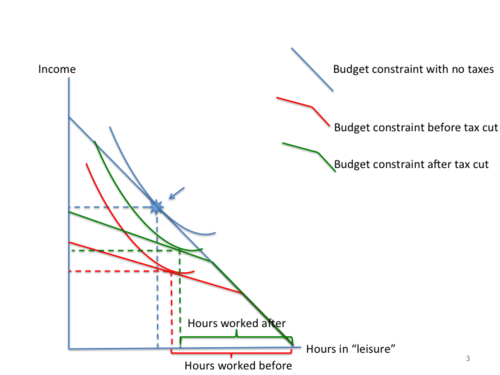
Except for individuals who are just to the left of the kinked point on the red budget constraint, the increase in the tax exemption will act like an increase in income. It increases the amount of leisure the individual can afford to consume, and thus would be expected to decrease the hours the individual works.
There are many good reasons to increase the basic tax exemption. It is a progressive way of reducing taxes, as the benefits as a percentage of income are greatest for low income people. It can be an important part of a strategy to reduce "welfare walls" and encourage people to enter the labour force. But it is unlikely to produce any kind of behavioural responses that lead to a significant increase in tax revenues.
The basic lesson of economics is that people – including governments – aren't stupid. If it was possible to generate an immediate increase in tax revenues by reducing tax rates, taxes would be cut instantly. Taxes are what they are in part because reducing taxes creates an immediate revenue short-fall.
The ultimate impact of a tax cut depends upon how that revenue short-fall is met. Are basic government services, such as transportation infrastructure or the legal system, cut? Inadequate infrastructure is an obstacle to doing business, just like high taxes, and can impede economic growth. Does the government borrow to maintain spending levels? High levels of government debt are hardly good for the economy. Is redistributive spending, such as social security and medicare, scaled back? It might promote economic growth, but it would be political suicide.
[Update] But what about the argument that Ryan makes in the comments below, "You can't create a low-tax regime in the long run without first cutting at least one tax in the short run"? It is true that circumstances change. If other countries cut corporate tax rates, the country that tries to stick with its existing regime may face a loss of revenue. The internet makes it easier to run a business from a Barbados beach house than it was 20 years ago. The first question to ask someone who proposes cutting taxes is: "What has changed? Why is the previous tax rate no longer optimal?" The second question to ask is: "What is a reasonable estimate of the likely behavioural response?"
Take, for example, the case of Amazon UK as described in a recent article in the Guardian:
The UK operation avoids tax as the ownership of the main Amazon.co.uk business was transferred to a Luxembourg company in 2006. The UK business is now owned by Amazon EU Sarl and the UK operation is classed only as an "order fulfilment" business. All payments for books, DVDs and other goods go directly to Luxembourg. The UK business is simply a delivery organisation.
The latest 2010 accounts for Amazon EU Sarl show the Luxembourg office employed just 134 people, but generated turnover of €7.5bn (£6.5bn). In the same year, the UK operation employed 2,265 people and reported a turnover of just £147m. According to the SEC filings, UK sales that year were between £2.3bn and £3.2bn. Amazon in the US has earned an average 3.5% profit margin over the past three years.
The only way to persuade Amazon to unwind these lucrative arrangements would be to reduce UK corporate income taxes to a level lower than Luxemburg's. Any smaller reduction would be unlikely to produce any behavioural response.
There are no twenty dollar bills lying on the sidewalk. Cutting taxes has consequences, and not all of them are pleasant.
Update: for an explanation of the Laffer curve, see this interview with Arthur Laffer on Icelandic television.
Update: this backgrounder from the Center on Budget and Policy Priorities makes the point that tax avoidance and evasion strategies, while they impact tax revenues, do not necessarily have significant impacts on the real economy. Also gives references.


 Worthwhile Canadian Initiative
Frances – True enough, but I’m not sure that in itself is enough to dismiss the idea that increasing tax rates presents new costs and challenges associated with collecting that revenue. But, like I say, in terms of pure theory, the concept is hard to ignore.
More realistically, I think certain individuals are more “tax-sensitive” than others. Like you pointed out, tax cuts only matter to people at the margin. But “the margin” isn’t actually determined by the economic conditions, it’s determined by that person’s utility function.
In other words, some people face a $200 tax decrease and think, “Stephen Harper is ruining this country,” and then basically put that money in their bank and forget about. Other people face a $200 tax decrease and think, “THE CONSERVATIVES GOT IT RIGHT AGAIN!!!!1” then they go buy a Playstation to celebrate. I don’t even think a person’s income level is what determines this, I think it’s their values, their utility function. It’s intangible. Mises would call it “an ultimate unknown.”
Ryan –
“certain individuals are more tax sensitive than others”
I agree, and I suspect that some things economists tend to dismiss as poor tax policy are basically ways of giving highly tax sensitive people opportunities for low cost tax evasion (claiming children’s fitness amounts for kids whose involvement in hockey is limited to the videogame NHL 2012).
“that in itself is enough to dismiss the idea that increasing tax rates presents new costs and challenges associated with collecting that revenue.”
One of the key arguments I’m making here is that there’s likely to be an asymmetry – high tax rates will induce people to leave. Low tax rates will not necessarily make them come back – tax rates have to be lowered quite substantially to make unwinding tax shelters worth while, plus after a while a person gets settled in New Zealand (or wherever) and doesn’t necessarily want to come back.
I have to commend Amazon’s international tax and transfer pricing teams, as well as their external advisers for a job well done avoiding UK corporate taxes. They managed to station almost all the high-value-added functions, risks and assets in Luxembourg, while leaving the routine, low-value-added order fulfillment functions to be performed in the UK. This arrangement is entirely acceptable under transfer pricing rules. I would be more concerned if Amazon UK’s business was able to avoid VAT than if it were able to avoid UK corporate tax. That being said, Amazon’s arrangements likely also make it likely that if losses occur, they will end up trapped in Luxembourg, where they will be hard to utilize. International tax planning can be a double edged sword.
Also, with respect to the comment that it is easier now to run a business from a beachhouse in Barbados now than it used to be, I respectfully disagree. Without some form of economic substance in Barbados, it is difficult to justify attributing most of the corporate profit there through transfer pricing. It is hard to get a lot of good quality technical and operations staff willing to live and work in a tax haven. A lot of these places have poor infrastructure, air links, schools and hospitals. They also tend to have high living costs.
Frances, I should have seen, that the video was made 4 years ago: – )
With a false quote of the Iron Lady: “socialism works until you run out of other people’s money”
This seems to hold for that kind of capitalism as well
btw, how unreadable is my Reagan tax cut example ? completely or just nearly ?
On tax rates, I think the German example is, that you cant run more than 60 % for more than 10 years, without people leaving in substantial numbers, but 48 % seems to be tolerable. And my view into the future is, that we will have some 53% in about 10 years.
Most governments need more money, and prosecuting tax cheats becomes more effective, see what the US do to Switzerland, this is getting pretty rough, even without sending in the 7th cavalry, as a former German FM talked about :- )
From my perspective, a left / green government reducing marginal tax rates to 45 % in 2004 worked remarkably fast to right this ship. There is a lot of psychology in such things, and numbers are not the most important influence.
The (christian democratic) right to raise taxes, and the (social democratic) left to cut benefits leads to unity and cohesion of the broad center, but introduces new fringe parties, like the socialists in 2005 and the pirates now.
Mandos,
the German Ordnungspolitk view on the Central bank independence is:
http://www.bloomberg.com/news/2011-12-02/merkel-says-joint-euro-bonds-unthinkable-as-eu-faces-debt-crisis-marathon.html
Merkel said the ECB has to be free to move in any direction and that she won’t comment on what it does or doesn’t do. The ECB’s independence to take decisions “in any direction” must be guarded, Merkel told lawmakers.
The ECB is independent and must choose its own method of ensuring the euro’s stability “without being praised or criticized”
genauer – I’m trying to pay some attention to my long-neglected economics of taxation students so am not replying to all posts, but for what it’s worth, my totally unscientific reading of this is that Laffer curve effects for most forms income start kicking it at around 50%. Which is not dissimilar to what you’re saying for Germany.
@Scott P Bacon
I think you made a strong case for the explanatory power of diagrams here (hope your reading Determinant!). I agree with Jim, great post!
My complaint was not against diagrams, I am very much in favour of diagrams, my complaint was against drawing conclusions based on logical deductions from axioms that are proven false in the real world, that is I object to conclusion without experimentation and verification. As Frances’ post goes into such verification and real-world comparisons in depth, I am quite satisfied with this post.
Second, Frances asked how we could increase tax collection on wealthy people. Simple. Pass some better laws and go after tax-havens.
But, as the NY Times reports “over the last 20 years, according to Dutch documents, the three musicians have paid just $7.2 million in taxes on earnings of $450 million that they have channeled through Amsterdam — a tax rate of about 1.5%, well below the British rate of 40%.” There is no way that the British could lure the Rolling Stones back without providing even more generous tax treatment.
Do what the US does and tax citizens on worldwide income. The Stones could not get away with stashing income in Amsterdam under that regime. While we’re at it we could go after tax havens who charge those high upfront fees in return for bank secrecy and non-domiciled tax rates.
The US has cracked down hard on Switzerland in the past few years; Swiss bank secrecy is over and in the process they obtained insider testimony on how those Swiss banks with fancy offices in Geneva and Zurich whose customers travel in limousines actually operate. It was criminal, actually criminal (Genauer has more cause to be angry at the Swiss than Icelanders). They would solicit clients in the United States at fancy sponsored gatherings (with no license or registration, in flagrant violation of laws to the contrary), advertise their tax-evasion services (again illegal) and go so far as to pay their customers in diamonds (easy to smuggle and easy to avoid reporting).
I support Canada moving to a worldwide income liability for income tax.
@Determinant,
for EU customers, Swiss bankers didn’t have to travel, they were coming into Switzerland, and sitting there and putting money into a bank account is not a crime. That people have to report income themselves is nothing unusual, especially from foreign countries, the same holds for me with my US accounts, nothing illegal with that. Switzerland has now agreed to collect summary taxes on German account holders, equivalent to the German procedure, very nice, supportive, and neighbourly behaviour, ZERO complaints from my side. Just the German social party is throwing a little tantrum, the usual. They have a local election (where they govern) to win, and have to drown out, that their promises of new social goodies were repeatedly rejected for unconstitutional budget, too much debt, the usual :- )
Determinant: “I am quite satisfied with this post.” High praise indeed! Thank you.
“I support Canada moving to a worldwide income liability for income tax.”
Interesting, I wonder how many people would renounce their citizenship for tax reasons, and what that would do to the amount of “foreign investment” in Canada. The numbers of people would be small, but the assets owned would be non-trivial (are the descendants of KC Irving resident in Bermuda for tax purposes too?).
If they aren’t resident for tax reasons aren’t they foreigners in an economic sense already? The US has worldwide tax liability and the number of renunciations each years is tiny. Hardly any are for tax reasons. Most are for political or personal reasons (life is in another country, wants to integrate, wants high or sensitive office).
@Genauer:
There was a documentary on 60 Minutes with insider testimony from Bradley Birkenfeld, a UBS employee. Identical content here: http://www.globalpost.com/dispatch/europe/100724/swiss-banking-secrecy
Switzerland now has to report the income of US citizens to the IRS. Bank Secrecy for Americans is over.
Earning income and not reporting it for tax purposes is a crime in the US. Providing services where the explicit intent is to not report the income earned to the IRS is a crime and it can happen anywhere in the world because US tax liability is worldwide.
It was fraud. Soliciting financial services in the US without complying with business regulations, for the purposes of tax evasion is fraud.
Banking, especially offshore banking, is all about the “veneer of respectability”. Few people question your loans, fewer still question your depositors if you appear to be respectable. There are rows of offshore banks in Nassau, Bahamas with tidy, nice-looking office buildings, resplendent with plans and architectural features, but who are their clients? Why are they not going to their local (usually US) bank? Where is the money going to pay for all those high fees (Swiss banking fees are very high)? Those are the questions they don’t want you to ask.
It’s the same reason that Canadian banks used to build palatial branches that exuded permanence and wealth.
@Frances,
I actually refused a Green Card because of Tax reasons.
@Determinant
I was talking about the Swiss / EU customer relationship, and there was nothing illegal on the Swiss Side, I have to be indignated about.
Both,
I would really like to discuss my Reagan Tax example with you, because the very most people don’t get it, that pushing people into tax avoidance causes substantial social loss.
And I would like to have a somewhat polished example handy for future discussions here, and in other places.
Further to renunciation for tax avoidance, the US levies an expatriation tax in which a citizen’s capital property is deemed to be disposed of on the date of renunciation, triggering significant capital gains liabilities.
On further investigation Canada charges a “departure tax” on those who cease to be resident here for tax purposes, so it is a more matter of refining the definition than objecting to the principle.
Canada generates a significant number of renunciations for the US because of cradle Americans who are defacto Canadians and have been since primary school. Or high-fliers like Bob Hommie (the Friendly Giant, who lived near to were I live now and is remembered well by locals) or Ernie Coombes (Mr. Dressup, who only got his Canadian Citizenship in 1994, I was there on Parliament Hill when he was sworn in.
There is no doubt that at some point tax reductions do increase revenue.
Consider an extreme case: a 100% tax rate on everything. Government revenue would be zero, since there would be no economy outside of the black market. Here reducing tax rates would increase revenue.
Consider another extreme case: a 0% tax rate on everything. Again revenue would be zero, so increasing tax rates must increase revenue.
Somewhere between these two zero-revenue extremes we have a point of maximum government revenue.
So the proper question is not whether decreasing tax rates can increase government revenue, but under what circumstances does it do so.
rabbit – We can all agree that there is a Laffer curve, and that it is theoretically possible that we are on the right hand side of it.
This is where the idea that there are no twenty dollar bills lying on the sidewalk comes in.
Fifty or thirty years ago, when income taxes were still relatively young, it might be plausible to argue “we got this wrong, we set the tax rates too high, now we see the light.”
It’s been over 30 years since Laffer drew the most famous curve ever drawn on the back of a napkin. Tax cutting has become political orthodoxy in a number of places. What possible reason is there to think that – if there were revenue gains to be had from cutting taxes – they would not already have been exploited by aggressive anti-tax governments such as Bush and Harper?
You could respond “ah, yes, but tax competition is more intense than it used to be, our major rivals have reduced their taxes, structural change makes tax enforcement more difficult.” In which case show me the evidence!
The Laffer Curve, as Rabbit points out, works on the assumption that avoidance or evasion is a viable alternative and will be taken. That’s needs to be examined.
As the Laffer Curve came on the scene, another legal doctrine came on the scene too: the doctrine of fiscal nullity. The UK and Australia have fully adopted it and it is the inspiration for the General Anti-Avoidance Rules in Canada. It works like this:
I could complete transaction A in one step and on the face of it owe tax B. But if I take three steps, each of which is legal, which together generate a tax loss to offset tax B. Formerly this was legal in many places and it led to large tax losses. Under the Fiscal Nullity doctrine the three-steps are considered self-cancelling since they produce a tax loss only and not a true economic loss. I’m not actually out the money. The courts consider the intermediate steps to be an illusion and abusive.
So if you can’t avoid taxes through a transnational two-step you can either not report income (but your consumption will be traced, its a basic tax enforcement technique) or leave. But don’t try to hide your money in Switzerland, the game is up there.
Frances is awesome. This post cuts through some serious BS.
It’s interesting to look at what David Hume says in On the Balance of Trade, that it is commonplace for people to assert that the imposition of a new tax generates the ability to pay it. So we’ve come 180 degrees in the art of holding mistaken assumptions about taxation!
Very timely post, I just went to a seminar by Roger Gordon yesterday where he told us that corporate tax rate cuts would increase tax revenue- So what’s the risk in cutting corporate taxes? Although he didn’t go into chapter and verse, I guess he is arguing a corporate tax cut should increase growth and investment (and thereby increase tax revenue), and discourage income shifting by mobile international capital. As an aside, I think he may tend to underestimate the degree to which corporate taxes fall on economic rents.
Taking his comments at face value- An interesting academic question to explore would be looking at the payoff period for such reforms. Because in the short term at least governments that reduce corporate taxes are reducing their tax base, and losing revenue. How long do governments have to wait on average to see a payoff for these reforms? An answer to that question would be very valuable to people in engaged in the process of tax reform.
Interesting, I wonder how many people would renounce their citizenship for tax reasons, and what that would do to the amount of “foreign investment” in Canada. The numbers of people would be small, but the assets owned would be non-trivial (are the descendants of KC Irving resident in Bermuda for tax purposes too?).”
Interestingly, Canada was proposing a series of non-resident trust rules which were intended to deem non-resident trusts with Canadian resident beneficiaries/contributors to be residents of Canada (and thereby subject to tax on their worldwide income). Sounds good in theory. Unfortunately for Finance, in practice, the rules were unworkable. Amongst some of the goofier results, foreign trusts with Canadian investors that were non-taxables (pension plans, etc.) would have been caught by the rules. And, of course, the imposition of Canadian tax on foreign resident entities on their worldwide income would seriously piss-off all Canada’s tax treaty partners who, but for these rules, would be the only ones entitled to tax those entities (the rules applied regardless of Canada’s tax treaties – who says international law binds parliament). As a result, Finance was told out and out by the Senate that the rules wouldn’t be enacted in their then current form (who says the Senate doesn’t do anything). They’ve come back with more modest proposals, which I confess I haven’t been following closely.
In terms of imposing tax on the basis of citizenship, I’m not sure the US example is inspiring. How many million US citizens living in Canada are, theoretically, risking hefty fines, if not jail time, for non-compliance with their US tax obligations? Sure, in practice you like to think the US would take a practical view of these things, but who risks their financial health or freedom on the reasonableness of the IRS?
That said, I have wondering about the possibility of imposing a citizenship poll tax on Canadian citizens who are not residents of Canada, if only to discourage the “instant” Canadians who miraculously rediscover their attachment to Canada shortly before WWIII breaks out in their homeland, or when the time comes to be extracted from some hellhole of a foreign prison. But, that’s a different topic.
Determinant, unfortunately for CRA (but thankfully for tax advisors and their clients) the GAAR has not lived up the expectations of tax authorities (and the fiscal nullity doctrine, while partly reflected in the GAAR, never made it into Canadian law). It’s been a while since I checked the statistics, but my recollection is that CRA still has a losing record in GAAR cases, and that’s after a lengthy process of screening out all but the most abusive cases.
In any event, most tax avoidance transactions are less artificial than that. For example, a common one a decade ago (which was subject of a recent SCC case) involved Barbados trusts engaging in “freeze” transactions (in simplified terms you trade you common shares in the company for preferred shares having a fixed redemption value equal to the current FMV of the company, then sell common shares to the Barbados trust for peanuts – because all the value is in the preferred shares). Nothing offensive or artificial about it, but all the future growth of the company accrues in the non-resident trust. So far the CRA has been going after the cases with the best facts (for them) and they’ve had success without having to rely on GAAR (in one case the court found that the trust was never properly formed, in the recent one the SCC concluded that the “Barbados” trust was actually a resident of Canada).
Timothy: “An interesting academic question to explore would be looking at the payoff period for such reforms. Because in the short term at least governments that reduce corporate taxes are reducing their tax base, and losing revenue. How long do governments have to wait on average to see a payoff for these reforms?”
A question that is much easier to ask than to answer! Over time the economy will (hopefully) grow anyways. How much of that growth can be attributed to tax cuts? Very hard to say, especially since tax cuts are potentially endogenous, i.e. economic growth causes taxes to be cut rather than the other way around.
Bob:
I for one fully support enacting the Fiscal Nullity doctrine into Canadian law by whatever statutory means will compel the Supreme Court to actually get with the program. Hmm, something for the Mulcair Government 🙂
In general I have a very low view of most of the advice tax advisors give, Artificial freeze transactions and the like.
“Amongst some of the goofier results, foreign trusts with Canadian investors that were non-taxables (pension plans, etc.) would have been caught by the rules.”
What’s goofy about it? Tax the income on accrual (as at present) with exceptions for pension plans, a class that already gets exceptions. Life insurance policies are taxed on accrual if they pass a certain threshold and become more investment-like than insurance like. Other than not liking the tax.
In terms of imposing tax on the basis of citizenship, I’m not sure the US example is inspiring. How many million US citizens living in Canada are, theoretically, risking hefty fines, if not jail time, for non-compliance with their US tax obligations? Sure, in practice you like to think the US would take a practical view of these things, but who risks their financial health or freedom on the reasonableness of the IRS?
This subject was brought up in the Globe & Mail and due to the Canada/US Tax Treaty most people in that class would owe very little tax, besides there was an amnesty anyway.
Frances,
Wouldn’t one method be to use a VAR approach, and decompose the tax effect along with various other explanatory variables chosen?
Tim – think what the data is going to look like – if econ growth picks up five or ten years after taxes are cut, how do you know it’s the tax cut as opposed to something else? There is no theory that says when tax cuts should increase revenues, and econ growth means revenues will quite likely increase eventually if you just wait long enough.
One way of thinking about this is to try to imagine where the increased corp inc is going to come from. Remember, it has to be a lot of corp inc – e.g. if the corp inc tax rate is cut by 10%, the corp inc tax base has to grow by more than 10% to have any kind of revenue impact. That’s a lot of growth in the base. So where are we going to get that growth from?
– people who are currently employees starting their own business (the Lee Valley Tools effect). Some of that might happen, but the gains on the corp inc tax side are offset by a loss on the personal inc tax side, and I find it hard to believe that there are a whole bunch of Mr Lees out there with the potential to start multi-million dollar businesses who are thinking “I won’t bother trying because the corp tax rates are so high.”
– people who are currently relaxing at home or working in the underground economy and using resources for personal consumption starting businesses. Again, there may be some people who are induced to move from growing pot to growing organic vegetables by a reduction in corp inc taxes, but I don’t see a huge amount of revenue potential there
– corporations who might otherwise have located in Mexico locating in Canada instead. Sure, we can get corp tax revenue that way for a little while – until our competitors cut their corp taxes. Race to the bottom anyone?
Tim – I’m not saying that we don’t have to respond to international tax competition. People want jobs. But at the end of the day it is highly unlikely that we will end up with more revenue than we have right now. Best case scenario is that we end up with more revenue than we would have done had we not matched other country’s tax cuts.
Before you say Ireland – EU subsidies. Barbados and Luxemberg can pursue the tax haven strategy because they have such a tiny pre-existing tax base.
“In general I have a very low view of most of the advice tax advisors give, Artificial freeze transactions and the like.”
Determinant, that’s the point, there’s nothing artificial about a freeze transaction. It has real legal and economic substance – at the end of the day, somewhat is subscribing for new shares at fair market value. .
“What’s goofy about it? Tax the income on accrual (as at present) with exceptions for pension plans, a class that already gets exceptions. Life insurance policies are taxed on accrual if they pass a certain threshold and become more investment-like than insurance like. Other than not liking the tax.”
Well, taxing pension plans (RRSPs, etc.) is goofy – and the rules did that. Taxing foreign trusts on their worldwide income when they have very small investments by Canadian investors is pretty goofy. Trying to tax foreign trusts in violation of our treaty obligations, while legal, is pretty bad policy. And of course, I didn’t get into the heart of the rules. Amongst the other provisions, Canadian beneficiaries/contributors to those foreign trusts would be jointly liable for the Canadian tax liabilities of the trust. Fair enough if the trust you have in mind is a Barbadian Trust, but query whether that’s quite as sensible when you’re a small investor in a large foreign commercial trust (say, something akin to our income trusts). All this keeping in mind that the legislation itself was more or less unintelligble to even the most experienced tax professionals, making compliance a nightmare.
It’s easy to think up rules that target abusive transactions, the challenge is dreaming up rules that target abusive transactions without catching perfectly innocent ones. That’s a lot harder.
“This subject was brought up in the Globe & Mail and due to the Canada/US Tax Treaty most people in that class would owe very little tax, besides there was an amnesty anyway”
I hope that’s not what the Globe and Mail said, because it’s wrong. First, liability for tax is less of an issue since most people are paying more tax in Canada than they would in the US, even in the absence of the treaty, they likely wouln’t have a net tax liability (although that can be tricky, things that aren’t taxed in Canada, TFSAs or the sale of your principal residence, are taxed in the US, so you could have a mismatch between your Canadian income and your US income). Rather the concern relates to the various (very punitive) penalties relating to reporting and filing obligations in the US – the treaty doesn’t provide any relief on that front.
Secondly, there isn’t an amnesty (there was, but it expired), at least not as conventionally understood. The IRS is extending administrative relief. In essense, dual-citizens are relying on the administrative goodwill of the IRS. You’d hope the IRS would be reasonable in applying US law (and will continue to be so reasonable in the future – their compliance obligations aren’t going away), but how keen would you be to rely on the goodwill of a foreign tax collector of a country running a trillion dollar deficit?
And it’s worth noting, in keeping with the theme, that in order to try to catch all their citizens, the US has proposed very onerous compliance obligations on foreign financial institutions (the so-called FATCA rules). Two points are worth noting about those rules. First, the impose a hefty cost on non-Americans (since, in theory all sorts of financial institutions, from banks to mutual funds, you name it will have to comply with US reporting and withholding obligations). Second, only the US is in a position to do it – since foreign financial institutions are simply not in a position to say “we’re not dealing with you, or investing in your country” (if Canada tried to do something like this, we’d be told to F-off and people would invest their money elsewhere). I gather the US has expressed a willingness to negotiate exceptions to these rules with treaty partners, so we may be able to avoid the worst effect of those rules, but it highlights the unworkability of citizenship based taxation in a globalized world.
Frances:
You assume that the authorities would immediately cut taxes if this would increase revenue. That is a dubious assumption.
First, the economy is an extraordinarily complex beast. No one can ever be certain just what the effects of a change in the tax code will bring about no matter how smart they are. If you asked ten different economists what the effect of a given change in tax rates would produce, you would get eleven different answers, and they would all likely be wrong.
Second, short-term and long-term consequences can be completely different. An increase in capital gains tax might increase tax revenue in the short run but decrease it in the long run. So one must ask “What is the time horizon?”
Third, politicians are not driven solely by economic concerns. A drop in tax rates for the wealthy might make perfect economic sense but be unpopular with the constituency. A left-leaning party, for example, might be bent on “getting the rich” even to the extent of hurting everyone.