There are three ways to reduce the price of a product. The first is through technological innovation – the reason why the price of computing power and memory storage is now so low. The second is to cut wages, or the price of other inputs. Even though the basic technology of sewing t-shirts has not changed in decades, textile manufacturers have kept costs down by shifting production to low-wage locations.
The third way to reduce prices is to eliminate rents. For example, manufacturers can charge thousands of dollars a year for Thalidomide - a 50 year old drug with very low production costs – because they enjoy patent protection. Eliminating that patent protection – and the rents it brings – would reduce the cost of Thalidomide to patients.
Milk and cheese costs more in Canada than in most other countries. The question is: why?
The basic technology of milk production hasn't changed for thousands of years: feed in, milk out. Cows aren't paid, so wages should not an issue. Hence most people explain the price difference between Canada and the US in terms of market rents. There are high tariffs on imported dairy products, and restrictions on the quantity that can be produced domestically.
The picture below shows a textbook analysis of the impacts of milk quotas and tariffs, and what would happen if they were eliminated.
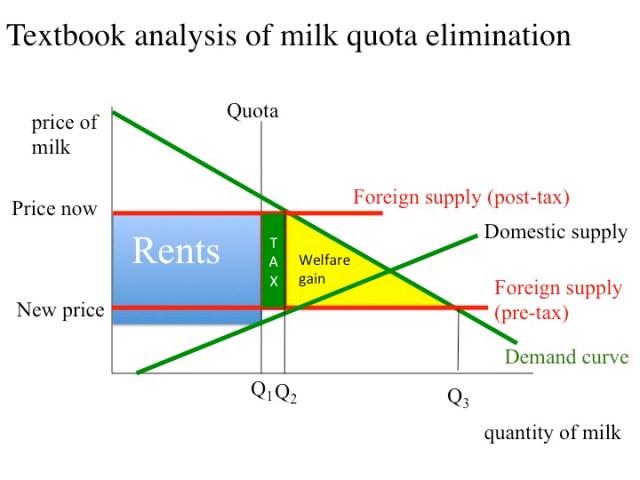 This might be called the fat-cat farmer model of the dairy industry. With quotas and tariffs, the market equilibrium is Q2. On the margin, the availability of imported (albiet taxed) milk and cheese is what limits the amount Canadian farmers can charge. Canadian market prices are thus determined by the (after tax) price of foreign imports. Farmers enjoy rents, or super-normal profits, equal to the difference between the domestic supply curve, which measures their cost of production, and the price they receive for their products.
Elimination of milk quotas and tariffs would, in this story, lead to an increase in milk imports, and a fall in the price of milk. Domestic farmers would stay in business – they just wouldn't enjoy the super-normal profits they were earning earlier. In fact, domestic farmers even stand to gain by the possibility of expanding milk production. On balance, the gains to consumers would outweigh the rents lost by farmers (and the government's reduction in tax revenue) by the amount shown in yellow, the "welfare gain" from eliminating tariffs and quotas.
The problem with this analysis is that it fails to take account of the structure of the Canadian dairy industry, and that of its international competitors.
First, because the value of Canadian dairy quotas has become capitalized, a production quota is part of a farmer's working capital. In some parts of the world, a successful farmer expands her operation by building more barns and growing her heard. In Canada, a successful farmer expands production by buying more quotas.
To the extent that new entrants to the dairy industry have to purchase quotas, the presence of quotas increases costs, and thus shifts the domestic supply curve upwards. The federal government could decide, tomorrow, to eliminate milk quotas and import tariffs. That would not eliminate the debt farmers have incurred to buy quotas – but it would wipe out dairy farmers' most important capital asset.
Second, American dairy farmers have spent decades competing on price. Canadian farmers have spent decades competing on quality (or not competing at all). Consequently, American and Canadian dairy farmers use different farming methods.
In parts of the US, for example, cows are fed bovine growth hormone (BGH), which allows them to produce more milk for a given amount of feed. Canadian dairy farmers are not allowed to use artificial growth hormones and, as a result, have higher costs.
Canadian dairy farms are also much smaller, on average, than American dairy farms. Agriculture Canada, drawing on the 2006 Canadian census of agriculture, paints a bucolic pictures of the typical Canadian farm: "It is a family-owned operation with a herd of about 60 cows. The farm owners are in their mid-forties and have built up considerable equity in their operation." By way of contrast, the US Department of Agriculture, reporting on the corresponding US agricultural census, observes:
Results of the 2007 Census show that concentration in milk cow production has increased in the last five years. In 2002, 24 percent of farms with milk cows produced 74 percent of the total value of U.S. sales of milk and other dairy products. In 2007, the same percent of farms produced 81 percent of the total value of sales of milk and other dairy products.
Odds are, if you're buying milk imported from the US, you're buying milk produced in a large-scale, corporate owned dairy operation, with at least 1,000 cattle. The major objections to such operations are environmental (think of the mess thousands of dairy cows make) and considerations of animal welfare. With thousands of cattle in a single operation, it is logistically impossible to do anything other than treat the cows as living machines, giving them no opportunities to graze grass, feel the sunshine, or enjoy the bovine good life.
Last, but by no means least, dairy products are subsidized throughout the world – in Europe through the Common Agriultural Policy, and in the US both directly through supports to dairy farmers, and indirectly through subsidies to corn and soy producers. Although the current US system is up for renewal, there are no plans to completely eliminate agricultural subsidies. The Canadian dairy industry would have much lower costs than they do at present to compete with subsidized farmers elsewhere.
Now one could argue that, if European taxpayers are prepared to subsidize our stilton and cambonzola, we should stop complaining and dig in. The resources currently devoted to producing expensive Canadian cheese can then be freed up for other uses. But I wouldn't advise making this argument in the presence of a dairy farmer.
If Canadian farmers' costs are substantially higher than the costs of dairy producers in the US and Europe, the predicted impact of elimination of the current system of quotas and tariffs looks more like this:
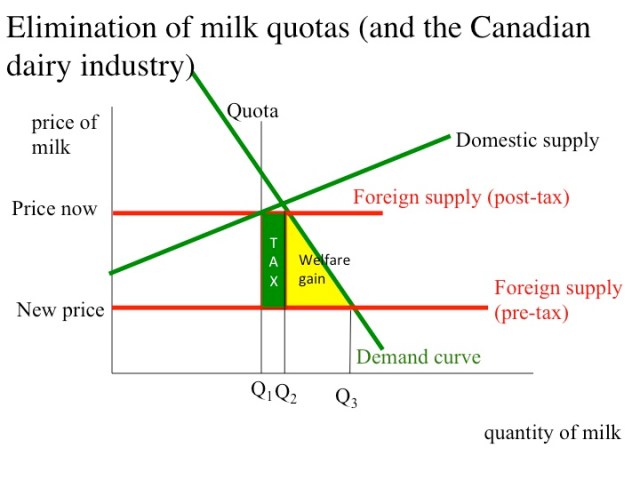
The observant reader will notice that I shrunk the welfare gain in this second picture by changing the shape of the demand curve. It's an open question: how much more milk would the average Canadian consume if dairy products were cheaper? (Which leads to the immediate follow up question: how much weight would we gain, and would we be better off in the long run?) In the first picture, unless milk consumption increases, there is no welfare gain, all that happens is that resources are transferred from farmers to milk consumers (which is good for consumers, but bad for farmers). In the second picture, there are still welfare gains even with an inelastic demand for milk, because of the gains from trade – but they are smaller than with a more elastic milk demand curve.
The true impact of an elimination of quotas and tariffs in the Canadian dairy industry probably looks somewhere in between these two extremes. We really don't know.
Here are the questions that I would like to ask anyone who is advocating elimination of quotas and tariffs:
- How precisely are existing dairy quotas to be eliminated? Over what time period? What compensation (if any) will be paid to current holders of quotas? What transitional supports will be available?
- What structural changes will have to take place in the Canadian industry to allow Canadian dairy farmers to compete with imports?
- Will (is) milk imported from the US produced with bovine growth hormone be labelled as such?
- How much more milk would an average Canadian consume if quotas and tariffs were eliminated?
I don't know the answers to these questions, but I would say to those who would like a radically re-structured Canadian dairy industry: be careful what you wish for.


 Worthwhile Canadian Initiative
I’d put up one potential path a while back. Buy out the dairy farmers – pay them for their quota. Pay off the bonds used to buy out the quota with a new temporary tax on milk (whether domestic or foreign sourced) that’s eliminated when the bonds are paid off.
You are wrong when you way that it’s impossible to run large dairy farms where the cows get to see pasture. NZ accounts for the majority of the world’s traded milk and I’ve yet to hear of a dairy operation here that’s other than pastoral. I’d even argue that cows here would be happier than the ones in Canada – we effectively don’t have winter, so any shift in dairy production from Canada to New Zealand increases expected animal welfare. It may marginally worsen environmental amenities in NZ, though dairy practices here are improving greatly – cows have to be fenced out of streams, for example.
So, hitting your questions (some of which I’d hit a few months ago, anticipating your question… :
1. Do it immediately with full compensation at quota prices that prevailed ex ante 6 months ago, or some time prior to common knowledge of anticipated buy-out.
2. Farms will have to get bigger and more efficient. 40-cow operations aren’t going to cut it. You’ll likely also get some shifting of production from hard-winter places to soft-winter places like BC.
3. If you don’t like hormone-added milk, it can be banned for consumption in Canada without having supply management. Or, you could easily set up a certification regime for Canadian producers who want to put a “Guaranteed GM Free” label on their product. We don’t require non-organic vegetables to come with big warning labels. In free-market NZ, I can buy organic milk at the supermarket any time I like.
4. Prices drop, but I don’t know the price elasticity of demand. Canadians seem to be on the high demanding side for milk though. Some oddities in the international data.
Frances: “The basic technology of milk production hasn’t changed for thousands of years:…”
You might get pushback on that Frances! The word “basic” there is carrying a lot of weight. Mechanisation of the actual milking has changed a lot from the days of milkmaids doing it by hand. My own knowledge of the technology is 30 years out of date. I don’t know how much that has increased total factor productivity in milk production. Cows per worker; cows per acre; milk yield per cow has increased a lot over the decades too, I think (e.g. those St Hyacinthe Qc Holsteins my Mother insisted we see.) But yes, it must be a couple of orders of magnitude less than a lot of manufactured goods.
“What compensation (if any) will be paid to current holders of quotas?”
That’s the biggie, in my eyes. It doesn’t have any obvious (to me) answer. What exactly is the status quo ante distribution of property rights? Do 2 wrongs make a right? The farmer whose milk quota is now his pension plan might have no connection to those who originally benefited from the introduction of quotas. But if we follow a rule of not compensating owners of illegitimately-gotten rents, it both discourages rent-seeking, and also means the losses are less when we eliminate quotas, because the potential for uncompensated loss was capitalised in the price.
I grew up with two siblings in Newfoundland where milk currently costs $7 a gallon. When I moved to the states it costs $2 – for the BGH-free stuff. Conservatively, equalizing milk prices (though probably not possible due to transport costs, etc), would’ve been worth tens of thousands to my parents while their kids grew up.
I’ll take the deregulation any way I can get it, please and thank you.
If it’s politically feasible, Nick’s proposal beats mine. Mine ignores what’s right (expropriate!) and goes for what might be practicable.
Nick: “You might get pushback on that Frances”
The feed in/milk out equation is illuminating, though, even though not strictly accurate. It brings home a lot of important points i.e.: cost of milk is closely related to cost of feed therefore grain subsidies translate into milk subsidies; anything that reduces cow’s calorific expenditure (ie. restricting movement) will tend to reduce the feed/milk ratio, etc. Sure, cooling, transport, storage etc technologies matter a lot too.
“But if we follow a rule of not compensating owners of illegitimately-gotten rents, it both discourages rent-seeking, and also means the losses are less when we eliminate quotas, because the potential for uncompensated loss was capitalised in the price.”
Why are milk quotas any less legitimate that emissions quotas, patents, an any other form of government-created property? We have a democratic government in Canada – just because one might not like the decisions made by that government nor the forms of property it creates, that doesn’t make those forms of property illegitimate.
Furthermore, with expropriation, where is the capital going to come from to finance a total restructuring of the Canadian dairy industry?
Andrew – peaches are expensive in Newfoundland, too – something about it being a rock.
Eric – “If you don’t like hormone-added milk, it can be banned for consumption in Canada without having supply management.”
Wouldn’t a ban on the import of BGH milk be considered a non-tariff barrier? Even the labelling of BGH milk a non-tariff barrier? I’m phrasing these as questions because I don’t know the answers, but these issues seem to be negotiated in trade disputes an awful lot.
The milk farmers can do something else. In Hfx my friend told me to support my local farmers. The milk at Loblaws chain was $7 for a 4L. Would’ve been $3-4 in MB. As a result I didn’t drink milk. I had the 2L ice creams that went on sale for $3 once in a while. Some dumb AB will have their kids pay for my heart attack down the road. Let’s trick Harper and all say health and human happiness is the economy, and then Harper will start looking and longeivty instead of tar. No, the tar CEOs won’t effect this. $7/L is like 1/2 a days work for me now, and 1/3 a days work when I was a kid. $%^&-ing rich people.
Frances: “Why are milk quotas any less legitimate that emissions quotas, patents, an any other form of government-created property?”
Hmmm. OK, lets assume they are. Suppose the govt imposes a quota at time t1, for reasons which seem good reasons at the time. And then some time later at t2 it changes its mind, for equally good reasons (maybe the facts have changed?). If it were known in advance that if the government would eliminate the quotas it would do so without compensation, and that there were a probability that the government would change its mind, then the value of the quotas would be less, so the loss when they were actually eliminated without compensation would be less.
How are quotas different from other assets, like human or non-human capital? Would it be OK for the government to confiscate those other assets too? Well, those other assets are real, not paper assets. They took real resources to create. And if there were a rule of confiscation without compensation, the value of those assets would be less, and fewer would be created. (A rather (Rule)-Utilitarian argument, I expect.)
There are a lot of things about the whole agricultural quota system that need to go. Another is that niche products are often banned because they would have to be produced off-quota, even though they would sell at higher prices than quota-controlled products. Take heritage turkeys. The modern broad-breasted white turkey can’t reproduce without artificial insemination. On the other hand all other breeds of turkey are imperilled, which leads to loss of genetic diversity. But in Canada you can’t get a heritage turkey because of turkey quotas.
Or when a few farmers decided to grew Red Fife wheat, a Canadian heritage which came from Peterborough and is the parent of most modern wheats, they had to sell it as “feed” because the Wheat Board had no way to fit it into its grid.
Genetic Diversity is a problem, witness bananas. Bananas are naturally clones, they don’t have seeds, so banana genetic diversity is naturally low. Banana blight is a huge problem and finding new varieties is very, very hard because they have to be spontaneous mutations without benefit of seeds and gene mix.
My brother buys Goat’s Milk from a dairy operation near his home for my niece. The owner had a nutrition degree from Guelph and she got into goats because she couldn’t get a dairy quota. She’s all about the “Quality for a price” end of the market that gets levelled in the quota system. (Actually her prices are quite reasonable, especially as my nieces likes milk that hasn’t been shelved, goat’s milk isn’t collected anywhere as frequently from farms as cow’s milk is and loses shelf potential and freshness sitting in tanks).
I agree with Determinant – Canadian smugness about higher quality actually leaves out the “high” end of the market – in the US one can get niche products that aren’t subject to quotas (dairy, poultry) or other forms of supply management, and it has allowed the development of niche products that have taken up a substantial part of the market there, and become broadly available. Canada misses out on that availability, which is sad for those of us who care about those items.
I guess I’m being too simple minded when I think: why not just send them a check and be done with it? Say we liberalize the market and if, for whatever reason, we decide that dairy farmers are particularly deserving of subsidies, or vital to national security, or just such darn nice chaps, or whatever, then let’s just have the Gov’t of Canada pay them $X/per month. Call it the Canadian Food Security Payment, or whatever Sir Humphrey-speak will keep the NAFTA/WTO/etc meddlers at bay.
Nick: I would say that your argument could go either way. Given how political process works, having tradition to cancel government-created property without compensation could increase resistance to dismantle such legislation. You would just shift the rent-seeking in time, instead of lobbying to introduce legislation you would have resistance to dismantle it. Also, people tend to discount future events when considering present situation. But anyways, I would say that you could use both these facts to promote your goal. This is the something I would call “EU way” – promise to phase out rents slowly all the while compensating net losers. This is how freedom of EU labor market was achieved: it was never possible that western countries would accept dismantling barriers for movement of cheap labor from eastern european countries. Make it happen far enough in the future, like 7 years, compensate it with smaller but immediate positive policy and the probability of accepting it the whole package without sour taste of government acting from the position of strength greatly increases.
JV: “You would just shift the rent-seeking in time, instead of lobbying to introduce legislation you would have resistance to dismantle it.”
Hmmm. That sounds correct. But if you do it my way you wouldn’t need to raise marginal tax rates on the rest of the population to buy back the quotas, and that would be a good thing, because of the standard welfare triangle costs of high marginal tax rates.
“First, because the value of Canadian dairy quotas has become capitalized, a production quota is part of a farmer’s working capital.”
That’s a depressing thought. To the extent that it’s true, doesn’t that mean that the imposition of quotas was a windfall gain to the dairy farmers who were around at the time and got quotas for free? Subsequent farmers had to buy their quotas, so they’re no better off. But consumers have been made worse off by paying higher prices the whole time. And now to eliminate the quotas, taxpayers will have to pay to compensate existing farmers for the loss of an asset.
Is that about right?
Ryan – yup, that’s about it.
Determinant, Whitfit: you’ve taken a stab at answering the question I wanted to pose in this post: what would happen to the Canadian dairy industry if milk quotas were eliminated. Your response is pretty optimistic “in the US one can get niche products “.
Two thoughts: One: I don’t know of any clear evidence on this. I can buy Red Fife wheat in the local organic food store. In Canada we have all of these fantastic local artisan cheeses – I don’t know to what extent these exist south of the border. It seems that organic milk is fairly widely available in the US, but that’s partly because people want to avoid BGH and other practices. I’d like to see something other than impressions as evidence on this.
Two: what else is likely to happen? Will Cdn dairy farms survive?
Patrick: “then let’s just have the Gov’t of Canada pay them $X/per month” That’s what’s done in the US, though they’re in the process of renewing their agricultural subsidy program, and those particular payments are on the table.
If we choose not to pay farmers $X per month, they go out of business, and Canada’s farm land is bought by foreign investors, does this have any long-term consequences for Canadian economic prospects?
Given that you have the votes to get rid of the quotas, just do it. Confiscating illegitimate rents (and, Frances, these are absolutely illegitimate; the rents are worth money despite representing NO created value) makes them less valuable now and reduces the incentive to secure them in the future. And despite the premise of the “innocent” farmer who hasn’t profited at all by the scheme (because he paid a market price for his quota) I bet that farmer has voted to keep the quota! They deserve to be expropriated.
Alex:
– whether farmers are compensated or not is a matter of moving dollars around. Sure, one can believe that eliminating quotas without compensation would reduce incentives for rent-seeking – that’s like believing merit pay eliminates perverse incentives in universities (it doesn’t, it just creates a whole different set of perverse incentives, e.g. to minimize teaching and admin effort and maximizing research effort).
In fact, I would think lobbyists would take the precise opposite lesson: entrenched policies can be changed if you lobby hard enough.
Let’s be honest, who’s going to really gain from the elimination of milk quotas? Is it going to be consumers? Or is it producers of every food from yogurt to tacos to mac cheese, who will see the cost of raw milk inputs fall 50, 60 or 70%, while they cut their prices to consumers by 0, 5, 10%? (Anyone want to bet with me how much the price of Kraft Macaroni and Cheese dinner will fall as a result of elimination of milk quotas?)
But gains and losses are just dollars moving around – they have equity impacts, but not efficiency impacts.
My issue is what are the real effects, what changes will we see in the real economy as a result of milk quota elimination? Will farmers go out of business? Consolidate? Will my local organic farmer be able to keep a couple of milk cows, and sell raw milk along with his raw vegetables? Will we see 5,000 head industrial scale mega-farms owned by international corporations?
I’ll bite…
How precisely are existing dairy quotas to be eliminated?
Wipe them from the books and stop enforcing them.
Over what time period?
How long does it take to cross something out?
What compensation (if any) will be paid to current holders of quotas?
If you pay quota-holders, then what was the purpose of eliminating the quota? Economically, such a subsidy would perform the same purpose as the quota…
What transitional supports will be available?
If you pay transitional supports, then what was the purose of eliminating the quota? Economially, such a subsidy would perform the same purpose as the quota…
What structural changes will have to take place in the Canadian industry to allow Canadian dairy farmers to compete with imports?
Why must we assume that such competition is good for anyone? If Canadian dairy farmers can compete, they will compete. If they can’t, they will find a more profitable use of their time and resources, and everyone will benefit from the corresponding reallocation of resources.
Will (is) milk imported from the US produced with bovine growth hormone be labelled as such?
Why not let the consumers and producers sort this out voluntarily?
How much more milk would an average Canadian consume if quotas and tariffs were eliminated?
I have no idea, and you correctly noted that we have no way of knowing this in advance. Whatever that quantitty happens to be, it would be the result of consumer preference, which is infinitely better than the agricultural lobbyists and politicians deciding for themselves how much dairy Canada should consume.
As an aside, I find a lot of Prof. Woolley’s questions assume a favorable view of central mandates and an unfavorable view of competition on the open market. In this case, we are to assume that a Canadian dairy farmer who loses his farm is necessarily a bad thing. And yet, this necessarily also assumes that we should all be happy that this farmer’s entire livelihood – and probably his family’s livelihood for generations – should forever be supported by a pool of taxpayers already over-burdened with their own personal responsibilities and lives. Why? Why is it better to save a farmer’s job than to leave money in the pockets of people who absolutely need it for their own important lives?
We all have problems that require financial solutions. All of us: dairy farmers and economists and doctors and lawyers and construction workers. An argument against quotas isn’t an argument against jobs, it’s an argument against favoring John’s job over Paul’s.
Alex: then I assume that mining companies or land owners also deserve to be expropriated after being compensated for investment/land improvement. In the end, it is not as if they created any value in terms of more land or more mineral resources.
Actually what Frances did is that she presented a quite interesting topic. In my eyes what is important is the fact if the current process of diary production is being coordinated using markets that can be considered as “free”. That for instance the quota rights can be sold to 3rd party etc. Imagine that those production and import quotas were introduced using a fair process. They could be sold by government to the highest bidder and proceeds could be used to decrease taxes. Would it be OK to dismantle the quotas under such circumstances? Would your answer change if the sales proceeds were used to finance some government program for specific group?
If the answer on the first question is “Yes” then I would say that such person has to be for nationalizing the private property if it could be proved that such policy increases welfare gain here and now. In a way the slogan “Nationalize their milk quota rights, they lobbied for them and stole it from the rest of us pocketing the profits !!!” is very similar to the call “Nationalize their property, 50 ago it was stolen from all of us!!!!”. Or “Nationalize this property, it was created by our misinformation induced by media and advertising to pocket gains !!!” To possibly “Nationalize their property. It is true that it was created by utilizing local monopoly gained through innovation, but the original innovative person already sold it to not so innovative person so it is OK for us to gain something back now !!!”
Thank you for a productive post. Industrial farms exist in Ontario now – barns with hundreds of cows with no pasture in sight are common. While I do see heifers roaming, nice contented herds of milk cows wandering in to the barn to be milked are an urban myth. Obviously, we need a regulation in food and growth hormones in milk would cause anyone concern. However, that is not the issue. The structural impact of the removal of quotas is important. More important is to examine the functioning of the entire milk system until it hits my table. There are three multi-national large firms controlling the bulk of the fluid milk processing and distribution. There is also corporate control of the vital operations that connect the farmer to the dairy. Any change in the system must be managed to avoid chaos and avoid monopsony profits being conferred on those multi-nationals. We also want to avoid the specter of milk being dumped because the returns do not meet the cost of production. This has been a regular issue in parts of Europe which enjoy equally screwed-up markets but also in the U.S.
My only point is that the discussion deserves more research than a few academic truisms. The move away from quotas will be complex.
Jciconsult – that’s the perfect response to Ryan’s last observation: “an unfavorable view of competition on the open market.” I have a favourable view of competition – it’s just that I wouldn’t describe a situation where three large multi-national firms control the bulk of milk processing an distribution competition.
J.V. – interesting.
I lived in a poor part of Louisiana for 6 months. There where no niche products available. Indeed the quality of food at the stores was very poor. For example I could not find crackers or cookies without trans fats. And the rare healthy option that was available was over priced compared to what it woud be in a well to do area. If the poor in Canada pay too much for their milk, the poor in the US drink hormone laden, industrially produced milk without any other choices. Anyone who loves the idea of less government would do well to stay in Louisiana for a while. There was very little street cleaning near our apartment and for while there was a dead dog decomposing on the sidewalk outside. I am much happier paying my municipal taxes these days
I also agree with Frances that animal welfare standards are likely to drop without small farms. The fact that there are large farms in New Zealand with good animal welfare is of small comfort. New Zealand is a special situation as it has a small population compared to the amount of farmable land.
I also have no faith that the market will allow Canadians better choices without tarifs. The corn and soy subsidies and the strong farm lobbies in the US will override any power Canadians have as consumers to get the products we want.
JV:
Alex: then I assume that mining companies or land owners also deserve to be expropriated after being compensated for investment/land improvement. In the end, it is not as if they created any value in terms of more land or more mineral resources.
We need property rights on land because it is scarce. “The right to produce milk” isn’t scarce unless we deliberately make it so to enrich a few incumbents.
Frances – But it becomes an unfair analysis.
Step One: Government establishes quota.
Step Two: rent-seeking ensues.
Step Three: Consumers wish to eliminate the quota and reclaim their consumer surplus.
Step Four: lobbyists and economists say, “But wait! Eliminating the quota is like stealing!”
In my mind, this is no different than when some economists choose to call tax credits “subsidies.” It’s all backwards. The quotas are the original point of theft. Giving back what was stolen isn’t a second example of stealing.
Imagine if a burglar stole your family jewels, was caught, found guilty, and instead of giving them back, lobbied the government to prevent you from “stealing” the jewels from him! That’s not just poor reasoning, it’s unmitigated audacity.
The quota is the problem – the quota distorted markets. That rent-seekers use these distortions to their own advantage does not mean that suddenly they “earned” the consumer surplus through hard work. We’re being ripped off – why can’t we say so?
Rachel – thanks for those comments.
Ryan: there’s a Step 0, a problem that quotas were designed to solve.
Without protection, the life of a dairy farmer is tenuous. My grandfather was a farmer – he lost his herd twice to food and mouth disease, and then decided to get out of the livestock business entirely.
There’s even a name for the kind of price volatility that characterizes agricultural markets: a hog cycle.
As people have rightly pointed out, the image of the small dairy farmer lovingly caring for happy, grass-fed Bessie and Bonnie is an urban legend. The question is: what would the reality of dairy farming in Canada be without our current system of milk marketing? It’s not a question that can be answered with rhetoric about the virtues of free markets.
Frances, I’m not talking rhetoric. Most of us have close relationships with people who are/were farmers, if not direct experience with farming, and the same holds true for me.
I’ll grant your Step 0, but this is merely a rephrasing of the question. For every job that exists, there are production problems, volatilities, and costs that make any business challenging. There is absolutely no reason to view certain industries as being special and needing extra protection. Doing so is a mere emotional appeal to the fact that most people eat dairy regularly and therefore feel more directly impacted by it than they do by, say, the hand-loomed textiles industry (if you catch my Friedman allusion).
I readily concede that producers face challenges. My question is why anyone should ever assume that these challenges disappear with rents – or that rents are the best way to tackle such challenges.
The free market answer to production problems is twofold: Innovation and trade specialization. With regard to this first point, you yourself noted that “the basic technology of milk production hasn’t changed for thousands of years.” With regard to the second, you yourself noted that Canadian dairy farms are on average smaller than those abroad and produce less milk.
It seems the economics of the issue are clear. What’s not clear are the non-economic questions, the political stuff. You are essentially tempting us to care more about Canadian dairy farmers than dairy farmers abraod; more about Canadian dairy farmers than Canadian computer programmers or architects; more about the costs associated with Canadian milk production than the potential consumer surpluses.
So, if what I’m saying is “rhetoric,” why is it more so than what anyone else is saying?
I guess every status quo policy must have been brought into existence for some good reason, therefore should never be ended. Is that right? To me this sounds like one of the most cut and dry cases I’ve ever heard of and if anyone had told me yesterday Frances Woolley didn’t think so I wouldn’t have believed them.
On the tenuousness of producer’s livelihoods, Matthew Yglesias has been pointing out recently that taxi medallions don’t actually fix that, they screw over both the cabbies who dump lots of their income into leasing them and to an even greater extent the consumers who have fewer cabs available at higher prices. Sounds like the same thing is the deal with quotas (though tariffs are a more unambiguous transfer to producers).
Presumably the answer in terms of compensating quota holders is to pay them an amount equal to what they paid for their quotas in the first instance. If they initially got them for free (let’s call them the “Initial Quota Holders”), they’ve had the benefit of rents on those quotas for 40 years, so it’s too hard to have much sympathy for them. The government created their “rights” and the government can take them away. Their only loss is the gain that accrued to them as a result of the government policy in the first instance.
On the other hand, for farmers who recently bought quotas (let’s call them “Secondary Quota Holders”), on the other hand, I have more sympathy. Yes, theirs “rights” are no more real than the “rights” of those who acquired them directly from the government. On the other hand, they incurred a cost in acquiring those quotas in order to comply with the law of the land at the time they acquired the quotas. In some sense, they really are out of pocket as a result of the change in policy. The thing to keep in mind here is that, in this case, both the Secondary Quota Holders and consumers are losers as a result of supply management (the winner is the Initial Quota Holder who sold their quotas and capitalized the rents). In the absence of supply management consumers would pay less for milk, and the Secondary Quota Holder wouldn’t have had to buy a quota to produce milk. So the question is, which loser of the supply management regime is better situated to bear the cost of doing away with it (and, I suppose, who will reap the benefit of doing so)?
Ideally, in the perfect world, we’d impose a tax on the proceeds of disposition of quota holders (be they Initial Quota Holders or Secondary Quota Holders) who sold their quotas to compensate the Secondary Quota Holders who retain their quotas. (Ryan, to your criminal analogy, this would be akin to an innocent buyer of stolen property trying to recover what he paid for it from the thief – in that case, he’s as much a victim of the crime as the original victim.) In practice, I suspect that that isn’t feasible, as those proceeds of disposition have either long since been spent, distributed to shareholders or heirs, invested in other businesses, or are so co-mingled with other funds that trying to tax or recover them isn’t practical.
As a practical matter, the farmers should have records of their cost of acquiring quotas (if only because the cost of the quotas could be a valuable tax attribute), so compensating farmers based on cost should be feasible. It would probably be less expensive than buying them out at FMV (pre change) (i.e., assuming that there are farmers (or corporations) who either aquired them from the government, or acquired them at an earlier time at a lower cost), and avoids valuation fights.
Finally, Ryan, you’re wrong that buying out the quotas is equivalent to continuing the subsidy. It’s a lump sum payment, instead of on-going price support. The latter affects farmer behaviour directly, the former doesn’t.
Wonks Anonymous: The challenge is simple: describe what you think the Canadian dairy industry would look like in the absence of quotas.
Rise to it.
Bob –
I appreciate that you want to view this as a practical matter, but I feel doing so drops necessary context from the discussion. Let’s accept your “buying stolen property” analogy and assume you are in second-hand possession of my stolen heirloom. Does it make sense for you and the police officer to sit at the table discussing how I, the party from whom the heirloom was stolen am going to reimburse you for the heirloom during the “transition period?”
Quotas screw things up royally for everyone. Justice and fairness under the law means eliminating quotas as soon as possible. Economic efficiency means eliminating quotas as soon as possible. There will blood – but I’m sorry, I will not accept the “guilt” for this. I oppose quotas both before and after they are implemented. That I realize they cost everyone dearly does not make me guilty of a rough transition period for the affected parties. That blood is on the government’s hands, not the hands of the free marketeers.
As for “affecting behavior,” I am not particularly interested in that question. Consumer surplus is more important than behavioral economics. First, establish a healthy marketplace; then, analyze how people behave. Part of the problem with behavioral economics is that it is too often invoked by bureaucrats to figure out how we can create rents “without affecting behavior directly.” Money non-neutral. If you transfer more of a non-neutral resource into the hands of John at the expense of Paul, both John’s and Paul’s behavior will be impacted significantly, regardless of whether or not that behavior is endogenous to an economist’s model.
Okay, okay… I’ve said way too much now. I’ll bow out here and let the discussion continue along without my 17 cents…
“Canada’s farm land is bought by foreign investors, does this have any long-term consequences for Canadian economic prospects”
I don’t know, and neither does anyone else.
I think the issue of supply management or subsidies or whatever we are calling it is political. Do we think there is something special about producing milk (or food in genera) in Canada, and are we willing to pay more to keep that capacity in Canada even if a free market would have us do otherwise?
Personally, I disagree very strongly with people like Ryan who say there is nothing special about food production. I think there absolute is something special about food production, and I think it is a terrible mistake to sacrifice a diverse and resilient food production system to chase every last decimal point of economic efficiency. Especially when we don’t need it. The world already produces plenty of food – it’s not like the world lacks food. In food production, as in banking, economies of scale and technology create some terrifying tail risks.
That being said, I’m not necessarily defending the current supply management regime.
Patrick – that’s pretty much my view on this also. Tails swing around and whip you – e.g. the Mad Cow (BSE) outbreak in Britain.
Let’s accept your “buying stolen property” analogy and assume you are in second-hand possession of my stolen heirloom. Does it make sense for you and the police officer to sit at the table discussing how I, the party from whom the heirloom was stolen am going to reimburse you for the heirloom during the “transition period?”
OK, let’s push the analogy further, shall we? In that case, we’d return the stolen heirloom to the original owner, and as the second-hand purchaser, I’d look to the original thief for compensation, i.e., the return of the purchase price I paid him. Well, who’s the “thief” in our quota example? Is it the Initial Quota Holder, or the government? I bought the quotas from the Initial Quota Holder, but I only did so because the government made me do it (i.e., without the government intervention, I would just have produced milk). And sadly, in democratic societies, the government represents you and I, so we end up getting dinged for its mistakes. Now you might say that that’s unfair to us as taxpayers. Maybe, but then again, why is it more fair to ding Secondary Quota Holders for the policies imposed on them by previous governments? As I noted earlier, both the Secondary Quota Holders and consumers are the victims of government policy here, so why is it that only the Secondary Quota Holders (or their creditors whose collateral is about to get wiped out) should get dinged with the cost of undoing that policy?
As for your suggestions that the first goal is to establish a “healthy marketplace”, well agreed, and to do that you have to undo all the distortions caused by supply management. But that’s tricky on supply side, because the distortion is a permanent one relating to the capital structure of farms (i.e., farms borrowed heavily to buy quotas). Forget policies for a second, in perfect world, we could waive a magic wand and “poof” supply management would go away. Well, what would that perfect world look like? There’d be no tariffs or quotas, and dairy producers wouldn’t be shackled with debts incurred to buy quotas. Well, funny, that’s the end result that I’m proposing.
I’m not suggesting that we shouldn’t get rid of the quotas/tariffs that prop up supply management. We should do it tommorow. Heck, we should do it today.
It’s probably even more complicated when delineated by socio-economic group. I would guess the poor would benefit from cheap-BGH milk. I could if I want, buy the (expensive) free-range, BGH-free, appelation-marked, designer milk if I chose, but I wouldn’t want to penalize others, so at least that part of the argument for keeping milk quotas is weak.
jt – don’t forget the whole processed food and restaurant industry. How much would MacDonald’s benefit from cheaper cheese? Makers of frozen pizza? How much would the price of those goods come down and how much would the profitability of these goods go up if there was a radical restructuring of the Canadian milk industry?
Patrick: “Personally, I disagree very strongly with people like Ryan who say there is nothing special about food production. I think there absolute is something special about food production, and I think it is a terrible mistake to sacrifice a diverse and resilient food production system to chase every last decimal point of economic efficiency.”
Fair enough, but let me ask you this, is an isolated domestic dairy industry more or less “diverse and resillient” than the global dairy industry? I don’t know, but my first instinct is that inherently, no, it can’t be – the sum will always be more diverse and resilient than its parts.
Moreover, I suspect that the effect of supply management is to discourage “diversity and resilience” in pursuit of economic efficiency. With an open dairy market, if I want to, I can go out and produce organic milk from heirloom cows, fed nothing but beer and grass (and around Toronto, you could probably find customers willing to pay big money for something like that). It may be less profitable than say, keeping a generic herd of milk cows in a barn, but so long as I’m happy with my return, and I can find customers looking for that product, so be it. Now, with supply management, I suppose I can do the same thing, but to do that, I have to go out and buy some quota. Well, the prices of those quotas are going to a function of the most profitable use someone can put to them. So the speciality/niche milk producer will always be outbid by the guy “chasing every last cent of economic efficiency”. The supply management regime puts profitability ahead of diversity and resilience precisely because you have to buy into it.
Patrick – Very surprised to read your claim that “the world already produces plenty of food.” I wonder why people starve…
A couple quick answers:
1. How precisely are existing dairy quotas to be eliminated? Over what time period? What compensation (if any) will be paid to current holders of quotas? What transitional supports will be available?
Australia already solved this problem when they eliminated supply management. Why not follow their lead? Why do we need to re-invent the wheel?
2. Will (is) milk imported from the US produced with bovine growth hormone be labelled as such?
Why would the existing regulations around bovine growth hormone change? We are not going from a system of no imports to some imports. Dairy imports from the US already exist.
Specifically: Imports of milk produced using hormones are currently banned BUT imports of products (cheese, yogurt, etc.) produced from milk produced using hormones are not.
Sorry to bring down the general tone of the conversation, but Canada has a large neighbor (us, the notably hungry USA) who has nearly no access to high quality dairy products (cheese especially), while Canada itself has no access to the cheap, mass-produced stuff. Why are we taxing each other’s products at all? Maybe I’m missing something but, dont we need some sort of boutique dairy/dairy factory trade agreement here? When I think of what you guys must lose on ice cream sales alone… Then there is our total lack of cheese.
Great. Now all I can think about is how delicious Canadian cheese is.
Ryan: “Patrick – Very surprised to read your claim that “the world already produces plenty of food.” I wonder why people starve…”
I’m suprised to hear that coming from you, I’d have figured you’d be all over the generally accepted answer to that question, namely lousy governments. Or at least that’s the generally accepted explanation for famines. Famine is predominantly a distributional issue, rather than a production one.
“When I think of what you guys must lose on ice cream sales alone… ”
Conveniently, we have reduced tarriff rates on the imports of milk and ice-cream (amongst other dairy products), which allow holders of import quotas to import those products at reduced tariff rates. I suppose our government thought that cheap ice-cream would make up for expensive milk (hmm, and people wonder why obesity is on the rise). Ironically, looking at the list of import quota holders for milk, those boutique cheese products you’re talking about, they may well be made with American milk (or “Natural Milk Constituents”, whatever that is).
Mike – thanks for your comments. Do you have a reference for that – i.e. that BGH milk is banned but BGH cheese isn’t? That’s a useful factoid.
On the Australian model – again, do you have any links? I looked but couldn’t find anything – though I should look at Eric Crampton’s post he linked to above. A couple of things to note – Australia still has quotas for exports: http://www.daff.gov.au/agriculture-food/meat-wool-dairy/quota/dairy. Also, Australia is an island. Milk doesn’t keep, and is relatively costly to transport. NZ is surprisingly far away from Oz. Hence there are limits to the extent to which the Australian experience would generalize to Canada.
KMS – just think of warm, ripe cheese, so soft that it’s just melting out of its rind….
Bob – I’m talking starvation, not famine, although I agree that government aggravates both.
“Also, Australia is an island. Milk doesn’t keep, and is relatively costly to transport. NZ is surprisingly far away from Oz.”
Yes, but New Zealand exports 95% of its dairy products to Asia, Japan, Europe, North America, etc. (from the ever so authoritative Encyclopedia of New Zealand: http://www.teara.govt.nz/en/dairying-and-dairy-products/11). Milk may not keep, but milk powder does.
starvation =/= famine? Interesting.
Bob:
Ummm, I was talking about sales to us. I never see Canadian ice cream, but everyone I know who buys the ludicrously high priced American boutique ice cream would love to. There are quite a few folks over here who would not blink to pay $8 a gallon for ‘real’ milk. We can send you some of that $2.50 a gallon (I love close exchange rates) rhbt stuff straight off the factory floor in return. There has to be some ratio where that would work. Send us your overpriced dairy products. Please! There’s no reason for both countries to make terrible cheese.
And Frances, you already knew I was jealous. That’s just mean. Didn’t anyone teach you that it’s cruel to exploit someone’s love of cheese?
http://www.dictionary.com
The BGH panic drives me nuts. There is no evidence that it causes harm. (And no, the American Cancer Society are not in the pay of Big Dairy.)
The cancer site doesn’t note it, but the basic science underlying this is that BGH, as a non-human peptide, would be digested by humans as animal protein, and would not be metabolized it as a growth factor. Antibiotics are a separate concern (and a serious one).
Wikipedia has a surprisingly strong piece RE: rBST use around the world:
http://en.wikipedia.org/wiki/Bovine_somatotropin
Australian experience RE: ending supply management:
Click to access janv06_en.pdf
Shangwen,
Ah, but people have a right to determine what they eat and pay for those choices. If folks want to pay family farmers to milk the old fashioned way, why not? It’s a fine deployment of discretionary income. Almost all of our family farms are gone. I personally pay $6 a pound for family farm butter. (no, they dont make cheese.) Thank the gods I don’t use much.
Besides, there was scientific proof vioxx was safe too. Science is remarkable for its constant struggle toward a greater truth, not because of the value of the sum of its knowledge at any given moment. At any given moment, we’re wrong about a lot.
KMS,
I adamantly support the right of people to participate in a free market. I’m not advocating banning BGH (or increasing it), I’m advocating the rational consumption of information. And what does Vioxx have to do with it? We once thought the sun around the earth, but we’ve also known pythagoras’ theorem for 2k years. This business of pointing to one past error to undermine current science is ridiculous. Generally, I lump the anti-BGH crowd in with the anti-soybean (i.e., “manboob panic”) crowd, and all those who say they are “concerned about chemicals”.
Edit to prior comment: I concede there is an animal welfare issue regarding the use of BGH.