There are three ways to reduce the price of a product. The first is through technological innovation – the reason why the price of computing power and memory storage is now so low. The second is to cut wages, or the price of other inputs. Even though the basic technology of sewing t-shirts has not changed in decades, textile manufacturers have kept costs down by shifting production to low-wage locations.
The third way to reduce prices is to eliminate rents. For example, manufacturers can charge thousands of dollars a year for Thalidomide - a 50 year old drug with very low production costs – because they enjoy patent protection. Eliminating that patent protection – and the rents it brings – would reduce the cost of Thalidomide to patients.
Milk and cheese costs more in Canada than in most other countries. The question is: why?
The basic technology of milk production hasn't changed for thousands of years: feed in, milk out. Cows aren't paid, so wages should not an issue. Hence most people explain the price difference between Canada and the US in terms of market rents. There are high tariffs on imported dairy products, and restrictions on the quantity that can be produced domestically.
The picture below shows a textbook analysis of the impacts of milk quotas and tariffs, and what would happen if they were eliminated.
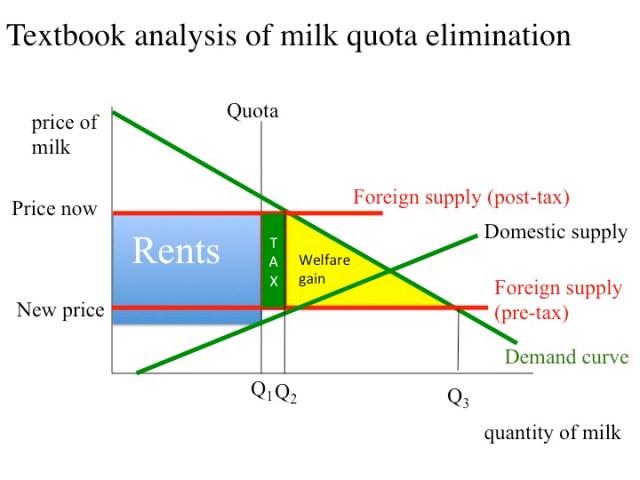 This might be called the fat-cat farmer model of the dairy industry. With quotas and tariffs, the market equilibrium is Q2. On the margin, the availability of imported (albiet taxed) milk and cheese is what limits the amount Canadian farmers can charge. Canadian market prices are thus determined by the (after tax) price of foreign imports. Farmers enjoy rents, or super-normal profits, equal to the difference between the domestic supply curve, which measures their cost of production, and the price they receive for their products.
Elimination of milk quotas and tariffs would, in this story, lead to an increase in milk imports, and a fall in the price of milk. Domestic farmers would stay in business – they just wouldn't enjoy the super-normal profits they were earning earlier. In fact, domestic farmers even stand to gain by the possibility of expanding milk production. On balance, the gains to consumers would outweigh the rents lost by farmers (and the government's reduction in tax revenue) by the amount shown in yellow, the "welfare gain" from eliminating tariffs and quotas.
The problem with this analysis is that it fails to take account of the structure of the Canadian dairy industry, and that of its international competitors.
First, because the value of Canadian dairy quotas has become capitalized, a production quota is part of a farmer's working capital. In some parts of the world, a successful farmer expands her operation by building more barns and growing her heard. In Canada, a successful farmer expands production by buying more quotas.
To the extent that new entrants to the dairy industry have to purchase quotas, the presence of quotas increases costs, and thus shifts the domestic supply curve upwards. The federal government could decide, tomorrow, to eliminate milk quotas and import tariffs. That would not eliminate the debt farmers have incurred to buy quotas – but it would wipe out dairy farmers' most important capital asset.
Second, American dairy farmers have spent decades competing on price. Canadian farmers have spent decades competing on quality (or not competing at all). Consequently, American and Canadian dairy farmers use different farming methods.
In parts of the US, for example, cows are fed bovine growth hormone (BGH), which allows them to produce more milk for a given amount of feed. Canadian dairy farmers are not allowed to use artificial growth hormones and, as a result, have higher costs.
Canadian dairy farms are also much smaller, on average, than American dairy farms. Agriculture Canada, drawing on the 2006 Canadian census of agriculture, paints a bucolic pictures of the typical Canadian farm: "It is a family-owned operation with a herd of about 60 cows. The farm owners are in their mid-forties and have built up considerable equity in their operation." By way of contrast, the US Department of Agriculture, reporting on the corresponding US agricultural census, observes:
Results of the 2007 Census show that concentration in milk cow production has increased in the last five years. In 2002, 24 percent of farms with milk cows produced 74 percent of the total value of U.S. sales of milk and other dairy products. In 2007, the same percent of farms produced 81 percent of the total value of sales of milk and other dairy products.
Odds are, if you're buying milk imported from the US, you're buying milk produced in a large-scale, corporate owned dairy operation, with at least 1,000 cattle. The major objections to such operations are environmental (think of the mess thousands of dairy cows make) and considerations of animal welfare. With thousands of cattle in a single operation, it is logistically impossible to do anything other than treat the cows as living machines, giving them no opportunities to graze grass, feel the sunshine, or enjoy the bovine good life.
Last, but by no means least, dairy products are subsidized throughout the world – in Europe through the Common Agriultural Policy, and in the US both directly through supports to dairy farmers, and indirectly through subsidies to corn and soy producers. Although the current US system is up for renewal, there are no plans to completely eliminate agricultural subsidies. The Canadian dairy industry would have much lower costs than they do at present to compete with subsidized farmers elsewhere.
Now one could argue that, if European taxpayers are prepared to subsidize our stilton and cambonzola, we should stop complaining and dig in. The resources currently devoted to producing expensive Canadian cheese can then be freed up for other uses. But I wouldn't advise making this argument in the presence of a dairy farmer.
If Canadian farmers' costs are substantially higher than the costs of dairy producers in the US and Europe, the predicted impact of elimination of the current system of quotas and tariffs looks more like this:
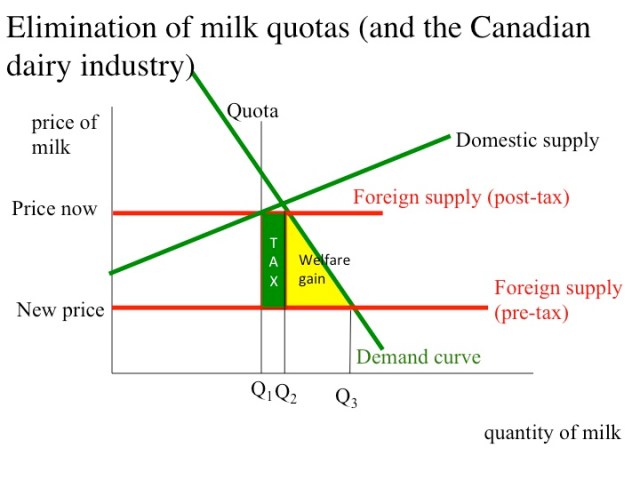
The observant reader will notice that I shrunk the welfare gain in this second picture by changing the shape of the demand curve. It's an open question: how much more milk would the average Canadian consume if dairy products were cheaper? (Which leads to the immediate follow up question: how much weight would we gain, and would we be better off in the long run?) In the first picture, unless milk consumption increases, there is no welfare gain, all that happens is that resources are transferred from farmers to milk consumers (which is good for consumers, but bad for farmers). In the second picture, there are still welfare gains even with an inelastic demand for milk, because of the gains from trade – but they are smaller than with a more elastic milk demand curve.
The true impact of an elimination of quotas and tariffs in the Canadian dairy industry probably looks somewhere in between these two extremes. We really don't know.
Here are the questions that I would like to ask anyone who is advocating elimination of quotas and tariffs:
- How precisely are existing dairy quotas to be eliminated? Over what time period? What compensation (if any) will be paid to current holders of quotas? What transitional supports will be available?
- What structural changes will have to take place in the Canadian industry to allow Canadian dairy farmers to compete with imports?
- Will (is) milk imported from the US produced with bovine growth hormone be labelled as such?
- How much more milk would an average Canadian consume if quotas and tariffs were eliminated?
I don't know the answers to these questions, but I would say to those who would like a radically re-structured Canadian dairy industry: be careful what you wish for.


 Worthwhile Canadian Initiative
Wait, why are people asserting that us Americans have no access to high quality dairy products? The grocery store a block from my house has an entire separate cheese section for higher-quality cheeses, and has a diverse selection of different milks. The higher quality stuff is just more expensive.
Alex – I think it’s a bit like asserting that Americans are fat. The American academic economists I know are, for the most part, just as lean as Canadian academic economists (though distinctly less likely to say “let’s just try walking to…”). The grocery store in Ithaca has an amazing selection of European cheeses at a fraction of the price you’d pay in Canada – last time I was there I came back with car load full of stilton and other gourmet cheeses.
But, on average, just as Americans tend to be a little heavier than people elsewhere in the world, it can’t be denied most of the cheese one encounters when travelling in the US is bland cheddar, mozzarella or monterey jack cheese. Moreover, as Rachel said earlier, the consumption opportunities available to the poor in the US are very different from those available to the better off.
Mike – thanks for those references. I’d like to see something a little bit more robust on the Australian experience though – someone must have looked at it.
Shangwen – I agree that information is key – I should write a post about labelling. Would it be possible, e.g., to label milk ‘animal cruelty free” just like some tuna is labelled ‘dolphin friendly’? I don’t know if it would even be possible to write down a generally agreed upon set of “workers rights” for cows.
Bleg to American readers: does anyone know how the cost of a Big Mac in the US compares to the cost of a bacon double cheeseburger? I’m figuring that, given that Big Macs don’t contain dairy and cheeseburgers do, the relative costs of the two should be slightly differenti n the US and Canada.
Bob: I suspect that would be most people’s reaction, but in fact independent isolated systems are more resilient to shocks, but they are less efficient (in general). The military is a good example. Or spacecraft. Is it efficient to have 3 copies of the avionics system? Of course not. But it’s sure a heck of a lot safer. Large integrated systems are subject to catastrophic cascade failures in ways independent autonomous systems aren’t. There’s a literature on this.
Anyway, I just wanted to point out that there is a cogent argument for some kind of supply management (probably not what we have today). Though IMOiIt’s not generally being made, but it’s there.
“I wonder why people starve”
Allocation. Malthus hasn’t caught us (yet).
Bob: just wanted to reiterate the last line of my first post: I’m not necessarily defending the supply management system we have today. But the budding small-c conservative in me (I think I’ve read too many of Nick’s posts!) says we ought to be really, really careful about messing around with the system we have. It was put in place by previous generations for a reason, and we better be damn sure we understand the consequences of our actions if we’re going to go around dismantling something that has apparently worked pretty well for a long while. I find it really disturbing when people come along with very glib attitudes about how we ought to just stick to to those damn dirty dairy farmers. Food is not iPhones. We shouldn’t f— around the production system lightly.
Hi Frances,
Couple points.
First, I’d expect that so long as any sanitary regs around milk were non-discriminatory, they’d pass muster. So if both domestic and foreign supply milk had to comply to the same regs, and the regs weren’t something obvious like “Milk must be produced by cows in barns where Hockey Night in Canada is played on Saturday Night”, I’d expect it’s ok. But I’m not a trade lawyer.
Second, the status quo has a pile of capitalized rents on which dairy farmers are sitting. If we liberalized the system, maybe the processors would take some of the rent. But how much could they really get? It’s not like we have a “Cartel of Cheese Producers” who get the government to go and shoot you if you make cheese without a permit; we only have that if you want to insist on your right to milk a cow without a permit. [Overdramatic? Think through carefully what happens if you sell milk without a permit and vehemently resist efforts to stop you.] Anyway, if there were big potential rents in processing, somebody else would just set up another cheese plant until they were only getting normal returns again. I can’t see how most of the gains don’t wind up being passed through to consumers.
Third, don’t hold up US markets as free markets in dairy. The dairy compacts there mess stuff up badly too. Read the story of Hein Hettinga and weep. Come to NZ some time and see what real dairy entrepreneurship and innovation looks like. All kinds of small scale dairy processing for niche markets, along with standard supermarket cheese that just knocks the stuffing out of standard Canadian cheddar.
Fourth, on Australian export quota, I put 20:1 odds that those are there because of restrictions from foreign trading partners. We have them too. The US simply will not allow us to export more than X amount of milk to them per year without high tariff. So some milk goes in under the quota, and some goes in above-quota with tariff. The carrot of access to US dairy markets is what the US is holding up for TPP negotiations; I mostly think they’re lying. We’re most likely to be stuck with their insane IP laws while having Fonterra barred access to US markets because our “big firms are ok so long as they help efficiency” antitrust line would be deemed by the US as being an unfair trade practice (a BS argument, but the likely first thing they’ll pull after we’ve agreed to take on their copyright/software patent insanity).
Patrick,
I’m not sure that’s right. A system that has 3 copies of the avionics system is more resilient than one that only was one copy. Under supply management, we’re relying on one system (Canada’s dairy system) rather than than on the dairy production of dozens of countries. But your point, I suppose is that with greater integration, you combine those different systems (although, with national regulation, you’ll never have perfect integration, so maybe we come out somewhere in the middle).
I’m not sure there is a particular cogent argment for supply management, but there may be a compelling argument for other types of policies to, for example, preserving farmland,(for example, by paying farmers adjacent to cities to put a restrictive covenant on their land to keep from being turned into townhouses)or preserving technology and know-how (for example, there’s a federally funded experimental farm near Ottawa) which might make it easier to re-establish or expand a future Canadian dairy industry if it became neccesary/viable (WWIII breaks out and we’re cut off from supplies of milk or, perhaps more realistically, increasing demand for milk in the developing world, make milk production commercially viable again in Canada). But those policies would be far more modest, and far less disruptive, than the sorts of supply management policies pursued in Canada (and, for what it’s worth, the subsidies pursued in Europe and the US).
On BGH, I’m with Shengwen, but think of it this way, if you care about that risk, but for import tariffs and quotas, Canada could start buying some of the vast surplus of subsidized, non-BGH treated, milk from the EU.
Bob,
Geez. You’re purposefully misrepresenting my point on redundancy and integration. But I think you know exactly what I’m talking about, so there’s no need to argue.
“re-establish or expand a future Canadian dairy industry if it became neccesary/viable ”
Are you sure about that? I’m not. Not at all.
Anyway, somewhere in your endless need to argue I think you more or less acknowledged my point, so I’ll leave it there.
🙂
“It was put in place by previous generations for a reason, and we better be damn sure we understand the consequences of our actions if we’re going to go around dismantling something that has apparently worked pretty well for a long while. I find it really disturbing when people come along with very glib attitudes about how we ought to just stick to to those damn dirty dairy farmers.”
I think I have two responses to that.
First, supply management is a relatively recent development – it was only nationally introduced in the 1970s (with the purported aim of promoting “price stability”, i.e. price fixing, in any other context an illegal practice). So the “wisdom of the elders” argument for preserving the status quo isn’t that compelling.
Second, I agree that the “stick it to farmers” attitude isn’t helpful, especially where newer farmers (who had to buy into the supply management system) are as much the victims of the status quo as consumers. On the other hand, perhaps I have greater faith than you do in the ability of Canadian dairy industry to adapt to changes in the status quo, with appropriate transitional support.
Frances:
Moreover, as Rachel said earlier, the consumption opportunities available to the poor in the US are very different from those available to the better off.
I know this is a little off-topic, but is there a country in which this wouldn’t be true? Higher incomes would be kind of pointless if they didn’t actually let you buy more/better stuff.
Or do you mean this in the sense that poor people generally don’t live near the stores that sell more expensive luxury goods? Honestly, that sounds like it’s probably an efficient outcome.
Interesting discussion here.
My contribution:
“given that Big Macs don’t contain dairy and cheeseburgers do,”
I don’t think that’s right. From my memory, the old Big Mac jingle goes like this:
“two all beef patties special sauce lettuce CHEESE pickles onions on a sesame seed bun”
Moreover, the ‘special sauce’ may (or may not!) contain mayo, which is derived from supply-managed eggs.
Those onions are all Adam Smith free market goodness, though!
@Kevin: Onions may vary province by province. Peak of the Market is another growers’ cartel in Manitoba; they might have cartel rights over onions.
http://www.buymanitobafoods.ca/mb-foods/find-food/all-products/peak-of-the-market/
Alex: “I know this is a little off-topic, but is there a country in which this wouldn’t be true?” Many countries have less income inequality than the US, and less physical distance between rich and poor neighbourhoods. The ritziest part of Ottawa (Rockcliff) is separated from one of the poorest parts (Vanier) by a single street: Beechwood. So the poor and rich can shop at the same stores. Similar lack of distance between rich and poor neighbourhoods in Vancouver – especially since it has viable public transit. New York is like that, but other US cities I’ve been to haven’t been.
Stores in poor neighbourhoods often charge higher prices than stores in rich neighbourhoods (elasticity of demand).
Kevin, you’re right! Darn it. Egg/oil ratio in mayo is so low you can ignore it – one egg will make a cup or two of mayo.
Eric – though did you know that onions are the only crop for which IIRC there is no US futures market? Interesting factoid which it must be possible to write a paper off of (but I haven’t figured out how).
Frances:
The Red Fife thing was for a bakery in Vancouver that wanted to use it. The Wheat Board didn’t have authority in Ontario, which has its own wheat board. It was a producer issue because the wheat couldn’t leave the farm without the Wheat Board’s approval. Besides, that Ottawa shop is one of the few stores that carries Red Fife, there few farms in Canada that grow it; one is near Keene, the wheat’s Canadian home. The Olde Stone Brew Pub on George St. in Peterborough makes a Red Fife wheat beer.
But you still can’t get a heritage turkey.
BGH is a regulatory issue, not a market issue. An Act of Parliament that says “Milk produced in or imported into Canada shall not contain Bovine Growth Hormone” is easy enough to pass. That’s a regulatory issue, not really an economic issue unless you want to get into the (small) deadweight loss of a BGH ban. Consumer product regulation is entirely separate from economic production management policies.
And supply management does nothing for the boutique end of the market except obliterate it as a potential competitor that is hard to regulate and seen as a pest.
But between the US and the EU, agriculture is hardly an example of anything like a free market.
You woke people up, Frances!
I’ll have a stab at this: “What compensation (if any) will be paid to current holders of quotas?”
The same as owners of footwear and clothing factories got when tariffs were reduced.
Canada’s dairy farmers are in business. They ought to be holding insurance against the loss of their quotas, the same as with other capital. If they aren’t, well, they made that decision.
Greg: “They ought to be holding insurance against the loss of their quotas” – is it possible to buy such a thing?
Frances,
Just to add to Eric’s comment. Those are EXPORT quotas. Removing export quotas could only benefit Australian dairy farmers so Eric is right. The quotas are there to protect US farmers.
Bob Smith: “Milk may not keep, but milk powder does.”
UHT milk keeps and Canda export a lot to South America and the Caribean, including Porto Rico. UHT keeps for months and only the open box needs to be refrigerated. Useful when you’re too poor to buy a large fridge and the electricity supply is unreliable and expensive.
One of the problems with BGH is that is makes the cows susceptible to mastitis. University of Vermont found a four fold increase. This means a much higher level of anti-biotic use and a great deal of suffering for the cows. I have had mastitis and if it is anywhere near as painful for the poor cow… All this is to say that there are good reasons to object to BGH.
“The same as owners of footwear and clothing factories got when tariffs were reduced.”
Not quite the same analysis, since the government didn’t force clothing and textile manufacturers to acquire quotas to carry on their business. I suppose you might fairly reply, though, that that’s no different than investing in any other capital good on the basis that it will produce returns based on the high, tariff-protected, price of their products. I have to think about that.
Rachel – ouch!
Bob – good point.
This argument was over as soon as Canada changed its food pyramid a decade or more ago. Milk got dropped from 4 servings/day to 1.5. So you might subsidize new or broke or for-toddlers-milk dairy farmers, but that’s it. In the Marimtes, poor people, unless on welfare or another subsidy, can’t afford milk. The soy subsidy might work for 3rd world markets as contains all essential amino acids unlike any other product. Corn subsidies too make Americans unhealthy. As GOP and Wild Rose as the USA is, as soon as an individual of any wealth has a heart attack, my old flaming NS landlord taught me this, you change your mind and wish you didn’t have CPC Ministers of health and Conservative MPPs that cancel healthy food Crowns to fight Provincial (healthcare addled…) deficits. Like above says, there are very rich dairy farmers and very unhealthy cheap ice cream selections; the latter a result of food production innovations recently.
For example, in a country where AB/SK separated and their tar/oil got carbon taxed by ports, you would offer quotas for the first 1.5 cups of adult milk as food stamps for cdns. It’s okay I’m learning to steal food expertly.
Someone should direct Wayne Easter to this blog, if these (http://wayne-easter.liberal.ca/media-reports/media-releases/a-letter-to-the-editor-on-supply-management/) are the best arguments he can make in defense of supply managment. On the BGH point he’s particularly weak:
“By eliminating supply management and opening our border to “cheap” milk and dairy products we would be doing indirectly what is illegal directly, namely placing on the retail shelves dairy products produced through the use of a growth hormone. Currently in the US, 17% of the 9 million dairy cattle are injected with this growth hormone.”
Well, let’s pull that apart. First, as others have pointed out, free trade in milk and dairy products doesn’t mean you can’t impose health and safety restrictions. Moreover, he assumes that we’d only import milk from the US, rather than BGH-free jurisdictions (Europe, Australia, New Zealand – all jurisidctions, its worth noting, who we’re trying to negotiate trade deals with and for which supply management is a sticking point).
But as weak as his first point is, he then blows it out of the water by observing that 83% of US dairy cattle are NOT injected with BGH (ok, for obvious reasons, he didn’t phrase it like that), which suggests that US dairy producers are quite capable of producing non-BGH for the Canadian market if permitted to (and it’s worth noting, in this regard, that a number of major retailers, notably Walmart, Sam’s Club, Kroger, and Safeway use only non-BGH milk in their house brands).
Frances: “you’ve taken a stab at answering the question I wanted to pose in this post: what would happen to the Canadian dairy industry if milk quotas were eliminated. Your response is pretty optimistic “in the US one can get niche products “.
Two thoughts: One: I don’t know of any clear evidence on this. I can buy Red Fife wheat in the local organic food store. In Canada we have all of these fantastic local artisan cheeses – I don’t know to what extent these exist south of the border. It seems that organic milk is fairly widely available in the US, but that’s partly because people want to avoid BGH and other practices. I’d like to see something other than impressions as evidence on this.”
I have nothing other than impressions, but one more piece of impression evidence that I originally intended to refer to is beer. In the US the high end of the beer market – meaning a variety of stuff that isn’t a light, mass produced lager (most Molson/Labatt/Coors/Budweiser, plus all of the European imports widely available like Stella/Becks/Heineken and others commonly pushed as premium) – has developed a lot of depth and breadth over the past couple of decades. In Ontario, we don’t have access to anywhere near the same depth and quality of products. I think it is because of the limits of the beer store/LCBO, which like the dairy industry is good at producing a mediocre middle, but don’t have the high end of the market of niche products or the low end where the only thing that matters is price. I think that at the high end of the market, you will get more local production, because people like the idea of local and freshness also matters. That might help local producers survive. For the mass end of the market, it is unclear to me what would happen – you might get consolidation, and lose some Canadian production. Canada isn’t like New Zealand – I have been to NZ, and it is amazing how much grass grows there, and how ideally the conditions are set up to grow pasture – it is like the best natural pastureland in the world, with the only disadvantage being distance from markets.
One other point: I haven’t seen a reference to Gordon Tullock’s writing on Transitional Gains Trap, which I think nicely points to the problem with the capitalization of rents. I personally think that more attention needs to be focused on the consequences of putting such policies into place, and in fact would support broad legislation that makes it impossible to do so, because politics creates these things so easily, and has no good way of getting out of the trap. I think that it is hard to argue that the government doesn’t bear some obligation to ease the transition, but I think that the cost should be shared with those that took on the risk of holding an asset that is derived from regulatory limits.
“I think that the cost should be shared with those that took on the risk of holding an asset that is derived from regulatory limits”
Maybe that’s the distinction I couldn’t articulate with respect to Greg’s last point. The dairy farmer has two broad classes of assets that derive their value (at laest in part) from tariffs/quotas. One class is a general one – the farm itself, the cows, capital equipment, buildings, whatever – the other is a limited one, the quotas. I don’t have any problem with the proposition that farmers shouldn’t be compensated for any losses associated with the first class of assets (just like textile factories were compensated if they went under). So how can I justify compensating farmers for the cost (but not the loss in value, I hasten to add) of the latter but not at all in respect of the former?
I suppose the distinction is that the quota isn’t just an asset that derives its value from regulatory limits, it IS the regulatory limit. I think the distinction would be clear if, instead of buying quotas from existing farmers, farmer had to buy quotas from the government. Now, that would be a case where I think we’d both agree that there’s something unjust about the government saying on the one hand “you have to buy this quota, and pay a pretty penny for it” and then turning around and saying “yeah, sucks to be you, that was a bad investment”. And in that case, compensating farmers for the cost of buying the quota would be uncontroversial, since the government was initially enriched (unjustly) by the sale of the quota, and so would just be disgording their original revenues from the sale of the quota.
OK, farmers didn’t buy quotas from the government, but whose fault is that? That decision resulted in a windfall to the initial quota holders (at least to the extent they subsequently sold them). But it isn’t clear to me that that really makes a difference for secondary quota holders (who bought them from the initial holders), because in either case,the government was telling them “you have to buy this quota”. It isn’t clear why secondary quota holders should be dinged because the government chose to enrich original quota holders by not charging for quotas and by making them transferable.
“Cows aren’t paid, so wages should not an issue.”
In real terms, cows get a living wage, plus free health care. 🙂
Frances: [Quota insurance] “is it possible to buy such a thing?”
I have no idea whether such a product exists. If not, it is because of lack of demand, which speaks to the risk management skill of Canadian farmers. I don’t see why government should protect businesses against foreseeable, limited, industry-specific risks.
Bob: I do so reply. Thanks for seeing my point.
Greg: “If not, it is because of lack of demand,”
Insurance works through risk pooling, i.e. car insurance works because not everybody has car accidents at the same time. The elimination of milk quotas is a correlated risk – i.e. if one farmer loses their milk quotas, everyone will lose milk quotas. It’s not possible to buy private insurance against highly correlated risks (which is why, for example, house insurance doesn’t cover acts of war, crop insurance doesn’t exist without government subsidies, etc).
Greg, Frances: All somebody needs to do is open up a futures market where folks wanting to lay off that kind of risk can do so. Pretty easily done: just put up contracts for each of 2013, 2014, etc reading “Contract pays $1000 if the market price of dairy quota at year end is under $5000 or if supply management no longer exists”. Farmers can buy the contract to lay off quota political risk; folks better able to bear that risk because it’s not correlated with the rest of their portfolio can short it.
Eric & Greg, alternatively we could just de-regulate gambling, and allow people to place bets on the odds of supply management ending. Inside trading problems though?
Er, what would the farmers do? In NS the farm land is very marginal. Where are millionaires: they’ll be okay. What portion of quota’d farmland is not fit for other uses? A honey quota would return 10x whatever the subsidy is via fruit canola and nut production increases.
Oh my. I can see the news items now: “Cabinet minister colluded with TBTF bank to rig milk quota futures market – no charges will be laid. In other news, anti-corruption protesters were kettled, tasered, strip searched, and held illegally by police. Justice Minister vows to continue law-and-order agenda.”
Now where’s that bottle of Innis & Gunn I’ve been saving…
Eric comments at length on dairy quota futures here http://offsettingbehaviour.blogspot.ca/2012/07/insurance-markets.html
Why is it that I can buy Swiss cheese produced in Canada at Trader Joe’s in the USA for about half the cheapest price I can get it in Canada? (Same with the crackers I put it on, BTW.)