This is a long and boring post. (Though some will no doubt find it highly controversial, and a very few might even get over-excited). It might be useful for economics students who want to put the Loanable Funds theory into perspective. They are my main intended audience. And maybe for those who teach them too.
Loanable Funds is a theory of "the" rate of interest. (I'm coming back to that "the" later). There are other theories of the rate of interest. That's why we call it a "theory".
Most (all?) economics students will have seen this diagram:
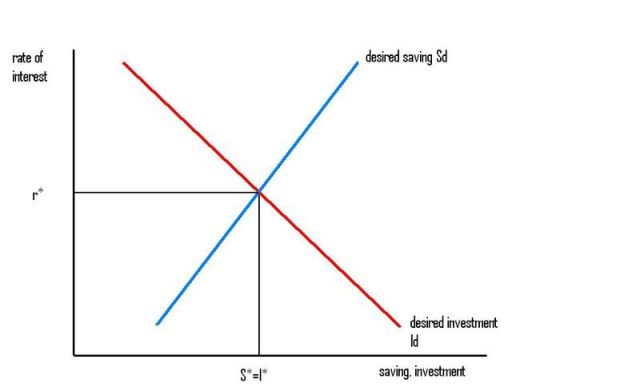
Put the rate of interest on the vertical axis. Put the flows of saving and investment on the horizontal axis. Draw a downward-sloping desired investment curve Id. Draw an upward-sloping desired saving curve Sd. Mark the point where the two curves cross. Draw a horizontal line to the vertical axis, to find the rate of interest predicted by the theory. The Loanable Funds theory says that the rate of interest is determined by the intersection of the desired saving and desired investment curves. (The rate of interest and actual saving=actual investment are co-determined simultaneously by those two curves.)
"Saving" has to be defined as "national saving", to include both private and government saving. And investment has to be defined as "national investment", to include both private and government investment. Otherwise things won't add up right.
Even then, things won't add up right in an open economy, unless we include borrowing from abroad and lending to abroad. Which means you have to bring in expected changes in the exchange rate, otherwise foreign and domestic interest rates won't always be the same even under perfect capital mobility. For now, let's just stick with a closed economy.
With a little bit of national income accounting, there's a second way to look at the Sd=Id equilibrium condition of Loanable Funds. Desired private saving Spd is income minus taxes minus desired consumption. Spd=Y-T-Cd. Add desired government saving Sgd=T-Gd, and we get desired national saving: Sd=Y-Cd-Gd. So we can re-write Sd=Id as: Y-Cd-Gd=Id. And we can rearrange that to get:
Y=Cd+Id+Gd
One of the joys of National Income Accounting is that it lets you see that two theories that sound very different are really the same. "The rate of interest equilibrates desired saving with desired investment" can be re-stated as "The rate of interest equilibrates desired expenditure on newly-produced goods (Cd+Id+Gd) with the output of newly-produced goods" (Y).
And a second joy of National Income Accounting is that by doing this it can reveal an ambiguity in the theory. Because we might want to replace Y (actual output of goods) with Ys (the quantity of output supplied, or that people and firms would like to sell). So that we could restate Loanable Funds as "The rate of interest equilibrates the supply and demand for newly-produced goods". But that means that "desired private saving" is ambiguous too. Does it mean "Y-T-Cd"? Or should it mean "Ys-T-Cd"? What does "desired saving" mean in Loanable Funds? Does it mean "Actual income minus demand for consumption goods"? Or does it mean "The income we would earn if we could sell all the output we wanted to, minus demand for consumption goods"? That difference is obviously going to matter, if the economy is in a recession with deficient aggregate demand, so we can't sell as much output as we would like.
Here's a second diagram for the loanable funds theory. Even though it's equivalent to the first diagram, by an accounting identity, you maybe haven't seen loanable funds presented this way:
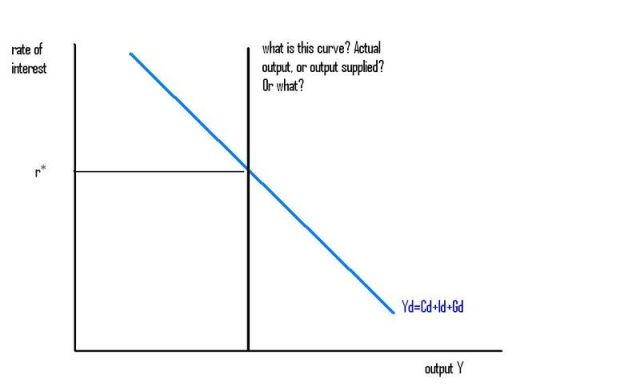
What exactly does the vertical black curve represent? Is it actual output (actual income)? Is it the level of output supplied, which means the level of output that people and firms would like to sell (and the income they would earn if they did)? Or something else?
Let's put that question aside for now, and consider an alternative theory of the rate of interest.
The Liquidity Preference theory of the rate of interest is the most obvious alternative. The rate of interest is determined by the supply and demand for money. Put the rate of interest on the vertical axis, the stock of money on the horizontal, draw a downward-sloping money demand curve, and an upward-sloping money supply curve, and the rate of interest is determined where those two curves cross.
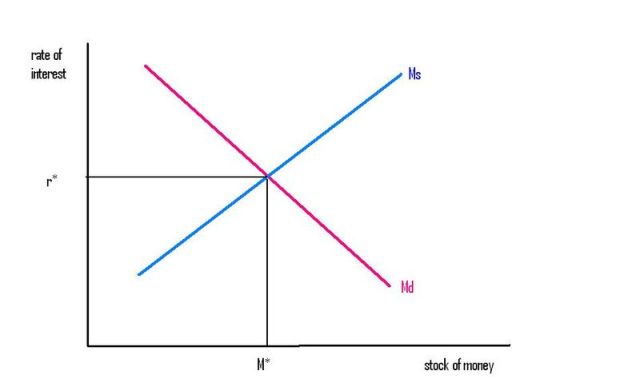
Almost every Canadian is familiar with a special limiting version of Liquidity Preference theory. It's the theory that gets reported in the news. "The Bank of Canada sets the rate of interest" is a Liquidity Preference theory. You can think of this as a limiting case of Liquidity Preference, where the money supply curve is perfectly elastic at a rate of interest chosen by the Bank of Canada.
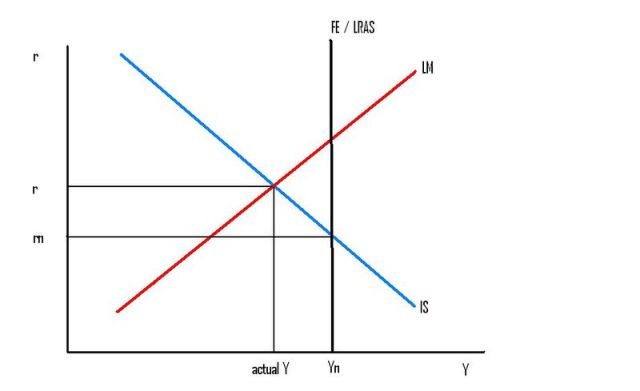
Most (all?) economics students have been taught both Loanable Funds and Liquidity Preference. And they have been taught one way to reconcile the two theories. They have been taught the ISLM model. The IS curve represents the Loanable Funds Id=Sd equilibrium condition, and the LM curve represents the [Liquidity Preference] Md=Ms equilibrium condition. But each is incomplete, because Y affects Sd (and maybe Id too), and Y also affects Md (and maybe Ms too). So you need to put both curves together to get the complete picture. The rate of interest (and the level of output Y) are co-determined by the IS (Loanable Funds) curve and the LM (Liquidity Preference) curve.
But in the long run, when sticky prices have adjusted to the demand and supply of money, we can ignore the LM curve. [Update: because the price level adjusts so the LM curve shifts endogenously to interesect the other two curves.] The level of output is determined by the Long Run Aggregate Supply curve (or the "Full Employment" curve). So in the long run, money demand and money supply have no effect on the rate of interest. The rate of interest is determined by the intersection of the IS and FE curves — by desired saving and investment at the long run equilibrium level of output determined by LRAS.
Now let me tell you a second way of reconciling the Loanable Funds and Liquidity Preference theories. (It's not inconsistent with the ISLM way of reconciling the two theories, but it does sound very different. It's really just a special case of the ISLM way, but it sounds much more real worldy).
The Bank of Canada sets the rate of interest. But the Bank of Canada does not set the rate of interest on a whim. Something determines where the Bank of Canada chooses to set the rate of interest. The Bank of Canada targets CPI inflation at 2%. It tries to set a rate of interest that will deliver 2% inflation.
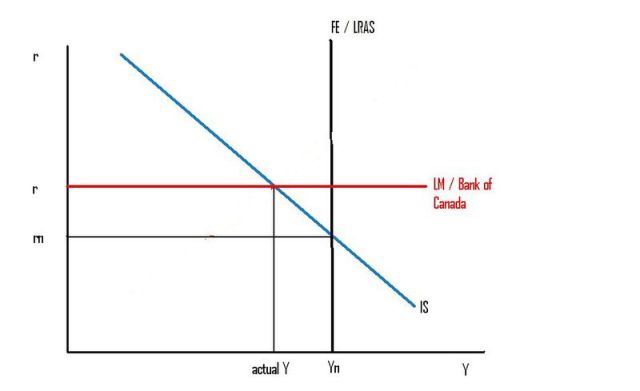
If the Bank of Canada sets the rate of interest "too high" (as in the above diagram), output demanded will be "too low", so actual output will be "too low", and inflation will start to fall below the Bank's 2% target. And if the Bank sets the rate of interest "too low", output demanded will be "too high", and inflation will start to rise above the Bank's 2% target.
So, what does "too high" and "too low" mean? Relative to what? It means "relative to the rate of interest at which output demanded would be at the right level to keep inflation at the 2% target". In the above two diagrams, I have called that rate of interest "rn", and that level of output "Yn". The Bank of Canada sometimes uses the names "neutral rate of interest" and "potential output". Some economists call them the "natural" rate of interest and level of output. Others use the name "NAIRU". Others use the name "Full Employment". Names sometimes have connotations, so people fight about names. But I'm going to skip that fight here.
Instead, I'm going to go back to a question I left unanswered: what does "Y" mean (and what does "Sd" mean) in the Loanable Funds theory? Because we now have a useful answer: "Y" should be interpreted to mean "that level of output compatible with inflation staying at the Bank's 2% target". Define "desired saving" to mean "what the the level of desired saving would be if output (income) were compatible with inflation staying on target" and we get a nice way to reconcile loanable funds and liquidity preference theories of the rate of interest:
The rate of interest is set by the Bank of Canada, but the Bank of Canada tries to set the rate of interest equal to the rate of interest predicted by the loanable funds theory, where desired saving equals desired investment at potential/natural/NAIRU/full employment output.
[Digression:
What I have sketched above represents the "mainstream"/New Keynesian/Neo-Wicksellian way to reconcile the loanable funds and liquidity preference theories. But before passing on I want to note briefly three possible problems with that reconciliation:
1. The Bank of Canada is trying to hit a moving target (the "natural rate of interest") that it can't see (except, barely, looking backwards). So it will miss. But when it misses the target that will have real effects on the economy (if it sets a rate of interest too high, it will cause a recession, for example). Those real effects may themselves have persistent effects on the economy, and so may move the target from where it would have been in future. It's like trying to hit a moving target you can't see and where your misses themselves cause the target to move.
2. The IS curve may slope up, and probably will slope up if tight monetary policy causes a fear of prolonged recession which reduces desired investment and increases desired saving.
3. There are (in this highly-aggregated model) three goods: output; bonds; and money. It is very tempting to think that three goods means three markets, and that one market can be dropped by Walras' Law. But Walras' Law does not apply in a monetary exchange economy. And in a monetary exchange economy with n goods there are (n-1) markets, one for each of the non-money goods, where it is exchanged for money. There is no "money market". In this case n=3. There is an output market where output exchanges for money, and a bond market where bonds exchange for money. There is no market where bonds exchange for output (it would be a barter economy if there were). But the IS curve implicitly assumes people and firms are looking at the trade-off between output and bonds.
End of digression.]
Other Alternative(?) Theories:
1. The Irving Fisher diagram. You may have seen this diagram:
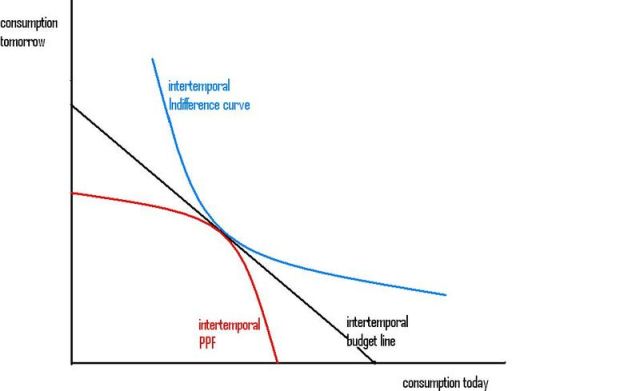
Equilibrium is where the Production Possibility Frontier and an Indifference curve kiss and the same budget line is tangent to both. It's exactly like the standard micro diagram where you have quantity of apples on one axis and quantity of bananas on the other. Except here you have "apples today" on one axis and "apples tomorrow (or next year)" on the other.
The slope of the budget line equals (1+the rate of interest). According to the Irving Fisher theory, the rate of interest is determined by intertemporal preferences and intertemporal production possibilities. In equilibrium, 1+the rate of interest (slope of budget line) equals the Marginal Rate of Intertemporal Substitution (slope of indifference curve) equals the Marginal Rate of Intertemporal Transformation (slope of PPF).
It looks very different from the Loanable Funds theory diagram. But really, it's exactly the same. You can derive the Id and Sd curves in the loanable funds diagram by varying the rate of interest (and so varying the slope of the budget line) and watching for the new tangency points on the PPF and Indifference curves. The tangency with the PPF tells you how much firms want to divert resources away from producing output for current consumption towards investment for output of future consumption. The tangency with the Indifference curve tells you how much of their wealth people want to spend on current consumption and how much thay want to save for future consumption.
2. Walrasian/Arrow Debreu General Equilibrium theory.
This theory is exactly the same as the Irving Fisher diagram, only with loads more dimensions. Lots of time periods, instead of just two. Lots of different goods, instead of just one. Lots of different people/firms, instead of just one. Lots of different states of the world (uncertainty), instead of just one (certainty).
3. The "The rate of interest is determined by the marginal product of capital" theory.
This theory ignores intertemporal preferences. It is not really a theory. It's either a misstatement of the equilibrium condition of the Irving Fisher diagram as a one-way causal relationship, or a special case of the Irving Fisher diagram where the PPF is a straight line so preferences don't affect the slope of the tangency. Or it assumes indifference curves are L-shaped. Or it assumes there is only one output good that can be switched costlessly between consumption and investment and that the stock of that good ("capital") does not change much within the period and can be taken as a predetermined variable. (For example, what happens to the Solow Growth model if people suddenly decided they didn't care at all about the future and wanted to eat the whole capital stock right now?)
4. The "The rate of interest is determined by the subjective rate of time preference" theory.
Same as the above theory, only the other way around. This one ignores intertemporal production possibilities. It's either a misstatement of the equilibrium condition as a one-way causal relationship. Or it assumes the indifference curves are straight lines. Or it assumes the PPF is reverse-L-shaped.
5. The "Start with Walrasian/Arrow-Debreu General equilibrium theory, make some simplifying assumptions, forget about the intertemporal preferences, and then say "Oh Look! the rate of interest is indeterminate, so it must be determined by my pet theory instead"" theory of the rate of interest.
Again, not really a theory. More of a non-theory. Useful only as a critique of the "the rate of interest is determined by the marginal product of capital" non-theory, which also ignores preferences. (And even then, the simple Irving Fisher diagram can make the same point more simply and in a much more constructive way. Yes, in general you need to look at preferences as well as technology to determine things like interest rates and other relative prices.) An awful lot of ink has been wasted on this subject.
6. All the other theories I've either forgotten or am too tired to talk about.
[Update: 7. Euler equation. Same as Irving Fisher, only in math not pictures.]
Loose ends:
Aside from the problem of how exactly the loanable funds theory works in the short run in a monetary exchange economy, the biggest problem with the loanable funds theory is that it talks about "the" rate of interest.
Even when we are talking about nominal rates of interest, there are lots of different assets, that all differ by term, risk, liquidity, etc.
Let's just look at the term structure.
Most investment projects have costs and benefits that come at many different time periods, not just costs today and benefits tomorrow. When you look at the Net Present Value to see if the investment is profitable, you will have to look at the whole term structure of interest rates. You can't just assume there is one equilibrium rate of interest for all terms. (Not just empirically, but theoretically too, because with one rate of interest an n-period NPV calculation becomes an n-degree polynominal equation with up to n different solutions for the rate of interest at which NPV=0, which is what the "re-switching" debate was all about).
In principle, this is no problem. You just switch from the 2-period Irving Fisher diagram to a mult-period version. But in practice it's a problem. The desired investment curve (and desired saving curve too) will shift if excepted future interest rates change. So you can't solve for what the current period loanable funds diagram is telling you without solving a whole sequence of loanable funds diagrams. Then you have to ask how people form expectations of those future equilibrium interest rates, when some people are planning to invest or save in future but haven't entered into forward contracts. Expectations matter. And if you expect the Bank of Canada might make a mistake in future, it becomes even more complicated.
Now let's look at the distinction between real and nominal interest rates.
Suppose the Bank of Canada had always been targeting 3% inflation instead of 2%, and suppose it were always expected to go on targeting 3% instead of 2%. If money were "super-neutral", then no real ("inflation-adjusted") variable would be affected by the inflation target. The loanable funds theory would then predict that the nominal interest rate would be 1 percentage point higher, but the real interest rate would be unaffected. (Both desired investment and desired saving curves would shift vertically up by 1%, because borrowers and lenders care only about real interest rates, not nominal). Loanable funds would then determine the long run real interest rate, and we would have to add the nominal inflation target to get the long run nominal interest rate.
Empirically, that seems to be roughly true, in that countries with higher inflation rates over long periods do tend to have higher nominal interest rates. But it is unlikely to be exactly true. If it were exactly true, it wouldn't matter what inflation rate the Bank of Canada chose to target.
Even if monetary policy were super-neutral in the sense defined above, so it makes no difference to real interest rates if the Bank of Canada targets 3% instead of 2% inflation, that is not the only sense that matters. The Bank of Canada currently targets the Consumer price Index. It could also target some other price index, or the price of gold, or the price of wheat, or almost any other nominal variable. And it will probably matter, in real terms, which target variable it chooses. Targeting 2% inflation for the price of fresh strawberries would probably have very bad consequences for the economy. A bad strawberry harvest would probably cause a massive recession, as the Bank of Canada tried to bring all other prices down to prevent the price of strawberries rising faster than 2% per year. And God only knows how a stupid monetary policy like that would affect saving and investment.
For any given monetary policy target, there will be a time-path of nominal interest rates set by the Bank of Canada that could hit the target. But when we talk about the real interest rate, since the real interest rate is the nominal interest rate minus inflation, there are many different measures of inflation (because there are many different goods and many different bundles of goods, and the CPI is only one of millions) and so many different measures of "the" real interest rate. Bear that in mind as we return to look at the open economy version of the loanable funds theory.
The simple loanable funds model won't work in an open economy. That's because we can also borrow from abroad or lend from abroad. The Sd=Id equilibrium condition gets replaced by Sd=Id+desired Net Lending to Abroad. And the Ys=Cd+Ig+Gd equilibrium condition gets replaced by Ys=Cd+Id+Gd+desired Net Exports.
The usual fix for this problem is to say that loanable funds determines the world interest rate (the world is a closed economy, so the world interest rate is determined by equilibrium between world desired saving and world desired investment). And then perfect capital mobility ensures each country has the same interest rate as the world.
But if the Canadian nominal exchange rate is expected to depreciate, the Canadian nominal interest rate would be higher than in the rest of the world, by an amount equal to expected depreciation. And if Canada produces different goods from the rest of the world, there is no reason to expect that the real exchange rate between Canadian goods and foreign goods will stay the same over time. So the Canadian real interest rate could be either lower or higher than the real interest rate in other countries, even with perfect capital mobility, and even in long run equilibrium.
If wheat is expected to rise in price relative to oats, then the real interest rate calculated by subtracting wheat price inflation will be lower than the real interest rate calculated by subtracting oat price inflation. If Canada produces and consumes mainly wheat, and if foreigners produce and consume mainly oats, then the Canadian real interest rate (with lots of wheat in the price index) will be lower than the foreign real interest rate (with lots of oats in the price index). You will need to figure out what is happening to the relative price of wheat and oats if you want to say what determines the Canadian real interest rate.
I think that is the major practical problem with the loanable funds theory of the rate of interest. In an open economy, it's not enough to talk about Canadian saving and investment. It's not even enough to talk about world saving and investment. You need to talk about world saving and investment, and Canadian saving and investment, plus how the relative demand for canadian vs foreign-produced goods is expected to change over time.
This isn't complete. But it's already far too long. And I'm tired.


 Worthwhile Canadian Initiative
[Edit: rsj: maybe skip this comment, and read the next one. I may have misunderstood you.]
rsj: “Demand to rent coffee shop space may be low in even periods, and high in odd periods. But as 10 year leases are being signed, the rental payments will reflect the average demand, not the spot demand. To the spot market, it will appear as if the rent rates on offer are “stuck”, in that they are not responding to the demand for spot rentals. In reality, the landlord would rather let the space sit empty and wait for one period until demand is higher, rather than get a lower payment for 10 years because they need to rent the space out now in order for the spot market to clear.”
Let the “period” be 12 hours. Coffee shops sit empty at night, and are used during the day. The rent would have to be negative at night to keep coffee shops fully employed at night. The landlord doesn’t want to collect a negative rent, so chooses to leave the coffee shop unemployed at night. But this isn’t Keynesian unemployment. This really is a Zero VMP coffee shop. The unemployment of coffee shops at night is an optimal allocation of resources.
(The analogy with sheep is as follows: a coffee shop/sheep is an asset that produces two goods in fixed proportions: daytime space/mutton; and nighttime space/wool. The demand curve for nighttime space/wool intersects the supply curve at a price of zero (it would be negative if you weren’t allowed unemployment/free disposal of nighttime space/wool. But we do allow unemployment/free disposal, so we get a corner solution, on the horizontal axis, where the coffee shop is unemployed at night/the wool is thrown away.)
I’m fine, Nick. Just being a devilish imp and nearly invoking those three letters: M, M, (dare not say the last one) that detonate threads.
Since I can’t do maths for geometric averages, let me change your assumptions slightly. Suppose the landlord wants the payment in a lump sum up front, and that coffee shops last two years. The rental in odd years is worth $100, and the rental in even years is worth $200.
If the 1-year rate of interest were the same in both odd and even years, the PV of a new coffee shop in an odd year would be $100/(1+r) + $200/(1+r)^2, which will be less than the PV in an even year, which is $200/(1+r) + $100/(1+r)^2.
You would get exactly the same result (PV less in odd than in even) if the lease is 2 years, at $150 per year, but the 1-year rate is r0 in odd and re in even years, and re > ro
In odd years, PVo= $150/(1+ro) + $150/(1+ro)(1+re)
In even years, PVe= $150/(1+re) + $150/(1+re)(1+ro)
PVe>PVo because the second terms are the same, but the first terms are different.
rsj: I’m working on a better example.
Assume workers can only do one thing: build coffee shops. Constant returns technology, perfectly inelastic labour supply, fixed nominal wage, and at full employment they can build 100 shops per year at $200 each. Shops last 2 years then fall down. So at full employment there is a stock of 200 shops. Let the equilibrium rental for a shop (when there are 200 shops) be $100 in odd years and $150 in even years.
The PV of a new shop at the beginning of an odd year is:
PVo= $100/(1+ro) + $150/(1+ro)(1+re) = $200
The PV of a new shop at the beginning of an even year is:
PVe= $150/(1+re) + $100/(1+re)(1+ro) = $200
Those two equations are not linearly dependant, so there must exist a solution for ro and re.
The intuition is that the denominators in the second term is the same, so the BoC can’t affect that by making r lower in odd years than in even. But the BoC can affect the denominators in the first term by making r lower in odd than in even years.
Nick,
No, if someone is selling a 2 year bond, then ro = re.
That’s the point.
Today, short rates are at zero, but long rates are not. Someone wanting to borrow long term must pay above zero rates. Why? Because in the future, short rates will be higher, and the long dated borrowing costs today reflect the anticipated higher short rates. Therefore even today, he must pay out a higher coupon, even though the short rate is zero. The borrower pays the same coupon every period. On average, half the time the coupon he pays is higher than the current short rate, and half the time it is lower (assuming pure EH). But he does not pay a lower coupon in one year than in another year. How much he pays for the next 10 years is decided by the long rates when he borrows.
Then you can ask, if I know that the market clearing sequence of long rates in each period is {L_1, L2, .. L_n,…}, can I select a series of short rates {r_1, .., r_n, …} such that the average of the short rates is the long rate in every period. This is not a convex optimization problem, and there is no guarantee of a solution. The answer is, generally, no, it is not possible for the CB to have long rates be whatever it wants in every period.
It is only possible to do this if each of the long rates {L_1} are “close” together and do not wiggle too much (sorry for being too technical). If they wiggle a lot or are not close together, then there does not exist a sequence of short rates that will cause the long rates to be the ones demanded.
[Edit: this comment is wrong, as rsj points out below. I was muddled with the yield on a 2-year annuity. NR]
rsj: I had (implicitly) defined ro as the 1-year rate in odd periods, and re as the 1-year rate in even periods.
The 2-period rate in odd periods r2o is defined by; 1/(1+r2o) + 1/(1+r2o)^2 = 1/(1+ro) + 1/(1+ro)(1+re)
The 2-period rate in even periods r2e is defined by; 1/(1+r2e) + 1/(1+r2e)^2 = 1/(1+re) + 1/(1+re)(1+ro)
You can see that r2o and r2e are not the same, if ro and re are not the same.
Roughly speaking, the 1-year rate must wiggle twice as much over time as the 2-year rate, and 3 times as much as the 3-year rate.
It’s too quiet. Eerily quiet.
I have just argued that modern monetary theory should assume loanable funds, because modern central banks set a rate of interest equal to the loanable funds rate. (OK, at least they try to, but we armchair economists don’t know better than the BoC what the LF rate is, so it makes sense for us to assume it.)
Maybe it’s Monday. Or maybe they are all plotting something….waiting for dark….
Nick,
You can see that r2o and r2e are not the same, if ro and re are not the same.
I am assuming EH, in which case r2O and r2e would be the same:
Let re and ro be the short rates in even and odd years.
I can borrow $1 in the first (even) period, and owe (1+re), Then I roll that over again, and owe (1 + re)(1 + ro).
Therefore my 2 period rate, r2_e, is the solution of this problem:
(1 + r2_e)^2 = (1 + re)(1 + ro)
Taking logs, you get that the two period rate, borrowed in an even period is the average under the approximation that log(1+x) = x.
If go through the same argument, but starting in an odd year, I get
(1 + r2_o)^2 = (1 + ro)(1+re)
Because multiplication is commutative, the 2 period rate, borrowed in an odd period, is the same as the two period rate, borrowed in an even period.
Also,
Note that counting equations is not enough here to assume a solution exists, as the solution set must be positive, and in general, you have an infinite dimensional problem so knowing that there is an infinite number of unknowns and an infinite number of data points is not enough to know a solution exists. The infinite dimensional aspect goes away in our cyclic case, of course.
rsj: OK. Try my 4.26 comment.
Nick – thanks for this post. It’s a great synthesis of the mainstream perspective on interest rates that I’ve been looking for, so that I can avoid going back to the text books :). I’d love to develop a perspective on this vs. post-Keynesian. I just don’t know enough about both yet. Hopefully someone else can chime in on that. RSJ should be able to, or JKH.
Nick,
“I have just argued …”
There doesn’t need to be a conflict.
Whether or not the CB is targeting the natural rate with its actual rate, it always has the freedom to depart from the natural rate with its next policy decision – by intention or by error. It sets the actual rate either way. It could be argued that it is constantly groping toward the natural rate, even if it is not aware of that or resists it with short term policy changes. It is free to make errors because it is free to decide.
And the loanable funds framework fits OK provided it somehow incorporates a projection of future I and S and Y (rather than a current, static snapshot), which allows for economic/financial growth and corresponding dynamic paths for I and S over time. A static assumption would be objectionable.
I think it’s primarily a static assumption that your favorite (other) heterodox group objects to.
wh10: Thanks! I’m not sure if any textbook really does a synthesis? All the bits are there, but sort of spread out across macro texts and micro texts, that often discuss interest rate determination only in passing.
I think the main Post Keynesian approach would be Liquidity Preference, in some variant. But I think there’s also a sense that interest rates are an instrument for determining the distribution of income between workers and capitalist/rentiers. Of course, there’s a big range of views out there. I don’t think there’s one single view that you can say represents the main challenger, apart from maybe Liquidity Preference.
Nick, re the 4.26 comment:
There is no solution for positive rates r_e, r_o. Just try to solve the simultaneous set of equations.
Geometrically what you have with the equation:
$100/(1+ro) + $150/(1+ro)(1+re) = $200
or
100 = 150/(1+re) = 200(1+r0)
or
0.5 = .75/(1+x) = 1 + y
or
y = -0.5 + .75/(1+x)
For x > 0, you have one leg of a hyperbola. Only a finite portion of it lies above the x-axis (because of the negative -0.5 term).
Similarly, the other equation gives you one leg of a hyperbola, shifted away from this one.
And unless these two hyperbolas are very close — which means that the two rental payments are close — one will lie above the other in the upper right quadrant and they will not intersect for x> 0 and y > 0.
I tried to spell out the intuition for this (although badly, I’m sure) when I gave my original example.
rsj: you know I can’t solve equations!
re will be positive. I don’t know whether ro will be negative. It may be. Nothing rules out negative real rates. It depends on preferences and technology. The Irving Fisher diagram can tell us that. (Costless storage technology would rule out negative real rates, because you could mothball the shop for 1 year so it lasts 3 years).
Wait! I’m wrong. Let me do some checking..
Take the worst case scenario. Suppose the rent is $0 in the odd year, rather than $100. And $250 in the even year, rather than $150. Then (I think, unless I’ve screwed up the math, which I might have) the solution is: ro=0, and re= 0.25
But if we changed my example slightly, so that shops lasted 3 years instead of 2, then (I think) ro could be negative. Because if you built a shop in an odd year you could only get one even year’s rent. But if you built a shop in an even year, you could get two even years’ rent. Not sure.
But interesting thoughts, these.
Nick, yes, in a 2 period model you will have a solution with dividends provided one of the terms is not zero.
Since these are nominal rates, the zero bound is a hard bound — I am assuming that the CB selects the short rates (which are nominal) in order to determine the market multi-period rate, which must then also be nominal. I have to think about this a bit more, as the dividend paying example should not destroy my zero coupon example. It should only add some complications.
Remember that the 6-month real interest rate on strawberries will be negative at times. Strawberry prices rise a lot from Summer to Winter, so the real rate will be negative. Then fall from Winter to Summer, so that real rate will be very high. As long as prices are flexible, and the CB doesn’t try to target a price that needs to fluctuate relative to other prices, it can handle negative real rates. (I’m pretty sure real rates go negative in the evening, because most stuff costs more at night than in the day.)
Nick writes: “Jon: as you will notice, I carefully avoided using the A-word. My reading of Austrians is like yours: same as Irving Fisher, plus uncertainty, minus the neat diagram. But some Austrians sometimes sound a bit more like 4.”
Yes, that is of course due to Mises’s error (or dogma); he accepted only the subjective theory of time preferences as determining the rate of interest (and rejected Bohm-Bawerk). Although Mises never wrote even an essay on origins of the rate of interest, he does refer always to interest as a arising from time preference alone and lectured to that effect…
http://www.econlib.org/library/NPDBooks/Moss/mslLvM4.html
Notice this is actually Riswik’s claim–that from time preference you can infer the marginal productivity of capital because capital can have no other yield than that consistent with time preference. I cannot say I see this, but on the other hand it has the form of a solution similar to your idea that targeting the inflation obviates the need to define Y.
If Mises could make Hayek believe it…
Nick,
I just realize that I have been snookered!
In your formula, because you are discounting the first payment by the short rate, which is a different rate from the discount rate applied to the second payment, you are implicitly assuming that the coffee shop is able to fund itself by rolling over short term debt or otherwise re-financing. My core assumption is that the coffee shop is not able to do this, and must fund itself by selling long term debt.
It is no different than saying that in the lean years, the coffee shop can borrow at the short rate and repay during the fat years. It is to avoid this type of re-financing risk that firms sell longer term bonds to finance long term investments, and they sell commercial paper to finance inventories. Admittedly there is no risk in my model, but grant me this assumption for purposes of argument.
Yes, you can have negative real rates ex-post, but arbitrage occurs against nominal rates, not real rates, borrowing occurs against nominal rates, not real rates, and the CB sets nominal rates, so let’s stick to nominal rates when looking at what the CB can and cannot do.
Nick
Since you’re missing the Neo-chartalists so much, let me suggest two ways in which one can rescue LP even while accepting the validity of your argument :
1) The central bank sets the short rate. ‘The rate of interest’ is the cost of capital, the long rate. CB tries to make the long rate clear its loanable funds value, but if the long rate does not respond much to changes in the short rate, LP of investors may still be determining ‘the interest rate’. This is Keynes not from the GT, but from the Treatise, so I’m not sure a Robinson-Kaldor fan will invoke it. But I like this explanation, Leijonhufvud likes it, and it is how I think about the LM curve – with or without a central bank that controls the short rate.
2) The Fisher diagram (or Bohm-Bawerk’s theory of interest) or indeed any theory of a savings-investment determination of interest necessarily has trouble explaining the existing capital stock and the trade in the outstanding stock of bonds. Fisher did this by assuming ‘circulating capital’, i.e. all capital goes down to 0 in all periods – hence flows are stocks, investment is capital. This is an absurd assumption. Much better is to observe, as Kalecki and Keynes did, that investment is just what capitalists do. Interest rates are an input into this but not determined by this. Investment determines income, and that determines saving, since saving is just an income residual. Central bank changes the short rate to control inflation, and it only does this through controlling the profitability of banks (ok, let’s not open THAT can of worms).
I think that there’s a way to rescue circulating capital (or as I prefer to call it, the equivalence of marginal capital and average capital) in a manner that’s consistent with Bohm Bawerk, Keynes, Hicks AND Fischer Black. But I don’t want to sound like a broken record, so I will leave it at that.
It’s just confirmed. I talked to the owner of a coffee shop and asked him whether he could re-negotiate his rent. He verified that the rent was a fixed payment for a long term lease, and that he could not re-negotiate it.
I asked him why he didn’t lower his prices, borrow short term, and use the proceeds to pay his rent. He looked at me like I was crazy.
Jon
That is a fair way to characterise my position on time preference/ MEC, though I’d just like to add that it’s not just ‘the interest rate’ which changes to ensure the equivalence, sometimes it’s income. That is Keynes’s main insight, and it’s one that stands up even in a world where central banks try to hit the loanable funds rate.
I was actually looking forward to reading about interest rates are determined, according to those who think loanable funds is bunk. My guess was that they’d argue something like there is nothing like a supply curve when it comes to credit. Then I was hoping Nick would explain how over the long-run, monetary policy decisions create something like a supply curve, and we could all shake hands and go home contented.
rsj: OK. I can’t do the math to solve for your problem, but I can set up the equations. Your coffee shop owners like a 2 year lease with the same rents on both odd and even periods. That’s like an annuity.
Let $Ao be the annual lease payment for a shop where the lease is signed at the beginning of an odd year, and $Ae the annual lease payment for a shop where the lease is signed at the beginning of an even year. Then we have two more equations to add to my two previous equations: (remember that $150 is the VMPk in an odd year and $250 is the VMPk in an even year).
The PV of a new shop at the beginning of an odd year is:
PVo= $100/(1+ro) + $150/(1+ro)(1+re) = $200 = $Ao/(1+ro) + $Ao/(1+ro)(1+re)
The PV of a new shop at the beginning of an even year is:
PVe= $150/(1+re) + $100/(1+re)(1+ro) = $200 = $Ae/(1+re) + $Ae/(1+re)(1+ro)
So we solve for ro and re as before, and use the two new equations to solve for Ao and Ae.
The Bank of Canada sets ro and re, (so we get full employment of labour in both odd and even years), and the market sets Ao and Ae so we get full employment of shops in both odd and even years (every shop finds a tenant who is just willing to sign the lease).
Luis Enrique: maybe, just maybe, nobody had ever sat down to explain to the Neo-Chartalists how to reconcile Loanable funds with Liquidity Preference, in a way they found satisfactory.
First, it is not immediately obvious that my second diagram is equivalent to my first diagram, and that the second is also a way of showing LF.
Second, and more importantly, maybe the only reconciliation they had seen was the ISLM method (like my third [I meant fourth NR] diagram) and they had assumed (wrongly) that the ISLM model assumed a fixed stock of money, which is an assumption they really don’t like. (It is true that many (most?) treatments of ISLM do assume a perfectly everything-inelastic money supply function, in which the stock of money is exogenous, but it doesn’t have to be taught this way.)
Notice, by the way, that I never actually talked about “funds” in this post (except as part of the same “Loanable Funds”. I talked about saving and investment instead. I did talk about “bonds”, but only in my digression/critique of ISLM.
Or maybe I’m totally wrong in trying to figure out where they’re coming from and why they don’t like Loanable Funds.
Ritwik: I’m going to take a stab in the dark to engage your second point:
Here are two very simple and very extreme models of capital and interest. (The real world lies somewhere between those two extremes, and is much more complex).
1. The only good is a plant, which never dies. You can eat the plant, or, if you don’t eat it, the bits of the plant you don’t eat grow at rate m. If the current size of the plant is K, then the flow of output/income is mK, and the growth rate of the economy is sK where s is the savings rate. The rate of interest will be equal to m. The PPF in the multiperiod Irving Fisher diagram is a straight line with slope 1+m. (IIRC the plant is called the Crusonia plant? Or is it schmoo?). This is actually equivalent to the AK growth model.
Without changing any of the results, we can instead assume the plant dies every year, but the seeds from one plant will grow 1+m new plants, if you don’t eat any of the seeds. This then becomes a model of circulating capital, with 100% depreciation.
2. The only real asset is a fixed stock of land, and you can never create new land. Land produces wheat, which cannot be stored. You can borrow and lend wheat, and buy and sell land, but aggregate output is exogenous. The Irving Fisher diagram has a reverse L-shaped PPF. The rate of interest (and hence the price of land in terms of wheat) is determined by the rate of time-preference.
This is an extreme fixed capital model. Land doesn’t depreciate at all, and you can’t consume it.
Nick @7.07,
Now your model is over-determined in multiple ways:
1) If the equilibrium rental payment is $150 in even years and $100 in odd years, but if people sign a contract to have the same payment in both years, then whatever the ECB does, rents will be too high for some stores and too low for other stores. Some stores will go out of business while others will earn excess profits.
2) Looking at your equation, divide both sides by the payment. You get a system:
200/A0 = something close to 2
200/A1 = something close to 2
This means A0 is about 100 and A1 is about 100, regardless of where the CB sets rates, and regardless of what the market clearing payment is.
ignoring terms of interest rate squared, you get
200/A0 – 200/A1 = r1 – r2 = something much less than 1 in absolute value.
Which goes to the point that if A0 and A1 are too far from each other (e.g. “wiggle”) then there is no solution.
I’m not sure why this is so hard — it’s clear that if we hypothesize that consumption goods are bought with multi-period fixed price contracts — I think they are called Taylor contracts — that this will lead to consumption good price stickiness. Same for labor.
Why then isn’t it also clear that if people borrow with fixed payment bond contracts that this will lead to rate stickiness. The only wrinkle here is that I am assuming the rate of the bond contracts are set via EMH to be the average of future short rates as set by the CB, and then I am asking whether the CB can select short rates in such a way so that their average can jump around a lot, and the answer is no.
Hi Nick.
I don’t think that this was covered above, but one thing I struggle with from time to time is why the standard loanable funds story focuses only on flows and ignores stocks. If one assumes that some of the existing capital stock is fungible (either because it was designed to be used flexibly or because, at its current stage of production, a change in intended final use is still possible), and can thus be repurposed (or perhaps even consumed), then, in effect, it can be converted back from the “investment side” (use of real savings) of the market to the “pool of real savings” side of the market. Does the flow-only model implicitly assume that all investments are non-fungible? Have I got this wrong?
rsj: You can either:
1. rent the shop period-by-period, with a high market rent in even periods and a low market rent in odd periods.
2. Or you can sign a lease contract for two periods with the same rent in both even and odd periods.
The two options have the same Present Value. If you sign the lease, you make losses in odd periods and profits in even periods, but the PV of those profits and losses is zero.
But if you sign the lease at the beginning of an odd period you pay less per period than if you sign the lease at the beginning of an even period. That’s because your losses come now and your profits come later, and so are discounted.
I think stocks versus flows is an important distinction. aq
david: you are not wrong.
Take an extreme case of what you are talking about. A one-good model where the capital and the consumption good are identical. The desired investment curve becomes horizontal. The rate of interest is determined by technology, and preferences determine the amount of saving/investment. (The 2-period PPF in the Irving Fisher is a straight line.)
In fact, the standard aggregate neoclassical production function used simple macro models has exactly this feature. Which is why in that model the rate of interest at a point in time really is determined by MPK, and not by saving preferences at all. But that model (applied rigourously) also gives you a horizontal IS curve, so Liquidity Preference would be false even in the short run. And so all the textbooks go to an awful lot of bother bringing in adjustment costs to try to derive a downward-sloping Investment curve and downward-sloping IS curve.
Put it another way. In the simple one-good model, you don’t get a relation between the flow of desired investment and the rate of interest. You get a relation between the desired stock of capital and the rate of interest. Which makes the Id curve perfectly elastic. And because empirically the Id curve doesn’t seem to be perfectly elastic, they stick in adjustment costs, to slow down the transition to the desired stock of capital.
Move away from the one good model, and you don’t get this problem. You need to increase the price of capital goods relative to consumption goods to get a finite reallocation of supply away from producing consumption towards producing capital goods.
Nick @2:27
Think about why store owners don’t want option 1. In our perfect foresight model, it makes no sense, but if you add risk, then store owners do not want to face the risk that next month’s rent will be raised more than they expect. You can think of it as roll-over risk. They have a recurring payment that needs to be made, but in order to plan they need some certainty about their costs. So they sign a contract that fixes their costs for a period, and are willing to pay more to sign this contract.
That contract is option 2 — fixed payments. But if you are saying that the store owner should borrow in one period and repay the loan at the next period, then you are re-introducing rollover risk and completely nullifying any benefit to the 2 period contract.
So when you add risk, stores will not borrow short to pay their rent, they will borrow short to finance inventory, but they will need to pay rent out of operating income.
Similarly, creditors will not be willing to lend short to a firm that doesn’t have enough earnings to cover interest costs but needs to borrow to make the coupon payment.
The above post was by me, not ZP — sorry.
Thanks Nick for your reply.
If one wanted to adjust the flow-only model for some assumed fungibility in the existing capital stock, then:
a) the Id (and presumably Sd?) would be more elastic; and
b) both curves would shift rightward (?).
Is the critical feature fungibility as between investment use and consumption – i.e., is any fungibility between various investment uses irrelevant (except perhaps post-bubble recognition of malinvestments, assuming for a moment an element of austrianism)?
And I guess the point here is that it is not enough to say “we need to take longer interest rates into account”, but rather the model should understand why people borrow long term at all.
Why do multi-period fixed coupon bonds even exist in the first place?
Why doesn’t the non-financial sector engage in maturity transformation?
Why does the financial sector (which does engage in MT) have to be protected with an armada of credit subsidies, emergency lending facilities, and federal guarantees in order to keep from exploding every few years?
I don’t think any aspect of loanable funds make sense at all unless you introduce a reasonable model of risk into the picture.
david: if the stock of capital goods were more fungible into current consumption (and vice versa) that would make the Id curve more elastic. I don’t think it would have any effect on the elasticity of the Sd curve, which depends on preferences.
Maybe in a world of uncertainty people would save more and invest more if they knew that any investment projects were easily reversible so they could get their savings back even if they regretted the investment?
I think fungibility between different types of capital goods will matter in a world of uncertainty. You would invest more and take bigger risks if you knew you could always covert your capital goods into a different use if relative demands and supplies changed.
rsj: “I don’t think any aspect of loanable funds make sense at all unless you introduce a reasonable model of risk into the picture.”
I would put it this way: the simple LF model I have sketched above is a model of “the” rate of interest. You can think about how those curves shift over time (recognising that the current position of those curves depends on expected future interest rates) and get a theory of the time-path for “the” (one period) rate of interest over time.
But if you want to talk about things like the term structure, and the whole slew of different rates of interest on different financial and real assets, that differ not just by term but by risk, liquidity, etc., then sure. You need something more than that simple LF model. That’s why God invented Finance people!
Now, you can see Arrow-Debreu as just an extension of the Irving Fisher diagram, which in turn is just a different way of looking at Loanable Funds. And in principle Arrow-Debreu handles risk and time, and can talk about the returns on any instrument you care to think of, because any such instrument is a bundle of Arrow-Debreu contracts. Trouble is, it assumes zero transactions costs (so all assets are perfectly liquid, and there are no enforcement problems and moral hazard problems etc. because you can observe all states of the world) and complete markets, etc. So it sort of throws away all the fun parts of Finance.
Nick,
“the simple LF model I have sketched above is a model of “the” rate of interest.”
You mean the risk-free rate of interest?
Lets get back to your plant. Assume the return from owning the plant is either m0 or m1 (m0 < m1) with equal probability. You and I both are the only two agents in the economy and we both hold all our wealth in plant (no other choice). Lets say you are younger than me and would like to hold some more plant exposure. I’m old and prefer to have guaranteed consumption next period. So I give you a one period loan which you use to buy some plant from me. You collateralize the loan with plenty of plant, so I’m guaranteed to get my money back with interest. It’s a risk-free loan.
Since neither of us is stupid, I know for sure that I wont lend you the money at a rate lower than m0 and you wont borrow at a rate that’s higher than m1. If we are both risk averse (concave utility of consumption), then I’m also quite certain that you’ll want to pay less, and I’ll be willing to lend for less than the expected return (m0+m1)/2 of owning plant. Apart from that, I have no idea what rate we’ll agree on. It strikes me that determining the risk-free rate is a function of our relative risk aversions (investment horizons, patience, whatever), in other words, very much a risk/finance problem as rsj says. How can Loanable Funds save us here?
K: “How can Loanable Funds save us here?”
It can’t. You need a model of risk-sharing.
But it’s easy to generalise it so you can.
Take the Irving Fisher diagram, and make it 3 dimensional, so there are two future states of the world. But you also have two agents, so you need to add both their preferences in.
Easy enough to do with math (if unlike me you can do math).
We each have an endowment today, and we can consume it, plus or minus what we borrow or lend, minus what I invest in the plant to increase consumption tomorrow. Let the price of consumption today be 1 (it’s the numeraire. Let the price of a unit of comsumption next year, conditional on state 0 be Po. Ditto P1 for state 1.
We each max U(Ctoday)+ EB(Ctommorrow) subject to the budget constraint to solve for our consumption and saving and investment plans as a function of the two prices. Then solve for the prices that give us the equilibrium where everything adds up right. Those two prices implicitly define the interest rates.
But the equilibrium won’t be exactly like you suggest. Unless you have weird preferences, even if you are more risk-averse than me, you will generally hold a mixture of debts and equity, but a smaller proportion of equity than me. In other words, your consumption in the good state will be higher than in the bad state.
(And it only really works if there are hundreds of me and hundreds of you, so we have a competitive equilibrium. Otherwise it’s bilateral monopoly/monopsony if there’s just me and you, and I can solve for the range of efficient outcomes, but we have to invoke something like the Nash Bargaining solution to tell us exactly what happens.)
K: OK, I can see it now, like the promised land! A 3D PPF in the Irving Fisher diagram with a 3D Edgeworth Box inside it.
Nick
Since, we are talking about capital theory now, yes, the Knightian crusonia plant. I prefer your explanation 1. Like I said, I don’t like 100% depreciation assumptions. But the crusonia plant may yet be saved.
To establish the equivalence of investment and capital, we don’t need to force capital down to 0. Investment is the marginal capital. So we need to show that the marginal capital is equivalent to the average capital. Where might we look for intuition?
1) From the Austrians (and Hicks), we take ‘capital is time’. However, we don’t get lost in the ‘period of production’ distraction.
2) From Keynes (and Hicks) we take that investment is long-term and outlives the business cycle, so that capital (both existing and marginal) financing/discounting is essentially through long bonds/perpetuities.
3) From Fisher (and Knight, and Hicks, and Black) we take that the production process is an integrated whole, so that capital is not a thing, so much as the production process itself. Investment by a firm is buying more of the same firm, it is buying time. Thus we lay to rest fears about modelling heterogeneity of capital as long we can model heterogeneity of firms.
4) From Fisher(and Black) we take that in the aggregate, the labour/capital distinction is futile. All input is capital, and human capital is quantitatively more important.
5) From Keynes (and Black) we take that the fundamental feature of time is uncertainty. So that buying time necessarily involves buying uncertainty.
6) From Black (and Tobin) we take that idiosyncratic risk can theoretically be hedged away. Heterogeneity is co-variance, not variance.
1,2,3 together tell us why the marginal capital could be equivalent to the average capital, so that we can model smoothly growing capital rather than assuming 100% depreciation. A stock of capital moving through time throwing off a flow of goods and services in each period.
3,4,5 tell us that this stock of capital in uncertain, it is likely to change every minute. Much of the capital is unobservable, but our best estimate of the stock of capital comes from the stock of wealth.
The rate of interest is the return on the total capital. Y0 = r0*K0. K1 = (1+ro-c)K0, so that Investment = K1-K0 = (r0-c)K0 = Y0 – cK0. Consumption is cK0. The growth rate Y1-Y0 = r1K1 – r0K0 and is not a simple function of the ‘savings rate’ (even in the AK model, it is the the level of capital and output – not the growth rate – that depends on the savings rate).
5 and 6 tell us that r is stochastic, and subject to uncertainty. The IS curve is horizontal, but this is not a one good model. It is a multi-sector multi-good model where the differentiating heterogeneity and uncertainty of a sector is captured by its co-variance to the economy.
We close the horizontal IS curve with an upward sloping, stochastic AS curve for a ‘real model’. For a ‘monetary model’, we close it with a upward sloping LM curve.
This is a theory of the risky long rate. The risk free rate is endogenously determined through a market for collateralized loans.
Nick,
“you will generally hold a mixture of debts and equity”
Definitely. I said I’d sell you “some” plant. Not all my holdings.
Maybe we agree – need to think some more…
Can it? I’m afraid I lost a thread here. Aren’t you taking the subjectivist view? The problem with the Crusonia plant is that it requires no husbandry. Naturally then it cannot reflect time preference. The subjectivist claim was always that such things were mere fiction–that no capital exists without human action and therefore all capital that does exist yields in accord with time preference… that’s Nick’s causality and backwards L in one go.
Jon
Did you miss the entire monologue that followed?! I was saying that time preference/ MEC are perhaps two ways of stating the same economic fact. Anyway, I’m no Misesian. I’m not even very interested in his capital theory. I’m also not very interested in fables of ‘no husbandry’ etc. I might have contradicted myself in MIses-ian terms, I do’t particularly care.
‘Evaluation of uncertainty’ or ‘risk-bearing’ is human action. So clearly r depends on human action. Consumption cK is also human action, so clearly the size of the plant depends on human action. When MEC/r is stochastic, the distinction between the technical fact of marginal productivity and the human fact of time preference is irrelevant.