Google Trends is a quick and popular way to assess the
importance of ideas, events and trends by looking at the results of people’s
web searches. In fact, as is well known, it has been
used to study flu activity based on searches for flu related terms. And, right here on WCI, it has been used to study marital discord and the holiday spirit. Indeed, it can also provide economic information and is apparently even becoming a way to supplement
economic forecasting tools. If the
searches for something are trending up, it is suggestive that it is growing in
importance as an economic force.
Indeed, Hal Varian –
Google’s Chief Economist and the author of the micro text many of us (well those of a certain vintage) used in
graduate school – has been doing work on how searches on items related to
spending – cars, homes, appliances – can improve forecasts of economic
activity. Apparently, a number of
central banks have expressed interest in the data that Google compiles and
there is work underway to assess its effectiveness in predicting trends in the business cycle.
Well, my curiosity was triggered. Is the fact that people are looking for something a good
indicator of what direction the economy might be heading? After all, we all want things but that
is not the same as buying them – effective demand – though desire and effective
demand are no doubt correlated. I
decided to do a few Google Trend searches myself for Canada over the period
2004 to 2012 using some terms that in my opinion can be used indicators of economic activity. It should be noted that the Google Trends
plot and data you can download after a search is not the number or volume of
searches but rather an index of the number of searches for a term to the
average number of searches for the term over the time period. For example, if there is a value in the
graph of 5, this means that traffic is 5 times the average for the time period.
As a result, it is a relative measure showing whether something is trending up
or down. Volume of searches might be a better indicator of effective demand.
First search (Figure 1) was “flat screen tv”. It would appear that searches for this
term have been trending down since 2009 but there are spikes that occur
approximately from October to February.
Another technological item – the “ubiquitous hand held personal
communications devices” (no I did not use that term). Figure 2 plots the Google trends for “blackberry” and “smart
phone”. Interestingly enough, both have been trending down since about the fall
of 2011. More interesting, the
results for “blackberry” seem to provide a very nice graphic on the overall
fortunes of RIM.
Figure 1

Figure 2

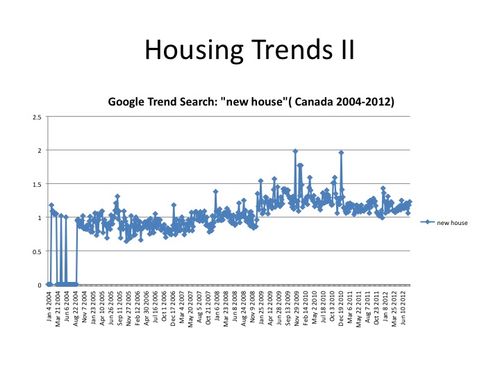
Next, we may as well look at the housing market. Three figures here: Figure 3 “mortgage
rates”, Figure 4 “new condo” and Figure 5 “new house”. The interest in mortgage rates which
should be correlated with loan and home purchases has definitely been trending
down since 2009 suggesting a slowdown.
On the other hand, this data is for Canada and we have had a hot housing
market. It could be that rates
have been so low for so long that they are pretty much taken for granted and
there is not much searching. There
does seem to be a downward trend in interest in a “new house” but then there
seems to be more recent interest in a “new condo”. On the other hand, what can this really indicate? If I decided to buy a new house, would
I actually just type in “new house”? How can we narrow down the importance of terms used in a search so as to distill the economic intent?
Figure 3

Figure 4

Figure 5
I think this type of work is really interesting but it is in
its infancy given the short span of data as well as the lack of refinement as
to how these searches might actually translate into effective demand. Case in point – Figure 6. Here are the search results for two terms: “sex”
and “babies”. Oddly enough, as
evidenced by the trend over time from the search terms, Canadians seem to be less
interested in “sex” but they are more interested in “babies” which all things
given is often the tangible long-term output from having sex. However, both terms are so general that who really
knows how they might translate into relationships and trends. I mean are people searching for "sex" as a service, entertainment, a how-to-manual or is it information on gender they are looking for? Similarly, if more people are searching for "smart tv" does it automatically mean there will on average be an increase in the interest to buy one?

For the time being, I suspect modeling at
the Bank of Canada will continue to rely on traditional methods. If there is a change in the demand for
staffing at central banks as indicated by combinations of terms used in Google Trends, ("web surfer"; "forecasting"; "central bank") then we
may have an indication there is a shift underway. However, if this type of forecasting becomes the future, then there is probably going to have to be a melding of consumer theory, marketing, psychology and language use in the intermediate micro course of the future.


 Worthwhile Canadian Initiative
Excellent – especially enjoyed the sex and babies one.
Google trends is, of course, normalized for the volume of traffic. So I suspect the sex trends reveal is a decline in the relative # of sex searches, as the internet becomes less dominated by, shall we say, a certain demographic, as opposed to an absolute decline in sex related searches.
if you type new house, new condo into google trends you can get the two on the same graph. Condo still a tiny fraction of house.
I remember a decade or so ago, people were talking about doing the same sort of thing with 7-11 or Walmart sales data. The theory was that their computerized inventory and sales data would give you real-time information about consumption patterns. If people stop buying steaks and start buying ground (wood)chuck, or start buying single cans, rather than 6-packs, time to brace for impact.
Mind you, as a forecasting tool it suffered from the distinct disadvantage that the information was the private, and very secret, property of the retailer.
We had Hal Varian talk about Google Insight at our real-time conference in Philadelphia a couple of years ago and while he pitched its potential, I’ve yet to see anyone make successful use of it for business cycle analysis. I’m still trying to understand how to get around two basic stumbling blocks.
1) Baseline drift. If Google tells me that the number of searches for “recession” has gone from 5 in 2004 to 4 now, I’d like to know how the total number of Google searches trended over that period, so that I can better understand how it compares.
2) Short data span. As Livio pointed out, this really hamstrings those who want to study business cycles. To make sense of a predictor, you need to see how it performs over several recessions. So far, we have one observation.
Of course, other Google data seems to be used with great success in the Billion Prices Project (bpp.mit.edu).
Don’t forget Google Insights. You can do geographical comparisons over time:
http://www.google.com/insights/search/#q=housing%20bubble&geo=US%2CCA%2CAU&cmpt=geo
Perhaps “sex” is in gradual decline as a search term because most users already have their favorite bookmarks? When confronted with an overwhelming number of goods, people may make rush decisions.
Further to Shangwen’s point, “girl on girl” shows a strong positive upwards trend, as do some other words that I won’t type here for fear of attracting spam.
@Frances: Specialization! Of course.
Livio: The linguist Mark Liberman, at U Penn, has a good discussion of problems in using search and corpus data here. Google Books’ data set is certainly older, though not necessarily larger than Google Trends data, depending on the popularity and recency of the term.
Thanks for the Liberman reference Shangwen. There needs to be a methodology for the searches using economic terms if they are going to be used as an indicator. Moreover, given how language changes over time, the methodology would also need to incorporate some method of modifying the searches to take language and terminology changes into account.
Your economic growth details are very effective.Then your graphical presentation are nice.
ewald struggl