Well, here are some depressing statistics from Banca
D’Italia’s recent release on Italy’s economy.
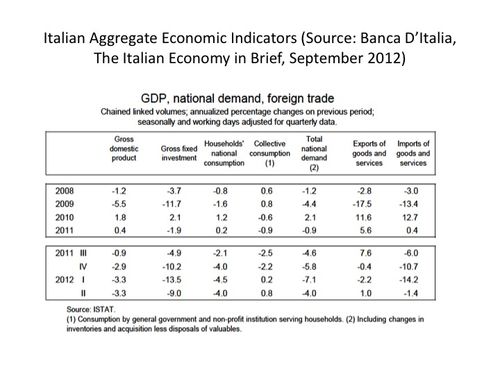
According to the September 2012 edition of The Italian
Economy in Brief, the Italian economy is marked by four consecutive quarters of
shrinking GDP and five of contracting investment spending. After the contractions of the economy
in 2008 and 2009, 2010 actually saw modest growth but 2011 has marked the
resumption of recession. (See Figure 1) The Italian economy is tanking as even
some of the less conventional indicators suggest.
Figure 1
This does not bode well for Mario Monti. When he arrived on the scene last year,
he brought in a package of austerity measures that have helped lower Italy’s
borrowing costs on a public debt whose debt to GDP ratio in Europe is exceeded only by
Greece. His government has brought in a package of reforms and deregulation
that were supposed to improve Italian economic performance and growth. Along with raising the retirement age,
there were also tax revenue increases (the VAT was to be increased from 21 to
23 percent). However, economic growth does not seem to be improving. If anything, the package of austerity
measures probably further contributed to the economic growth drop while any
reforms designed to boost productivity have not yet yielded results. True, a year may not be enough time but
unfortunately the statistics are showing a worsening of the situation rather
than an improvement.
Figure 2
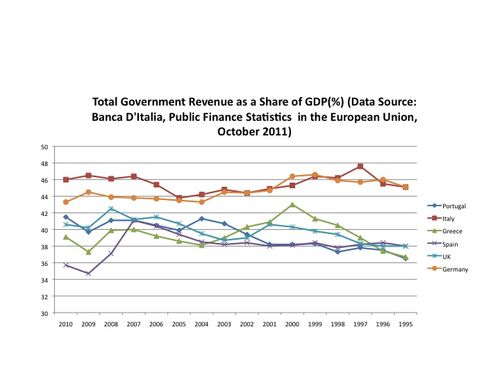
One interesting aspect of Italy’s fiscal situation compared
to Spain, Portugal and Greece is that Italy had a higher total government revenue to
GDP ratio going into the financial crisis. (See Figure 2) Indeed, on this particular economic
variable, Italy looks a lot more like Germany and the UK looks more like Spain, Greece and
Portugal. Italy’s tax effort as
measured by the total government revenue to GDP ratio was not weak. The combination
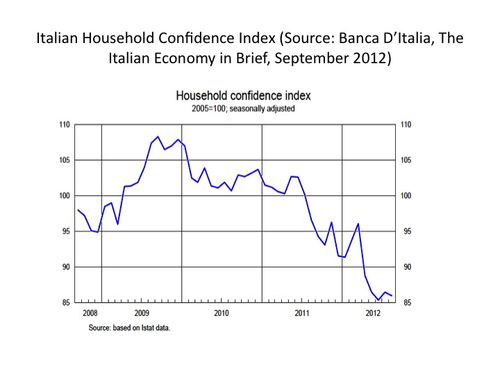
of a recession and austerity measures have all come together to further weaken the growth potential of the
Italian economy by reducing household economic confidence. (See Figure 3) Italy
desperately needs economic growth but seems to be at a loss in putting in place
the policies to achieve it. For
the average Italian household, their confidence level shows that the
economic winter is already here.
Figure 3


 Worthwhile Canadian Initiative
My ex has an ex (the guy before me) whose daughter married an Italian building contractor. The life of Riley building second homes on beaches in Tuscany. She just came back with their two children last month. He made an application to immigrate to Canada…
Livio,
Regardless of the doomsayers, and setting aside the short term transition cost of exit, does it not seem reasonable to you that Italy should at least discuss exiting the euro to regain its competitiveness with a devalued lira?
Examination of various economic metrics suggests that Southern Europe has always been mless prosperous than northern Europe, which suggests lower levels of productivity in the south of Europe.
If one thinks it was a mistake for Italy, Spain, Greece and Portugal to join – and the data at the time suggests this was the case along with a number of prominent economists including both Friedman and Krugman – is it not a mistake to remain within the EZ – given their inability to get growth going again and their inability to compete with Germany et al?
Hi Ian:
I’m not sure Italy is in the same league as Greece or Spain when it comes to the fiscal crisis. It has always had a very productive private sector with a lot of industrial and manufacturing activity particularly In the North. Italy has many creative industries designing world class products whether in fashion, furniture or transportation. Italy’s economy is in need of structural reforms in terms of labour market productivity and a more efficient public sector. Exiting the Euro would provide merely a short term crutch via a devalued currency and postpone the needed adjustments that have to be made. In any event, the Euro is now probably beyond an economic discussion. It has a political significance in that it’s end would be seen as a severe setback if not the end of the European experiment. If the Euro were to be abandoned, in three days it would have to rise again. It is now a symbol as much as an economic device. The only political way around it might be to create a “temporary”exit of Greece, Italy, Spain from the Euro with the understanding that they would rejoin once their houses were in order. However, this approach would come with major transactions costs.
Just another quick thought. I don’t know enough about currencies to know if this might be workable but with respect to Italy, Greece, Spain and Portugal why not have them temporarily exit not to separate national currencies but a lower value EuroB currency. In a sense, there would be two Euros. The devalued EuroB currency would allow the harder hit Mediterranean zone to have devalued currency that would enable them to recover. However, if this was such a good idea I suspect it would have already been thought of and advocated by more capable monetary minds than mine.
Punishing an economy with tight money to enact “needed” reforms seems to me to be, well, insane.
If the ECB continues to strangle Italy’s economy with tight policy then it seems to me that they don’t really have a choice but to go back to a devalued lira. No amount of structural reforms they could feasibly commit to could overcome the hit they’re taking to AD.
The IMF forecast for Italy came out today. GDP for the year 2013 is now expected to be 0.7% lower than 2012, which is only modestly worse than it predicted last July. I couldn’t find a quarterly forecast, but Dec 2012 to Dec 2013 growth was predicted to be flat. I back out that the IMF expects a decline in Italian GDP in the first half of 2013 followed by growth in the second half of next year–about 9 more months of “winter”. The IMF report warns readers that it sees more uncertainty than usual around this forecast, but let’s hope it doesn’t turn out to be too optimistic.
One of the biggest dangers of combining bad monetary policy with good structural reforms is that the latter gets the blame (“Monetary policy- you mean interest rates?”).
How can people get behind structural reforms (including deficit restructuring) if they’re suffering a recession? The UK went through major lasting reforms in the 1980s because, for most of the decade, the economy was booming and monetary policy was actually objectively too loose (though not as bad as the 1970s). Many of the key reforms to the US economy didn’t take place until the mid-to-late 1990s boom.
If you look at the sectors of the eurozone who are most likely to spend on final goods (households and non-financial corporations) and look at what’s happening to their deposits in real terms, it’s no wonder that the eurozone is in recession. I thought that one of the distinctive things about the ECB was that they would care about M3?
Click to access bsi_m3_by_sector.pdf