Last WCI post, I used the OECD 2012 Health Data spending
statistics to examine the growth of total health care spending. The question I want to look at this
time is what does increased spending yield a health care system in terms of the
health care resources available?
While we are concerned with the cost and sustainability of a health care
system, the fact is that in some sense you should also get what you pay for. If you are spending more, over time is
this associated with more doctors, nurses, equipment, etc…? Moreover, based on
our international ranking in terms of health spending, how does Canada rank on
these resources?
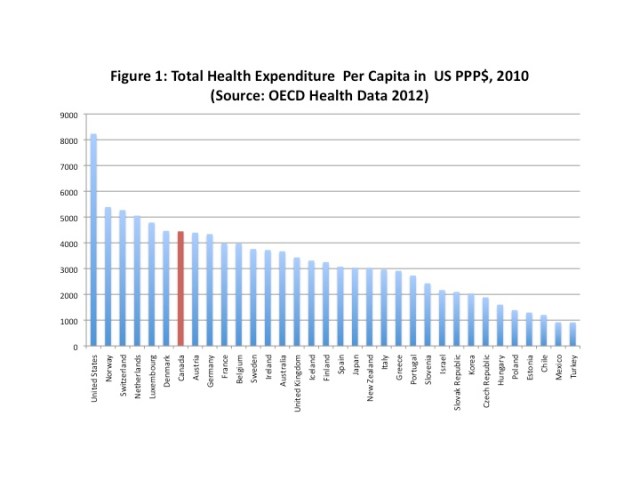
Figure 1 plots ranked total health expenditure in US PPP$ in
2010 for the 34 OECD countries and shows that Canada ranks seventh in terms of
total health spending per person.
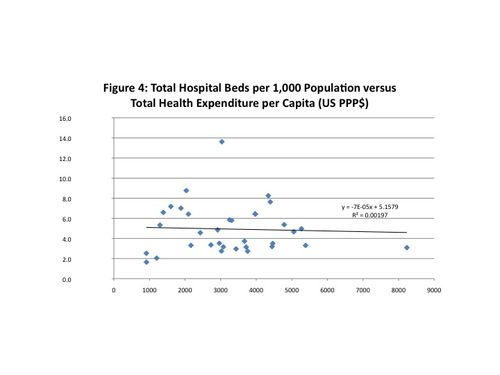
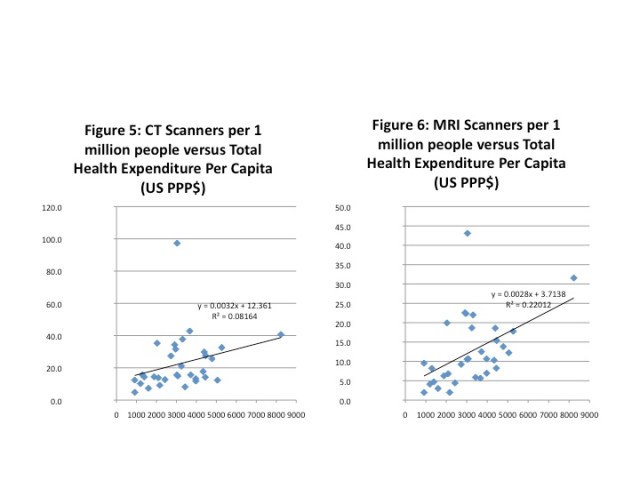
As Figures 2-6 reveal, more per capita spending is generally associated
with more per capita health resources when it comes to doctors and nurses as
well as diagnostic technology such as CT scanners and MRIs. An exception is hospital beds where the
relationship is pretty flat.
These graphs are for the OECD countries in 2010.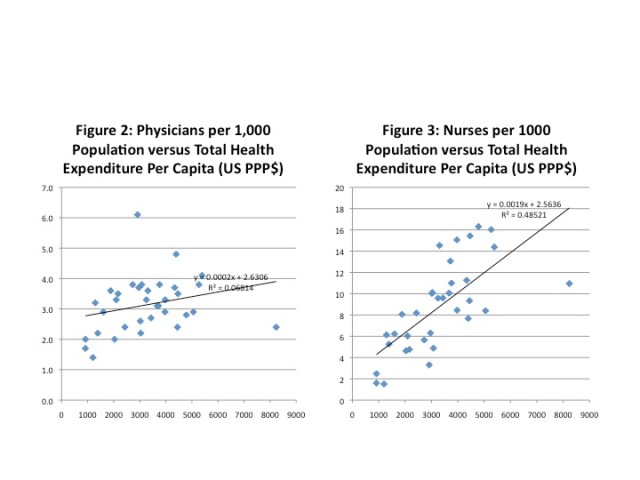
The linear trends in Figure 2-6 are just simple OLS. In
terms of the estimated relationships across the OECD, each 1,000 US PPP dollars
per capita is associated with an additional 0.2 physicians per 1,000 of
population, an additional 1.9 nurses per 1,000 of population, an additional 3.2
CT scanners per one million of population and 2.8 more MRI scanners per 1
million people. These are of course crude relationships without controlling for
any other variables but I’m trying to simply illustrate the point that with the
exception of hospital beds, more money seems to buy you more resource inputs. You might want to argue that there are
differences across these health care systems that make comparisons difficult
but these are for the most part pretty highly developed countries.
Canada is the seventh biggest spender in per capita terms
amongst these 34 OECD countries but when it comes to physicians per capita, it
ranks 26th. Are we possibly
substituting nurses for physicians and rank more highly there? Not likely as in that category, we rank
25th. Norway is the second biggest spender per capita after the United States and ranks 3rd for physicians per capita and 6th for nurses per capita. We also rank 25th
in the number of total hospital beds per capita, 21st for CT
scanners and 20th for MRI units. While we are in the top ten per capita spenders, we are
never in the top ten for any of these five health care resource
indicators. This seems to be a
pretty simple comment as to how efficient of health care in Canada is. The United States spends the most per capita and also do not appear to be that efficient when it comes to health resources as they rank 28th in the number of physicians per capita and 28th in the number of hospital beds per capita. On the other hand, they are 10th with respect to nurses per capita, 3rd with respect to CT scanners and 2nd with respect to MRIs. Based on these figures, we consistently spend more but get less health care
resources for our money.
Naturally, we also need to look at health outcomes. More to come in another post.


 Worthwhile Canadian Initiative
A technical comment: I am thinking the linear trends are badly affected by the USA. A fit to the rest of the countries might be abetter indicator of them: ie including the USA in the fit makes the fit a less reliable description of the rest of the world.
What the American system provides (for many, not all, Americans) is the sense that if you get very sick, the best tools, researchers, cutting-edge stuff is available. It is a terrible way to spend money in aggregate, but if you or someone you love is that sick person, it has its appeal.
Chris: A good point about the US. They are exceptional. The US is a definite outlier but leaving them out did not affect the relationships that much – it is only one of 34 data points. It also does not change the observation that we in Canada seem to spend a lot and do not seem to get as much in terms of what the money buys in terms of resources.
The problem with using this kind of data is that it offers no measure of satisfaction with the health care system. Nothing about the number of doctors or the number of CT scanners per capita indicates how many people in the population are actually using those resources. And it certainly doesn’t describe anything about people using Resource X versus people who actually need Resource X.
Health care is too complex to measure with these kinds of data. You have to control for extraneous use of resources, which is what CADTH is constantly trying to do in Canada… But you ALSO have to control for resources that go unused. Both are examples of wasted funds, you could analogize it to something like a type i versus a type ii error.
And then there is the whole Pandora’s Box of the thing:
(1) Some patients prefer Treatment X even though “experts” have determined that they “should” prefer Treatment Y. Such patients will never be satisfied with their health outcomes because they are not allowed to be.
(2) For some patients, Treatment Y actually provides a superior outcome despite the fact that Treatment X is the best treatment “on average.” Such patients are actually being slowly killed by their health care system simply because they are unlucky enough to fall outside of the first two or three sigmas of cost-effectiveness research.
(3) Certain aspects of health care are consumption spending, i.e. people simply want to spend their money on Treatment X because they have the money and can afford to do so. In an unregulated situation, supply of X would adjust according to market incentives, but in the heavily regulated health care market, there is a legitimate point to those who say that health care resources are being “wasted” in these instances. But are they really? I think that’s a moral judgment call, not an economic issue.
…and so on, and so forth.
The implication is not surprising. Certainly the long-run trend is that healthcare productivity has been mostly negative since the 1950s, given the combined effects of cost disease, rent-seeking, and (depending on the environment) regulation. It’s worth noting that epidemiologic effects that are constantly catastrophized in the media (aging, obesity, etc.) do not contribute significantly to increases in spending and declines in productivity. The problem is policy.
Livio, I look forward to your next post on outcomes.
Keep in mind that some of the US’s spending is on Canadians who can’t get timely treatment in Canada and come down here for it. I know two Canadians who’ve saved their lives by using the Mayo Clinic in Minneapolis, rather than sit on waiting lists at home.
Also, a lot of American spending goes to the elderly near the end of their lives, paid for by the taxpayers.
@Patrick, here is the only published study I’m aware of that estimates cross-border consumption of health care by Canadians in the US. There may of course be other studies. The amount of medical tourism to the US is very small, though it certainly happens (I’ve done it twice and it was worth the cash), but it’s nothing like what the myth suggests.
I’d like to second (third, actually) the comment on outcomes vs. resources. While interesting, these measures all penalize any kind of preventative care that keeps people out of the hospital bed, as well as fiscally (and medically) responsible practices by Doctors NOT conducting unnecessary MRIs.
Actually the more I think about these numbers the more dangerous I think they are and the more annoyed I become. They incent the exact wrong response.
Would you also judge the judicial system as being better if we have more jail cells?