Raphael Deketele, a student in my fourth year honours seminar, just unearthed a strange finding from the 2006 World Values Survey (WVS).
The WVS interviewed over 1000 Americans, and asked them:
Here is a scale of incomes on which 1 indicates the “lowest income decile” and 10 the “highest income decile” in your country. We would like to know in what group your household is. Please, specify the appropriate number, counting all wages, salaries, pensions and other incomes that come in.
Each income decile, by definition, contains ten percent of the population. In a randomly selected group of people, about ten percent should be in the first decile, ten percent in the second decile, and so on. The distribution of responses to the income decile question should be uniform, that is, flat.
In fact, it looks more like this:
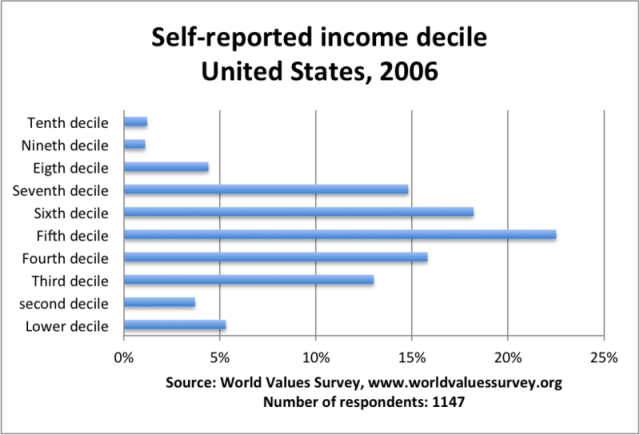
Fewer than ten percent of respondents to the World Values Survey placed themselves in the top 30 percent of the income distribution. Twenty-five percent of respondents placed themselves right in the middle of the distribution, and just under ten percent placed themselves in the bottom twenty percent.
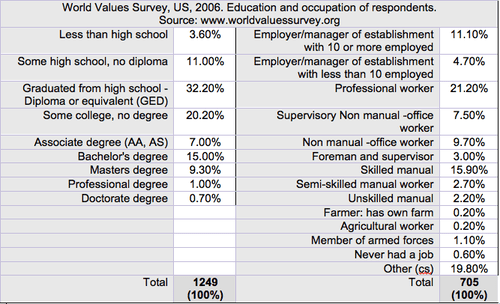
Now it could be that the WVS's sample is not representative of the US population; that the wealthy were under-surveyed and the middle class over-represented. One way of checking the representativeness of the WVS is to look at more objective indicators of socio-economic status, for example, income or education. The World Values Survey doesn't seem to be particularly biased against higher income earners: 25 percent of respondents have a bachelor's degree or higher; significant percentages work in professional or managerial positions.
I suspect people just live in their own little worlds. A typical respondent, when answering this question, probably reasons along these lines: "I'm not as well off as the people across the street with the slightly nicer car and slightly better job, but I'm slightly better off than the people down the road who seem to be struggling a bit financially, so I guess that puts me around the middle of the income distribution."
Such mistaken beliefs could have real impacts of public policy. If few people perceive themselves as being poor, then they will see programs to help the needy as benefiting others, not themselves. If taking action against the deficit requires sacrifice from those who are most able to pay, people who (incorrectly) perceive themselves as only average will refuse to chip in.
Still, the WVS results explain why politicans court the middle class: whether they're rich or whether they're poor, that's how most people perceive themselves.
Update: in the Canadian World Values Survey, the question was phrased slightly differently. People were asked:
Here is a scale of incomes [e.g. up to 12,500, 12,501 to 20,000,…]. We would like to know in what group your household is, counting all wages, pensions and other incomes that come in. Just give the letter of the group your household falls into, before taxes and other deductions.
The distribution of incomes generated by this question is shown below.
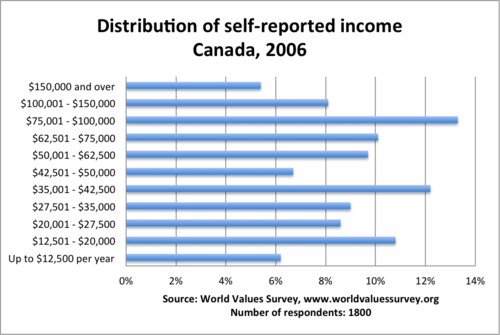
To put these numbers into perspective, according to Cansim numbers in 2006 an household income of $101,000 (2010$) would put a two person household right in the middle of the fourth income quintile. The corresponding figure for a single person household would be $42,200.
Update 2:
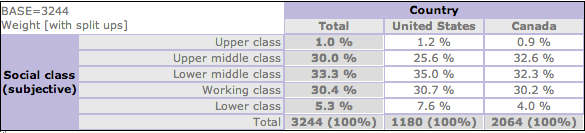
The World Values Survey also asked respondents to identify, subjectively, their social class. I've reproduced the 2006 Canada and US results here, but they're pretty unsurprising.


 Worthwhile Canadian Initiative
Sam / DocMerlin make a pretty important, how distorted the perspectives of what is normal / median / average are today. Probably because the really “poor” / below average have so little impact on the public voice in many countries, especially the US. What do you expect, if you have to be a millionaire, to gather some seat in the house or senate? Indirect, party lists, making up half the seats in Germany, have some advantages.
Question 1:
Who of you can calculate a Gini coefficient from the self reported distribution Canada 2006, shown above? What is it, what are the difficulties?
Question 2: “did they buy their own furniture”?
The 2 Roonies remembered me of http://www.economist.com/node/7289005
“If America’s poor ever start to believe they will never get rich, the place will be heading for trouble.”
And that is another thing you can study in this East/West Germany comparison. Where most upward mobile Westerns proudly showed their new, custom made furniture (from “Nussbaum”, Teak, preferably, but at least without the eeky US brass handles : – ), like “we have the money to buy new expensive, custom made furniture”. The eastern upward, to the present day, proudly display pre war, preferably pre-WWI furniture, usually with some story of some aunt or so to go with it …. : -). Like “we belong to some old bourgeoisie”, before the socialists took over.
My father is using that furniture now (bed, desk, etc.), essentially buying his dream for me, 40 years ago : – )
Anything similar in Canada?
Question 3: “what is the just income distribution?”
From an engineering point, if some process needs fixing, you a) have a solid idea, where it has to be (numbers!), and b) why there, and c) where you are now. Hint: Statistical Process Control (SPC). These are basically the 3 questions I asked Frances with respect to the income distribution, yesterday. Any takers?
Just to complete this, there were just “catholic” and “evangelisch” in my Germany, no class differences, and the tiny rest looked at somewhat suspicious. http://en.wikipedia.org/wiki/Religion_in_Germany
The distribution actually resembles closely, which areas where conquered by the Romans, 1500 years earlier.
genauer – on the question of just income distribution, see the work of Tony Atkinson, who talks a great deal about how to measure the distribution of income, and also how value judgements can be incorporated into income distribution measures. Frank Cowell is also worth reading.
Hi Frances,
many thanks for the quick reply, I looked them up. But
a) could you be slightly more specific, where they quantify their opinion of “just”, and not just describe another index (Theil, Pareto, etc., comes to mind). I am no particular friend of the Gini, I welcome other ideas.
b) I am actually interested in YOUR opinion and the folks here around.
genauer – there’s something called the Atkinson index – that’s Tony Atkinson’s best attempt to incorporate justice into income inequality measurement. My opinion? It’s complicated.
Frances,
would you have a sentence or two, what these two Gentlemen teach us, what we didn’t already knew?
well,
when I looked at the bios of these 2, I somehow needed to look at “Eat the Rich” http://www.youtube.com/watch?v=o5Q3TM1WlqE&feature=related