Every year I attempt to teach students the Coase theorem, and devise some new question to test their understanding of it. Every year I fail to communicate Coase's ideas.
Here is this year's Coase question (adapted from one by Jesse Bull):
A
rancher and a farmer are located next to each other. Here are the facts of
their situation:
- There
is no fence between the ranch and the farm - The
cattle enter the farmer’s fields and destroy $300 worth of corn each year. - The
rancher’s business is worth $1000 annually (not taking into account any crop damage). - The
farmer’s business is worth $800 before the cattle trample the corn - It
would cost the rancher $100 to build a fence that would keep the cattle on his
property. - It
would cost the farmer $400 to build a fence that would keep the cattle out of
her property.
Assume
that it costs the rancher and the farmer nothing to negotiate with each other.
- Suppose
the rancher has to compensate the farmer for any crop damage. Will a fence get
built? If so, who will build it and who will pay for it? How much better off do
you think the farmer will be as the result of the fence? The rancher? Explain your
answer. - Suppose
the farmer has to absorb (pay for) the crop damage herself. Will a fence get
built? If so, who will build it and who will pay for it? How much better off do
you think the farmer will as the result of the fence? The rancher? Explain your
answer.
In The Problem of Social Cost, Ronald Coase argues that the outcome is "the same whether or not the
cattle-raiser is held responsible for the crop damage brought about by his
cattle". As long as it is clear who is liable for the crop damage, and there are no costs of negotiating a settlement, "the ultimate result (which maximises the value of production) is independent of the legal position".
In other words, it doesn't matter who is responsible for building the fence, as long as the cost of the fence is less than the cost of the crop damage, the fence will be built – and in the least costly fashion.
Answering part 1 of the above question, the part where the rancher is responsible for damage, is straightforward. The rancher builds the fence, because the cost of the fence ($100) is less than the cost of compensating the farmer for crop damage. Together, the rancher and the farmer are $200 better off ($300 crop damage less $100 fence). The Coase theorem doesn't predict how the gains will be shared – they could be shared equally between farmer and rancher, or the rancher could enjoy the full benefits of not having to pay for crop damage. (When marking this question, I accepted any answer to the "How much better off" question as long as the total added to $200).
The solution in the second situation, when the farmer is responsible for damage, is less obvious. It would cost the farmer $400 to build a fence, and the crop damage is only $300. Perhaps this means the fence doesn't get built? The Coase theorem says that it doesn't matter who is responsible for paying for the damage, the outcome will be the same, and that suggests the fence does get built. But who will build it?
The trick to answering Coase theorem-type question is to think about all of the possibilities. Sure, the farmer could build a fence for $400, but that wouldn't make economic sense. The smart solution is for the farmer to pay the rancher some amount between $100 and $300, say $200, and ask the rancher to build a fence. Since it only costs the rancher $100 to fence in his cattle, surely the rancher would agree to such a proposition. Both would be better off, the fence would be built, and the crops would be saved.
It's not that my students had forgotten, or hadn't studied, the Coase theorem. A number wrote out the Coase theorem correctly – before going on to say the fence would get built if the rancher was liable for damage, but wouldn't if the farmer had to absorb the cost. It's not just this group of students either. The same thing happens every year.
One possibility is that the question itself was not as clear as I imagined it to be. Some seemingly irrelevant detail might have led the students astray. The fact that numbers were included in the question might have led people to think that the numbers held the key to the solution. As always, students were confused by things I hadn't clarified, for example, the fact that the fence is a one time cost, and the crop damage is on-going. A number answered something along the lines of "the farmer would build the fence because it's worth spending $400 once to save $300 on an on-going basis." (This is incorrect: it's still cheaper for the farme to pay the rancher to build the fence.)
The Coase theorem, at least the way that I teach it, involves concepts and ideas that are not given much attention elsewhere in the undergraduate curriculum. It's argued in words, not in diagrams. It talks explicitly about the process and costs of negotiating transactions through the market, which are more often assumed away. I've been trying to teach the Coase theorem without spending much time discussing the processs of negotiation or the nature of transaction costs, and that might be the source of the problem. (Perhaps, also, I need better readings than the Rosen Public Finance textbook).
Maybe if I formalized Coase, and modelled the rancher/farmer problem as a game theoretic problem, it would be clearer:
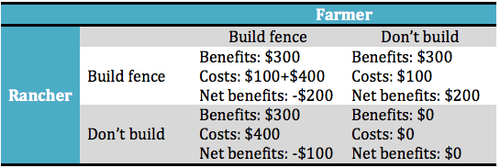
The Coase theorem can be restated as follows: in a two player game, with full information, unlimited communication and costless enforcement of contracts, players will reach the outcome with the highest net benefits. In this case, the net benefits are highest when the rancher builds the fence and the farmer doesn't. Any agreement will leave each player at least as well off as she would have been in the absence of an agreement, but the division of benefits is not specified by the theorem.
I teach the Coase theorem in the context of a discussion of externalities. Here is a question that applies the Coase theorem to an externalities situation:
Ruth’s
demand for piercings (pierced ears, etc) is given by:
P=110-10Q
where Q is the number of
piercings. The marginal cost of piercings is $40 per piercing.
- Calculate the number of piercings Ruth will choose. Illustrate with a picture.
- Ruth’s
father, Phil, intensely dislikes piercings. Ruth’s piercings cause Phil psychological harm of $50 per piercing. Calculate the socially optimal quantity
of piercings. Add this information to your diagram from part (a). - State
and explain the Coase theorem. - Individuals
under 16 cannot get piercings without the permission of their parents.
Individuals 16 and over do not require parental permission. Use the Coase
theorem to predict what will happen to (i) the number of piercings Ruth has and
(ii) the distribution of resources between Ruth and Phil when Ruth turns 16.
The students answered, with no difficulty, the first three parts of the question:
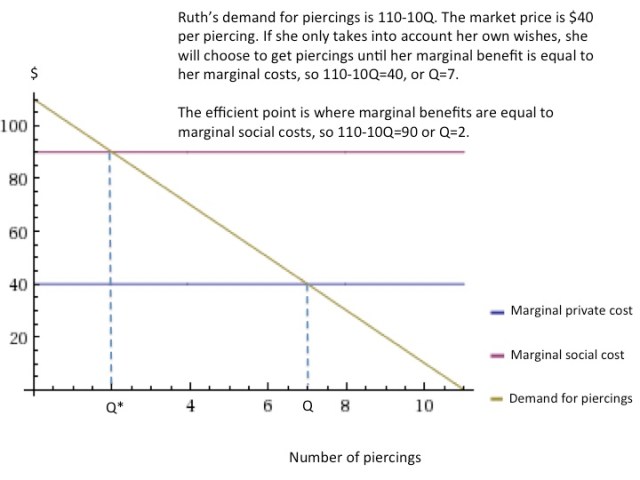
(Notice that the weights of the various parts of the question are not specified, leaving ample room for manipulating the grade distribution ex post by giving more or less weight to the part of the question that all of the students failed to answer correctly).
The answer to part 4 of this question is that, according to Coase, Ruth will get the optimal number of piercings, regardless of whether or not she has to get Phil's permission (Becker's Rotten Kid Theorem is basically just an application of the Coase Theorem). If Phil has final say over the number of piercings, he will allow Ruth two piercings, either because he cares about her well-being enough to grant her permission, or because she will persuade him by offering him compensation for the psychological harm the piercings cause "I will study/tidy my room/eat broccoli if you allow me to get my ears pierced." If Ruth has control over her body, Phil has to bribe her not to get piercings: "I will pay for your university tuition as long as you don't get your tongue/eyebrow/belly-button/nose pierced." Who has final say on piercings matters for the distribution of resources between Ruth and Phil, but not for the number of piercings.
Perhaps the reason that my students answered the question incorrectly is that I hadn't shown them how to use formal methods – mathematics, diagrams – to analyze Coase theorem type questions. One way of formalizing the Ruth and Phil problem is shown in the two diagrams below. When Ruth has to get Phil's permission for any piercings, she has to compensate him for damage caused, as shown on the diagram on the left.
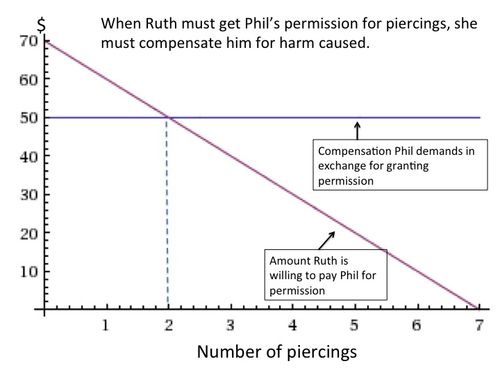
The amount Ruth is willing to pay Phil for a piercing is 70-10Q, where Q is the number of piercings she has. This is the marginal benefit she gets from a piercing, which we can infer from her demand function, 110-10Q, less the private costs she pays for getting a piercing done, $40. The compensation Phil demands is equal to the psychological harm the piercings cause him, or $50. The number of piercings Ruth gets is the point where these two meet, or 2 piercings.
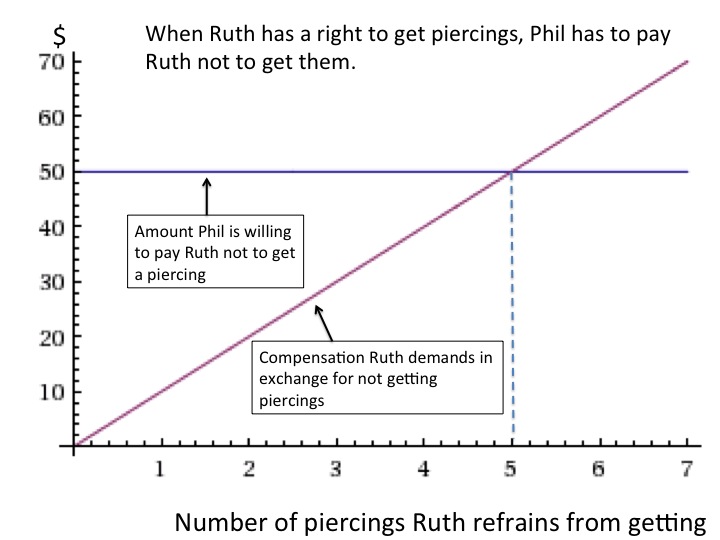
When Ruth has the right to get piercings, however, Phil has to compensate her. Her preferred number of piercings is 7, the point where her private costs are equal to her private benefits. Let X equal the number of piercings Ruth doesn't get, defined as X=7-Q, or the number she would like to get less the number she actually gets. Every piercing she refrains from getting has a cost to her of 10X, calculated by substituting X=7-Q into the the net benefits of piercing, 70-10Q, calculated above. However, by paying Ruth $50 not to get a piercing, Phil can persaude her not to get 5 piercings, as shown on the diagram on the right. As before, the number of piercings she gets is 7-5, or 2.
Does formalizing the question like that make things easier? I'm not convinced it does.
When I go over the Ruth and Philip question with the students in class, someone invariably puts up their hand and says "But what if Ruth can't afford to pay Phil $50?" This is a perfectly legitimate point. The Coase theorem assumes away income effects. Many 15-year-olds simply would not have the wherewithal to compensate a parent for the psychological harm caused by a tongue piercing. At 16, they no longer have to.
Students live in a world where income effects matter and negotiations are costly. The Ruth and Phil question asks "Use the Coase theorem to predict…", so the right answer is the outcome predicted by the Coase theorem. However in an exam situation, people often don't take time to read the question carefully. They answer with their intuition, rather than reasoning through the question the way a lawyer would.
Teaching the Coase Theorem is not the real issue. The real challenge is getting people to step back, analyze the underlying structure of costs and benefits, and systematically work through all possible outcomes. That I fail to do.
p.s. Eric Crampton has a number of interesting Coase-related posts on Offsetting Behaviour. The diagrams for the Ruth and Phil question were created by typing, for example, "plot 50+(10^-10)Q, 10Q over Q = 0 to 7" in wolframalpha.com, copying and pasting the image into powerpoint, and then adding labels. The 10^-10 is needed because it can be hard to persuade wolframalpha to plot horizontal lines.


 Worthwhile Canadian Initiative
Frances: I get it, maybe I did not explain my objection correctly. So let’s sum it up
1. First, you frame a decision to get piercing as something where the cost of getting one is something important.
2. Then you frame parenting in an economic way as if parents evaluate how much various decisions of their children impact THEM.
This for me as a student would be a signal to switch-off my “creative” thinking and just change “Ruth”, “Daddy” and “Piercing” for “Person A”, “Person B” and “Good” so that I don’t get distracted. And then if as a response to this totally unrealistic scenario some student would ask “What if daughter does not have money to bribe her father?” there are several possible answers to that question:
a) Technocratic answer. It is clearly assumed that “Person A” has enough money to buy her preferred quantity of goods (7 x $40 = $280) – at least you wrote it as part of answer for question 1. Why change this assumption for question 4? It would be silly to think about this example if Person A had no means to make her purchase.
b) What I would think as a student hearing somebody asking it: Really? Is this the only thing that you found wrong with the example? Oh, wait. You just want to seem active and thoughtful before our prof. Disgusting.
I was somewhat distracted by the idea that there may be a wealth transfer at work – I read that by destroying crops, the cattle were eating them, and thus saving the rancher some money if crop damage remained the farmer’s responsibility.
Coase’s theorem is like a lot of abstract economics. It’s difficult to grasp because its assumptions (free negotiations, free contract enforcement) eliminates any relationship with the real world. You then provide a pseudo-real world example and expect people to remain focused on applying a purely theoretical rule. Creating a more abstract problem might help.
Frances: For the Ruth and Phil case, you don’t really need the 2nd diagram. For the second case, the “what Phil must be paid” schedule becomes the “foregone marginal payment from Phil” schedule. This is a now a marginal cost to Ruth of a piercing, so she choose the number of piercings where marginal net benefit equals marginal foregone payment from Phil: 2 piercings.
One of the things that bothers me about the textbook expositions of Coase is that they all concern external effects that are confined to a single agent. Once the Marginal external effect is spread out among many people – surely the more typical case – the Coasian solution requires that we solve a collective action problem. Getting the problem fixed is then a public good, subject to free-riding. And then we can see how the scorned Pigouvian tax/subsidy is precisely a solution to such a collective action problem.
Kevin: “One of the things that bothers me about the textbook expositions of Coase is that they all concern external effects that are confined to a single agent.”
Absolutely, because with multiple agents, the assumption of zero transaction costs isn’t particularly appealing. But as you say, the externalities that exist – which exist precisely because they can’t easily be internalized through negotiation – tend to be ones affecting multiple actors.
Neil “Creating a more abstract problem might help” It might help students answer the question correctly, but would it help them apply Coase to real world situations.
J.V., sorry, my reaction was unnecessarily snappy.
I agree with Mike Huben. When I was presented with these problems during my undergrad, I had trouble grasping that you could pay someone to take advantage of their lower costs (or higher benefits). Your game example illustrates it perfectly because the student thinks the farmer only has one decision to make with two possibilities, i.e. to build their own fence or not. They don’t fully get that you can negotiate to make one of those outcomes more or less likely to happen.
Bizarre that you think the only costs which matter to choice are “given” money costs.
Countless additional subjective costs of various kinds can be imaged for the actors in this situations.
The stipulated “givens” of any whiteboard people falsify the nature of choice — as Coase repeatedly attempted to get economists to think about …. but failed.
Greg: “Bizarre that you think the only costs which matter to choice are “given” money costs.”
I’m not sure who “you” refers to here. People make decisions. The basic premise of economics is that those decisions are made on the basis of costs and benefits. Those costs and benefits may be either monetary or non-monetary. In fact, they almost always are both monetary and non-monetary.
In order to make a decision, however, people have to say either “the costs are greater than the benefits” or “the benefits are greater than the costs.” Implicitly, this requires aggregating benefits and costs in some way. Expressing things in dollar terms is nothing other than a convenient way of aggregating costs and benefits.
Aggregating in dollar terms, rather than say utiles, implicitly assumes that it is possible to compare, e.g., Phil’s psychological harm and Ruth’s psychological benefits. Yet people do make such trade-offs. There was a fascinating paper published, I think in the Feminist Economics volume on Amartya Sen, that looked at situations where people had made explicit trade-offs between, say, freedom and security (freed slaves petitioning to be re-enslaved in order to be with family and receive care in old age, for example).
People make choices. People have alternatives. Recognizing that is the basic value of economics.
“Rancher” number two now appears and offers to build a $100 fence to contain his prospective cattle if the farmer pays him $200. He builds the fence, pockets his $100 profit and sells the fenced property. Rancher number three now appears…