My colleague, Steve Saideman, has a thing about milk in bags. On Saideman's Semi-Spew he claims that, as compared to gallon milk jugs, they're an "inferior technology." They're not even good for the environment because "bags in which milk may be delivered have no other purpose. A gallon jug, on the other hand, has a vast array of re-purposes."
The "real superiority", Steve argues, of gallon jugs is their ease of use:
one can simply open a gallon jug of milk and pour. If you have bought bags of milk, you need to get a container, make sure it is clean, open the bag without spilling anything (no crying necessary with a gallon jug), pour it into the container and then pour some of the contents into one's bowl of cereal.
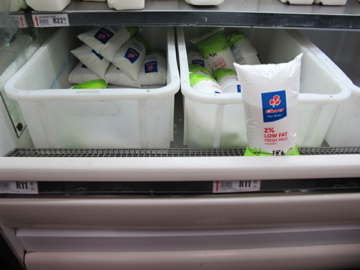
Steve, it turns out Canadians aren't the only ones using plastic bags. South Africans use them too. Photographic evidence is on the right.
Perhaps South Africa sells milk in bags because it too has a milk marketing board? Actually, South Africa's milk board was disbanded in 1994. According to the South African Milk Producers Association, "The South African dairy industry operates entirely according to free market principles."
I don't take the milk producers' claim entirely at face value, but let's say that there is enough competition in the industry that milk bags cannot be explained solely in terms of the South African milk industry's isolation from competitive pressures. So why do they exist?
I don't know, but here are two theories.
First, history matters. People who have grown up using milk bags find them easy and convenient to use (hint: don't pour the bag into another container; buy a purpose built milk-bag holder). Even if the milk board goes, the milk bags may stay.
Second, there are a fair number of people in South Africa who don't have much money. Milk bags use less materials than jugs, so are cheaper to make. Some people are willing to pay for convenience, some people aren't.
The cost-based argument is supported by the fact that South African jams, especially the more local flavours (e.g. melon and ginger) are often sold in cans, rather than glass jars.
The convenience of gallon jugs comes at a price – one that not everyone is willing to pay.
Update 1: Chris Auld wrote to Dan Wong of the BC Dairy Council and received this reply. Mr Wong explained that milk is not sold in bags in BC because of widespread cross-border shopping – consumers prefer milk sold in jugs, and be even more inclined to buy milk in the US if milk was not available in jugs in BC.
Update 2: A closer inspection of South African milk bags supports a price-discrimination type explanation. A one litre milk bags sells for 8 rand (around $1), a 2 litre milk jug sells for 20 rand (closer to $2.50). Given that the bag/jug cost differential is less than 50 cents, it seems likely that packaging types are being used as a way of getting those who are willing to pay more for milk to do so.


 Worthwhile Canadian Initiative
Actually, in terms of other uses, the plastic milk bags can be rinsed out and afterwards make excellent freezer bags.
Livio beat me to it.
Hey, let’s not over-generalize here! To find milk in bags, I must, first, leave civilization. Once I am on the mainland, I must travel several thousand kilometres through lands where people drink milk the proper way: from cartons. Only upon reaching the distant and strange land of “Ontario” would I find the odd custom of drinking milk from… bags?
Chris – I’m pretty sure milk was sold in bags in BC in the 70s/80s – it definitely wasn’t new to me when I moved to Ontario. When did that change.
Livio, Stephen – I wonder how many people actually do that? My grandmother used to rinse out and reuse plastic bags.
This comment has been reposted here as it was relevant to the macroeconomics of middle earth post – FW.
Peter – I’ve moved your comment. Interesting observations.
As an American, I found this entire post bizarre. Bags? Huh? Is there something in the water up north?
It is NOT easier to use! I find it extremely difficult to pour from a jug without spilling when it is full, because the milk runs down the side of the jug if it’s not held at a steep enough angle.
I’ve never had that problem with bags.
PS I am American
Peter N’s comments have been reposted here on the macroeconomics of middle earth post.
Alex – come up to Ontario and, yes, you’ll see milk sold in bags. You’re not the only one to say bags? huh?
Milk is also sold here in Ontario in waxed cardboard cartons, as it is in many other places. It is also available in plastic jugs in many stores. There is plenty of choice.
I just think that bags are a superior tech, and use them. I agree with JVM that a gallon jug is difficult to pour from, even for many adults.
Not only are the bags cheaper, they take less space in the fridge.
You can compare this (with reactions similar to Alex’s) to the various ways of storing retail wine. Bottles with corks? Screwcaps? 4-L boxes? Tetra-paks? There are similar cost/convenience issues for consumers, though there are more prestige issues that arise with selling wine in non-bottle packaging. In Europe, Tetra-Pak wine for domestic use has been around for a while, but in NA it’s only recently come around and is still viewed with distaste by many.
The first time I saw bagged milk I was an adult and thought it was gross, and of course assumed it must be some kind of serious disease vector. So it goes with the cost of path dependence.
Frances, I was just teasing you for implicitly equation “Canadians” and “Ontarians.” But I’m not sure we have a reasonable explanation yet:
– If it’s something to do with marketing boards, why did some provinces’ boards choose to switch to cartons and not others? This observation also casts doubt on path dependence and related explanations.
– If it’s cost, what explains the inter-provincial and international (across countries with similar income distributions) differences?
– If it’s that some people prefer cartons and others bags, why isn’t there a choice everywhere?
PS: I don’t remember milk in bags as a kid growing up in BC, but apparently that’s what we had, as you say. According to my mother milk in bags disappeared circa 1980.
I vaguely remember bagged milk from my youngest years in the early ’80s in Alberta. I had completely forgotten them before spending a couple of months in Ontario in 2002. I’m not convinced there’s a good economic argument for why Ontario still has these, and almost nowhere else does. I think it would be pretty hard to demonstrate that plastic jugs are somehow better than plastic bags, since there’s clearly believers in both.
well,
as a contribution from a market economy, Germany : – )
Milk comes here in 1 liter tetra paks at a price of 0.55 Euros / liter (retail, around the corner), that would be 0.73 Canadian.Italy, last summer, was like 15% more?
Are those prices real?
http://www.numbeo.com/cost-of-living/country_result.jsp?country=Canada
Please comment
Most stuff looks 2x more than in Europe.
These bags were seen a few times a few years ago, and people looked at it like “From Mars?”
The numbers are fairly accurate in that website. But prices mean nothing without reference to wages.
Milk is expensive,. Alcohol, Tobacco and Gasoline have extensive “sin” or excise taxes over and above normal sales taxes.
I’m fine with you moving my comments. I wanted you to see them, because of the middle earth post and also because public policy concerning tail risk catastrophes would seem to be an issue in your area of interest.
And, of course a Canada connection – “Another Cascade Arc volcano with similar hazards is Mount Meager in southwestern British Columbia.”
Milk in bags? I’m old enough to remember delivered milk in glass with a cream bulb at the top. The empty crates were very handy. Why when I was a lad…. (cue the Scotsmen).
thanks Determinant !
in terms of “fair value” exchange rates, the Euro would be actually 5 – 10% overvalued relative to the US Dollar, the Yen just at model, and relative to the Swiss franc 9% undervalued (to make their peg fit this picture here). How Canadian buying power is relative to the US, you are the better judge, but maybe 0.97 US for 1 Canadian ?
So making the comparison even slighty (5%) worse for canada, from the view of poor people, who buy relatively more food than iPads.
gas is 60% more here, housing pretty similar http://www.numbeo.com/property-investment/rankings_by_country.jsp
In terms of cost, the packaging is clearly negligible.
In terms of usability I would clearly say (and I did have those (quart) gallons for years in the US):
Tetra best, mugs 2nd, bags …..eeewh.
Mean Canadian after-tax monthly salary: C$ 3,000.00, ranging from $2,500.00 to $4,000.00
Mean German after-tax monthly salary: €2,120.00, ranging from €1,750.00 to €2,675.00.
CAD/USD exchange rates have fluctuated drastically in the past 15 years, from a low of 1 CAD buying 60 cents US to par currently. We have reached a new paradigm in the last few years.
I’d trust an American friend at University who said that purchasing power is equal once you factor in health-care costs in the US, which are paid privately while a Canadian has more taxpayer-provided services.
Currently the exchange rate is in Canadian’s favour which means cross-border shopping is attractive. The volume of cross-border shopping is a good approximation of how much excess purchasing power the CAD has, since it makes such trips attractive.
Steve: we have special container in which to put the bag. And special cutters to cut the corner of the bags… Anyway,bags,bottles,jugs,cartons? Nobody use UHT in TetraPak
http://www.grand-pre.ca/index.php?option=com_content&view=article&id=7&__=&Itemid=&lang=en
straight from the shelf? It always freak out my visiting ‘merican friends when I ask them to pick a L of milk from an unrefrigerated shelf…
The process that’s used to make milk shelf stable (for tetra packs at ambient temps) seems to change the taste and texture of milk. I don’t think I care for it. Tetra packs are available in Ontario, but not commonly used.

For those who don’t understand how bags work:
You buy a 4L large bag containing three of these clear bags. They slide into one of the hard plastic holders that are ubiquitous in Ontario and you cut the tip off the corner. It’s actually much easier to pour than one of those huge gallon jug containers. Much easier for children to handle without dropping the whole thing on the floor/spilling all over the table or counter.
Chris – these are all excellent questions. I tried to find out more about the history of milk bags on the internet and only found this interesting article about recycling milk bags into plastic mats http://www.dpcdsb.org/NR/rdonlyres/33B02CAD-7E16-45A2-A240-FAB7754C811F/90021/milkbagprogram.pdf . So I can’t answer them. A couple of observations. First, once milk bag packaging technology is installed it will be costly to retool a factory to put milk into jugs, so if consumers don’t complain and the market isn’t particularly competitive, firms won’t. Second, one difference between the non-milk-bag and milk-bag provinces is that out West one of the main supermarkets, Safeway, is US-owned. Perhaps supermarket stocking practices contribute to the interprovincial differences?
Determinant, genauer – retail sales taxes are another factor influencing x-border shopping – see, e.g. work by Steve Ferris, and a number of Canadian trade economists e.g. Loretta Fung, Keith Head.
Andrew F, yes, it’s worth re-emphasizing that Canadian-type bags are completely different from tetrapak milk.
Jacques Rene – the question is – which is the optimal direction to cut the bag – horizontally or vertically?
genauer – for years eating out was much cheaper in Canada than in Europe; it’s still comparable. Gasoline is a lot cheaper. Clothes vary, it depends upon what/when/where. Generally hotel rooms are less in Canada, though again it depends where in Canada/where in Europe. Canada/Europe air tickets are often less than Europe/Canada air tickets. I don’t know about the price of cars.
Only a bunch of Canadians could think that producers sell milk in plastic bags (!) because that’s what consumers really want! And I mean that in the nicest way.
As a natural-born cynic, I’d guess that it has to do with distribution, like most packaging decisions. Does milk have to travel on planes in Canada?
“Does milk have to travel on planes in Canada?”
Mostly it travels by dog sled. Because of the thin plastic packaging, the milk freezes almost instantly during transportation for ten months of the year which helps preserve it, so you are right that it’s a distribution issue. Also, contrary to popular belief, the high cost of milk in Canada is not due to production quotas. It is because it’s tough to restrain a moose during milking.
@oblivia, as others have noted, in Ontario, milk is sold in bags, cartons and jugs. In the same store. So the bags are not some sort of unnatural constraint on consumer choice. I expect that you are right about the main advantage of bags being the economics of distribution, though. The bags of milk are transported in reusable, stackable plastic crates which pack easily and densely on a truck. The costs savings might be greater if these crates were not so often stolen.
@K, I dimly recall a childhood geography class film which depicted the citizens of Verkhoyansk purchasing milk in unusual packaging: paper wrap. At least in winter, your milk was chopped off a convenient frozen slab.
“The process that’s used to make milk shelf stable (for tetra packs at ambient temps) seems to change the taste and texture of milk>”
Yes, I remember that from living in France when I was younger. For anyone used to real milk, it is undrinkable. (Sorry Genauer, it’s true) Happily, we had a dairy farm near our town and could buy real milk every now and then.
The only clear advantage I’ve ever seen with jugs is that, because they’re re-sealable, you don’t have to worry about funky smells in the fridge tainting the milk (same issue with cardboard cartons). In practice, I have kids (and a clean fridge) so an opened bag of milk doesn’t last long enough to pick up any smells. But when I was single… That’s mitigated to some extent by the smaller size of the bags.
I have a vague recollection of people freezing milk when I was a kid (presumably because it was on sale or something), I could see bags being better for freezing than jugs.
Chris: “- If it’s cost, what explains the inter-provincial and international (across countries with similar income distributions) differences?”
Is there some sort of disconnect between the BC dairy market and the Ontario dairy market? I only ask because my recollection is that dairy products (notably cheese) was significantly more expensive in BC than in Ontario. I don’t have any hard data to back that impression up, and it may just be a function of shopping at different stores. But if there’s some sort of intra-provincial disconnect in the dairy market more generally, that might be related to the different packing technologies.
Milk in bags also doesn’t spoil as fast, since you’ve cut your 4L purchase into 3, 1.33L sealed units. So, if you don’t go through a lot of milk, you’re often better off buying 4L in bags instead of a 2L carton — you’ll waste less to spoilage.
The bags also freeze well (many people freeze milk for long-term storage, although I’m not a fan) since the flexible, softer plastic of the bags accommodate the expansion of the ice better than cartons or jugs, and are less likely to burst.
And, as others have said, it is far easier to pour from a full 1.33L bag than a full 4L jug.
Finally, vertical cuts are better. You want the edge of the spout to be a sharp-edged weir to prevent dripping, and a vertical cut results in a more stable, sharper edge to the plastic (a horizontal cut is more likely to fold over and dribble).
The internet says tetrapak milk is UHT Milk, that abomination unto the name of Milk that purports to be Milk but in fact is merely a liquid impostor. I claim it in fact comes from plastic cows.
Indeed bags freeze weel. Useful if you buy the ultra-filtered kind, not subject to price controls ( in QC) and so periodically on sale ( plus Air Miles ).
UHT doesn’t taste that good but anyone who had relatives or friends in the Dark Triangle during the 98 Ice Storm understand the value of emergency provisions and rolling them off.
Yes, I was being diplomatic. It is awful. Europe is a wealthy place, with plenty of dairy cows and a sophisticated cold chain. Do they really drink that awful stuff?
I’ve used the tetrapak milk while camping before. You can get it in drinking box sized containers, which are handy.
“UHT doesn’t taste that good but anyone who had relatives or friends in the Dark Triangle during the 98 Ice Storm understand the value of emergency provisions and rolling them off”
My recollection of the ice storm was that keeping milk cold was the least of my problems (getting it warm, on the other hand…), but your general point is well taken.
On UHT milk – the link to Indian milk sachets someone posted earlier mentioned that the milk there is flavoured with cardamon – presumably to disguise the test.
michael, interesting analysis on the vertical v. horizontal cuts.
Phil, oblivia – I suspect the distribution issue is both important (as you say Phil) and complex. I’m thinking about the ease or difficulty of putting milk out on the shelf for people to purchase. With jugs, the jugs can be just thrown on the shelf – no need for a specially designed shelf or crate. Milk bags, on the other hand, can puncture if mistreated, or flop about, or people can search through the bags to find the one with the later sell-by date.
I’m also wondering if milk bags – to the extent that some people might consider them awkward to use – facilitate price discrimination. This might matter in S. Africa.
Many stores don’t even decant milk crates. They are placed on gravity-fed rollers in a cooler room behind the display. Customers grab the bag straight from the crate.
Also, crates are commonly used in the US to trasport gallon jugs. 4×1 gallon jugs fit in a milk crate just as 4x4L bags do. Crates are common in the industry because milk is heavy, and needs robust packaging for transport. Cardboard is expensive for single-use cases, whereas plastic crates can be used many times and per-use cost is lower than corrugate. Milk is especially suitable for plastic crates, as it is usually produced locally, making for easier return logistics.
@Frances Woolley: The packet/sachet milk that I have bought in several Indian states from several milk producers including farmer owned co-ops has never been flavoured. It comes in different fat levels, like in Canada. I’ve never heard anyone ask for flavoured milk (e.g. elakkai) at a milk stand, fwiw.
Now I understand.
Most of you apparently associate “tetra pak” with UHT milk, you can store for 4.0 (checked) month at ambient temperature. And in the old version you needed scissors to open them, and could not completely reseal.
This UHT milk (“H-Milch” in German), just as low fat, in deed leaves much to be desired, most people dont want to drink it, but as an emergency reserve I have one. A Müsli, or coffee, with it is still better than no müsli / coffee.
Then we had, until about 2 years the traditional “fresh milk”, somewhat homgenized and pasteurized, not “raw milk”, to be kept in the cooling chain / fridge, and with a lifetime from store of about 3 – 4 days. That was identical to what I had in the US, in the gallon jugs, just that we dont do the Vitamin A & D “fortification”. With a BIO label , you pay 2x the price, for 3x you get it in a nice glass bottle : – )
There was typically a clear transition within on day from good to bad, you saw as flocking in your morning coffee : – (
What we have now is “Extented Shelf Life” in “Pure Pak”. Just turning the plastic screw outlet and reseal it, easily, like from age 2 on. No need for a holding jar nor scissors. It has to be kept cool as well, but holds for 14 days. Tasting maybe some 5 % in the direction of UHT, but in the transition period, I would definitely not pay more than 10% more for the old version.
It changes from perfect to less so in more like 2-3 days, you know in time to buy new one, without loosing out on a morning coffee : – )
I have a feeling some of the Canadian respondents have a nationalistic bias that’s reflected in their preference for clearly inferior bagged milk. Why would you store liquid in a vessel that can neither be resealed nor support its own weight? The only justification I can see is that it’s a little cheaper.
In Africa they store lots of liquids in bags. A friend told me they sell water in bags in Ghana, so I’m not surprised about the bags of milk in South Africa. In poor countries where container costs make up a higher percentage of total costs they aren’t willing to pay a premium for the convenience of a bottle. Here in Canada, only milk comes in bags, because we are held hostage by Big Dairy and their evil cabal of protectionists, who charge a massive premium for the convenience of a bottle. In this way, they can price discriminate against those of us who would rather not store our milk in a water balloon.
Here in Canada, only milk comes in bags, because we are held hostage by Big Dairy and their evil cabal of protectionists, who charge a massive premium for the convenience of a bottle.”
Except in BC and Alberta, apparently. That’s where the market structure argument breaks down. (It also doesn’t help that most stores don’t stock bottles, at all, which kind of undermines the “shake down consumers” theory – shake downs only make sense if you’re actually shaking down consumers).
My recollection is that you have to pay a $0.25 deposit when you buy a jug of milk at Macks, which you don’t pay for a gallon bag of milk. Are there similar charges in BC/AB (I think yes in BC, at least at one point, but stand to be corrected)? Could that be the competitive edge for bags in Ontario. Certainly, provincial packaging regulation might be a starting point.
When I was in El Salvador cola was sold in a bag with a straw; the vendor kept the bottle.
I think Frances’ suggestion that once the packaging equipment was in place it didn’t (doesn’t) make sense to change it without significant consumer pressure. Customers in the west of Canada presumably elected to stop purchasing bagged milk but Ontarian’s continue to buy the bags and therefore the bags are still provided. I guess the real question is why bags in the first place? What is the price difference between a 4L jug and a plastic bag?
Maybe Alberta can convert its massive surplus of dirt-cheap crude into low cost milk jugs for the cost conscious Canadians…
We in the UK solved this problem in a simple pragmatic way – sell milk in containers of varying volumes and materials including bags (these must be a recent additiion to the UK as they didn’t have them when I left for Canada 4 years ago). It seems to work quite well 🙂
And since this is a grocery oddity and moan thread – does there exist in Alberta or any other province a grocery store chain that actually has a website where I can see what product lines they stock without having to go into the store?
So, the volume seller for milk in Ontario are the various fat levels of normally pasteurized milk in 4L bags. Product life from the store is typically at least 7 – 10 days. At a slight premium you can get microfiltered milk, which tastes a bit better and has a 21 day shelf life from production, and typically 14-19 days from retail. My understanding is that Western Canada doesn’t have this long shelf life milk.
The ‘premium’ milks, creams etc. usually come in cardboard cartons with plastic resealable screwtops. These have even longer shelf life (cream is usually good for months).
I have no idea why milk would spoil after 3 days. It seems to me that that is very risky for a retailer to carry, as consumers would need inducement to buy milk that has even slightly less than the usual life left. I imagine there must be some difference in pasteurization.
And now comes the economics part of it.
I would say about 95 % of us, who live in DAILY contact to some grocery, were content with the old 4 day version, for the last 40 years, and that is usually a killer argument for alternatives to the one mainstream version.
But in the moment you look at it in a WEEKLY way ……
Background:
In the moment I do live in a high density area (16k / km^2). I enjoy short walking distances, > 100 restaurants within 15 min walking distance, I don’t need a car, ordering at 5 pm a book, and delivered at noon next day, university library, …. you get the picture.
I understand rural flight very well : – )
But I am also thinking 20 – 50 years into the future / retirement, beyond my death, and whether we could get a rural renewal. More global equality of chances, when a poor black girl in a the south west African desert can attend a similar quantum physics lecture (AND EXAM !) to some rich WASP brat at Harvard : – )
Not to mention Carleton, Canada : – )
@ Andrew F
On these curves, taste vs life time, cost, risk, the 14+ day version, which came up in the last few years, looks like a very significant progress.
Some more detail, somewhat unfinished (!):
I don’t know how much of a problem it is in Canada, but in Europe we think a lot about the rural flight, the slow death of the small villages of 50 to 500 people.
The mail office is long gone, churches operate for parishes of about 2000, a doctor for 1000, a discounter for 3000.
a) Switch your mindset to a kind of WEEKLY contact to the global supply chain
b) What cut down in “supply chain” contact frequency is really impacting your quality of life, especially for the older (> age 50) holdouts, or 2 week vacationers, …..
The WEEK is the traditional rhythm, the folks come down Sunday morning from the Alm to attend Mass, the male’s mass: the local tavern with beer and playing cards : – )
But let us have a look at it more from a younger look, wanting to stay away from noisy neighbors, but keeping as much as possible of the amenities, at a good price : – )
When I take a look at the typical supply/ groceries list :
milk, meat/ sausage, bread, fruit, vegetables, …..
– most fruit and vegetables hold for a month or longer, or are available in suitable canned form
– bread can be produced locally, from suitable mixtures, long term stable
– potable water, is not a problem in most, even very remote areas here around
– some power supply, photovoltaics, as long as you can clear the roof from snow in 1 week, not a real problem
– some internet connection, satellite downstream, marginal mobile, upstream, available all over Europe
– meat / sausage, enough variety which is durable over several weeks
And then comes milk
Maybe, in this unfinished way, some food for thought : – )
The folks above who prefer bags to cartons seem to be comparing 4L cartons to 1.33L bags. Is there anyone who prefers bags to cartons of the same volume?
I couldn’t find anything relevant in the literature explaining inter-provincial differences. I have written to the B.C. Milk Marketing Board asking them if they know. I will report back here if they offer any interesting answers.
There’s an article from the The Star here that touches on the subject, as well as on a number of comments that have been made.
The article makes a few points:
1) It was cheaper to use bags
2) The conversion from imperial to metric spurred the change in the 70’s (I’m not entirely sure why)
3) It was more environmentally friendly than jugs, which Ontarians were having problems returning in good shape.
From my own experience in Alberta, we had milk in bags in the 90’s, but they disappeared sometime in that decade. We also didn’t have an easy recycling program for plastic milk jugs until fairly recently (you had to wash the jug thoroughly, remove the label, crush it, and then return it to a special bin at the grocery store – a total pain). Now it’s just rinse and crush, bring it in with the other bottles for recycling, and you get your 25 cents back. Nothing like a deposit and convenience to spur change!
As for Ontario, I’m sure one day they’ll make the sensible change to drinking their milk from jugs, because if you think about it, that is how mother nature intended it. (Or if you’re offended by that joke, what I mean is that it’s udderly impossible not to make the switch.)
“As for Ontario, I’m sure one day they’ll make the sensible change to drinking their milk from jugs, because if you think about it, that is how mother nature intended it.”
I don;t know, milk bags have apparently taken off in the UK since having been introduced in 2008 and are used in other places (http://en.wikipedia.org/wiki/Milk_jugs). No doubt, one day, BC and Alberta (to say nothing of our cousins to the south) will catch-up to the rest of us. 🙂
“The folks above who prefer bags to cartons seem to be comparing 4L cartons to 1.33L bags. Is there anyone who prefers bags to cartons of the same volume?”
I’d think a single gallon bag of milk would be awfully awkward, replicating all of the disadvantages of both bags and jugs -maybe if you put in a box, like a box of wine (no doubt, you were thinking of smaller cartons). That said, apparently some US stores sell half-gallon bags, so I suppose it must be workable. Curiously, in large parts of the rest of the world, milk is distributed in 1 liter bags (the 1 1/3 liter bag, I suppose, being a concession to our history).
Bob – “I think yes in BC” In BC there are deposits on all containers even tetrapacks for juice – which is a subject for another blog post.
Steve – lots of grocery stores have web sites but it’s hard to get a good sense of product lines or prices. I’ve never seen milk bags in the UK but will look next time I’m there.
Chris “Is there anyone who prefers bags to cartons of the same volume?” I’ve never seen 1 or 1.33 l bags sold separately in Canada, like the one pictured in the photo above. So either the answer is no, because if people preferred bags then milk would be sold in bags, or the answer is don’t know, because the experiment hasn’t been tried. Good work on contacting the BC milk marketing board!
To me, deposit/return systems are annoying. Why would having to crush and return a plastic bottle to the grocery store be superior to a plastic bag that you can either reuse or crush down to essentially nothing and put in garbage or your normal recycling bin (where available).
Alcohol bottle deposit/return is annoying enough. I return the bottles less because of the deposit and more because I feel obligated to not just put them in the recycle bin.
I don’t know to what extent it matters, but restaurants, particularly quick serve restaurants, have for years used bagged milk. The milk comes in a large bag — about 5 gallons, I think — and has an attached flexible spigot hose that is fully sealed. You put the bag in a refrigerated dispenser with cabinet that has a hole in the bottom; you thread the spigot hose through the hole, past a weighted cut off value, and down to the serving point. The weighted value cuts off the flow by pinching the hose. Once you have done all that, you simply cut the tip of the hose off.
The key advantage for restaurants is that the milk is served directly from the shipping container. There is almost no way for the restaurant equipment to contaminate the milk. (The serving container might not be clean, but that’s a problem for any beverage you order.)
At least in this way, bagged milk is quite common, and I suspect used across almost all of North America. If you drink milk at all, then you probably have had bagged milk in a restaurant or possibly in a milkshake.
The key different then seems to be that people using bagged milk at home are using a more industrial-style process, with attendant gains in pricing and efficiency. You do need specialized equipment – the bag holder jug, and scissors – but after that, it works just fine.