This post is premature. It's too early to say for sure. And I don't have any real answers to explain this (possibly non-) event. I'm trying to fit together a number of things that have been puzzling me.
The first puzzle is why inflation targeting failed. The Bank of Canada succeeded in keeping inflation on target, but keeping inflation on target failed to prevent the recession.
The second puzzle is why inflation did not fall below target during the recession. Why was inflation so persistent? Did inflation targeting make inflation stickier?
(The first and second puzzles are closely related. You might say they are just different ways of looking at the same puzzle.)
And now a third related puzzle seems to be emerging, though it's still a little too early to say for sure. Just as the economy has more or less recovered from the recession, with the unemployment rate back down to 7.1%, inflation seems to be finally falling well below target.
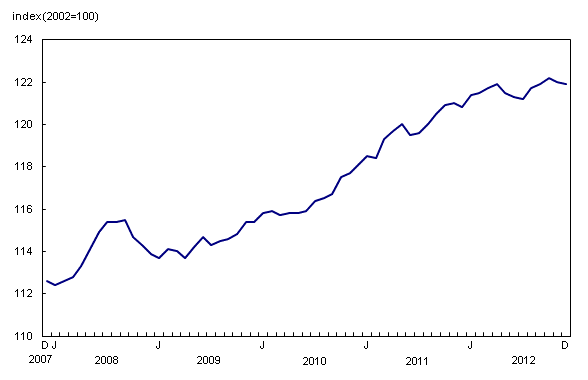
Here is Chart 4 from Statistics Canada's December CPI release, showing seasonally adjusted CPI:
Here are some more data from the Bank of Canada, showing various measures of core and headline inflation.
Any way you measure it, inflation has been falling, and falling below target, over the last few months. The price level (both total and core) was about the same in December as 8 months previously. Inflation seems to have fallen to zero.
This post is about Canada, and the Canadian picture-puzzle is clearer (to me anyway). But I don't think Canada is alone.
8 months is not long enough to say for sure. But it looks like inflation might finally be doing what it was supposed to have done a couple of years earlier. If so — if this recent trend is in fact a trend — why the long lag? Are the supertankers of the Phillips Curve finally turning south, nearly 4 years after the canoes jumped south? Just as the recession is finally ending?
[My blogging will probably continue to be very light in the next few weeks.]


 Worthwhile Canadian Initiative
@ edeast
one indiscret question, I am perfectly fine, if you dont give numbers, but I am really curious
at what age did you do the steps?
the more general question: what do you think a 45 year old construction worker,
with the best will and intentions, would add to your programming team?
Do you know a single example?
early 20s later 20s
Programming is(can be) very abstract and hard. Even CNC programming is out of reach for some factory workers.
However the specific example of making smartphone apps, isn’t out of the question for a construction worker because there is a very large market in making tools and programs that allows easier app creation.
But getting a financially successful app is like a recording artist getting a hit, anyone can play chords on a guitar, virtuosi shred:)
There is still a chance a construction worker can use domain knowledge and get lucky, but not on my team.
edeast, thanks a lot.
Let us drive this “gedankenexperiment” a little further.
You are a corporation of 50 folks or more, in your field, growing at 30% per year.
Just to put some numbers to it.
And I am a really mean big bad “socialist” government, not the North Korean type,
but like Sweden in 1975. I want you to hire at least 30% male unemployed construction workers with age 45 or more. I can do cruel things to you, like ratting you out publicly for being anti social, age discriminating, …., you know, the whole program : -)
But I do ask you and similar establishments, at what fraction of the wage, I have to subsidize that, to hire these folks, at otherwise equal wages to normal employees, and I will play nice with you, give you some public recognition as “fair chances, good Canadian” certificate, you can put in your front office / web site : – )
How high does the wage subsidy fraction has to be, to make you succumb to my targets?
for tonight, people who walk their own trails:
I dunno genauer, way too many variables and speculation. Throwing bodies at a software problem, slows it down.(Mythical Man Month). Growing at 30% a year, product already shipped, I’d add them to sales or something, commission based. Base salary = minimum wage + gov subsidy. Those with technical aptitude would find a better role. Sales liabilities would be fired.
Genaur:
I am very much not suggesting that anyone can become a useful computer programmer. Most people have a range of things they can do or can be trained to do. That range is often fairly broad, but not infinite. As I said, a 45 year old construction worker is unlikely to be capable of being trained as a computer programmer, but probably has things he can be trained to do, and other interests, besides construction. Someone else quite possibly can become a programmer, but is doing something else. If there is an excess supply of construction workers and an excess demand for programmers, I suggest that rising wages for programmers will entice people throughout the economy who have the interest and the capacity to take the training, freeing up jobs that the construction worker can take. I also suggest that evidence like the experience of Canada at the start of WWII suggests this sort of process can happen pretty fast.
@ edeast
I enjoyed reading the Mythical Man Month. The problem of folks drawing up too optimistic time lines and budgets is absolutely not confined to programming : -)
I have seen stories, that they have even now difficulties in the US, to fill open jobs for CNC. Still nobody wants to get some grease under his fingernails, or …. ?
@ Paul
To answer some of your questions:
Germany did not have any housing bubble until 2008. Prices jumped in fact by 20% here in Dresden, because people got scared of inflation. Nominal prices went down from 1800 / m2 in 1998 to 1200 in 2008, and now we are back at 1800, with the hyperlow interest rates. Now we start our bubble.
In the moment I go with what I know about the US in this time and just assume that Canada was very similar. Your employment numbers went up at the same time, although you went to war two year earlier. Interesting! In 1940 you had just 2.2 Mio paid workers. I am looking at your Series D260-265 data. Here it looks like your overnight took more like 2 years. If something is different, please tell me.
Many people had been unemployed for a long time. Many of these new jobs did not require much training or special skills, or were extremely physically demanding.
The government controlled prices and wages, and determined who gets what amount of material.
That meant that if somebody worked at only 50 to 70% of “normal”, then this was paid. There was no competition / significant trade from any other country. No WTO accusing you of unfair competition : – ) You had huge additional demand. Not to worry about the government deficit, while at war.
Private debt went down, pretty substantially. No wonder, if a lot of consumer goods were simply not available any more.
The Income tax started with 23% at 0 Dollar, and went up to 94% at 200 k$
http://taxfoundation.org/article/us-federal-individual-income-tax-rates-history-1913-2013-nominal-and-inflation-adjusted-brackets
The tiny picture I have hear for Canada, looks very similar.
When you can do all such things, you can solve your unemployment problem within 3 years, the 2 from the history above, and 1 more for more skill necessary today. I agree on that : )
I just realize, that we somehow got into this Spanish 45 old construction worker thing, not from me shown as “the typical example of skill mismatch everywhere”, but as a very specific Spanish problem, and why you have to track a lot more parameters then just government debt. Apparently that specifity did not get across fully.
Finally, to get some 1 or 2% of the working population moving out of a gainful employment, like in Canada or Germany, that can happen with some natural attrition, etc. But 26 % unemployment, as in Spain, the change of wage differentials would have to be huge. You would need war like powers.
Agriculture is some 4% in the EU, manufacturing shrinking (from 50% to 20% over the last 20 years, here around) You will not push substantial fractions of people into these sectors, unless you force them to very low wages.
The bitter truth is, it took Finland and Eastern Germany some 15 years, to work down a 20 % unemployment in 1992.
A few more thoughts
Short form:
1. Cost-Benefit-Analysis
As in the case here, very often, in the moment you try to get specific, you pretty quickly arrive at a point, where the cure looks worse than the disease, at least in a society, which has some social minimum payment system defined and organized, like the Nordics and western / central Europe.
2. Social minimum payments
When you think about costs, and what are the alternatives, how cruel are certain politics in fact, you arrive very quickly at the question: What do some people at the lower end of the social ladder, e.g. long term unemployed get, and how bad is that.
To summarize this short, what would a family of 4, for whatever reason long term unemployed, but Canadian citizens in good standing, get in Montreal or Toronto, or whatever some here consider median Canadian?
Long form:
1. Cost-Benefit-Analysis
As in the case here, very often, in the moment you try to get specific, you pretty quickly arrive at a point, where the cure looks worse than the disease, at least in a society, which has some social minimum payment system defined and organized, like the Nordics and western / central Europe.
I would be very interested in some (quantitative) description of the Canadian system. Some of you may ask, why can’t that German goy google it for himself? We recently had this here, for severance packages, that when I googled a world bank paper on comparisons, the description for Canada (federal rules) was very low and very misleading, and Determinant put this straight right here, that in Canada the state rules are much more generous and relevant.
To ask people with local competence, like here, has substantial advantages : – ) Within a few hours I knew substantially more than the world bank clown, authoring a paper on this topic.
2. Social minimum payments
When you think about costs, and what are the alternatives, how cruel are certain politics in fact, you arrive very quickly at the question: What do some people at the lower end of the social ladder, e.g. long term unemployed get, and how bad is that.
In Germany this is called HARTZ IV. The official calculator was pulled down, because in Europe we very much try not to attract folks from somewhere else, based on such numbers. Last summer, after our Supreme Court (Bundesverfassungsgericht) found, that people applying for political asylum should get just 90 Euro more in cash payout per month, instead of food, etc., whoooms, suddenly 560 % more in Bosnia and 300% more in Macedonia discover that they are politically persecuted, within just 3 months, and are soo scared that they make it through 2 safety layers of “safe 3rd countries”, right to the german handout office, despite that not a single one of them was finally accepted, after the usually 2 years litigation : -) http://www.zeit.de/politik/deutschland/2013-01/asyl-deutschland-erstantraege
One inofficial calculator (in German only, but I can imagine that most of you could figure it out http://biallo.sueddeutsche.de/tz/sueddeutsche2/Soziales/ALG2rechner.php) gives NET 24 000 Euros, or 32 000 Dollar per anno, as a social minimum for a family of 4, in a cheap eastern German town. Not to be sneezed at, I think. Free education, health insurance exactly the same as mine, comes on top of that.
To summarize this short, what would a family of 4, for whatever reason long term unemployed, but Canadian citizens in good standing, get in Montreal or Toronto, or whatever some here consider median Canadian?
The forgotten link to Canadian data I mentioned:
http://www.statcan.gc.ca/pub/11-516-x/sectiond/4057750-eng.htm
was it helpful at all, to do a short/long form?
Genaur
I am sorry that I don’t have much knowledge about your question. I will tell you what I think I know, but it might not be completely right.
Here in Ontario, the program for the long-term unemployed is called Welfare. It used to be administered provincially, but this was changed some years back and now it is the responsibility of municipalities. Very bad idea, I think, creating a situation like what you describe, where any municipality that is more generous gets punished.
Many say that the payments are very inadequate, but I do not know enough to judge the fairness of such opinions. There are also charities, including food banks, and a program, “Ontario Works” which aims to provide subsidies to help people get into the labour force.
I think we do not have as much of a problem with attracting unwanted immigrants as you although there certainly are situations. We are relatively isolated from poorer countries. Our current Federal government is more antagonistic to immigration than past ones. They have been trying to block refugee claimants, including Roma from Hungary. I don’t think we really have a serious problem with people coming here to get welfare, although I am sure you could find someone claiming otherwise. We do let in quite a few immigrants and refugees, most of whom wind up working, but often in low-paid jobs. One problem you hear a lot about is that immigrants often cannot get their qualifications recognized by our professional associations, so a lot of talent and education is wasted.
Hope this at least gives you a little context for what you can find on line.
@ Paul
Thanks a lot. I think you helped me enough, to get the following picture together, in an efficient way.
With social minimum payments in Canada at just 43% for 4, and 59% for one person, compared to Germany, there is no surprise, that long term unemployment has a very different meaning here and there.
If I would be willing to ratch up the daily poverty pain by a factor of 2 or more, to Canadian levels, then I could push people around a lot more like Nick Rowe imagines.
I am neither a Xian nor a union member, but I cite Matthew 25: 40 “The King will reply, ‘Truly I tell you, whatever you did for one of the least of these brothers and sisters of mine, you did for me.’
There is some financial cost of the abuse of political asylum, but what would you do in their situation? But we weigh it against having blood on our hands with a false rejection.
With the problems of recognizing qualifications, similar here, there is also the other side, e.g. people claiming to have computer science degrees, which then turning out to have just some training with MS Office.
Details & references:
According to http://www.peelregion.ca/ow/applying/allowance.htm
the Canadia equivalent would be 12 * (448 + 688) = 13632 $ / anno or just 43% of the German rate.
This is …..
…. harsh, to say the least, from my perspective, which is probably on the 10% most fiscally conservative side here. No politician in Germany, who wants to stay alive, would argue against a relative 40% raise.
For a single (e.g. http://de.answers.yahoo.com/question/index?qid=20100301124428AA3d5XW
550 – 663 $/ month (the side above: 227 + 372 = 599 $) or 59% of German
The German value, calculated with the link in my last post (382 + 372 Euro) = 755 Euro = 1010 Dollar / month
Toronto (http://www.toronto.ca/socialservices/foodrent.htm)
standard 4 person family 12* (453 + 695) = 13776, same as Ontario with rounding errors.
Genaur:
I would not dispute your judgement of our system. Our whole social support system has been in decline for the past couple of decades. I think you could say it started with the way we balanced our federal budget back in the mid 90’s. The federal government balanced largely by reducing its payments to the provinces, which then downloaded responsibilities to the municipalities. We have become much more like the Americans and less like the Europeans. The main difference is that we still have reasonable health care.
Don’t forget, though, to take the cost of living into account. I traveled a bit in Spain and Portugal before the crisis really hit. My impression was that you could buy for a Euro there about what I can buy for a dollar here although the Euro cost a lot more.
@ Paul,
I usually try hard to be not judgemental, just trying to know what is, and to understand, especially the dynamics and dependencies.
This blog entry made me much more aware of
a) what one can do with war powers, or not
b) together with analyzing the pickles on the loonie exchange rate with the up/down kinks on the BoC balance sheet
http://worthwhile.typepad.com/worthwhile_canadian_initi/2013/01/what-is-going-on-with-the-bank-of-canadas-balance-sheet.html?cid=6a00d83451688169e2017ee818ef23970d#comment-6a00d83451688169e2017ee818ef23970d
You do, what you have to do (a somewhat ironic quote from Hegel: Freiheit ist Einsicht in die Notwendigkeit)
this is kind of the last straw to make me aware, that the economic decision freedom of Canada, in relation to the US as the (90%) center star, is even lower than I thought.
This enforces, what I am afraid of, to be the case for Germany as well, the local center star, but only a 25% fraction of the whole. Our social spread will go up as well.
For exchange rate / PPP discussions, we had recently
http://worthwhile.typepad.com/worthwhile_canadian_initi/2013/01/take-that-steve-saideman.html?cid=6a00d83451688169e2017c362c8806970b#comment-6a00d83451688169e2017c362c8806970b
that the present 1.33 CADEUR=X (yahoo lingo) is not far of the 1.25 fair value I use.
I readily believe that visible prices in Spain/ Portugal were higher by 10 – 15% in the boom, before the crisis hit. I also believe, they are down by that now : – )