Well,
Ontario has a new finance minister – Charles Sousa – and according to the
Toronto Star: “Charles Sousa, the
two-term Mississauga South MPP who finished fifth in last month’s leadership
race, will succeed the retiring Finance Minister Dwight Duncan at the treasury.
An affable former Royal Bank executive, Sousa inherits a $11.9-billion deficit
that the minority Liberals hope to eliminate by 2017-18.” As far as inheritances go, I suppose I
would prefer to be on the receiving end of a few thousand acres of rolling
English countryside and Downton Abby rather than an 11.9 billion dollar
deficit. No doubt, the new
minister has been briefed on what is coming down the pipeline. The most recent Ontario quarterly
finance update provides a lot for him to chew on.
The new minister will undoubtedly be keen to put his stamp on the government’s plan to
balance the books and restore the public finances. The most recent quarterly finances reveal what the expenditure control
priorities were in the last budget.
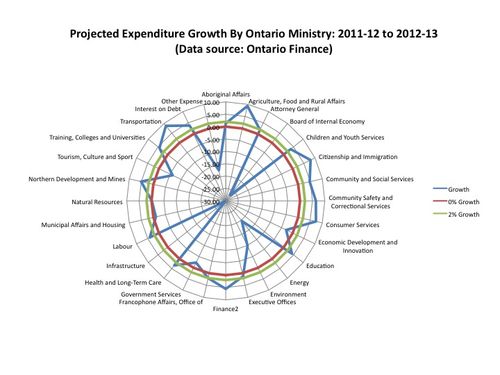
The accompanying figure plots the growth rate of spending by Ontario
ministry between the 2011-12 fiscal year and the 2012-13 outlook. Moreover, I’ve included for comparison
purposes what spending growth would look like if all ministries got a zero
percent increase or a 2 percent increase. Why 2 percent?
Total expenditures are expected to grow about 2 percent – from 122.7 to
125.2 billion dollars. However,
when you look across the ministries it would appear that some ministries are
receiving rather large cuts while others are definitely winners. I imagine that spending restraint in Ontario is also
an opportunity if you can either demonstrate value, have a vocal constituency or are very skilled at
lobbying.
The losers? Infrastructure drops 30 per cent, Energy
drops 20 percent and for a time of restraint, the appropriately named Board of
Internal Economy is being reduced by 27 percent. For those of you who might be interested, the Board of
Internal Economy consists of spending for the following offices: Office of the
Assembly, Office of the Chief Electoral Officer, Ombudsman Ontario, and Office
of the Auditor General. Tourism,
Culture and Sport is being hit by a 6 percent cut while Government Services is
seeing a 2 percent cut.
The
winners? Agriculture, Food and Rural
Affairs and Transportation each go up 9 percent while Citizenship and
Immigration follows close behind at 8 percent. Consumer Services goes up 7 percent, Community Safety and
Correctional Services goes up about 6 percent and even the Finance Ministry has
managed an increase of nearly 6 percent.
Universities and Colleges and Education in general do well at just over 4
percent. Health care no
doubt feels hard done by as it is only going to see a total increase in its
budget of just over 3 percent. However,
with Health at nearly half the budget, this three percent increase generates a
large proportion of the overall spending increase.
Interesting
enough, it is difficult to find ministries that have grown by the overall
increase of just 2 percent. A
total of 14 ministries saw their spending increase by more than two
percent. Another 3 saw their
spending increase by less than 2 percent.
The only ministry that grew by exactly
2 percent was the Office of Francophone Affairs. And ten categories saw cuts in their budgets (including a 17 percent cut for "other expense"). Of course, these changes reflect the
priorities of the past. It is now
a new era. We shall see what the
new Finance Minister does with his inheritance.
Related articles


 Worthwhile Canadian Initiative