Statistics Canada has released its most recent report on
police personnel and expenditures and notes that police strength measured as
officers per capita declined in 2012 by 1 percent. Moreover, there has been a slight decline in police
expenditures overall with spending in 2011 totaling 12.9 billion – a decline of
0.7 percent from the previous year.
However, spending and officers per capita have generally grown over the
last decade and police forces and police spending are higher than they used to
be. What is of more interest to me are
the numbers at the CMA level and their relationship with crime rates.
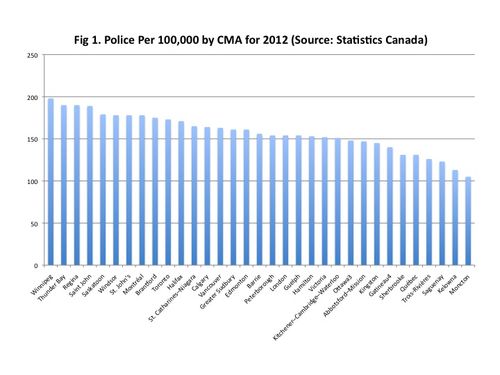
Figure 1 ranks police strength per 100,000 in 2012 across
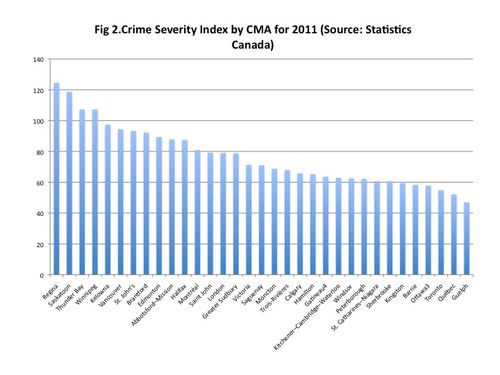
Canada’s CMAs while Figure 2 ranks crime rates in 2012 as measured by the
Statistics Canada Crime Severity Index for 2011. In per capita terms, police strength is the lowest in
Moncton, Kelowna and the Saguenay and the highest in Regina, Thunder Bay and
Winnipeg. As for crime rate
severity, it is the lowest in Guelph, Quebec City and Toronto and the highest
in Thunder Bay, Saskatoon and Regina.
So, is there a correlation between crime severity and the per capita
size of the police establishment?
Figure 3 plots the two variables along with a linear regression line and
the answer is yes but there is a fair amount of dispersion around the
line. No doubt, other factors can affect
the number of officers per capita aside from just the crime severity but one
would think crime severity should be an important factor in generating a demand for police officers.

For example, take a city like Kelowna. It has a Crime Severity Index of 97.4
and 113 officers per 100,000 of population. Based on the regression line in Figure 3, it should have 169
officers. Moncton has a Crime
Severity Index of 68.8 and 105 officers per capita but the regression line
suggests it should be at 153 officers.
On the other hand, Winnipeg has a crime severity score of 107.2 and 198
officers per 100,000 of population while the regression line suggests it should
be at 174 officers. As well, Saint John has
a crime severity of 79.2 and 189 officers per 100,000 of population whereas the
regression line predicts its police strength should be at 159. I find the
results intriguing. Based on crime
severity alone, some CMAs have substantially smaller police forces than their
crime rates alone would mandate while others are substantially larger. What might the other determinants
be? Is geographic size of
municipalities and subsequent population density a factor – more spread out
CMAs need more police? Is age
distribution of the population a factor – “older” cities are quieter and easier
to police? The types of crimes – are some crimes more police intensive than
others? Neat stuff.
Related articles


 Worthwhile Canadian Initiative
I predict the present wave of police expansion will end, due to costs. While the Criminal Code is federal in Canada, Law Enforcement is provincial, who in turn delegate most enforcement responsibilities to municipalities, who pay for it though property taxes.
In Peterborough, for example, the Mayor (Paul Ayotte, a typical MOTR fairly conservative municipal politician for Central Ontario) went three rounds with the Police Services Board over the police budget. The police wanted a 10% increase and Ayotte wanted 3% at most. In Ontario when the city and police board disagree over the budget, it goes to a provincial commission who usually side with the police. So Ayotte tried to axe the neighbouring township’s seat on the board to give the City a majority. The province slapped his wrists and suspended him from the police board.
All of this was over money. The story is the same across Ontario: municipalities are choking on their police budgets. Municipal politicians simply refuse to put themselves on the line to vote for the property tax increases that are necessary to support increased police costs.
The tide will turn from the bottom up.
Yep. I always think of simultaneous equation estimation problems in questions like this. If we put # of cops on one axis, and # of crimes on the other, and plot the points, are we seeing a supply curve or a demand curve? Hiring more cops should reduce crime, other things equal. But more crime should lead to governments hiring more cops.
Trouble is, I don’t know how to do that simultaneous estimation.
This may be of interest (from the Parliamentary Budget Office):
Expenditure Analysis of Criminal Justice in Canada – .PDF / 36 pages
Click to access Crime_Cost_EN.pdf
You could try checking if the CMA requires any specialized units in the force.
Toronto, for example, has both significant specialized traffic and Marine units. Regina likely does not have a marine unit. What about SWAT units? It might be hard to do this comparison without knowing more details about the parts of each CMA force. It might also matter if the CMA has specialized functions compared to other regions — Toronto, for example, has the Ontario Superior Court which might trigger an uptick in police over a baseline. (I think the courts definitely trigger an uptick in your chance of being on a jury if you are a resident of Toronto.)
I would also expect that there is a non-linearity in the scale-up of Police compared to the baseline, where you don’t need ten times as many police for ten times as many people, but that’s only an expectation – I’m not any sort of expert on that.
@Nick – isn’t that a quantum question ?
Police is political choice.
NYPD varies from 35K officers to 42k. It depends onthe budget, no correlation with crime. LAPD with about the same population to cover and 4 times the area goes by with 7-10K , also depending on budget.
But then ,the Chandler family who managed the city behind the curtain, went for what they called the / Containment policy”. The LAPD does two things: normal policing of white areas and patrolling the borders with black and chicano zones ( containment). What happens there is black-on-black and who cares. Expalin why LAPD is more violent than NYPD ( and that’s putting the bar,)
You can consult the New Yorker at the time of Christopher Commission
http://en.wikipedia.org/wiki/Christopher_Commission
or the oeuvre of James Ellroy
http://fr.wikipedia.org/wiki/James_Ellroy
Toronto, for example, has the Ontario Superior Court which might trigger an uptick in police over a baseline. (I think the courts definitely trigger an uptick in your chance of being on a jury if you are a resident of Toronto.)
???????
Toronto has Osgoode Hall, which houses the Ontario Court of Appeal and the Divisional Court, which hears administrative appeals from provincial tribunals.
The Superior Court sits throughout the province in Superior Court courthouses, wherever needed. It is organized into regions.
Civil juries are optional in all Canadian provinces and have fallen out of favour with the bar. Juries are only required in Criminal trials and then absolutely only for murder, most other crimes can be tried summarily in the Provincial Court and often are. Sex crimes especially are tried at bench trials as judges are believed better able to stand the horrid evidence in such cases and still be impartial.
Interesting thing about the PBO report is that it was being spun in the media as evidence of a massive increase in spending in the criminal justice system over the past decade. But if you actually read it, the big jump in spending started in 2008, and seems to be largely attributable (as least with respect to the courts and the prisons) to n large increase in capital spending (stimulus package anyone?).
Am I alone in thinking that the practice of lumping capital and current spending together constitutes a questionable accounting practice? Certainly it’s hard to infer anything useful from their topline number. Geeze, I’m a fan of the PBO in theory, but the execution on this one isn’t great.
And there are all sorts of other sloppy errors in this paper. They purport to describe expenditures in Canada’s provinces and territories, but when you dig down, they say that they’re only describing the expenditures of the 4 large provinces (and no territories) nand the feds. I’m not sure that makes a difference one way or the other, but if that’s all you’re doing, say that from the get go, don’t hide it in a footnote.
Similarly, I’m not sure why they break-down police expenditures into crime related and non-crime related time. While there’s no doubt that police officers do things that aren’t crime-related (traffic enforcement, etc.), when you hire a police officer you buy the whole package, except for things that are clearly not crime related (the RCMP musical ride), I don’t know why they didn’t toss all police spending into the mix. As long as they’re consistent, that’s all we need. And the methodology for making the division between those different classes of spending is decidedly haphazard, apparently they’re assuming that every municipal police force in Canada is similar to the Ottawa police Service(based on, I kid you not, a series of emails with the Ottawa Police Service) and every non-municipal police force is similar to the Ontario Provincial Police. That’s a heck of an assumption.
Ditto, in trying to break-out crime-related expenditure in the courts. They seem to have broken it out by court hours in various criminal and non-criminal courts. Ok, but an hour in the small claims court is relatively low cost, since it’ll only involve a deputy judge, maybe a clerk, and a security guard. The cost of an hour-long hearing in a criminal case will be many multiples of that, since it’ll include a real judge (either in the Ontario Court of Justice or the Ontario Superior Court, paid more than a deputy judge), plus more security and administration (a lot more paperwork in a criminal hearing). Plus, that judge might spend non-court time reviewing the various submissions and actually writing a meaningful judgement). In any event, this methodology leads to some strikingly silly results. Did Ontario’s spending on civil trials really fall by more than 50% between 2007 and 2008, or did the same people, being paid the same amount of money, just sit for fewer hours in 2008 than 2007(I’m trying to recall what big commercial hearings were going on in that year)? This strikes me as a really sloppy way of doing things.
Sorry Livio, but this is pretty sophomoric. Police do lots of things in concert with other elements in the whole law enforcement space (neighbourhood watch, judges, prosecutors), crime is a legal artifact, social trends are somewhat independent of expenditure on both, and the perceptions that drive expenditure are another thing again. You can respond to increases in crime by ignoring the crime, repressing it or decriminalizing the offence – to point out just three avenues (it’s usually a mix). In short, your regression doesn’t mean anything. But there are loads of good books and helpful experts out there.
You should be a part of a contest for one of the finest blogs on the internet. I am going to recommend this blog! Madison http://www.rgbdrgb651rtdbdbfgbndf.com/
I would like to thank you for the efforts you have put in writing this site. I really hope to see the same high-grade blog posts from you in the future as well. In fact, your creative writing abilities has motivated me to get my own site now 😉 Cameron http://www.rgbdrgb651rtdbdbfgbndf.com/
The CMA isn’t enough detail. I’ve been harrassed for tenting it in suburbs yet you can steal anything in a downtown. I’m refining my GAI position. Maybe $300/month for everyone. And then more based on service the public good. Things like participating in cheap-future medical trails (recording your food and some cell-phone vital signs). Drug testing. Participating in education or R+D (high school level science projects), lest we turn into the USA’s South. I figure hard drugs should be illegal for some mental illnesses that cause noise or violence, but I really don’t know the economics of treatment vs incarceration vs just keeping people in one mentally ill part of a community. I figure there should be a daily limit to recreational drug use (for drugs that cause noise or violence), like for a prescription. And a demerit license system’ I’ve freaked out once withdrawing from hash but under extreme stress. This will be important for future neurotechnologies and synthetic drugs. I get now why Pickton was ignored.
An old buddy of mine used to joke how we put him (a future police officer) through High School. My Dad used to joke how a cop at a party (for some strange reason) wouldn’t let someone blaze a doobie.