James Dean knows how to tell a story. These days he'll share his thoughts on Burning Man ["But Ed, you and I know you can't run an economy this way"] or on advising the South Sudan government how to set up its central bank.
But his best stories are from his days as a graduate student at Harvard in the 1960s, when he marched in Selma-Montgomery. James Dean wasn't just at the civil rights marches, he was in the thick of things; picking people up from the airport, and being harassed by police. He had a camera, and did the best thing he could possibly do to preserve his pictures for posterity: he dumped the negatives at his father's house, and forgot about them.
Now, decades later, James' brother Tom Dean has had the photos digitized. There are seventy in all, I am just reproducing a couple here. If you are interested in seeing more photos, please contact jdean@sfu.ca.

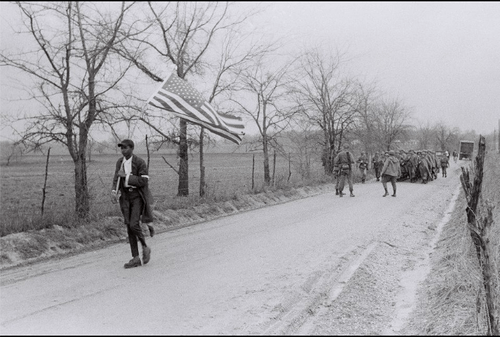
Here is James Dean's version of the story behind the photographs:
My friend David Isaac (a math PhD student at Brown) and I hitchhiked down, with many dramatic adventures en route. We got to Selma early and slept on pews in a black church. Soon after, thousands of people flew in from all over the country. I was assigned to meeting them and taking them to hotels and motels. On the march we were harassed by Alabama State Troopers in slick blue uniforms, who filmed us at every detour. But we were "protected" by Alabama National Guard in jeeps and helicopters, ordered by President Lyndon Johnson. You can see both kinds of cops in the photos.
On the first night of the march, spent in a large tent city en route to Selma-Montgomery, half of America's black singers entertained us, and MLK gave a resounding speech. He was at the head of the march throughout (along with Jesse Jackson). We celebrated the second night of the march in a Montgomery black nightclub. About 11 pm the music stopped and it was announced that two people had been pulled out of a Pontiac and shot dead: a woman marcher from Detroit and the black man who was with her.
The march was triggered by on-going obstructions to black voter registration in the South. It proved a tipping point politically. Within two years, the color of Southern politics had changed: for example Atlanta had a black mayor, whereas some of us had been cursed and arrested on a civil rights march in Atlanta just before the Selma march. I am very grateful to my late father for preserving these negatives over the years and to Tom for digitalizing and posting them.


 Worthwhile Canadian Initiative
Very nice, thanks for this!