You may recall my recent post on Ontario university financing in
which I focused on the university debt levels of Brock, Wilfrid Laurier and
Guelph given that they were undergoing program reviews designed to address “sustainability”. Well, I have done a bit of an update by
getting information on long-term debt, total revenues and enrolment for all of
the Ontario universities and the results suggest that debt should be more of a
concern for the smaller universities.
Universities in Ontario have acquired a large amount of
long-term debt to deal with rising enrolments,
infrastructure renewal and program expansion. I have generated four figures with
data taken from university financial statements and enrolment reports as
provided by the Council of Ontario Universities on their web site. This long-term debt, as reported on
university financial statements, is an incomplete measure of all the
longer-term liabilities universities face as it excludes pension deficiencies
and liabilities.
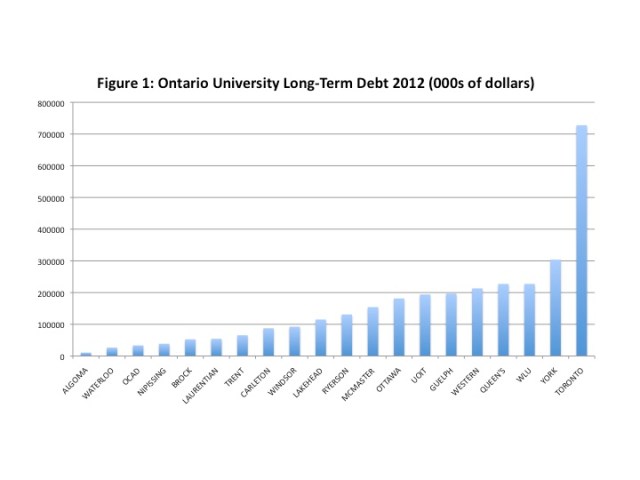
Figure 1 plots the long-term debt of Ontario’s universities
from highest to lowest ranging from just under 11 million dollars for Algoma
(Ontario’s newest university) to just under 730 million dollars for
Toronto. Total long-term debt for
all of Ontario’s universities in 2012 totaled 3.1 billion dollars. Long term debt ranked by university
suggests that with few exceptions, the larger universities (as measured by
enrolment in 2011 as shown in Figure 2) have larger long-term debt levels. Notable exceptions are UOIT (University
of Ontario Institute of Technology) and Wilfrid Laurier (WLU) which are in the
top third for long-term debt but in the bottom half when it comes to total
enrolment.

It is of course not just about total debt but the ability to
carry the debt and Figure 3 presents long-term debt as a share of total
university revenue. Here, the
results are quite different. All
the universities at the top of the debt to revenue ratio are the smaller
Ontario universities. Top is UOIT
at a debt to revenue ratio of about 125 percent followed by Wilfrid Laurier at
76 percent, then Lakehead at 73 percent, OCAD at 50 percent, Nipissing at 48
percent, Trent at 45 percent, Algoma at 41 percent and finally Laurentian at 34
percent. Next comes York – the first
large university – at 32 percent.
Guelph and Brock, which are undergoing reviews with respect to
sustainability, are not at the top of the debt to revenue ranking. Meanwhile, the university with the
lowest long-term debt as a share of its revenues is Waterloo at 3 percent. Again, I caution that these numbers do
not reflect issues these universities may have with their pension plans or
other liabilities.


The eight small universities (with a combined enrolment of
about 52,000 students placing them between York and Toronto in terms of
enrolment size if they were one university) with the highest debt to revenue
shares account for 13 percent of Ontario’s total university enrolment, 10
percent of university revenues and 24 percent of university long-term debt. Is this a problem? Well, Figure 4 shows debt interest
payments as a percent share of total expenditure in 2012. Again, debt interest as a share
of total spending is generally highest for these small universities but the
amounts are generally under 4 percent which are not expenditure shares that to
my mind pose any significant financial risk. However they do represent a lot of money that could be spent
on programs. In 2012, Ontario
universities collectively spent about 175 million dollars on servicing their
long-term debt.
Ontario allowed its universities to
take on rather large amounts of debt over the last decade as a substitute for
more government capital funding or additional fees on students. Some of this was to deal with the
double cohort of graduates that came from the abolition of Grade 13 but there
was also anticipated to be long-term growth in enrolment. Indeed, from 2000 to 2011, total
enrolment in Ontario has grown from 242,309 to 409,569 students – a 69 percent
expansion.
In their bid to acquire more students, perhaps many of the
smaller universities have adopted a “build it and they will come” approach
hoping that new capital additions would attract more students. UOIT after all was a brand new campus
(which is undoubtedly a factor in its high debt level) and both Lakehead and
Wilfrid Laurier opened substantial satellite campuses in Orillia and Brantford
respectively. Or perhaps there are
economies of scale issues with smaller universities in Ontario that make them much
higher cost places when it comes to capital expansions? Anyway, I do not have any conclusions to
draw from all this other than in terms of debt to revenue ratios the smaller
places have a bigger problem than the larger ones.
// <![CDATA[
// <![CDATA[
// &lt;![CDATA[
// &amp;lt;![CDATA[
// &amp;amp;lt;![CDATA[
// &amp;amp;amp;lt;![CDATA[
// &amp;amp;amp;amp;lt;![CDATA[
var sc_project=9080807;
var sc_invisible=1;
var sc_security=&amp;amp;amp;amp;quot;4a5335bf&amp;amp;amp;amp;quot;;
var scJsHost = ((&amp;amp;amp;amp;quot;https:&amp;amp;amp;amp;quot; == document.location.protocol) ?
&amp;amp;amp;amp;quot;https://secure.&amp;amp;amp;amp;quot; : &amp;amp;amp;amp;quot;http://www.&amp;amp;amp;amp;quot;);
document.write(&amp;amp;amp;amp;quot;&amp;amp;amp;amp;lt;sc&amp;amp;amp;amp;quot;+&amp;amp;amp;amp;quot;ript type=&amp;amp;amp;amp;#39;text/javascript&amp;amp;amp;amp;#39; src=&amp;amp;amp;amp;#39;&amp;amp;amp;amp;quot; +
scJsHost+
&amp;amp;amp;amp;quot;statcounter.com/counter/counter.js&amp;amp;amp;amp;#39;&amp;amp;amp;amp;gt;&amp;amp;amp;amp;lt;/&amp;amp;amp;amp;quot;+&amp;amp;amp;amp;quot;script&amp;amp;amp;amp;gt;&amp;amp;amp;amp;quot;);
// ]]&amp;amp;amp;amp;gt;
// ]]&amp;amp;amp;gt;
// ]]&amp;amp;gt;
// ]]&amp;gt;
// ]]&gt;
// ]]>
// ]]>

Related articles


 Worthwhile Canadian Initiative
The other interesting question is what is Waterloo doing differently, and can that be replicated elsewhere?
Jesse:
What is also interesting is that U of Waterloo and WLU have such different performances in terms of their debt and yet are in the same community.
Livio – how are your demographics at Lakehead? The potential base of university students is very much concentrated in the GTA. So I would figure Windsor, say, is in worse shape than those numbers suggest, because its neither in the GTA, nor attractive enough to be a destination university for middle class kids looking for a nice lifestyle choice – Guelph seems to be doing well in that later niche right now.
Interesting. Those are big differences in debt/income ratios.
Just a hunch: maybe a lot of universities’ long-term debt was used to finance income-earning assets like student residences. We can imagine two otherwise identical universities, except that one borrows money to buy/build a student residence, where the rents it collects from the students pays the mortgage, and the other lets its students rent off-campus accommodation. We can’t really say that the university that owns the residences plus the debt is in worse shape financially.
If my hunch is right, universities with the highest debt/income ratios would also have the highest income/student ratios, since they get rental income from students as well as tuition fees and BIUs (vouchers) from the Ontario government.
Good question Frances. The region immediately around Lakehead is aging and high school have closed over the last decade. Not sure what the demographics are like around Orillia which saw a large capital expansion. Orillia is close to Barrie/the GTA.
Nick:
For 2011, total revenue per enrolled student was highest for: Queen’s, McMaster, Toronto, Western, Guelph & Ottawa U. It is the lowest for Brock, WLU, OCAD, UOIT, Nipissing & York. Its total revenues so revenues from research grants and contractsas well as sales of goods and services and investments is also factored in.