As part of my summer entertainment, I read Dan Brown’s most
recent novel – Inferno – which features
a bio-terrorism plot involving the release of a virus designed to cause
sterility in one-third of the human race in order to control overpopulation.
The novel highlights a neo-Malthusian “Population Apocalypse Equation” which
argues that the “sustainable population” of the world is only 1.5 billion human
beings and the world now faces imminent collapse of civilization due to the
rapid increase in population especially over the last 250 years. According to this apocalyptic scenario, population
is rapidly outstripping the resources required to produce basic needs leading
to international breakdown of law and order, war, revolution, and collapse.
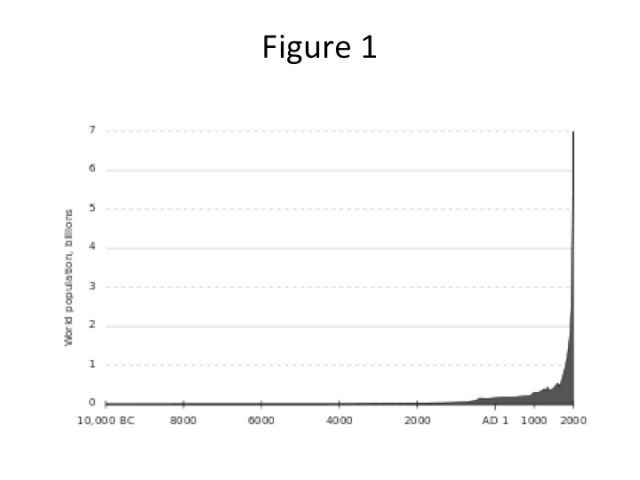
Graphics such as Figure 1 usually accompany these types of
arguments to illustrate runaway population growth and the inevitability of the
collapse of civilization. A solution
to a future sustainable world according to these arguments is a massive cull of
the world’s population. Apparently, this
argument comes from Audrey Tomason – a Director for Counterterrorism for the
U.S. National Security Council– in her M.A. Thesis. Yet, a quick search of Google Scholar produced
no cites to such a work in the literature.
Yet, Audrey Tomason and her population apocalypse appear to have taken
on a life of its own on assorted web blogs.
However, to my mind this is all just another in a long line
of “end of the world population scenarios” that started with Thomas Malthus and
his Essay on Population and has been
cycling through assorted incarnations ever since. Humans seem extraordinarily preoccupied with apocalyptic
end of the world scenarios. Indeed, if
you want to start having visions of an apocalypse, I suppose you can work your
way back to the New Testament. Every age
seems to feel it is on the brink of an apocalypse – check out Richard Erdoes A.D. 1000 for a description of how
Europe approached the millennium with its nightmare visions. Then there is John Leslie’s End of the World which chronicles the
assorted ways the world could end ranging from nuclear wars, ozone layer depletion,
new plagues and pestilences, climate change, annihilation by alien invaders, asteroids,
etc… Indeed, Leslie concludes that the human race likely is in danger of
extinction. Indeed, one only has to look back at the
dinosaurs to see that extinction can and does occur. Moreover, there is a “Doomsday
Argument” based on probabilities that argues that there is a 95% chance of
human extinction within 10,000 years.
Let me come back to the population apocalypse scenario. I watched Soylent
Green as a teenager (remember the movie trailer? It is
the year 2025, nothing runs, nothing works…) and countless TV shows and documentaries
in the 1970s that suggested I would be lucky to see my 40th year and
yet today the sun also rises. Does that
mean I think there are no problems facing the human species? Not at all – there
are lots of problems and they are complex and dire. As H.G. Wells wrote: “History is a race
between education and catastrophe” and it is a race that will only end if
catastrophe eventually trumps education. The
race is still on and I am glad of it. Yet
the way in which we often approach issues such as the end of oil, greenhouse
gases, and population growth – debates that often seems rife with apoplectic
emotions and ideology – does little to inspire a vision for a human future.
Let me offer the following example. When I have taught first year economics, I
discuss Malthus and population growth and technological change. The essence of the Malthusian analysis – that
population increases geometrically while resources increases arithmetically
means that population will outstrip resources – is correct, all other things
given. I discuss an example of two fruit
flies in a glass aquarium sealed in with a fixed supply of food. The flies will breed and the population curve
will look a lot like that in Figure 1 and eventually the food supply will be
exhausted and population will collapse. However,
simply extending that argument to human population by arguing the resources of
the planet are fixed only works if we assume that our current ability to deal with the problems does not change. All other
things are not given.
Human beings differ dramatically from the fruit flies – they
can think, reason and innovate. As human
population expands, they look for solutions to resource issues. As their population expands, fruit flies in
the sealed aquarium do not begin to hold symposiums on the technological change
required to breach the glass walls of the aquarium. Humans do.
Indeed, technological change has been the hallmark of the economic
progress of the last two hundred years.
Technological change has shifted that PPF to the right and afforded
improvements to the human material condition.
In the end, it is a race between education and
catastrophe. Human thought and
ingenuity can fix things but can also screw things up – one solution to a
short-term problem can cause other problems down the road. For example, solving transportation problems with
the development of the internal combustion engine or extending human lifespan
with vaccines and medical technology has created longer-term problems down the
line, which in turn require solving. Provided there is enough time and the problem identified, solutions will emerge. The real random variable is being blindsided by problems that we cannot anticipate or have vary little time to deal with – case in point – a massive asteroid discovered just a few days before impact.
John Brunner’s preface to Philip Wylie’s End of the Dream (another apocalyptic
novel from my teen years) contains the following line: “Perhaps one of these
days, archaeologists will come to Earth from another planet and think of
erecting a monument to mark our passing.
If so, they could choose no better inscription for it than this: Here lies a species capable of thinking, but
too lazy to think anything right through.”
Provided there is time, thinking things through is our best hope for the future.
// <![CDATA[
// <![CDATA[
// &lt;![CDATA[
// &amp;lt;![CDATA[
// &amp;amp;lt;![CDATA[
// &amp;amp;amp;lt;![CDATA[
// &amp;amp;amp;amp;lt;![CDATA[
// &amp;amp;amp;amp;amp;lt;![CDATA[
// &amp;amp;amp;amp;amp;amp;lt;![CDATA[
// &amp;amp;amp;amp;amp;amp;amp;lt;![CDATA[
// &amp;amp;amp;amp;amp;amp;amp;amp;lt;![CDATA[
// &amp;amp;amp;amp;amp;amp;amp;amp;amp;lt;![CDATA[
var sc_project=9080807;
var sc_invisible=1;
var sc_security=&amp;amp;amp;amp;amp;amp;amp;amp;amp;quot;4a5335bf&amp;amp;amp;amp;amp;amp;amp;amp;amp;quot;;
var scJsHost = ((&amp;amp;amp;amp;amp;amp;amp;amp;amp;quot;https:&amp;amp;amp;amp;amp;amp;amp;amp;amp;quot; == document.location.protocol) ?
&amp;amp;amp;amp;amp;amp;amp;amp;amp;quot;https://secure.&amp;amp;amp;amp;amp;amp;amp;amp;amp;quot; : &amp;amp;amp;amp;amp;amp;amp;amp;amp;quot;http://www.&amp;amp;amp;amp;amp;amp;amp;amp;amp;quot;);
document.write(&amp;amp;amp;amp;amp;amp;amp;amp;amp;quot;&amp;amp;amp;amp;amp;amp;amp;amp;amp;lt;sc&amp;amp;amp;amp;amp;amp;amp;amp;amp;quot;+&amp;amp;amp;amp;amp;amp;amp;amp;amp;quot;ript type=&amp;amp;amp;amp;amp;amp;amp;amp;amp;#39;text/javascript&amp;amp;amp;amp;amp;amp;amp;amp;amp;#39; src=&amp;amp;amp;amp;amp;amp;amp;amp;amp;#39;&amp;amp;amp;amp;amp;amp;amp;amp;amp;quot; +
scJsHost+
&amp;amp;amp;amp;amp;amp;amp;amp;amp;quot;statcounter.com/counter/counter.js&amp;amp;amp;amp;amp;amp;amp;amp;amp;#39;&amp;amp;amp;amp;amp;amp;amp;amp;amp;gt;&amp;amp;amp;amp;amp;amp;amp;amp;amp;lt;/&amp;amp;amp;amp;amp;amp;amp;amp;amp;quot;+&amp;amp;amp;amp;amp;amp;amp;amp;amp;quot;script&amp;amp;amp;amp;amp;amp;amp;amp;amp;gt;&amp;amp;amp;amp;amp;amp;amp;amp;amp;quot;);
// ]]&amp;amp;amp;amp;amp;amp;amp;amp;amp;gt;
// ]]&amp;amp;amp;amp;amp;amp;amp;amp;gt;
// ]]&amp;amp;amp;amp;amp;amp;amp;gt;
// ]]&amp;amp;amp;amp;amp;amp;gt;
// ]]&amp;amp;amp;amp;amp;gt;
// ]]&amp;amp;amp;amp;gt;
// ]]&amp;amp;amp;gt;
// ]]&amp;amp;gt;
// ]]&amp;gt;
// ]]&gt;
// ]]>
// ]]>

Related articles


 Worthwhile Canadian Initiative
“Every age seems to feel it is on the brink of an apocalypse – check out Richard Erdoes A.D. 1000 for a description of how Europe approached the millennium with its nightmare visions.”
Also worth reading along the same vein is Tom Holland’s Millennium (actually, all his history books are quite good).
Ditto Bob’s recommendations. A quick review of journalism archives from 1999, and the dawn of 1984, have the same po-faced pseudo-certainty as today’s doomsayers.
There are many different projections of future world population out there, including some that show a decline. However as with water, money, and skill, the issue is not the total quantity but allocation. Rapid growth of the population in Yemen, where the median age is about 17 and water resources are extremely stressed, has a lot of downside. A surge in fertility/immigration and population in Canada or Australia would be a good thing. This is why the fruit-fly analogy doesn’t carry over to humans, as you say. Humans have the ability to allocate, including over the long term (not always very well, mind you, and not consistently). A population graph like the one above, but for spiders or seagulls rather than humans, would likely be more ecologically devastating than a human one.
Apocalyptic scenarios are just our way of thinking things through. It is best to bear in mind that our greatest obstacles are never those that dominate our thought at any time but will always lie before us, waiting to be discovered.
I will never understand why intelligent people waste their time reading stupidity like Dan Brown. Isn’t there some concept out there called opportunity cost? Why not read a classic instead, say Dostoyevsky or Dumas (if you want a quick dose of action and thrills). Ok, maybe that’s too high brow. Sometimes one’s brain craves junk food. I understand. Watch an old episode of Survivor instead (for the game theoretic aspects), or just TV in general. Yes, TV stuff, even the reality shows, are more intelligent than “books” written by folks like Dan Brown (not that’s saying much). Is this some kind of cultural thing I’m not privy to? Like everyone knows it’s stupid but everyone reads it simply because everyone else reads it, so it survives because it’s a focal equilibrium for possible conversation topics?
Please don’t do injustice to Malthus by lumping him in with the so-called neo-Malthusians. Malthus never predicted “end of the world population scenarios”. Just that population would adjust to keep standard of living constant. It’s pessimistic, but not apocalyptic. There is a difference. Which is not appreciated by most of these “neo-Malthusians”.
Speaking of pessimism, and nit picking to some extent, it’s actually not true that “The essence of the Malthusian analysis (is) that population increases geometrically while resources increases arithmetically means that population will outstrip resources “. You can have BOTH population and resources (technology) grow geometrically and you can STILL get a Malthusian trap. The necessary condition is that (in addition to diminishing returns to labor) technological growth is slower than maximum possible population growth. Put growth of population on y-axis and income per capita on x-axis. Draw a constant growth of labor productivity curve, a horizontal line. Draw an increasing, concave, function representing population growth. If they cross you got a Malthusian trap even though technology is growing “geometrically” (exponentially). If A is technology, geometric technological growth is (dA/dt)/A=g. Arithmetic technological growth is (dA/dt)/A=g/A. Not necessary and an unnecessary distraction in fact (because a sentence like “population increases geometrically while resources increases arithmetically” has more rhetorical umpfff)
To the extent that there is something to the whole neo-Malthusian idea, as wrapped up in confusion and rhetoric as it is, it has to do with the substitutability of technology for “resources” (whichever are the relevant ones). If technology and “resources” are pretty good substitutes we’re ok. If the production function is Cobb-Douglas it’s a race between their growth rates. If they’re sufficiently complementary then we’re screwed. I think this was all in Nordhaus back in the 70’s but it’s been awhile since I’ve peeked.
Bob & Shangwen:
Tanks for the reading suggestions and examples.
Lord:
Interesting – apocalyptic scenarios as a sort of collective species “planning and simulation” function to deal with potential alternative future events?
Not Sneaky:
1. As I said, it was summer entertainment. I also watched Lillehammer, Revolution and Edward VII on Netflix. By the way, Revolution an apocalyptic scenario of what happens if all the lights go off…
2. Good point.
3. As I said, under certain assumptions and “all other things given”, that is the result. If you vary assumptions, you can get other scenarios.
4. Good point. I think technology is also a way to expand the resource frontier so to speak and make resources thst were previously difficult to extract more accessible. Think of fracking for example.
No comment on Dan Brown, and I’m not worried about the zombie apocalypse. But it’s worth noting that “Malthusian” crashes have been part of the human story for a long time. Elizabethan England, for instance, was less populated than the England three centuries earlier. It’s more complex than a simple food and population ration – vulnerability to disease, the ramifying effects of shortages amplified or damped by social structures, and particular critical elements all play a part. There is an interesting literature on this (you could start with Peter Turchin). And while we have, so far, overcome local and short-run problems, those “local” and “short-run” problems usually involved some millions of deaths.
The essence of the Malthusian analysis – that population increases geometrically while resources increases arithmetically means that population will outstrip resources – is correct, all other things given You have to be careful how you phrase that principle. The original version from Malthus has an obvious problem — all plant and animal food sources are themselves populations.
Darwin took from Malthus his constraint for natural selection to operate, but realised that it was resources external to the biosphere which were the real limit, since it is possible for prey and predator populations to be in balance for long periods of time. Population crashes are not an endemic feature of the natural world, after all. Until an asteroid hits or the Deccan mega-volcano blows or whatever and suddenly everyone’s budget constraint gets really vicious.
The focus on human population is anyway inappropriate when what we actually have is a population of men and machines. The thing we ought genuinely to be afraid of is the propensity of all complex systems to maximise the throughput of free energy – e.g. to dissipate free energy from such flows and reservoirs that are available as quickly as possible.
This imperative appears to apply to all complex systems from the weather through to pre human ecologies through to human civilisation. As Brain Cox said in one of his recent documentaries the only real purpose of men and other life forms is to burn energy. And in fact that’s the only obvious purpose of machines as well.
So the ‘rebound effect’ is more frightening than mere population numbers. That is, that an increase in energy efficiency of some human technological process always results in an increase in the rate of energy consumption of the whole. Mathematically, like decreasing electrical resistance (decreasing the quantity of electrical energy dissipated as heat) increases power consumption, all else equal.
These kinds of things are intensive changes – e.g. changes which restructure the form and efficiency of the internal processes of human economy and the biome it is embedded in. A mere increase in population is an extensive change which simply scales up what was already there without change.
Likewise one may see muted or slowing population growth and think that there is no problem, while at the same time the amount of energy consumed outside the human body (exosomatic) is running away thanks to various advances, internal restructuring of the whole process or whatever.
So considering population alone without also considering the growth of the machine population alongside is pretty pointless, IMO.
Livio, on #3, I was just pointing out that Malthus’ original formulation in terms of geometric vs arithmetic growth is a sufficient but not necessary condition for Malthusian traps. Vary assumptions, get the same scenario (with some subtleties).
If I had a blog I’d write up a “Common misconceptions about Malthus and Malthusianism”. Even Malthus misunderstood some Malthusianism (sorry bud, no endogenous oscillations unless you put extra stuff in there.)
“The essence of the Malthusian analysis – that population increases geometrically while resources increases arithmetically means that population will outstrip resources – is correct, all other things given”
We can’t beat the problem on the resources side: there’s a finite energy supply, among other things, and that’s only the simplest of the many reasons why trying to increase the resource side of the inequality is a dead end in the long run.
However, we can beat the problem on the population side. Humans have invented artificial birth control.