Statistics Canada just released its total population estimates for 2013 and the picture shows declining shares of population not just for Quebec and the Atlantic region, but also for parts of the west. While the population share of the western provinces has grown over the period 1983 to 2013, this increase is due to Alberta and British Columbia. The population shares of Manitoba and Saskatchewan have also declined.
This is quite interesting particularly in the case of Saskatchewan which has also enjoyed a robust economy due to its resource endowments.
It would appear that even with a booming economy, Saskatchewan is still not able to attract population as quickly as its two far western counterparts,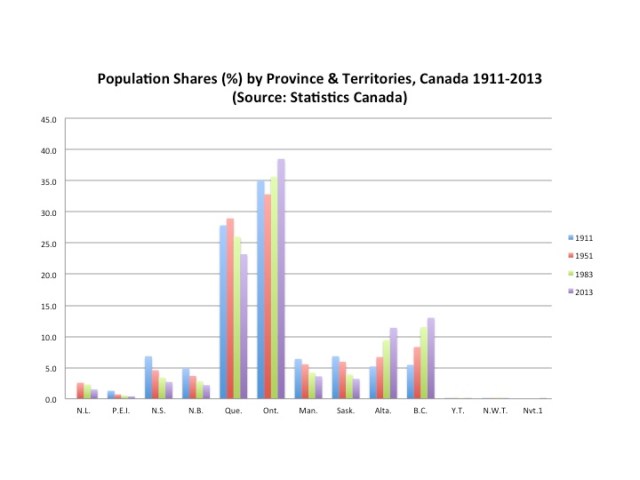
I've extended Chart 3 provided by Statistics Canada backwards to 1911 to provide a 100 year perspective of this type of change. It has been a pretty consistent declining share of national population for both Manitoba and Saskatchewan over the last 100 years along with the Atlantic region. Quebec's relative decline dates from the 1950s whereas Ontario declined during the pre World War Two era but has since grown as a share of national population. Almost two-thirds of Canada's population – and by extension most of its economy – now resides in only three of its provinces.
// <![CDATA[
// <![CDATA[
// &lt;![CDATA[
// &amp;lt;![CDATA[
// &amp;amp;lt;![CDATA[
var sc_project=9080807;
var sc_invisible=1;
var sc_security=&amp;amp;quot;4a5335bf&amp;amp;quot;;
var scJsHost = ((&amp;amp;quot;https:&amp;amp;quot; == document.location.protocol) ?
&amp;amp;quot;https://secure.&amp;amp;quot; : &amp;amp;quot;http://www.&amp;amp;quot;);
document.write(&amp;amp;quot;&amp;amp;lt;sc&amp;amp;quot;+&amp;amp;quot;ript type=&amp;amp;#39;text/javascript&amp;amp;#39; src=&amp;amp;#39;&amp;amp;quot; +
scJsHost+
&amp;amp;quot;statcounter.com/counter/counter.js&amp;amp;#39;&amp;amp;gt;&amp;amp;lt;/&amp;amp;quot;+&amp;amp;quot;script&amp;amp;gt;&amp;amp;quot;);
// ]]&amp;amp;gt;
// ]]&amp;gt;
// ]]&gt;
// ]]>
// ]]>

Related articles


 Worthwhile Canadian Initiative
SK got oil due to arbitrariness of the provincial boundaries. Otherwise, it still would be a purely agricultural region, where fast increasing productivity combined with low income elasticity of demand would make it a population-emptying area ( though still with a good lont-run income per capita).
And what would happen to our statistics if the west had beeb divide into north and south provinces instead of east (SK) and west (AB) same situation with the Dakotas…
Odd that the stories I saw in the news are all about how the west is decimating the Atlantic provinces yet the bigger story is Ontario’s continued and increasing domination of Canada.
Perhaps I am stepping on a landmine, but how much of this is tied to the ability of each province to attract and retain immigrants?
“Almost two-thirds of Canada’s population – and by extension most of its economy – now resides in only three of its provinces. ”
But this was almost always the case – Ontario, Quebec and B.C. Or do you mean something else?
Almost two thirds now resides in Ontario and the two western provinces of Alberta and British Columbia. The remainder is spread out amongst the other seven with the largest concentration in Quebec.
QC is definitely not “most of the other seven”. QC and ON form a rather integrated unit.
Good point Jacques. I just fished that comment out of spam – got your message. By the way, e-mail is usually a quicker way of getting hold of me. all the best. Livio.