The Canadian Institute for Health Information (CIHI) has put
out their 2013 National Health Expenditure Report and the big story seems to be
that the numbers show that public sector health care costs in Canada are
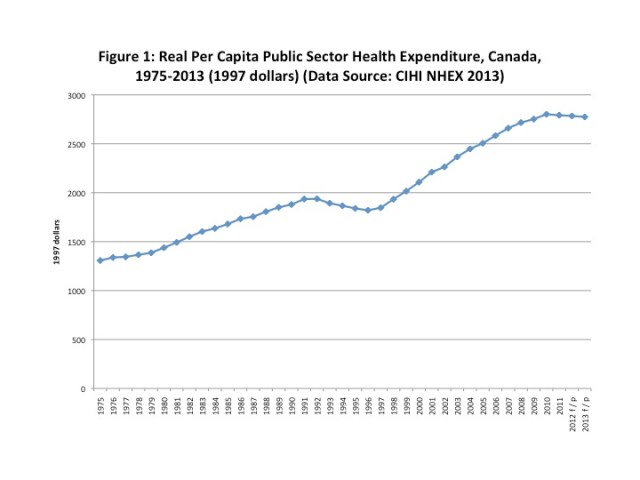
declining. Real per capita public sector
health care spending (in 1997 dollars and I used the Health Care Implicit
Price Index to construct these estimates) was $2,792 in 2011 and is forecast at $2,784 in 2012 and $2,774
in 2013. These estimates also represent annual percent
declines of -0.4 in 2011, -0.3 in 2012 and -0.3 in 2013. As
Figure 1 shows, this is the first time in a long time – since the early 1990s
to be precise – that per capita spending has gone down. The question is, does
this represent the result of successful attempts to reform public health care
spending?
If these declines are the result of successful
transformative change attempts that control health care spending in a manner
that maintains or boosts services and reduces costs, then this is a good
thing. If this is simply being
accomplished by reducing services, then this is not a good result. Part of the answer may lie in where the
declines are occurring. Figures 2 and 3 plot the annual growth rates for real
per capita spending from 2011 to 2013 for the main categories of public sector
health spending as laid out by the CIHI.
The results are interesting.

There have been consistent increases over the last three
years in real per capita public sector health spending for physicians, vision
care and other professional care.
Hospitals saw increases in two out of the last three years. Drugs, administration, research and all other
health spending (eg. Home care, etc…) all saw consistent declines across all
three years. Capital spending, dental and
public health saw decreases in two out of the last three years.

So is there a story here?
Well, the biggest declines seem to have occurred in areas that have seen high growth rates over the last few decades of health expenditure growth –
especially drugs. Hospitals and
physicians, the traditional core of public health care, have actually gotten
off lightly from recent restraint even though they still represent the bulk of spending.
Hospitals and physicians still
account for 60 percent of Canadian public sector health spending. Capital and research have been particularly
hard hit but they are politically the easiest ones to hit given that any effects of
reducing spending here will materialize over the longer term. If there has been
one consistent area of success when it comes to controlling costs it does appear to be public drug spending as the
annual growth rate of real per capita spending there has been below 2 percent
since 2007 and 2010 to 2013 has seen negative growth each year. My guess is that the decline in real per
capita health spending will be short-lived given that the brunt of the decline
has been borne by 40 percent of public sector spending – unless the next wave
of restraint/reform also affects hospitals
and physicians.
// <![CDATA[
// <![CDATA[
// &lt;![CDATA[
// &amp;lt;![CDATA[
// &amp;amp;lt;![CDATA[
// &amp;amp;amp;lt;![CDATA[
var sc_project=9080807;
var sc_invisible=1;
var sc_security=&amp;amp;amp;quot;4a5335bf&amp;amp;amp;quot;;
var scJsHost = ((&amp;amp;amp;quot;https:&amp;amp;amp;quot; == document.location.protocol) ?
&amp;amp;amp;quot;https://secure.&amp;amp;amp;quot; : &amp;amp;amp;quot;http://www.&amp;amp;amp;quot;);
document.write(&amp;amp;amp;quot;&amp;amp;amp;lt;sc&amp;amp;amp;quot;+&amp;amp;amp;quot;ript type=&amp;amp;amp;#39;text/javascript&amp;amp;amp;#39; src=&amp;amp;amp;#39;&amp;amp;amp;quot; +
scJsHost+
&amp;amp;amp;quot;statcounter.com/counter/counter.js&amp;amp;amp;#39;&amp;amp;amp;gt;&amp;amp;amp;lt;/&amp;amp;amp;quot;+&amp;amp;amp;quot;script&amp;amp;amp;gt;&amp;amp;amp;quot;);
// ]]&amp;amp;amp;gt;
// ]]&amp;amp;gt;
// ]]&amp;gt;
// ]]&gt;
// ]]>
// ]]>


 Worthwhile Canadian Initiative
It would be interesting to see this data adjusted for age in some way. Per capita is not quite right with this analysis as an aging population requires more health services.
If the cost is going down per capita while the population is aging we are either doing quite well or neglecting aging patients.
Benoit: I agree. The CIHI also reported that spending on “old seniors” was three times that of “young seniors.”
Benoit: Just to fill out my previous comment more fully – the CIHI reports that provincial/territorial health spending per capita in 2011 was $26,336 for seniors aged 90 years + and $24,003 for those in the 85-89 category and $6,431 in the 65-69 age category.
There was a similar slowdown in all HC spending in the US. The consensus there is that it’s almost all attributable to the recession. Given the politics of HC in this country, I find it hard to see any other reason for the slowdown here.
Benoit: It appears from the report that home care spending had a brief setback. In demographic terms, home care is our major institutional bulwark against the potential financial ruin caused by a huge expansion of inpatient long-term care. So if home care spending isn’t growing, there likely isn’t a lot of fundamental reform going on. Having said that, it’s not clear from the definition used by CIHI that they’re talking about what most people in healthcare would call home care (see here, p.42).
Livio: a tweak on spending is that some of the spending coded as “private insurance” is health care benefits paid to public sector workers and retirees. The PS is relatively small but has generous pay and very generous benefits compared to private. Public sector wages in 2012 were $16.5 billion (sadly, a terminated data series). If we estimate an additional 10% of that for employee health benefits (and not including retirees), that’s $1.6 billion that’s actually government. A drop in the bucket, relatively speaking, but it’s worth noting that both CIHI and OECD code that as private.