There
was a recent piece in the New York Times on Italy’s economic situation and how
its high unemployment rate and stagnant economy appears to have led to a return
of Italian emigration. This story struck a personal chord given my own
parents came to Canada during the post World War Two wave of immigration.
While current Italian emigration it is not near the levels of the 1950s and
1960s, about 400,000 university graduates have left over the last decade. This
is quite different from the out migration of the past, which saw the outflow of
mainly unskilled labor. This represents an outflow of valuable human capital
and the departure of future potential economic growth and innovation. It
also reminded me that we have seen this before in Canadian economic history.
The period prior to 1900 was viewed as a period of stagnation by
contemporaries and witnessed substantial migration by Canadians to the United
States. The absolute numbers of Canadian-born residents of the United States
grew from 147,711 in 1850 to 1,204,637 by 1910 as between 1850 and 1920 nearly
two million Canadians immigrated to the United States.
A paper by Jackson (1923) notes the following: "The Americans may say with
truth," wrote Goldwin Smith' in 1891, "that if they do not annex
Canada, they are annexing the Canadians. They are annexing the very flower of
the Canadian population, and in the way most costly to the country from which
it is drawn, since the men whom that country has been at the expense of
breeding leave it just as they arrive at manhood and begin to
produce."(27-28). Indeed, according to the IPUMS five percent census
sample for the year 1900, 1.64 percent of the US population was Canadian born
and Canadians made up 12 percent of the foreign born population.
This outflow of Canadians is quite significant when compared to the size of the
Canadian population at the time. Vedder and Gallaway (1970) note that
whereas in 1950, the Canadian-born living in the United States represented 6.2
percent of Canada’s population, in 1900 it was 22 percent.
Now the concern that your population is too small in a
world that is often considered overpopulated may seem strange but large
populations can be the source of economies of scale and agglomeration economies
provided there is the resource base and institutions to sustain it. In
Canada’s case, being a long thin country with isolated clumps of population
scattered in a 100 km band along the US border has posed transportation and
economic challenges of its own. It would be interesting to think about
what Canada’s population might be like if all that migration to the United States
had been retained.
Take a look at the accompanying figure. I have
taken Canada’s population in 1910 of 6.988 million people and added to it
another 1.204 million people – the number of Canadian born living in the United
States in 1910. I then let the population grow at 1.6 percent annually
from 1910 to 2012 – the average annual rate of population growth that occurred
in Canada between 1910 and 2012. I plot both Canada’s actual population
and this counterfactual population in the accompanying figure. By
2012, the counterfactual Canadian population is 41.477 million people compared
to 34.880 million people. The country’s population would be almost 20
percent larger – about another 6.6 million people. That is like adding another
GTA and then some to Canada. What the impacts might have been on our
urban centers and internal market size and subsequent economic development is
an interesting question.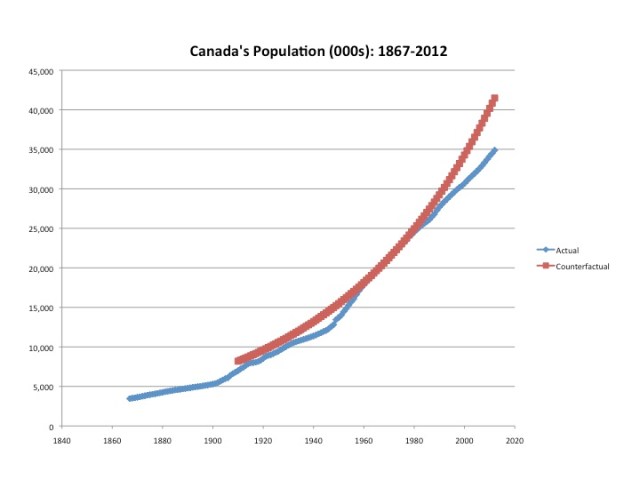
References
Jackson,
G.E. (1923) “Emigration of Canadians to the United States,” Annals of the
American Academy of Political and Social Science, 107, Social and Economic
Conditions in the Dominion of Canada, 25-34.
Ruggles, E. J. Trent Alexander, Katie Genadek,
Ronald Goeken, Matthew B. Schroeder, Matthew Sobek. Integrated Public Use
Microdata Series (IPUMS): Version 5.0 [Machine-readable Minneapolis: University
of Minnesota, 2010.
Vedder, R.K. and L.E. Gallaway (1970) “Settlement Patterns
of Canadian emigrants to the United States, 1850-1960,” Canadian Journal of
Economics, 3,3, 476-486.
// <![CDATA[
// <![CDATA[
// &lt;![CDATA[
// &amp;lt;![CDATA[
// &amp;amp;lt;![CDATA[
// &amp;amp;amp;lt;![CDATA[
// &amp;amp;amp;amp;lt;![CDATA[
// &amp;amp;amp;amp;amp;lt;![CDATA[
var sc_project=9080807;
var sc_invisible=1;
var sc_security=&amp;amp;amp;amp;amp;quot;4a5335bf&amp;amp;amp;amp;amp;quot;;
var scJsHost = ((&amp;amp;amp;amp;amp;quot;https:&amp;amp;amp;amp;amp;quot; == document.location.protocol) ?
&amp;amp;amp;amp;amp;quot;https://secure.&amp;amp;amp;amp;amp;quot; : &amp;amp;amp;amp;amp;quot;http://www.&amp;amp;amp;amp;amp;quot;);
document.write(&amp;amp;amp;amp;amp;quot;&amp;amp;amp;amp;amp;lt;sc&amp;amp;amp;amp;amp;quot;+&amp;amp;amp;amp;amp;quot;ript type=&amp;amp;amp;amp;amp;#39;text/javascript&amp;amp;amp;amp;amp;#39; src=&amp;amp;amp;amp;amp;#39;&amp;amp;amp;amp;amp;quot; +
scJsHost+
&amp;amp;amp;amp;amp;quot;statcounter.com/counter/counter.js&amp;amp;amp;amp;amp;#39;&amp;amp;amp;amp;amp;gt;&amp;amp;amp;amp;amp;lt;/&amp;amp;amp;amp;amp;quot;+&amp;amp;amp;amp;amp;quot;script&amp;amp;amp;amp;amp;gt;&amp;amp;amp;amp;amp;quot;);
// ]]&amp;amp;amp;amp;amp;gt;
// ]]&amp;amp;amp;amp;gt;
// ]]&amp;amp;amp;gt;
// ]]&amp;amp;gt;
// ]]&amp;gt;
// ]]&gt;
// ]]>
// ]]>


 Worthwhile Canadian Initiative
Interprovincial migration also has important effects. Here in New-Brunswick we have over 10% unemployment. Alberta has 4%. We have high emmigration of those trying to find a job or start a career. The most productive segment of society is leaving us.
However, provincial debt is around 15k per person in NB (compared to AB’s 3k surplus) and it doesn’t follow you when you move. Therefore every time a family of four moves to AB they leave behind 60k in provincial debt for the rest of us to pay. This means higher debt per capita ( and likely per GDP ) and money that was spent educating our population benefits Albertans instead of New-Brunswickers.
Wow. I had been vaguely aware of the Canadian wave of migration to the US around that time, but not of its scale. That really is an interesting counterfactual
Well Steve, one has to wonder about the many Canadas that might have been. Counterfactuals have a way of highlighting the alternate roads not taken.
Benoit: which is one reason why equalization payments are not “payments to moochers”. They are a vital complement to manpower mobility.