The dramatic municipal opera currently underway in Toronto over embattled Mayor Rob Ford is fascinating for those of us who live in small hinterland “non-world class cities” that are supposedly devoid of the sophisticated political leadership enjoyed by cities like Toronto. The enduring popularity and populism of Rob Ford in Toronto despite his outrageous behavior gives one cause to wonder if there indeed is any truth to the claim that his core constituency is based on his sound fiscal leadership of Toronto.
Today’s Toronto Star attempted at length to deflate the claims that he has been a sound fiscal steward and saved Toronto taxpayers one billion dollars. The Toronto Star “deconstructed” the specific claims Rob Ford has made with respect to saving Torontonians from assorted user fees, the elimination of a vehicle registration tax, outsourcing and other efficiencies. As well, the article concluded by noting that “Though he has slowed the pace of spending growth — and come close to stopping it totally — spending has increased a little bit each year, from $9.38 billion in 2011 to $9.39 billion in 2012 to $9.43 billion in 2013.” These numbers refer to “tax supported” gross spending and there is additional rate supported spending funded by waste management fees, parking fees and water fees. For example, in 2012 the total gross operating budget was approximately 10.7 billion dollars of which 9.4 billion dollars was tax supported and 1.2 billion was rate supported.
Of course it is useful to note that Rob Ford took office in 2010 and it might be more interesting to compare the total gross expenditure for Toronto both before 2010 as well as after 2010 to see what patterns or trends emerge. The accompanying figure plots the operating gross expenditures (tax and rate supported) from City of Toronto budgets since 2001 and the results are interesting. Spending in Toronto has grown steadily but the rate of growth has moderated. From 2002 to 2010, the average annual growth rate in spending works out to just over six percent per annum. For the period 2010 to 2013 it works out to 2.7 percent per annum. This would suggest that the Ford administration has cut the total gross municipal expenditure growth rate in half.
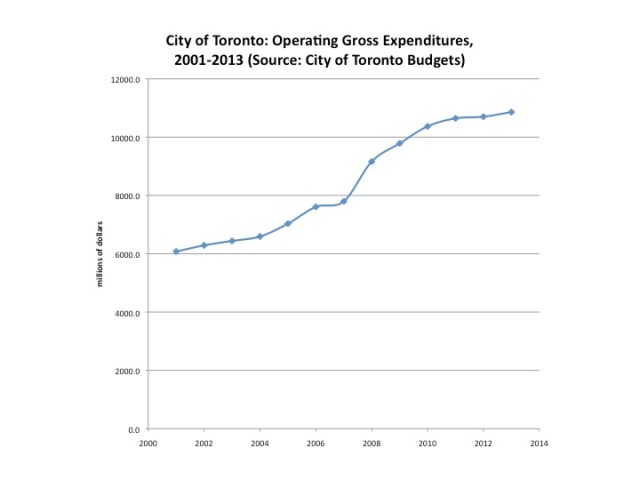
That Rob Ford has been embarrassing and appalling in his public performance as mayor of Toronto is something that is obvious for all to see. As for the fiscal record, Toronto is certainly not spending a billion dollars less than it was in 2010 though whether it is spending a billion dollars less than it might have without Rob Ford is open to debate. What is noteworthy and obviously a factor in his core popular support is that while Toronto is spending more than it was in 2010, there has been a very pronounced moderation in expenditure growth.
// <![CDATA[
// <![CDATA[
// &lt;![CDATA[
// &amp;lt;![CDATA[
// &amp;amp;lt;![CDATA[
// &amp;amp;amp;lt;![CDATA[
// &amp;amp;amp;amp;lt;![CDATA[
// &amp;amp;amp;amp;amp;lt;![CDATA[
// &amp;amp;amp;amp;amp;amp;lt;![CDATA[
var sc_project=9080807;
var sc_invisible=1;
var sc_security=&amp;amp;amp;amp;amp;amp;quot;4a5335bf&amp;amp;amp;amp;amp;amp;quot;;
var scJsHost = ((&amp;amp;amp;amp;amp;amp;quot;https:&amp;amp;amp;amp;amp;amp;quot; == document.location.protocol) ?
&amp;amp;amp;amp;amp;amp;quot;https://secure.&amp;amp;amp;amp;amp;amp;quot; : &amp;amp;amp;amp;amp;amp;quot;http://www.&amp;amp;amp;amp;amp;amp;quot;);
document.write(&amp;amp;amp;amp;amp;amp;quot;&amp;amp;amp;amp;amp;amp;lt;sc&amp;amp;amp;amp;amp;amp;quot;+&amp;amp;amp;amp;amp;amp;quot;ript type=&amp;amp;amp;amp;amp;amp;#39;text/javascript&amp;amp;amp;amp;amp;amp;#39; src=&amp;amp;amp;amp;amp;amp;#39;&amp;amp;amp;amp;amp;amp;quot; +
scJsHost+
&amp;amp;amp;amp;amp;amp;quot;statcounter.com/counter/counter.js&amp;amp;amp;amp;amp;amp;#39;&amp;amp;amp;amp;amp;amp;gt;&amp;amp;amp;amp;amp;amp;lt;/&amp;amp;amp;amp;amp;amp;quot;+&amp;amp;amp;amp;amp;amp;quot;script&amp;amp;amp;amp;amp;amp;gt;&amp;amp;amp;amp;amp;amp;quot;);
// ]]&amp;amp;amp;amp;amp;amp;gt;
// ]]&amp;amp;amp;amp;amp;gt;
// ]]&amp;amp;amp;amp;gt;
// ]]&amp;amp;amp;gt;
// ]]&amp;amp;gt;
// ]]&amp;gt;
// ]]&gt;
// ]]>
// ]]>


 Worthwhile Canadian Initiative
See second graph in this:
http://metronews.ca/voices/ford-for-toronto/688301/doug-ford-says-critics-cant-go-after-our-fiscal-record-challenge-accepted/
Leo:
Thanks for the link. That was a good article – liked it better than the one I saw today in the Toronto Star. The net operating budget graph is property tax revenue. You would need to get annual average growth rates for the 2010 to 2013 period versus the pre-2010 period to make a similar comparison and see if property tax revenues have been growing more slowly during the Ford period. Moreover, you might want a total own source revenue calculation – including water fees, etc..
I don’t live in Toronto, but I seem to remember that Ford had some consulting firm (KPMG?) try to find the billions in waste he and his followers are sure must exist, and they basically came back and said there wasn’t much to cut that wasn’t part of the basic services lots of people use.
I know in my town (Edmonton), big spending cuts would be a disaster. The municipal gov’t provides most of the services and amenities people use on a regular basis (roads, snow clearing, buses, LRT, garbage collection, pools, rinks, etc …).
Supposing this is also true in Toronto, it’s not surprising the Fords weren’t able to really slash and burn; it would have been political suicide.
“The enduring popularity and populism of Rob Ford in Toronto despite his outrageous behaviour…” Almost as bad as the last mayoral election in London where voters had the choice between a member of the loony left (Ken Livingstone) and bumbling Boris Johnson, who can’t walk up a flight of steps without tripping up.
If voters had any sense, they’d go for boring grey politicians like John Major or Angela Merkel who can actually do the job. Unfortunately, voters are attracted by politicians with charisma and colour.
I remember what had been said of Maurice Duplessis by Pierre Fortin: “He left Québec with no debt. And no roads or universities.”
How can we evaluate the investment deficit that is the legacy of such politicians?
A lot of what a city buys directly or indirectly is energy…
http://www.eia.gov/dnav/pet/hist/LeafHandler.ashx?n=pet&s=rbrte&f=m
Ford came in after most of the rise in Brent occurred… and the rise in operating expenses that the rise in oil led to.
Makes me think of Maggie Thatcher, who rode the prosperity of the rise in North Sea oil production. How’s the U.K. doing now that it is a net importer.
http://mazamascience.com/OilExport/ (select United Kingdom)
“I know in my town (Edmonton), big spending cuts would be a disaster. The municipal gov’t provides most of the services and amenities people use on a regular basis (roads, snow clearing, buses, LRT, garbage collection, pools, rinks, etc …).”
But you’re assuming that spending cuts means cutting services. That may be true, but it’s contestable. There are two ways you can reduce spending. Buy less stuff, or buy the same stuff cheaper (or both). The mistake that parties on the right make is to campaign on the latter approach, but do the former (because its easier), but equally parties on the left make the opposite of campaigning against both, rather than just against the former (because they’re backed by public sector unions). It’s not about “cutting waste”, it’s about “cutting costs”, which is a very different cup of tea. The handful of tangible accomplishments under the Ford administration, namely the contracting out of garbage pick-up (which even the Toronto Star subsequently conceded is a success, and which has spurred the remaining public sector garbage workers to improve productivity in their portion of the city) or the wage settlement with public sector unions are examples of the latter approach. In fact, one of my big beefs with Ford administration (apart from the obvious fact that he a clown) is that they didn’t pursue negotiations with the police and fire service (both of which account for huge portions of the city’s budget) with the same zeal (although in fairness, the city is handcuffed by the fact that those negotiations always go to arbitration which, somehow, usually works out in favour of the unions).
Three are limits, of course, to how far you can cut costs before you find you can’t attract good people to work for you. But I’d suggest that, at least in Toronto, we aren’t pushing those limits yet.
As an aside, anyone worried about Rob Ford characterizing moderating spending growth as a $1 billion saving should check out Maude Barlow’s whopper in today’s globe, characterizing the federal government’s decision to hold the rate of growth of health care spending to the rate of growth of the economy as a whole as “removing $36-billion from medicare” (I’m not sure how you “remove” an amount that was never spent). Granted, on ye olde credibility scale, there isn’t much to choose between Barlow and Ford (except that Barlow doesn’t get the benefit of being a drunken crackhead to explain her ramblings), but it just goes to show that politicians (or activists) of all stripes like to play the fun with numbers game when it suits their agenda.
The slope of that line looks similar between 2001-05 and 2009-13.
I suspect that some of these spending trends hides provincial uploading.
Differences in the pace of provincial uploading can skew underlying municipal spending growth.
Bob Smith: if GDP/capita is growing, if all other wants are satisfied and had become income-inferior goods and health spending (or education)is an income-superior good, then spending on health must increase faster than GDP or growth of GDP itself will be constrained as we refuse to produce the goods the consumers want and persist in producing what they don’t want… Trying to even decrease the rate of growth would be like saying that “in the ’20’ the share of cars in GDP was growing ” or “in the ’70-80’s GDP share of computer was growing” and that problem must be adressed. (I am leaving aside the issue of efficiency, which is a micro-administrative problem).
If we were so efficient that 1% of the workforce could produce all the food and another 1% all manufactured goods, then health care could be 98%. In fact it would and should be. Unless we want the added productivity as voluntary leisure or forced unemployment.
In fact, growing health spending could be a way to avoid secular stagnation where you are so rich that you don’t know what pt do with excess savings. We can build a second rail line from London to Manchester, or dig hole or gold mines , build cathedral or pyramids à la Keynes. Or five space stations. Ot something useful. like hospitals ot universities. Unlike we really don’t want to do that because we’re VSP.
Krugman Today’s solution is increasing Social Security payments
http://krugman.blogs.nytimes.com/2013/11/20/social-security-and-secular-stagnation/
Jacques,
All fine, but to characterize a reduced rate of growth of federal health care spending as a cut to health care spending is seriously misleading. And in any event, those are some pretty strong assumptions you’ve built into your analysis, somehow I doubt Maude Barlow believes that “all other wants are satisfied”.
With respect to efficiency, it is a micro-administrative problem, which is why federal funding is problematic (and in particular, open-ended federal funding). The provinces have the ability to determine what gets provided and how it gets provided, they should be (and are constitutionally) responsible for funding it
“Differences in the pace of provincial uploading can skew underlying municipal spending growth.”
Would uploading skew municipal spending growth? It typically involves taking expenses off the books, not adding them. You might be able to tell a story about increased provincial or federal funding driving growth. Maybe the election of the McGuinty government in 2003 led to increased provincial funding (with a 1-year lag) and I seem to recall the feds started providing increased transit funding to cities in 2007. But that just makes it easier for local politicians to spend without the political cost of raising taxes or running deficits, it doesn’t get them off the hook for doing so.
Of course, the other possibility is that the 2005-2010 trend reflects the election of a certain David Miller in (late) 2003 and his political decimation (announcing he wasn’t going to run again, following his defeat/surrender to city workers in the 2009 strike) in late 2009.
Strong hypothesis to test to the limits…
Barlow, like Harper, is not in science but politics. Misleading arguments are not bugs but features, unfortunately.
Ot something useful. like hospitals ot universities”
Which assumes we’re building something useful. On the other hand, at least in Canada, a fair bit of the increased spending on health care and education flows into labour costs. That’s fine if we’re paying market wages, but you look at the horde of under-employed teachers or PHDs working as contract lecturers (worker harder and making significantly less than tenured professors) you have to ask yourself “are we really paying market wages for those services?” If not, the increased spending is just redistributing money into private pockets (i.e., the insiders) without actually “building something useful”. It’s like paying a contractor above market to build a new road, the road costs more, but isn’t any better than a cheaper one.
A problem is that political audiences care about absolute results, rather than results as a % of GDP. This is an even bigger issue when one talks about deficits. The economic impact of say, a 1 billion dollar deficit or surplus (federally) is inconsequential. Yet voters would likely view the former less favorably than the latter.* In contrast, they might make no distinction between a 12 billion dollar deficit and a 1 billion dollar deficit (e.g. witness the number of people that equate Rae and Harris/Eves, though the latter had a much smaller deficit).
The problem is that the public doesn’t really understand how economic variables impact their lives. It would be much better if we had some metric like “estimated policy contribution to long-term economic growth” or “estimated policy contribution to systemic risk” (based on a sophisticated economic model) that was regularly reported in the news.
*The Canadian electorate also erroneously attributes the good times of the 90s to deficit reduction, when low interest rates were far far more important.