All-you-can-eat restaurants should not exist.
People with large appetites crowd into all-you-can-eat establishments. These greedy customers eat vast amounts, driving up the restaurants' costs. Restaurants have no choice but to increase prices, but this turns off people with small appetites. Eventually the only people who eat at the restaurant are hulking athletes, and the restaurant fails – a victim of "adverse selection".
All-you-can-eat restaurants also suffer from moral hazard. Patrons can fill their plates for free, so eat until the marginal benefit of piling on additional food is zero. It is trivial to show diagrammatically that all-you-can-eat pricing is inferior to marginal cost pricing:
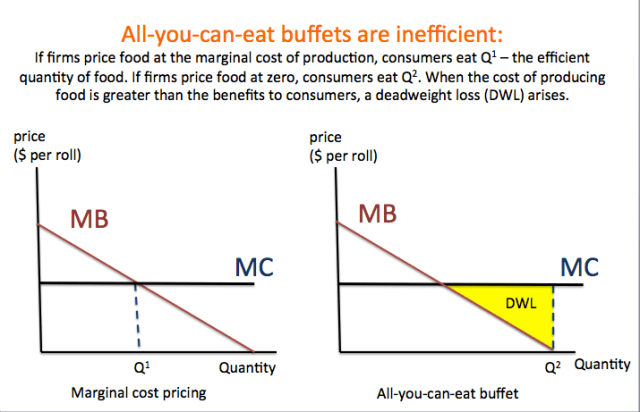
Clearly, all-you-can-eat sushi restaurants should not exist. So why do they?
First, restaurants have fixed costs, like rent. They generally do not set prices equal to their marginal production costs, because if they did, they would never generate enough revenue to cover their fixed costs. In the real world, restaurants cover their fixed costs by pricing their products at the average cost of production – a state of affairs called "monopolistic competition".
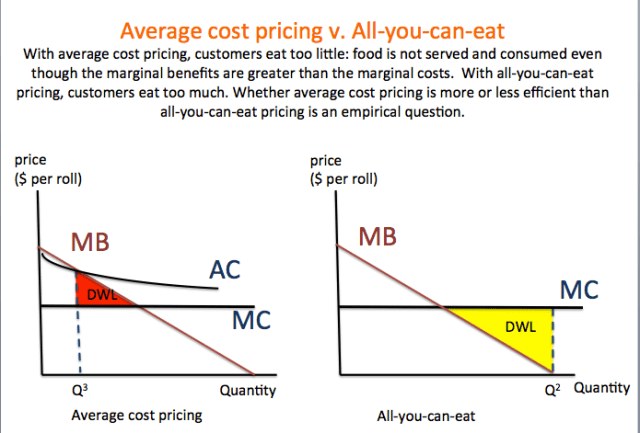
Both average cost pricing and all-you-can-eat pricing are inefficient: the only issue is which one is more wasteful. The deadweight loss associated with over-eating is greatest when the marginal cost of food production is high – for food that is highly labour intensive to prepare, for example, or for expensive ingredients. The deadweight loss associated with average cost pricing is greatest when fixed costs are high, when restaurants have to charge a price far above marginal cost to cover their overhead.
The diagram above explains why all-you-can-eat restaurants exist, but the existence of all-you-can-eat sushi restaurants remains a puzzle. The analysis above suggests all-you-can-eat restaurants will feature food that is easy to prepare in bulk, like roast beef, or cheap food, like potatoes or scrambled eggs or pancakes. Sushi is laboursome to prepare, and some of the key ingredients, like sushi-grade tuna, are very expensive.
One possibility is that the opportunity cost of sushi ingredients, once purchased, is low. If sushi-grade tuna is not used right away, it has to be thrown out. It is better to feed the greedy than to throw food away.
Another possibility is that all-you-can-eat sushi restaurants flourish because they have found ways to curve moral hazard and adverse selection. Indeed, there are a number of features of the all-you-can-eat sushi experience that work to curb hazardous over-eating. First, consumers are charged for food that they don't eat, so it is risky to over-order. Second, the food arrives gradually, and the more one orders, the greater the time between orders (or so I've been told). Third, some restaurants limit the number of expensive items one can order – all-you-can-eat California roll, yes, all-you-can-eat red dragon roll, no. Finally, all-you-can-eat sushi restaurants tend to feature relatively more of the cheap-but-filling Asian food items – squash tempura, miso soup, cucumber roll, sushi made with crispy tempura or mayonnaise.
Some customers will parse the list of sushi offerings with great expertise, and order the most costly items from the menu. Yet perhaps this is a feature of the system, not a bug: perhaps all-you-can-eat sushi restaurants are effectively price discriminating between the more knowledgeable and less knowledgeable customers, just like restaurants who charge the same price for every wine on their menu?
Like moral hazard, adverse selection is not an insurmountable problem. All-you-can-eat sushi restaurants will tend to attract people with greater-than-average appetites. So what? People with lower-than-average appetites will eat elsewhere. As long as the people with greater-than-average appetites form a relatively homogeneous group, the restaurant will set prices so that it makes money serving hungry patrons, and fill its tables with the young and the greedy. It's called a "separating equilibrium" and, under the right conditions, it can exist.
The point of this post: Economic reasoning can be used to "prove" things that are patently false, like the non-existence of all-you-can-eat sushi. And sometimes "inefficient" choices are actually reasoned responses to something missing from the economist's model.
Note: AC curve corrected.


 Worthwhile Canadian Initiative
Did the mystery ever get solved here? Nick: I don’t see how heterogeneity can explain a marginal price BELOW marginal cost in a 2-part pricing scheme. Take a 2-type case. Think of two linear demand curves, same slope but one – the high-value type- with bigger intercept, and constant costs. If I must charge everyone the same fee and marginal price, and it is optimal to sell to both, the highest fee I can charge is limited to the economic surplus created when the low-value type is charged marginal cost. That leaves a lot of unextracted surplus form the high-value type. Raisng the marginal price above MC slightly, I must lower the fee. I lose a little triangle of surplus from the low-value type (I get most of the fee reduction back via the higher marginal price) On the high-value type I get all of the lower fee and then some back on the higher per-unit charge, since I’m extracting some of the surplus that had gone begging before. At the margin, the loss of profits from the low-value type is 2nd order, while the gain in profit from the high value type is first-order. So we want raise the marginal price above marginal cost to some extent. But why would heterogeneity ever see us lowering the marginal price below marginal cost. (An old joke comes to mind: your prices are so low, you’re losing money on every item you sell! Yeah, but I make it up on the volume!) And I know he solution to the mystery cannot be that the restaurant has negative marginla cost!
“First, the most efficient method of pricing would be to charge a fixed price for using the space at the table, the roof over your head, the health inspectors, etc. and then a variable (probably the marginal cost) price for the food. If it is monopolistic competition, and people are heterogeneous, it may be optimal to charge somewhat more than MC but two-part pricing would still be ideal. The reason restaurants don’t do this is a mystery to me but let’s put that aside and just assume they can’t for some reason.”
Reason number one: ability to walk out on scams. No new customer likes to pay a cover charge because they’re not sure what they’re going to get: if they go in, spend a little time, and then send back the food because it’s inedible, and walk out, they don’t want to pay anything.
Reason number two: a variant of the above: promotional pricing — if you’re curious about the restaurant, you can walk in and buy the cheapest thing just to try it out, and if you like it, you may come back and buy more in the future.
Reason number three: simplicity of pricing making transactions more comprehensible to customers, which is appreciated.
Reason number four: having people visibly sitting in your restaurant serves as marketing. The marginal cost of seating someone is nothing unless the restaurant is already filled. However, the marginal benefit is large because it makes the restaurant look more “happening” and attracts more customers.
Important additional fact: some places DO have cover or “walk in the door” charges — these are usually places which are full, or at least places where you can’t tell from outside whether they’re full. So it’s clear that the lack of cover charges is related to the desirability of filling your restaurant even if you fill it with “unprofitable” customers.
Marketing. THE most important part of microeconomics, and yet not covered in most intro classes.
thanks!!!
“having people visibly sitting in your restaurant serves as marketing. The marginal cost of seating someone is nothing unless the restaurant is already filled. However, the marginal benefit is large because it makes the restaurant look more “happening” and attracts more customers.”
Or, as Yogi Berra said: “Nobody goes there anymore. It’s too crowded!”
Sushi is one of the most adored foods in our area. Restaurants do exist in the present. Why questioning sushi restaurants’ existence?