It is of course useful from time to time to take a look at the longer-term picture when it comes to health spending especially given that there is a slowdown in health expenditure growth. Figure 1 plots per capita total health expenditure in US PPP dollars from 1960 to 2014 for Canada (to 2014) and the OECD (to 2013) using data from the OECD Health Statistics 2015.
In 1960, Canada was spending $112 per capita on health spending (both public and private) compared to an average of $77 for the OECD – about 45 percent more per capita. By 2013, Canada is spending $4,351 compared to $3,403 – about 28 percent more. Thus there has been some convergence between Canada and the OECD average over time. Over the entire period, Canadian health spending per capita has grown at a slightly slower rate than the OECD but with some variations in performance as Figures 2 and 3 show. Canada sees especially slow rates during the 1990 to 1996 retrenchment period compared to the OECD.

In both Canada and the OECD, the growth rate of per capita spending has come down over time with growth rates highest prior to 1980. This was an era of higher economic growth but also an era that coincides with an expansion of the public health system in many countries particularly during the 1960s. One could argue that many of the early warnings about the growing cost of health care may have been overly alarmist if they were using numbers from the earlier part of this period.
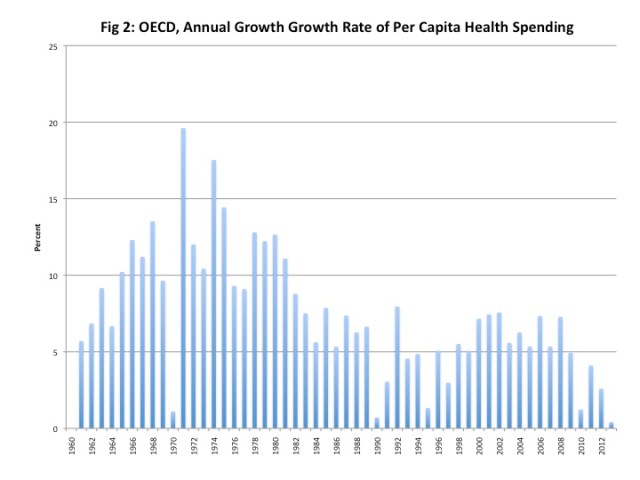
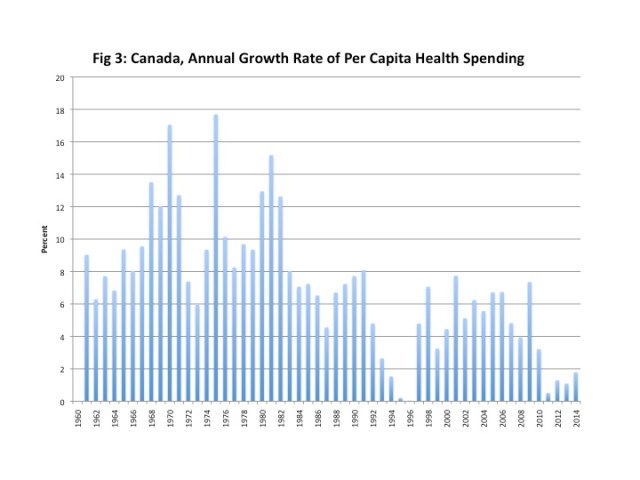
The average annual growth rate of per capita spending for the OECD countries for the period 1960 to 1980 was 11 percent whereas for the 1981 to 2013 period it has been halved to just over 5 percent. For the period since 2008, it has come down yet again with an average growth in per capita spending rate for 2008 to 2013 of 3.4 percent. On the one hand, this could be interpreted as the result of long-term efforts to bend the cost curve that have started to show results especially over the last decade.
On the other hand, one can more likely argue that the fall in per capita health spending growth rates depicted in Figures 2 and 3 largely tracks the slowdown in global economic growth since the 1960s. In other words, like everything else, health spending follows the economy.
// <![CDATA[
// <![CDATA[
// &lt;![CDATA[
var sc_project=9080807;
var sc_invisible=1;
var sc_security=&quot;4a5335bf&quot;;
var scJsHost = ((&quot;https:&quot; == document.location.protocol) ?
&quot;https://secure.&quot; : &quot;http://www.&quot;);
document.write(&quot;&lt;sc&quot;+&quot;ript type=&#39;text/javascript&#39; src=&#39;&quot; +
scJsHost+
&quot;statcounter.com/counter/counter.js&#39;&gt;&lt;/&quot;+&quot;script&gt;&quot;);
// ]]&gt;
// ]]>
// ]]>


 Worthwhile Canadian Initiative