Discussions about demographics are typically focused on trends in fertility/morbidity and immigration/emigration, and these are what matter at the national level. But at the local level, trends on internal migration are also important. Statistics Canada has been publishing data on inter-provincial migration for years, but there's only so much you can get out of them. Migration trends within large provinces such as Ontario and Quebec may be more important for local service providers than inter-provincial trends.
Happily, Statistics Canada started publishing data on migration flows between Census Metropolitan Areas (CMAs) and between non-CMA regions in its Cansim Table 051-0065. It's still not as good as the county-to-county migration flows data published by the US Census Bureau, but it's a start. Moreover, the series begin in 2011, so there's a limit to the information you can extract from them.
That said, my first pass at what we can learn from these internal migration data is below the fold.
This table shows the average annual internal migration flows for the three years that are available. These exclude immigration and emigration flows to and from Canada, so net internal migration for Canada as a whole is zero. There are 47 regions, one for each CMA, and for non-CMA regions in each province. (Ottawa-Gatineau is broken out into its Ontario and Quebec components.)
| Region | Persons | Per cent of 2011 population | ||||
|---|---|---|---|---|---|---|
| Inflows | Ouflows | Net flow | Inflows | Outflows | Net flow | |
| St John's | 6,375.3 | 4,530.3 | 1,845.0 | 3.148 | 2.237 | 0.911 |
| Rest of NL | 6,389.0 | 7,809.0 | -1420.0 | 1.981 | 2.421 | -0.440 |
| PEI | 2,371.3 | 3,189.3 | -818.0 | 1.646 | 2.214 | -0.568 |
| Halifax | 12,461.7 | 11,805.0 | 656.7 | 3.097 | 2.933 | 0.163 |
| Rest of Nova Scotia | 9,365.3 | 13,009.7 | -3,644.3 | 1.728 | 2.400 | -0.672 |
| Moncton | 5,498.3 | 4,695.3 | 803.0 | 3.921 | 3.348 | 0.573 |
| Saint John | 2,439.3 | 3,472.0 | -1,032.7 | 1.897 | 2.700 | -0.803 |
| Rest of New Brunswick | 9,042.0 | 11,683.0 | -2,641.0 | 1.858 | 2.400 | -0.543 |
| Saguenay | 3,152.7 | 3,233.7 | -81.0 | 1.978 | 2.029 | -0.051 |
| Quebec City | 16,760.0 | 14,850.0 | 1910.0 | 2.158 | 1.912 | 0.246 |
| Sherbrooke | 7,099.0 | 6,288.7 | 810.3 | 3.468 | 3.072 | 0.396 |
| Trois-Rivières | 5,064.0 | 4,509.7 | 554.3 | 3.304 | 2.943 | 0.362 |
| Montreal | 44,045.7 | 57,941.3 | -13,895.7 | 1.134 | 1.491 | -0.358 |
| Gatineau | 9,046.0 | 9,665.0 | -619.0 | 2.841 | 3.036 | -0.194 |
| Rest of Quebec | 53,664.3 | 52,817.7 | 846.7 | 2.139 | 2.105 | 0.034 |
| Ottawa | 26,498.7 | 24,209.3 | 2,289.3 | 2.784 | 2.543 | 0.241 |
| Kingston | 6,960.3 | 5,950.3 | 1,010.0 | 4.231 | 3.617 | 0.614 |
| Peterborough | 4,426.7 | 4,247.3 | 179.3 | 3.623 | 3.476 | 0.147 |
| Oshawa | 15,822.3 | 12,506.0 | 3,316.3 | 4.308 | 3.405 | 0.903 |
| Toronto | 66,725.3 | 92,419.3 | -25,694.0 | 1.156 | 1.602 | -0.445 |
| Hamilton | 22,381.3 | 19,803.0 | 2,578.3 | 3.014 | 2.667 | 0.347 |
| St. Catharines | 9,598.0 | 8,589.7 | 1,008.3 | 2.384 | 2.134 | 0.250 |
| Kitchener | 15,221.7 | 15,277.7 | -56.0 | 3.088 | 3.099 | -0.011 |
| Brantford | 5,114.7 | 4,457.3 | 657.3 | 3.669 | 3.198 | 0.472 |
| Guelph | 6,699.0 | 6,074.0 | 625.0 | 4.600 | 4.171 | 0.429 |
| London | 13,543.0 | 13,033.0 | 510.0 | 2.767 | 2.663 | 0.104 |
| Windsor | 6,671.7 | 6,711.0 | -39.3 | 2.032 | 2.044 | -0.012 |
| Barrie | 10,560.0 | 9,110.0 | 1,450.0 | 5.478 | 4.726 | 0.752 |
| Sudbury | 4,288.7 | 4,428.7 | -140.0 | 2.595 | 2.680 | -0.085 |
| Thunder Bay | 3,102.3 | 3,048.0 | 54.3 | 2.483 | 2.439 | 0.043 |
| Rest of Ontario | 70,402.3 | 71,244.0 | -841.7 | 2.643 | 2.674 | -0.032 |
| Winnipeg | 13,948.3 | 17,096.3 | -3,148.0 | 1.870 | 2.292 | -0.422 |
| Rest of Manitoba | 11,506.7 | 13,715.3 | -2,208.7 | 2.360 | 2.812 | -0.453 |
| Regina | 7,728.7 | 6,976.3 | 752.3 | 3.550 | 3.204 | 0.346 |
| Saskatoon | 11,235.0 | 9,104.7 | 2,130.3 | 4.158 | 3.369 | 0.788 |
| Rest of Saskatchewan | 15,197.0 | 17,936.7 | -2,739.7 | 2.627 | 3.101 | -0.474 |
| Calgary | 44,970.7 | 30,291.3 | 14,679.3 | 3.557 | 2.396 | 1.161 |
| Edmonton | 46,206.7 | 29,996.3 | 16,210.3 | 3.831 | 2.487 | 1.344 |
| Rest of Alberta | 50,364.3 | 47,378.7 | 2,985.7 | 3.816 | 3.590 | 0.226 |
| Kelowna | 9,659.7 | 7,343.0 | 2,316.7 | 5.263 | 4.001 | 1.262 |
| Abbotsford | 8,191.0 | 8,233.0 | -42.0 | 4.699 | 4.723 | -0.024 |
| Vancouver | 36,270.3 | 41,106.7 | -4,836.3 | 1.528 | 1.732 | -0.204 |
| Victoria | 13,758.3 | 10,977.7 | 2,780.7 | 3.908 | 3.118 | 0.790 |
| Rest of BC | 40,317.0 | 38,912.0 | 1,405.0 | 2.847 | 2.748 | 0.099 |
| Yukon | 1,366.3 | 1,276.3 | 90.0 | 3.859 | 3.605 | 0.254 |
| NWT | 1,739.7 | 2,228.0 | -488.3 | 3.999 | 5.122 | -1.123 |
| Nunavut | 848.7 | 917.7 | -69.0 | 2.482 | 2.684 | -0.202 |
| Canada | 794,098.3 | 794,098.3 | 0 | 2.312 | 2.312 | 0 |
The scale of the gross flows (2.31% of the population) strikes me as large, but they're almost the same size as the state-to-state migrations in the US (2.37% of the population).
The size and direction of the net flows are consistent with the story that is usually told about Canadians moving from east to west. But what I find interesting are the data on the region-to-region transitions, which you can look at for yourself in this excel spreadsheet. There are 47 regions, which makes for 2209 transitions. Surprisingly enough, there are only 35 cells that show no transitions during these three years.
When scaled by the population of the region of origin, these flows can be interpreted as a transition matrix for a Markov chain. And once that idea got into my head, I couldn't resist the idea of finding out the stable distribution of the population across the regions. (If you know what the stable distribution of a Markov chain is, you can skip the next two paragraphs).
Suppose that there are two regions, Loserville and Winningtown, each with a population of 3 million people. Suppose also that 2% of the people in Loserville move to Winningtown in each period, and 1% of the people in Winningtown move to Loserville. When you apply these exit rates to populations of 2 million, that works out to 60,000 people moving from Loserville to Winnertown, and 30,000 making the reverse trip. Winningtown ends up gaining 30,000 people at the expense of Loserville.
Suppose that these rates are sustained, so that Winningtown continues to send 1% of its (rising) population to Loserville, and Loserville continues to send 2% of its (falling) population to Winningtown. But since Winningtown is growing and Loserville is shrinking, the net flows get smaller over time. When the populations of Winningtown and Loserville reach 4 million and 2 million, respectively, the net flows will stop: the 40,000 people leaving Loserville (2% of 2 million) will offset the 40,000 people leaving Winningtown (1% of 4 million). The distribution 4 million/2 million is the stable distribution: the transitions do not affect the distribution of people between Winningtown and Loserville.
The stable distribution from the matrix of internal transitions is a long-term projection of regional populations if internal migration was the only force at work. So it's not a forecast – it excludes immigration and natural increase – so much as a measure of the direction and size of the effects of internal migration.
The difference between the current and stable distributions can't always be inferred from the net flows in the preceding table. For example, Quebec City was a net beneficiary from internal migration over 2011-2014, but its 'stable' population is almost 20% less than what it was in 2011. It turns out that the regions from which Quebec City draws its internal migrants – mainly elsewhere in Quebec – are also losing population.
This chart compares the 2011 population with the stable distribution. It shows that Quebec is by far the biggest loser from internal migration, much more than Atlantic Canada. The relative stability of the population of the Atlantic provinces is driven by the net population flows to Newfoundland and Labrador. (Explanations for why people were moving to NL during 2011-14 are solicited in the comments.)
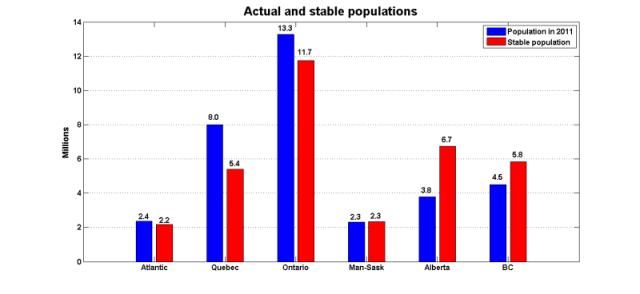
It's often been remarked that Quebec's demographic challenges have less to do with fertility rates and immigration than with Quebec's difficulty in retaining the people who are already here. This chart underlines just how strong those headwinds are. If internal migration were the only factor at work, and if current trends held, Quebec would eventually be the fourth most populous province in Canada, behind Alberta and BC. (The relative stability of the Manitoba-Saskatchewan total is a bit misleading: it masks the gains in Saskatchewan and the losses in Manitoba.)
This table compares the actual and stable distributions for all 47 regions:
| Region | Persons | Variation | ||
|---|---|---|---|---|
| Actual population | Stable population | Per cent of 2011 population | ||
| St John's | 202,533 | 310,112 | 53.12 | |
| Rest of NL | 322,504 | 334,343 | 3.67 | |
| PEI | 144,038 | 114,282 | -20.66 | |
| Halifax | 402,433 | 401,289 | -0.28 | |
| Rest of NS | 542,036 | 422,140 | -22.12 | |
| Moncton | 140,228 | 140,597 | 0.26 | |
| Saint John | 128,605 | 85,434 | -33.57 | |
| Rest of NB | 486,697 | 372,817 | -23.40 | |
| Saguenay | 159,383 | 115,842 | -27.32 | |
| Quebec City | 776,821 | 632,937 | -18.52 | |
| Sherbrooke | 204,709 | 163,382 | -20.19 | |
| Trois-Rivières | 153,247 | 122,169 | -20.28 | |
| Montreal | 3,885,709 | 2,348,554 | -39.56 | |
| Gatineau | 318,392 | 246,158 | -22.69 | |
| Rest of Quebec | 2,509,395 | 1,777,350 | -29.17 | |
| Ottawa | 951,840 | 982,586 | 3.23 | |
| Kingston | 164,492 | 187,640 | 14.07 | |
| Peterborough | 122,197 | 120,164 | -1.66 | |
| Oshawa | 367,266 | 383,617 | 4.45 | |
| Toronto | 5,769,759 | 4,315,604 | -25.20 | |
| Hamilton | 742,498 | 743,779 | 0.17 | |
| St. Catharines | 402,563 | 421,485 | 4.70 | |
| Kitchener | 492,961 | 462,893 | -6.10 | |
| Brantford | 139,388 | 152,022 | 9.06 | |
| Guelph | 145,637 | 145,751 | 0.08 | |
| London | 489,461 | 489,353 | -0.02 | |
| Windsor | 328,321 | 319,554 | -2.67 | |
| Barrie | 192,777 | 195,607 | 1.47 | |
| Sudbury | 165,253 | 153,034 | -7.39 | |
| Thunder Bay | 124,952 | 128,484 | 2.83 | |
| Rest of Ontario | 2,664,179 | 2,531,759 | -4.97 | |
| Winnipeg | 746,059 | 590,563 | -20.84 | |
| Rest of Manitoba | 487,669 | 390,941 | -19.83 | |
| Regina | 217,710 | 286,308 | 31.51 | |
| Saskatoon | 270,226 | 399,897 | 47.99 | |
| Rest of Saskatchewan | 578,413 | 658,069 | 13.77 | |
| Calgary | 1,264,460 | 2,380,555 | 88.27 | |
| Edmonton | 1,206,040 | 2,357,392 | 95.47 | |
| Rest of Alberta | 1,319,691 | 2,003,690 | 51.83 | |
| Kelowna | 183,524 | 333,439 | 81.69 | |
| Abbotsford | 174,321 | 217,242 | 24.62 | |
| Vancouver | 2,373,045 | 2,728,221 | 14.97 | |
| Victoria | 352,072 | 574,077 | 63.06 | |
| Rest of BC | 1,416,177 | 1,981,679 | 39.93 | |
| Yukon | 35,402 | 46,415 | 31.11 | |
| NWT | 43,501 | 41,537 | -4.51 | |
| Nunavut | 34,196 | 32,029 | -6.34 | |
It's a bit surprising to see Toronto as a large net loser to internal migration, although a glance at its housing market probably goes a long way to explaining it. (On the other hand, what about Vancouver?) Perhaps the lesson to be drawn here is that Toronto's population growth is heavily dependent on inflows of immigrants from abroad.
As I said, this is a rough first pass. But these data on internal migration flows should help us get a better understanding of an important dimension to the debates about demographic trends in Canada.


 Worthwhile Canadian Initiative
Inflows to NL 2011 to 2014: Hebron and Long Harbour megaprojects.
Very interesting, thanks. I would expect a post-2014 exercise to come up with something pretty different given recent developments in inter-provincial migration. It will be very interesting to see what happens with the Toronto numbers given the continued sharp rise in housing prices. I believe that Guelph, on the other side of the green belt was the fastest growing Ontario CMA between the 2011 and 2016 censuses.
Luke – Thanks. I wasn’t sure if it was a question of NL drawing people in, or of NL expatriates coming back home after being laid off in the oil and gas sector.
Patrick – yes, I suspect extrapolating 2014-2017 trends would give a very different picture. I’ll probably come back to this and see how the estimates for the stable distributions changed.
Toronto isn’t such a surprise. As largest city, it’s often the first landing point for immigrants (a place they’ve heard of) and then they fan out once established in Canada.
Newfoundland is likely driven by similar forces to Alberta. High resource prices caused significant in migration, though in Newfoundland’s case the makeup of their arrivals was probably mostly Newfies coming home.
To expound on Neil’s point, New York City is usually a huge loser in net internal migration despite having a growing population, this is due to strong international net immigration. Similar factors may be at play for Canada’s major cities, and at a provincial level, for Ontario and Quebec.
Echoing Neil and Jmcdon10: Quebec’s separate immigration system. Of immigrants landing there, probably higher percentage that have planned to fan out upon landing.
Curious about the Ottawa/Gatineau dichotomy. It’s kind of puzzling that near identical economic base would have such a big gap in direction, but on the ground it does look like Ottawa bedroom burbs keep pushing E/S/W much faster than their Gatineau counterparts. Maybe the culture/language and the lack of transport routes north of the river do make a difference.
The big metropolises gaining in international migrants (plus an extremely arrogant intellectual class) while losing their domestic populations outwards is happening all over the western world (except Japan but then remember Kuznets: “There are four kinds of countries in the world: developed countries, undeveloped countries, Japan and Argentina”.)
In the current political climate, it is not ultimately a good thing.
It’s too bad that this data isn’t available at the CA or sub-CMA level as the rough numbers raise many questions.
For example in Barrie we have a big flow back and forth with Toronto, which is most likely flows to Toronto’s (relatively) cheaper suburbs, but you can’t confirm that from the crude data. Also the “Rest of Ontario” category attracts many migrants in both directions. Most of these flows are likely to nearby Angus & Essa which added many new homes in the period, but once again this can’t be verified.
Another metric I thought was interesting was gross flows. At 10.2% of the 2011 population, Barrie was the most volatile place in Canada. The rate seems to generally be higher with smaller communities going through growth spurts and/or economic woes. Given the unprecedented growth we are enduring locally, I’d expect a significantly higher rate when the 2015/17 data becomes available. In some ways I imagine this data could be seen as a proxy for local dynamic conditions and the impact of development or changing economic conditions on existing residents.
Oil peaked around June 2014 before falling off a cliff and has just recently found its way to ~50% of that: What month are the 2014 numbers from? I am wondering if the Alberta 2014 #s are showing peak population?
http://www.macrotrends.net/1369/crude-oil-price-history-chart
Wikipedia shows some 2016 pop #s that indicate Alberta is still going strong population wise – not everybody scrambled back to the Maritimes!
https://en.wikipedia.org/wiki/List_of_census_metropolitan_areas_and_agglomerations_in_Canada#cite_note-2016census-1
It would seem that in time the Alberta experience might be useful for looking at the flexibility/elasticity of labour supply.
The flows are July 1 to July 1, so the last observation would have been almost exactly when oil prices stared to fall.