I gave a talk at Memorial University in Newfoundland & Labrador last week sponsored by the Department of Economics and the Collaborative Allied Research in Economics Initiative (CARE). My talk was based on joint research currently underway with David Cantarero Prieto at the University of Cantabria in Spain comparing the determinants of government health spending in Canada and Spain and particularly the role of physicians as a factor in that spending.
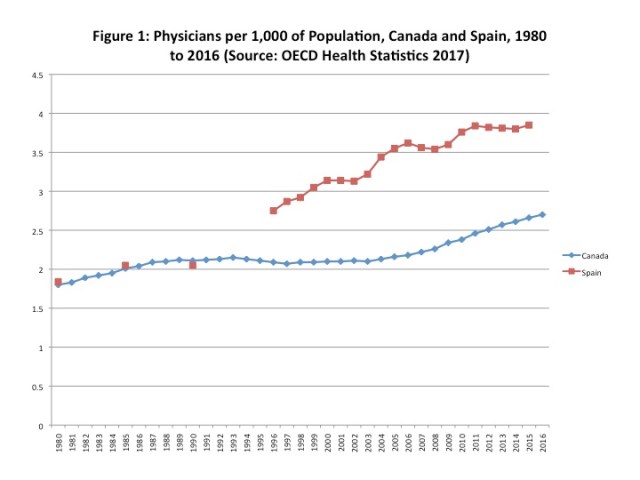
Briefly, the presentation studied the impact of physicians on health care expenditure and its dynamics over time in Canada and Spain for two overlapping time-spans of provincial/regional data availability: Canada, 1981 to 2013 and Spain, 2002 to 2013. Regression analysis found that physician numbers were a statistically significant driver of real per capita provincial government health expenditures in Canada but not for regional government health expenditures in Spain despite the fact that the per capita number of physicians is greater in Spain. It should also be noted that in Canada fee for service still accounts for about 70 percent of physician remuneration while in Spain physicians are on salaries.
Supplier induced demand therefore may more characterize the health sector in Canada but not necessarily in Spain. However, in terms of its contribution as an expenditure driver in Canada, the effect was pretty modest. Indeed, technology (as measured by a time trend) and the proportions of population aged 25 to 64 (and not 65 and over) were more important drivers.
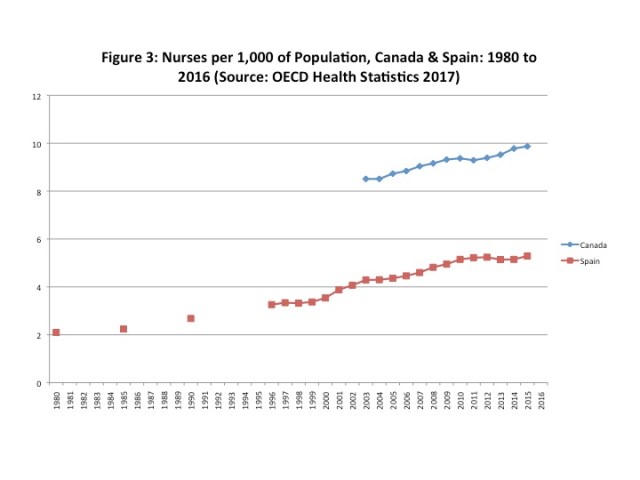
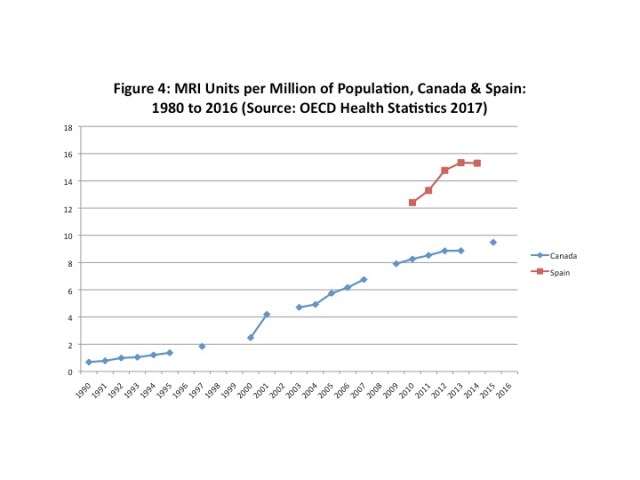
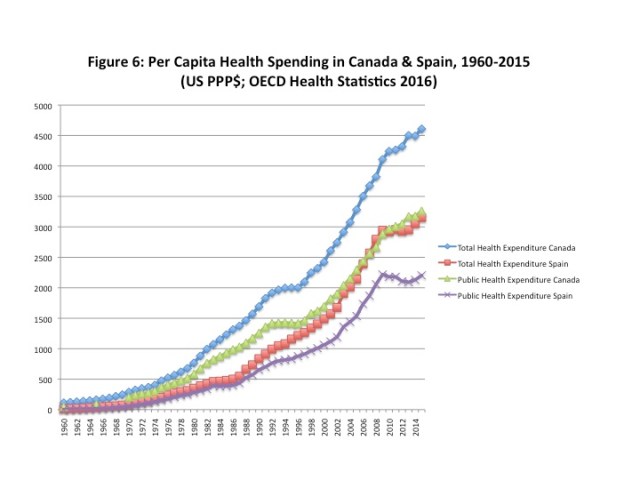
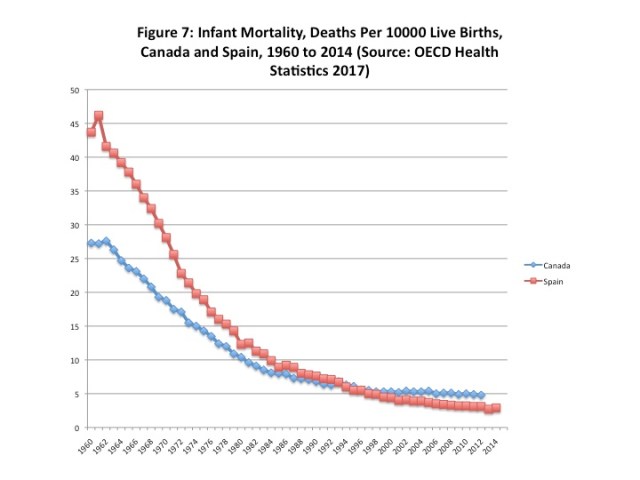
More interesting, I think was the additional take away that Spain appears to be achieving health outcomes that are the equivalent or better than Canada and is doing so with more resources per capita in a number of areas (eg. medical technology, physicians per capita, etc…but not nurses it turns out) but also while spending less per capita. Its infant mortality rates are now lower than Canada and its life expectancy at birth is higher even though the rates of drinking and smoking in Spain are still higher than Canada’s.
The seminar was well attended and the students and faculty who attended very engaged and a theme in the comments and questions was what about the impact of other factors – or other differences in the two systems. To that effect, I have put together a few charts below presenting some additional health spending/system comparisons of Canada and Spain from the OECD Health Statistics. Enjoy.
Thanks again to the Economics Department at Memorial for the invite. I had a great visit.


// <![CDATA[
// <![CDATA[
// &lt;![CDATA[
// &amp;lt;![CDATA[
// &amp;amp;lt;![CDATA[
var sc_project=9080807;
var sc_invisible=1;
var sc_security=&amp;amp;quot;4a5335bf&amp;amp;quot;;
var scJsHost = ((&amp;amp;quot;https:&amp;amp;quot; == document.location.protocol) ?
&amp;amp;quot;https://secure.&amp;amp;quot; : &amp;amp;quot;http://www.&amp;amp;quot;);
document.write(&amp;amp;quot;&amp;amp;lt;sc&amp;amp;quot;+&amp;amp;quot;ript type=&amp;amp;#39;text/javascript&amp;amp;#39; src=&amp;amp;#39;&amp;amp;quot; +
scJsHost+
&amp;amp;quot;statcounter.com/counter/counter.js&amp;amp;#39;&amp;amp;gt;&amp;amp;lt;/&amp;amp;quot;+&amp;amp;quot;script&amp;amp;gt;&amp;amp;quot;);
// ]]&amp;amp;gt;
// ]]&amp;gt;
// ]]&gt;
// ]]>
// ]]>


 Worthwhile Canadian Initiative
Livio: any idea on Canadian vs Spanish doctor’s average incomes? Would this explain the higher costs?
Hi Nick:
Actually I did find some numbers in US PPP dollars for 2011 and they suggest that Spanish physicians are paid about half as much as Canadian ones when it comes to total remuneration.
I wonder if high physician compensation in the US puts upward pressure on physician compensation in Canada.
We could use more MRIs. The future is innovation though. Private MRI clinics are correct as long as more radiation technologists and doctors are publicly educated. We have urban commutes and fast food; I’d expect Spain to live longer. This needs to be quantified for MRI wait times. Our doctors are powerful; they form policy as a consequence of reduced salary vis a vis the USA. Spain had a cold war dictator in the early 1980’s, so salary before 1984 is a meaningless indicator. Our brain imaging advances can be used to boot the PM and form a basis for future anti-WMD global governance.
If you take the RF coil of an MRI, and wear a CNT textile, you can measure the FID of an abstract thought utilizing working memory. You can hire positions of power and leaders who will avoid WMDs using it. Canada has 0.5 of these devices and everyone else: 0. I couldn’t get my hometown to invest in cutting edge textiles but because of Greenway I read enough different books to learn the theory…in general public medicine should segway to utilitarian thinking and C-of-C.
Continual improvements will herald clerical brain imaging. A 1970’s researcher noted the need to think in terms of webs of working memory. And almost everyone worried about risks is in time trouble; intuition would be more useful than working memory. The USA missed most of the sci-fi risks because they need to triangulate low taxes votes, and the Republican system is reactive to risks (as you keep power if you misplay a hand). The individual as important is something you want to map. After new actors have brain imaging, new technologies can be more safely invented and hopefully spies and terrorists can be mapped. CNTs and cognitive science meet in the future of office health care. For example, put rail guns or lasers on the Zunum and it forms a 5-Eyes ground robot killer assuming the staff is sane and effective.
The main underlying problem with Canada`s healthcare and future global government officials coming from Canada is Universality. You want people in gvmt, military, surveillance, and NASDAQ power to have more mental health services than others; mandatory honour and lateral thinking for the powerful.
Using the RF Coil of an MRI, and a PPE (a mining industry technique) precession sensor, office workers can be brain imaged a little better than an EEG facilitates. Their self-reflection about duty and honour can be measured before making judgements about AI and robotics. My kindergarten curriculum involved a Remembrance Day presentation by WWI soldiers fighting for Responsible Government. Buckminster Fuller delivered an amazing 1960s list of risks to housing, but he missed narrow high windows and the need to limit AI research (indeed all hackable R+D) because his curriculum was counter-culture. Here, only UK healthcare might be better.