The Canadian Institute for Health Information (CIHI) recently released its 2017 edition of its National Health Expenditure Trends and its worth a trip to its website for the downloadable data on all things related to health spending. I've been on an advisory group to the CIHI with respect to its national health expenditures for a number of years now and I always enjoy the release of the product and the assorted materials provided that can shed light on recent trends in health spending.
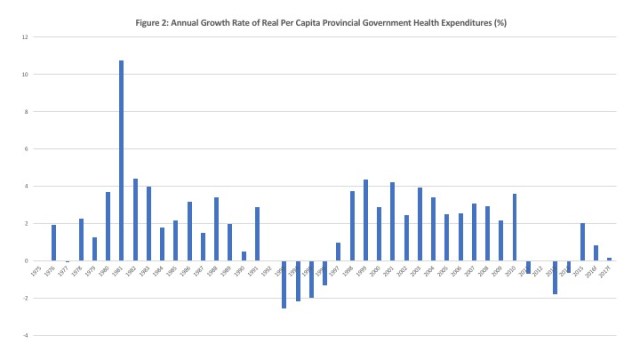
The last few years have seen a flattening out of real per capita ($1997) provincial government health spending and a fall in growth rates as Figures 1 and 2 show. However, after a decline from 2010 to 2014 that saw real per capita provincial government health spending fall from $2,589 to $2,508 – a drop of 3.1 percent – spending is expected to increase to $2,585 by 2017 for an increase of 3 percent since 2014.
This might suggest that whatever restraint kicked in after the 2008-09 recession and the anticipation of an end to the 2004 Health Accord transfer escalator (which was announced by former Finance Minister Jim Flaherty in 2011), it appears to have come to a halt and one might wonder if a resumption of the higher health expenditure growth rates that have marked most of the period since 1975 can be expected.

However, Figure 3 presents the forecast growth for government health expenditures for each province and the results are quite mixed. After adjusting for inflation and population growth, real per capita provincial government health spending in 2017 is expected to rise in Newfoundland and Labrador, Prince Edward Island, New Brunswick, Quebec and Alberta. It is expected to decline everywhere else with Saskatchewan showing a particularly steep drop of 5 percent. Saskatchewan is looking at its total nominal provincial government health spending to fall from $5.482 to $5.389 billion between 2016 and 2017.

Of course we all know that 2017 marks the debut of the new federal health transfer funding formula which replaces the Health Accord's six percent escalator with federal increases to its total health transfer pot of growth tied to GDP subject to a floor of three percent. Given the per capita allocation of the federal Canada Health Transfer(CHT) and differences in provincial growth rates, it means that not all provinces will see their health transfers from Ottawa grow at 3 percent. After factoring in population growth at about 1 percent and inflation at about two percent, this suggests that total real per capita federal transfers are essentially frozen. Growth in Canada Health Transfer totals by province in 2017-18 will range from a high of 3.5 per cent for Alberta to a low of 2 per cent for New Brunswick. Saskatchewan and Manitoba are expected to see 3.4 per cent growth, Ontario 3.1 per cent and BC 3 per cent. The rest of eastern Canada, including Quebec, can expect to see their federal CHT money grow at less than 3 per cent.
Population is expected to grow in every province except Newfoundland and Labrador where in 2017 it is projected to fall just over half of one percent. Inflation (as measured by the Government Current Expenditure Implicit Price Index) will range from a low of 1.2 percent in Newfoundland and Labrador to a high of 2.8 percent in Saskatchewan. After adjusting for inflation and population, all provinces will see their real per capita federal transfers either frozen or shrink slightly. Yet there is quite the divided response as about half of Canada's provinces are expected to increase their real per capita government health spending while the other half are expecting to show a decline. When it comes to provincial government health expenditure, the force has not awakened yet.
// <![CDATA[
// <![CDATA[
var sc_project=9080807;
var sc_invisible=1;
var sc_security="4a5335bf";
var scJsHost = (("https:" == document.location.protocol) ?
"https://secure." : "http://www.");
document.write("<sc"+"ript type='text/javascript' src='" +
scJsHost+
"statcounter.com/counter/counter.js'></"+"script>");
// ]]>
// ]]>


 Worthwhile Canadian Initiative