Here are the results of my Twitter poll:
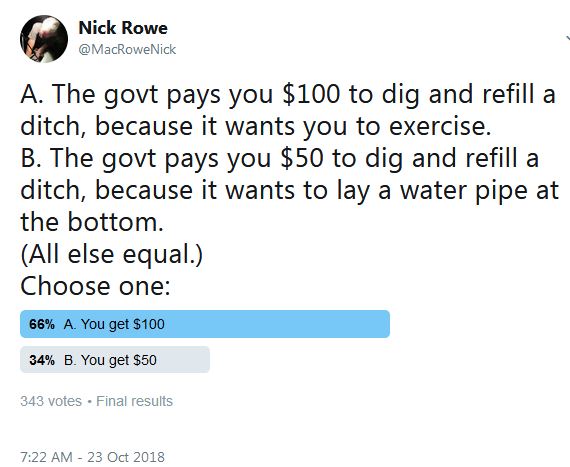
This post is my interpretation of those results.
I recognise all the usual caveats. I am more concerned about bias in the sampling method than in the small size of the sample (because it's not that small). The people who follow me on Twitter (or who follow those who follow me and reTweeted it) are probably richer than average, so less in need of the extra $50, so more likely to choose B. But they are also more likely to be economists, or to "think like economists", and maybe think it might be a trick question, because why would anyone leave $50 on the sidewalk, and if there's no trick then A is the obvious answer. Plus the normal caveat that how people answer any survey might not be the same as their revealed preference in any real choice. (But it's an anonymous survey, so there's no point in signalling a socially-approved answer.)
I would have answered "B" myself. And I wanted to find out how many people thought the same way, and how strongly they felt about it. (I would have switched to "A" if I had been poorer and needed the money more, but I would still have switched back to "B" if the $50 had been raised closer to but still less than $100.)
It's not easy explaining my choice in terms of economists' standard means-end dichotomy. And it wasn't easy constructing a poll question that would get at what I was trying to get at (and I'm not satisfied I've got it right). I find doing something more satisfying when I think it has a purpose than doing the exact same activity when it doesn't have a purpose and so isn't a "real job". And it's not (just) about altruism vs egoism; I get satisfaction out of chopping wood for my fireplace, or my Mother's fireplace, that I don't get out of chopping wood for no reason at all (except exercise), that is separate from any satisfaction I get later from the firewood itself. And I think most people think like me, at least to some extent. And my little poll was intended to try to find out how many people and to what extent.
If I'm right about this, it will matter for labour supply curves. People (or some people) will choose jobs they think need doing over otherwise identical jobs they think don't need doing, unless there's an offsetting wage difference. It will also matter for comparing programs like Basic Income (Negative Income Tax) vs wage subsidies vs job guarantee.
[A few years back I installed a heat pump in my home. The salesman said I would get a subsidy from the Quebec government as an incentive to install a heat pump to reduce electricity consumption. Filling out the forms to collect that subsidy got stuck on my "To Do" list, because it was a pointless job I would get no satisfaction from doing, just to transfer some money.
And I'm recently retired, so I'm still adjusting to a life where I don't really need to do a lot of the things I used to need to do.]
But how could I have asked my question better, to measure what I am trying to measure?


 Worthwhile Canadian Initiative
Interesting thought process. I suppose I thought about it from an employee point of view in terms of not having a choice. I recall voting for A as I concluded that the outcome was exactly the same. Market rates dictate you get paid as in Option B but if someone wants to pay me a $100 for the same work simply because of new policy objective, so be it.
Now, on a personal level, if the government offered me a free gym membership to exercise, I doubt I would use it as I don’t exercise now (and I really need to). And I earn enough income to pay for a membership already.
Perhaps I’m missing something, but I don’t understand why someone would choose B. Why would I want to be compensated less for the same work? Since all other things are equal I assume there are no extra conditions or stipulations.
As far as I understand, the reasons to choose option A would be either because you do not support the government’s exercise initiative and would pay $50 to signal that, or if you think of government funds as essentially yours because you’re a taxpayer and you don’t want them wasted. I think you would have to be really ideological for the former, and superhumanly civic-minded for the latter.
Michael: “As far as I understand, the reasons to choose option A would be either because you do not support the government’s exercise initiative and would pay $50 to signal that, or if you think of government funds as essentially yours because you’re a taxpayer and you don’t want them wasted.”
Was that a typo? Did you mean to say “option B”?
And are you an economist? Because you think like one 😉
I answered B. Mostly because that kind of use of public funds disgusts me, but also as partial protest against being encouraged by government to exercise.
Eric: I was very unsure about how to phrase the poll question. I originally had A as “The govt pays you $100 to dig and refill a ditch, because it wants to give you money”. But then people would think “so why doesn’t it just forget the ditch and just give me money?” So I added “exercise” as a motive. An alternative might be “because it wants to make sure the money only goes to people who need it enough to dig and refill a ditch”. Or maybe “because it had planned to lay a waterpipe, but ran out of pipe to lay, and it was too late to cancel the ditch digging contract.”
But what I’m trying to get at is the difference between labour supply to pointless work vs work that has a purpose. So the “exercise” motive (even though you get the same exercise in both jobs) introduced a bit of a red herring.
My reading of the poll:
(a) Do you want something that’s best for you
(b) Do you want something that’s best for society
I think if you frame the question as asking whether the government pays ‘people’ instead of pays ‘you,’ you’d get very different answers. I.e., asking if someone would prefer
(a) The government pays 10,000 workers $20/hr to dig a ditch and fill it back up as jobs program.
(b) The government pays 10,000 workers $10/hr to dig a ditch and lay a pipe as an infrastructure program.
The choices as given suggest (to me) that there is no social benefit in A, only a private benefit–that is, that nothing of value is being produced.
Given the initial choice, I’d pick B–I get $50 and society gets improved water supply. If the choices were modified to make the social outcomes the same, then there is no cost to picking A instead of B. (But maybe that was your point? That if the social outcome is greater in B some people will choose to sacrifice a larger personal benefit, and if there is the same specified public benefit in A and B, no one has any particular motive for picking B?)
Ted and Don: that is one (very reasonable) way to read the question. It wasn’t precisely what I had in mind though. I personally would find working at job A deathly tedious and unpleasant, simply because I would know it’s a pointless job. But I could get satisfaction and pride out of doing job B. It’s less about altruism than about doing something worthwhile. But I can’t figure out a thought-experiment to get at the distinction.
I can see the intuition – doing work that “matters” is less costly (or has some benefit) than work that doesn’t. I’ve certainly worked on files – infrastructure files – where I derive some satisfaction from the fact that my work will have a lasting impact on society, that I wouldn’t get for other, less meaningful, files (indeed, my kids are tired of me pointing out one infrastructure project every time we pass it, saying “I helped build that”). Not sure I derive enough of a benefit to justify a 50% wage discount, but I could see some discount that would rationalize choosing option B.
Like Ted and Don, I wasn’t sure if you were asking people what they would personally choose or whether you were asking people what they thought the government should do as a matter of public policy. As I have no interest in doing any digging myself, I chose the latter interpretation and also chose B. This was partly for Eric’s reason, but also because I don’t think it’s a good use of resources to do things pointlessly just to do a helicopter drop. During the GFC, I think I heard the (Australian) Treasury Secretary promote option A-type actions over option B-type options on the basis that B would actually increase the gap between potential and actual GDP and this would drive inflation even lower. It seemed pretty warped to me – waste public money apparently just to overcome the ZLB; is this what NK models say?
But yes, framed in the way you intended, I think there’s a lot more personal satisfaction and well-being that comes with doing something that is valued by or helps others. Robert Wiblin has a link to this as his pinned tweet: https://80000hours.org/career-guide/job-satisfaction/
Sorry to spam your comments, Nick. I went back to the Hansard transcript (see below) and think I was unfair to the Secretary (Dr Henry). At the time, I must have only caught the middle comment and missed the later one, where he explains the reason for the rubbish spending was speed rather than deliberately trying to avoid increasing potential GDP for some weird NK reason:
Nick, even if you’re correct (might be) there is going to be a threshold for each person where they will switch over to the higher amount. A good experiment would be to offer many of these options at different $ amounts and find average thresholds for the populace. But I’m pretty sure if it’s a choice between $10,000 or $50 you’ll get a different answer from those that were taking the $50.
A straight $50/$50 choice would determine if you’re onto something; whether work is more satisfying.
Great to see you in action again!
Pete
What exactly are you trying to learn from this poll? Most people are going to take more money for the same effort. Why not? Maybe if you asked people to choose between $50 to dig and fill holes for exercise as opposed to $50 for digging and filling holes for laying a pipeline.
The more interesting poll would be whether the government should pay $20 an hour for digging and filling ditches or $30 an hour with $20 going to the contracting agency and $10 to whoever is actually digging and filling the hole. The latter seems to be the more modern preference with its emphasis on getting the most out of the private sector.
I think Dan Ariely was trying to get at this issue in this paper
https://www.sciencedirect.com/science/article/pii/S0167268108000127
Brett: good find! (But paywalled.)
Kaleberg: OK, but that’s a different question.
Thanks Pete: Yes, presumably there will be a distribution, with different people being indifferent between the two options at different wage differentials. My little survey was just trying to find one point on that distribution.
Rajat: yes, my poll was unclear. I couldn’t think of a better thought-experiment to try to get just one of those interpretations.
Bob: yep. That’s how I feel about it too. (I enjoyed cleaning my (other) computer today. Now the damn thing won’t boot! That does take away my pride, but doesn’t take away the pleasure I got at the time for doing what would otherwise be a boring job because I felt it was productive.)
Free version:
Click to access Legos.pdf
Late to the party; FWIW I’d also take the $50, option B.