Eighteen months ago, I posted a brief history of the federal budget surplus, based on data up to the end of fiscal year 2005-6 – that is, up until the Conservatives took power. At the time, I said:
After ten years of surpluses, we can perhaps breathe a little easier.
The debt is less and less of a burden, and the cost of servicing it is
almost back to what it was in the 1960s. So now that the deficit is not
the burning preoccupation it once was, we can start thinking of other
priorities. Do we … decide to cut
taxes? Or do we … decide to increase
spending?
It would appear that Stephen Harper's government has done both. The Department of Finance will be releasing the final numbers from 2007-8 in a couple of weeks, and I'll revisit the graphs in that brief history post when they come out.
So today I'm going to look at the trends in the monthly numbers on revenues and expenditures, as published in the Fiscal Monitor. These numbers are pretty noisy, especially around the beginning and the ends of the fiscal years, so I've smoothed them by taking 12-month moving sums. Here is what has happened to revenues and expenditures (program spending + debt service charges) since April, 2006:
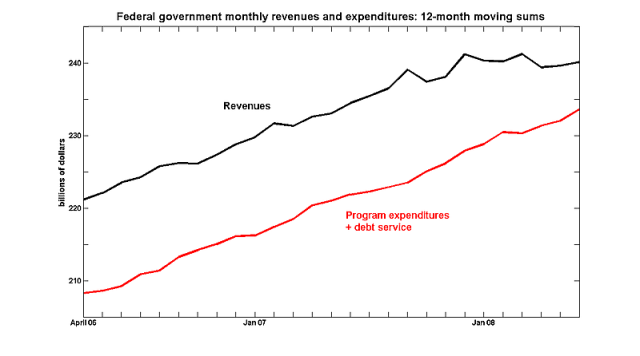
Sometime last fall, federal government revenues started to plateau – the result of slower growth and tax cuts. But program spending continued to grow (debt service charges were either stable or falling during this period). If we were in a mood to indulge in a completely unjustified extrapolation of the trends in that graph – and apparently I am – we'd get something like this:
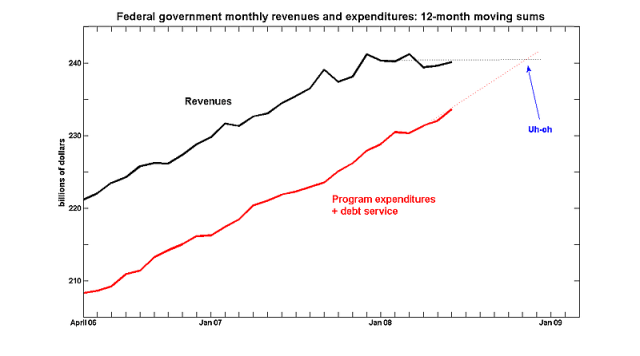
It's been a very long run, but the era of indestructible federal surpluses is over.


 Worthwhile Canadian Initiative
This is striking. From a quick look at the Fiscal Monitor, it seems the trend for program spending (excluding debt charges) would be even more striking – since spending on debt service seems to have actually been dropping recently. If the operating surplus is shrinking faster than the overall surplus, does that have an accelerating effect (since less debt could be repaid, lessening the offset from retiring debt)? It might also be interesting to show program spendng as a share of GDP – constant spending growth divided by slowing GDP growth…
I’m afraid we’re going to have to wait a couple of weeks to get the movements in GDP shares. I’ll be updating as soon as the numbers are published.
Tax cuts (like the recent GST cuts) should cause a one-time drop in the level of tax revenues, but should not affect the future growth rate of tax revenues (I am ignoring supply-side effects, of course). So the recent flattening of the tax revenue curve may just be the result of those tax cuts (plus the effects of the current near-recession), and if so, tax revenue should start growing again at the same rate as it was growing before (unless there are new tax cuts).
Even if the surplus goes to zero (as it may), inflation plus real GDP growth mean nominal GDP grows at around 4%-5%, so the debt/GDP ratio will nevertheless decline at 4%-5% (not 4-5 percentage points) per year, even with zero surplus.
A more controversial point: interest rates on government debt seem to have settled at around 4%. Suppose they stay at around 4%. With the (long-term) growth rate of nominal GDP higher than the nominal rate of interest, we are now in the world where Ponzi schemes are sustainable (Samuelson’s Exact Consumption Loan model, rather than a Barro-Ricardo world). Maybe, just maybe, the debt/GDP ratio is below the efficient level. If so, this may be time to recommend deficits big enough to at least stop the debt/GDP ratio falling any further.
I imagine there are three factors squeezing the surplus: lower taxes; slower GDP growth; and increased spending. Can we calculate the relative contribution of each to the current squeeze? I’m thinking about Krugman’s pushback on Bush’s claims that the US deficit came from war and economy, rather than tax cuts.
Governments should run balanced budgets, no more. Your graph pleases me because I see the Conservatives cutting taxes so that revenues match expenses. Your prediction that they will keep cutting until a deficit is… a prediction.