Alternate title: "Dear Jack Layton: The 1970's called – they want their economic policies back."
After the last election, I entertained the belief that the NDP was finally on track to come up with sensible, reality-based progressive policies and become a serious contender for power. I am sorry to report that this belief was apparently based on the (mistaken) hypothesis that Paul Summerville was prepared to do the hard slogging of dragging NDP economic thought into the 21st century. Summerville is now long gone, and today's announcement from the NDP is a depressing throwback:
New Democrats would:
- Stop unproductive, untargeted and fiscally irresponsible corporate
tax cuts, and target investments instead to stimulate innovation - Invest in low-emission vehicle production
- Train new and displaced workers through a Green Collar Jobs Fund
- Create a Jobs Commissioner to investigate shutdowns
- Develop sector-based industrial strategies
- Stop the export of Canadian jobs overseas through new,
manufacturing-friendly trade policies while adopting a Made-in-Canada
procurement policy for the federal government and its agencies.
New Democrats will commit an average of $2 billion a year to this
program, aiming to directly create 40,000 new manufacturing jobs and
thousands of spin-off jobs while protecting many more.
Okay, training is a worthy cause, but everything else is either pork for the NDP base or just plain stupid – and some are both. $2b/year for 40k jobs works out to forking out $50k/year per job – why exactly is this a good idea?
The Globe article dutifully notes that
Some estimates suggest there have been 400,000 manufacturing jobs lost across Canada since 2002.
This statistic has been repeated so often that I'm sure that there are people who think that there are 400,000 unemployed former manufacturing workers. But that's not the case. As I concluded at the end of my post on Queen's PhD candidate Stephen Tapp's work,
- The transition of employment from manufacturing to other
sectors is going much more smoothly than what we might have predicted
from such a sharp decline in employment: there has been no spike in
layoffs or in unemployment. - The most important factor leading to the decline in employment in
the manufacturing sector is attrition: workers who leave are not being
replaced.
In fact, here's what has happened to the number of unemployed manufacturing sector workers – Cansim series v13682098, for those of you playing along at home – since 2002 (when the appreciating CAD started affecting profitability of manufacturing exports). The monthly data are pretty noisy – only one worker in eight is employed by the manufacturing sector – so I've smoothed them a bit by taking three-month moving averages:
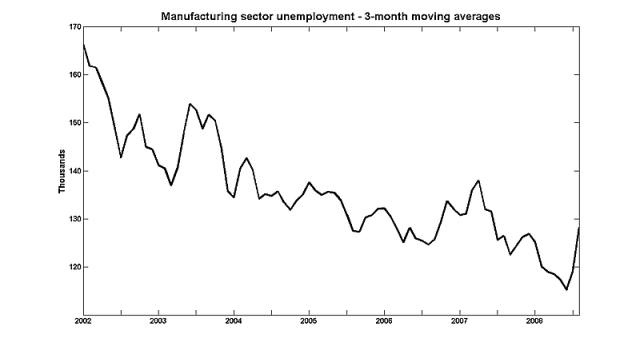
Unemployment in the manufacturing sector has declined by some 50% since 2002 – so why is the NDP throwing so much cash at this one, relatively small sector that is handling its decline surprisingly well?
I'm extremely sympathetic to the idea of helping unemployed workers adapt to changing economic environments. But the overwhelming majority of them have no ties to the manufacturing sector.


 Worthwhile Canadian Initiative
The green sector is one of the fastest growing sectors in the world economy and Canada is missing the boat. Layton just wants to do what has been done for every other new economic sector throughout history; jumpstart it with government cash.
Unemployment is a temporary thing – people pass through it on their way to another job. As Tapper notes, this often leads them to less well-paying jobs in another sector. When they lose/leave that job, they are no longer part of the “manufacturing unemployment” numbers. So, declining manufacturing unemployment doesn’t mean workers in that sector are doing fine. I’m not sure how many of the “vanished jobs” are due to layoffs versus attrition (if you take a layoff rate of about 1.6%/a since 2002, that gives about 212K lost jobs – but I doubt that’s a sensible way to calculate this).
While I take your bigger point that there<s no obvious policy reason to prop up a declining sector, I’m not sure this makes the NDP unique. How different is the NDP approach of targeted tax cuts, sectoral industrial strategies and “manufacturing-friendly trade policies” from the other parties’ platforms (first thing that comes to mind is sector-specific regulation under the Tory climate change plan and sector-specific subsidies/exemptions under the Green Shift)?
are no obvious policy reasons to support a declining sector, is this really unique to the NDP? How different is their approach to the other parties’ platforms? I’m thinking, for example, of sector-specific regulations under the Tory climate change plan and sector-specific subsidies/exemptions under the Green Shift.