The most recent issue of Canadian Public Policy has this short note:
Minimum Wage Increases as an Anti-Poverty Policy in Ontario: In this article, we consider the possibility of alleviating poverty in Ontario through minimum wage increases. Using survey data from 2004 to profile low wage earners and poor households, we find two important results. First, over 80 percent of low wage earners are not members of poor households and, second, over 75 percent of poor households do not have a member who is a low wage earner. We also present simulation results which suggest that, even without any negative employment effects, planned increases in Ontario's minimum wage will lead to virtually no reduction in the level of poverty.
I've blogged on this before, but it's worth doing so again.
The intersection of … low wage earners and members of poor households … is the target group for poverty alleviation through minimum wage increases. According to our calculations, 17.1 percent of all poor individuals or 23.2 percent of all poor households fall into this category. In other words, an increase in the minimum wage to $9.10 per hour in 2004 would have likely have affected less than one-quarter of all poor households. On the other hand, over 80 per cent of the potential beneficiaries of such an increase in the minimum wage do not belong to a poor household.
This is the point to take away. According to their data, something like 10.3% of people live in low-income households, and 10% have low wages. The two groups are roughly the same size, but the overlap is small: only 1.8% are in the intersection:
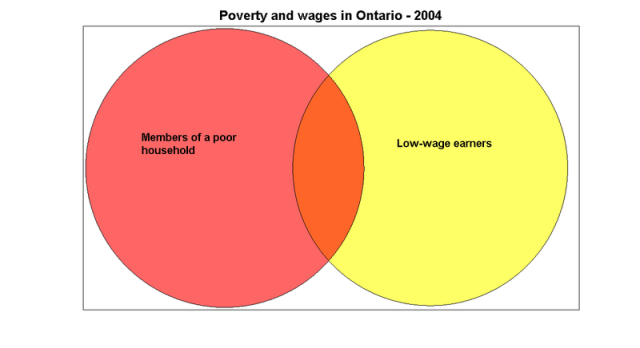
This discrepancy may seem puzzling, until you take into account the fact that almost 90% of low-wage earners are between the ages of 16 and 24 – and most of them do not live in poor households.
Even under the assumption that there are no employment effects, "only 10.66 percent of total wage increases accrue to workers belonging to poor households." Given that 10.3% of households are in poverty, increasing the minimum wage is only slightly more effective as an anti-poverty measure as would be distributing money at random across households.
If employment effects are taken into account, the story gets worse. The gains from higher wages are so small that available estimates for labour demand elasticities suggest that there is a significant risk that increasing the minimum wage will increase poverty.
It would be a good thing if those who were concerned with reducing poverty could stop wasting time on the minimum wage file. As anti-poverty measures go, increasing the minimum wage is pointless at best.


 Worthwhile Canadian Initiative
And that’s how we know the Earth is shaped like a banana.
Come on, Stephen, this is blithering idiocy. Household income has little relation to individual income. Let me give you a perfect example why it doesn’t.
When I first moved out of my parents house, I shared an apartment with two high school buddies. I was making a decent buck working construction and one of the other guys was making a decent buck as the manager of a retail outlet. The third guy however, was making minimum wage stocking shelves at a grocery store. According to this blithering idiocy he wasn’t living in poverty because his two roommates who were doing alright raised the household income above the poverty level.
The modern household is no longer simply mom, dad and 2.4 kids pooling their incomes into one pile. It is often a collection of individuals living together out of necessity and because of that, the overall income of the household has little bearing on the income of the individuals within it.
If employment effects are taken into account, the story gets worse.
There have been hundreds of minimum wage increases and none of them have ever affected employment. McDonalds for example, still employs the same number of people in each of their restaurants as they did 5 minimum wage increases ago.
Its not clear to me where the blithering idiocy lies here. The particular example given by the commentator is atypical. Household income is the best measure of the standard of living of the people living in a house. Of course we know there may be imperfect sharing – maybe your flat-mates don’t like you for some reason- but in general the evidence is that people in well-off households enjoy a relatively well-off standard of living.
As for employment effects, the overwhelming evidence is that increases in the cost of labour reduce the demand for labour. For the same reason, increases in the minimum wage (MW) tend to reduce employment too. It depends on the bite: if the MW is below the market wage then it may well have no effect of course. If McDonalds are paying 6 an hour and the MW is increased from 4 to 5 then big deal. That is not an argument for OR against the MW. Well designed studies for the most part show the expected negative employment effects. There may be good reasons for a MW but an anti-poverty measure is not one of them & there are usually far better instruments available to governments to achieve this end.
My goodness Bobby Mac where are your manners. Household income has little relation to individual income? OK… they are different metrics. Why should they? Nobody claimed that household income was a perfect measure of the economic resources available to an individual, but it seems like a decent proxy.
Are you implying individual income is a better proxy for the economic welfare of Canadians than household income is? Perhaps, but it seems unlikely since your counterexample is more of an exception than the norm. By measures of individual income a stay at home mom with a wealthy husband is worse off than a single mom working to support her child.
Perhaps you are implying that some other proxy for economic resources available to an individual is superior to household income? If so please share.
“There have been hundreds of minimum wage increases and none of them have ever affected employment.”
Wow. Why is anyone taking this man’s preposterous comments seriously? No minimum wage increase has had an effect on employment?
http://cafehayek.com/2007/01/the_empirical_l.html
If you think that the laws of supply and demand don’t apply to labour, I suggest demanding a 300% pay increase from your employer. Or perhaps opening a plastic surgery clinic where you offer to pay the surgeons the minimum wage. Since there is no relationship between supply and demand in fixing in the price of labour, you’ll have Harvard med school alumni lining up to take the job, right?
“McDonalds for example, still employs the same number of people in each of their restaurants as they did 5 minimum wage increases ago.”
It’s rare that you see someone make a claim that is not only wrong but plainly, on its face, utterly ridiculous. No McDonalds restaurant has increased or decreased its number of employees over the past five increases in the minimum wage? And never mind the question of which minimum wage we’re talking about, given that there are 10 provinces in this country.
There must be some adult arguments in favour of the minimum wage, but that ain’t them.
You’ve summarized the issues well in this blog and your previous blog, where your final points were:
* When minimum wages are ‘low’ – say, less than 40% of the average hourly wage – then moderate increases won’t have a significant short-run effect on employment.
* When minimum wages are around 45% of the average, they significantly reduce employment.
* No-one has been able to find any evidence to suggest that increasing the minimum wage has a measurable effect on reducing poverty.
You also point out that an increase in the minimum wage that doesn’t affect employment will have a progressive redistributional effect. That’s a good thing …, even if it’s measurable effect is small.
Without a doubt there will be progressive redistribution of income to lower wage earners. While you raise the issue that increasing the minimum wage won’t directly affect many low-wage earners (such as the McDonald’s worker already earning more than the minimum wage), one would think that there will be knock-on effects where employees earning wages just above the minimum wage will subsequently get their own raises to their pay. For instance, in your example, your McDonald’s worker was employed at McDonald’s in part because they were receiving 1-2 dollars more than the minimum wage — if minimum wage was raised, McDonald’s would be pressured to maintain the wage differential.
Undoubtedly it is difficult to isolate these knock-on effects and link them to the minimum wage increases. But it is clear that there will be a progressive redistribution of income to lower wage earners if the minimum wage is raised. And that has to have some beneficial effect on poverty. And that is a good thing.
The real question is whether increasing the minimum wage will have significant negative short run effects on employment. If the effect is not “significant”, then aren’t the potential beneficial effects of a minimum wage raise on poverty, even if they are difficult to measure, worth it?
As for employment effects, the overwhelming evidence is that increases in the cost of labour reduce the demand for labour.
That’s absolute hogwash. Considering the cost of labour has increased steadily since, like forever, there’d be no jobs left by now if it were even remotely true.
Are you implying individual income is a better proxy for the economic welfare of Canadians than household income is?
No, but it is a better proxy for the economic welfare of Canadian workers than household income is.
Robert McClelland, I want to ask the following question: what is the definition of ‘household’ used in the post above?
You seem to be assuming that “household income” is the income of people who are living together in the same house (e.g. a couple of roommate would form a “household”). Instead, I think that “household income” is used in its tax sense, e.g. a household doesn’t refer to a phyiscal residence, but instead to people who file tax together such as spouses, their children who they get deductions for, their parents and grandparents, etc. I hypothesize that the definition of household isn’t people who live together, but instead people who file together – which is significant because the latter definition of household implies income sharing amongst the household members whilst yours doesn’t.
“As anti-poverty measures go, increasing the minimum wage is pointless at best.”
So what would be a good anti-poverty measure? It would be a good thing if those who were not concerned with reducing poverty could stop wasting time criticizing those who are.
How about giving money to poor people? Boosting the Earned Income Tax Credit, or the GST credit, or start work on a Guaranteed Annual Income.
I was going to ask Joshua’s question. He beat me to it. It’s key.
Where’s Frances? This is a question of the definition of “household”, but also a question of the extent to which a “household” shares income.
I was surprised to see that the correlation between low wage and living in poor household was so low. With approx 10% in each category, it would be 1% in the intersection of the two sets if they were totally independent, and 10% if perfectly correlated. 1.8% is getting close to independent.
So, why are poor households poor, if it’s not low wages? Presumably it’s unemployment, not in the labour force, retired, disabled?
The data would likely come from Statistics Canada’s “Survey of Labour and Income Dynamics”. I tried to poke around their description of that survey and it appears that the definition of household used in it IS a physical residence. The survey apparently includes data on intra-household income sharing.
Yes, the data do come from the SLID.
“That’s absolute hogwash. Considering the cost of labour has increased steadily since, like forever, there’d be no jobs left by now if it were even remotely true.”
Robert, I want you to stop and think for a second. You are literally saying that the laws of supply and demand do not apply to the provision of labour. If you really believe that, as I said, ask your employer for a 300% raise and see what happens.
“It would be a good thing if those who were not concerned with reducing poverty could stop wasting time criticizing those who are.”
So intentions are all that matter? Results are irrelevant? Throwing poor people out of work is OK if you’re trying to help them?
You are literally saying that the laws of supply and demand do not apply to the provision of labour.
They don’t really apply. If you need 10 employees you need 10–not 9 or 11–employees regardless of the supply or cost of labour. The only time supply and demand generally comes into play is in determining wages for specialized labour where the demand exceeds the supply.
Robert-
What about where labour is competing with mechanisation (10 employees or 5 and a machine)? Or where labour here is competing with outsourcing (10 employees or 5 and 5 in India)?
Or where the business simply goes under, or doesn’t get started at all because its labour costs are too high?
If a business goes under or is prevented from starting because of minimum wage then it was never a viable business to begin with.
Right, so if we disregard all marginal jobs, then labour demand is price insensitive.
That’s as meaningless as it is obvious.
“They don’t really apply. If you need 10 employees you need 10–not 9 or 11–employees regardless of the supply or cost of labour. The only time supply and demand generally comes into play is in determining wages for specialized labour where the demand exceeds the supply.”
Robert, this is an insane statement. No one needs 10, or 9, or 11, or any employees. Economically speaking, labour is just one more input in production. In simple terms, if you can create $10 of wealth for your business by hiring someone at $9 an hour, you’ll do it. If the guy who costs you $9 an hour is only going to bring in an extra $8 an hour, you won’t hire him. Of course you can’t calculate what the marginal gains will be down to the penny, but you can estimate them, just as you would for any input.
If you really believe what you wrote up there, then I’m afraid you’re an economic illiterate. I don’t mean to offend, but your assertion is the economic equivalent of “thunder happens because the gods are angry at us.”
And for the third time, please, ask your both for an enormous raise tomorrow morning. See how (s)he reacts. I doubt the response will be, “well, I need exactly the number of employees that I have now, so I have no choice but to give you more money.”
“If a business goes under or is prevented from starting because of minimum wage then it was never a viable business to begin with.”
I really don’t know what to say to a statement like this. It could only be written by someone who doesn’t have the slightest grasp of elementary economic principles. I don’t even mean the kind that you learn in an economics course, I mean the kind you pick up on by engaging in basic economic behaviour like buying and selling things.
“Right, so if we disregard all marginal jobs, then labour demand is price insensitive.”
That pretty much sums it up, MattM.
That should read, “ask your BOSS”
Are either of you still talking about minimum wage?
“Are either of you still talking about minimum wage?”
I’m not sure to whom you’re speaking, but minimum wage is a price floor on labour. Which means that our discussion of whether the law of supply and demand applies is very relevant.
As with any good or service, a price floor leads to oversupply. In the case of labour, “oversupply” means unemployment.
“That’s absolute hogwash. Considering the cost of labour has increased steadily since, like forever, there’d be no jobs left by now if it were even remotely true.”
Yes, but only because we’ve managed to create more productive jobs as a whole, you blithering idiot. Minimum wage has gone up slower than the average level of growth in productivity. If China implemented a minimum wage of $50, do you think people would bother move their factories there? Their economy would tank because they’re not yet at the level where they can be as productive as we are.
“If a business goes under or is prevented from starting because of minimum wage then it was never a viable business to begin with.”
Minimum wage has removed the garment industry from the developed world, for example. This is a viable industry, but it can’t compete anymore.
“They don’t really apply. If you need 10 employees you need 10–not 9 or 11–employees regardless of the supply or cost of labour. The only time supply and demand generally comes into play is in determining wages for specialized labour where the demand exceeds the supply.”
Yes, and only if they can still sell the service/product that the heightened cost of labour produces. Again, we haven’t killed the garment industry, just exported it because we can’t compete at $9/hour. New arrivals to this country now have a harder time making a fresh start because of it. As much as I’d like them to be successful when they come here, we can’t just pay them as much as we already make when they don’t have the same levels of experience as we do.
If you need 10 employees, but can’t afford them then you don’t have a business. If there are people willing to work for less, but are not allowed you’ve just killed their jobs.
Do you really think it doesn’t matter? Do you really think that if the government made minimum wage $40/hour that McDonnalds would still be as cheap and people would still flock there and they wouldn’t go out of business if they didn’t figure out how to do the same level of work with less people?
Interesting and related post and paper reference (bonus: the paper is readable by mere mortals!) at baselinescenario:
If financiers can manage to extract rents with their pay, then I suppose it can work in the other direction too.
What problem is minimum wage solving? If someone is being paid less than MP, then either fix the labour market so they are, or give them money to compensate (preferably by taxing the employer). And if someone is being paid MP and we decide it’s too little to live a humane existence, then why not just give them money and avoid creating unnecessary unemployment?
The main problem I see with the second scenario is that it would tend to stifle innovation by subsidizing labour that would otherwise be automated away or simply eliminated as uneconomical. On the other hand, there are jobs (like child care?, teachers?) that are impossible to automate (one hopes) and which demonstrate diseconomies of scale (unless we go all Brave New World) and other inconvenient characteristics, but we might decide as a society to subsidies them anyway.
Come to think of it, I think Adam made more or less this point (no doubt more succinctly) the last time this topic came up.
Where on Earth are Profs. Gordon and Rowe? When someone spouts such economically illiterate nonsense on your economics blog, shouldn’t you correct him? Think of it as a teachable moment. Please!
Minimum wage reduces the exploitation of workers who do not have adequate economic power to defend themselves.
The suggestion to “fix the labour market” is a little vague. I suppose I could support a no minimum wage economy if it was an everybody belongs to a union economy.
I would support raising the minimum wage to the point that total wages paid to minimum wage workers would fall (due to job losses) if it was raised any more. Use income support mechanisms to deal with the resulting unemployed. This would drive a high wage – high productivity economy.
With respect to this particular study (I can’t get to it), what is the definition of low wage? Exactly equal to minimum wage?
I found a draft study with data from 2001
Click to access fortin.pdf
Hourly wage
Working poor
Average: 11.81$/hour
Median: 9.61$/hour
Working not poor
Average: 19.20$/hour
Median: 17.46$/hour
It looks like the working poor are mostly either working not enough hours or are supporting large households. However, it would certainly appear likely that the number of poor households helped by a minimum wage increase is underestimated by the cited study.
“.. you blithering idiot ..”
Please, can we keep it civil.
“Are either of you still talking about minimum wage?”
?
We’re discussing your statement that a minimum wage has no effect on labour demand. We have provided you with multiple margins at which a legislated floor on the price of labour can restrict the labour demand of employers:
1) Automation subsituting for labour
2) Foreign labour substituting for domestic labour
3) Simple restriction of production
Your only response has been to deny that marginal labour demand even exists in any meaningful amount. Where is your empirical evidence for the following extraordinary claim:
“There have been hundreds of minimum wage increases and none of them have ever affected employment.”
?
Also, you seem to have blithely ignored the secular increase of labour productivity in making the following statement:
“Considering the cost of labour has increased steadily since, like forever, there’d be no jobs left by now if it were even remotely true.”
There is no magic formula whereby employers can simply be made to pay their employees more without any effect on the quantity of labour they purchase. You can argue about the magnitude of such an effect, but the only way to do this is with empirical determinations of the price elasticity of labour demand.
Jim: The suggestion to “fix the labour market” is a little vague
Granted. But just because something is hard or not obvious is not a good reason to go do something that at best is going to do nothing, and at worst is going to make more people poor and unemployed.
“Minimum wage reduces the exploitation of workers who do not have adequate economic power to defend themselves.”
Yeah, I get that. And I agree power imbalance is a problem. But I don’t think minimum wage helps. I think of it with an example: Poverty level for a family of four in Toronto is just under $40K a year. Imagine an immigrant family of four: two preschool kids, mom at home, dad working. Dad is at a serious disadvantage as an immigrant and can only find work at $10/hr, despite being a professional in his country of origin. Even full time, $10/hr is WAY below poverty level. Minimum wage does nothing to help. And if minimum wage is set above the MP of a job he can get hired to do (power imbalance and all), then he ends-up unemployed. Who does that help?
You lost me on the data you cite. The hourly wages for working poor are above minimum wage for 2001, so the minimum wage is doing nothing – it’s set below the equilibrium wage so it’s not creating a wedge, nor is making them any less poor. But if it was set above the wages cited, it would just make those people poor AND unemployed.
Adam: “Where on Earth are Profs. Gordon and Rowe? ” Watching you guys handle it 😉
But there is one case where a (small) increase in the minimum wage will not increase unemployment (and might even increase employment): monopsony in the labour market. Not sure of its empirical relevance in Canada though. Monopsony (wages below competitive equilibrium) implies that employers would like to hire more workers at the existing wage, but can’t find any. Monopoly (wages above competitive equilibrium) implies that workers would like to sell more labour at the existing wage, but can’t find jobs. My sense is that most of the time most of the labour market looks a bit more like monopoly than monopsony.
By the way, I’m not particularly surprised that the intersection of minimum wage and poor families is as small as it is. In my experience, even in workplaces where the average wage is fairly low, the only people making within a few dollars of the minimum wage had been working there for less than a year, and almost all of them were students (I was in this group).
A few months or a year’s experience is generally worth 2 or 3 dollars an hour above minimum wage to an employer.
MattM hit a critical point. The rest of you seem not to have direct experience with this part of the labour market. It’s like looking at an interest rate that is above prime and assuming if prime changes that rate will stay the same. Wage rates in this part of the market are implicitly set as minimum wage plus a premium. So when minimum wages rise, so do all of the others. MattM points out why. If you are paying at minimum wage your workforce is volatile. Everybody knows they will not take a pay cut by moving to another job. So employers start people at minimum wage and pay as small a premium as they can to keep people they want. This mostly leaves workers exploited, but less so as minimum wage rises.
Patrick, that example is unlikely. Immigrant family? Mom is working. Dad is way over 40 hrs/week. They are also very likely coping with poverty by sharing accomodation. TDSB has trouble with immigrant high schoolers working 40 hr weeks because that’s part time for their families.
But the more significant point is the argument above.
I have no idea how you got what you said from what I said.
What part of the argument do you not understand?
“Patrick, that example is unlikely.”
Agreed. It’s practically impossible because they can’t live on the wage. Regardless of any value judgement about the situation you describe, the economic reality remains: if minimum wage is set above the equilibrium wage, then our protagonists will likely be unemployed. That helps nobody. If we decide that their income is insufficient or their living conditions intolerable, I’d rather they keep their jobs and just give them money. My hope would be that dad would choose to work 1 job instead of 2 and spent time being a parent, but they may just sock it away in an RESP for the kids. Either way, I’m cool with it. It’s better than having them go on EI and/or welfare.
Which equilibrium wage?
Every place of employment has a different equilibrium wage (BTW nobody knows what it is, because nobody knows what their demand curve looks like). So whatever the minimum wage is set at, somebody is unemployed, and somebody else is exploited. My bias is to reduce exploitation because there are a lot more of them and the other economic effects of doing that (notably flattening the income/power distribution) are a good thing.
So when minimum wages rise, so do all of the others.
You’ve made this point several times. I’ve never, ever seen any empirical evidence to support this claim – and I’ve looked. I think the burden of proof is on you to find some.
And then you’re going to have to make the link to how the measure affects poverty.
Well, you have actually convinced me that the direct effects of minimum wages on poverty are small, since a large chunk of the working poor lack hours of work.
As far as providing evidence that minimum wage increases drive other increases, yes, evidence would be a good thing. Could you tell me where you looked?
Your posts on the employment effects keep using words like significant, what are the numbers? How big are the effects found?
My current take on this debate is that we would agree on setting the minimum wage at 45% of the average industrial wage, rather than a fixed nominal amount.
The realpolitik amount is the level at which the number of people that appreciate the increase equals the number of people that are pissed off by losing their jobs.
Of course, another argument is that only some low wage jobs are actually minimum wage. In BC, for example, the minimum wage hasn’t changed for years – but a significant amount of those low wage jobs migrated past the minimum wage.
The realpolitik amount is the level at which the number of people that appreciate the increase equals the number of people that are pissed off by losing their jobs.
I think you’re forgetting two groups here: the employers who are pissed off because they have to pay more and make fewer profits, and the consumers who are pissed off because they have to pay more and have less consumer surplus. Minimum wage increases hurt more than just the people who lose their jobs.
That’s another thing – even if the net wage gain (increase in wage minus the loss in employment) is positive, you have to ask where that extra money is coming from.
At least some of it is coming from the economic rents that would otherwise accrue to employers. What’s the evidence on how much that is? Do any of the studies showing employment drop also examine price increases?
Not all profit is economic rent.
And no, pretty much no-one traces this out in the data. That’d take a general equilibrium model, and those are brutal to estimate.
Jim: For my part, I’m not disagreeing that there are labour market failures. Some workers are certainly paid less than marginal product, some workers are paid more than marginal product. And some workers, regardless of whether they are paid ‘fairly’ or not, do not earn enough to provide a humane existence for themselves and their dependents. All these situations are, in my view, problems. All I’m saying is that minimum wage does a lousy job of addressing any of these issues, and it creates a new problem: more unemployment than would exist otherwise. If I’m going to try to convince people that they need to pay higher taxes or higher prices then I’d at least like to be able to tell them that their money is likely to do some good.
“Five Myths About Our Land of Opportunity”
http://www.brookings.edu/opinions/2009/1101_opportunity_sawhill_haskins.aspx?rssid=LatestFromBrookings
#4 is really interesting. I wonder if it applies in Canada.
Yeah, a really hard nut to crack is getting teenagers to finish school and to avoid having children before they’re ready. I’ve got no great insight there, except a preference to go with whatever works, and to not insist on points for style.
Some evidence.
From Newfoundland
The Employers Council