The minimum wage in Ontario went up today, and Jim Stanford thinks that it's cause for celebration. I'm not sure why. I'm guessing that he – as does the editorial board of the Toronto Star – believes that a higher minimum wage will help reduce poverty.
Sadly, this belief is mistaken. As I noted earlier when discussing this study, recent research using data from Ontario finds that the intersection between those in poverty and those who earn low wages is remarkably small:
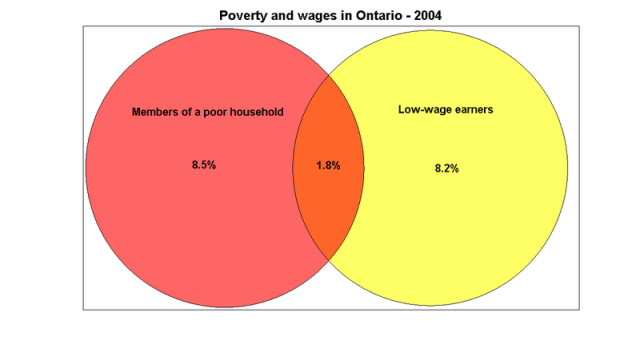
From that previous post:
Even under the assumption that there are no employment effects, "only 10.66 percent of total wage increases accrue to workers belonging to poor households." Given that 10.3% of households are in poverty, increasing the minimum wage is only slightly more effective as an anti-poverty measure as would be distributing money at random across households.
Not really cause for celebration, is it? I've said it before, and I'll say it again: if you want to help people in poverty, give them money.


 Worthwhile Canadian Initiative
Isn’t the question, what percentage of poor households earn the minimum wage? I agree that if you want to help the poor give them money. The easiest way of doing that is giving everyone a minimum amount of money and taxing back that above the minimum. The reason this is done through wages rather than directly is to encourage productive work. The down side is it misses those unable to do so. No solution is without its problems. Providing money without a minimum wage would discourage work. A negative income tax would be more efficient in distribution but less efficient in collection. Encouraging lower productivity work would encourage employment but discourage innovation.
Jim Stanford thinks that it’s cause for celebration. I’m not sure why. I’m guessing that he . . .
If you are unsure, why don’t you just read his column to find out? There’s no need to guess.
I can think of three scenarios, 1) there are no gains only losses, those with lower productivity lose their jobs, 2) employers are labor short and forced to pay them more than their productivity, there are gains for workers but costs to employers whether passed on to customers or not, or 3) employers are labor short and invest to raise their productivity, gains all around. Which weight do you place on these scenarios?
I’m poor. Since June 2007. I became unemployed in July 2006 and when I couldn’t get another job it took a year to exaust my financial supports (EI, Savings, Credit). What Stephen Gordon advocates is to give me money. I need more than money. I need money AND a job. I don’t imagine there is any political party that could guarantee both at once should they come to power. That’s why the gov’t doesn’t give the money you speak of. It’s not enough. I’m a lost cause and so is my child. The poor are always with us. I like that Dr. Suess book ‘The Lorax’. Unless. Lift me.
I found this particularly funny:
“This “trickle up” effect helps explain recent increases in real average hourly wages in Canada. In the three years ending in 2009, average wages (after adjusting for inflation) grew by 4 per cent. That’s not a lot – but it’s the best wage performance for Canadian workers since the 1970s. The unheralded revitalization of minimum wage policy is a big reason why.”
If we really want to raise real average hourly wages, we should fire anyone making less than $50 an hour. Then the real average hourly wage will be greater than $50, by definition.
The labor force participation rate fell in Ontario by 0.6 percentage points between Feb 2009 and Feb 2010. If those individuals in the labor force who stopped working had below-average wages, knocking them out of the labor force would increase average wages.
Back when I taught econometrics I’d make my students read ‘How to Lie With Statistics’ as a guide on what ‘not to do’ (http://www.amazon.com/How-Lie-Statistics-Darrell-Huff/dp/0393310728). Stanford’s article would make a good case study on how selective use of statistics can mislead.
Karen, presumably if we gave you money, and lowered the minimum wage, there would be an employer out there willing to take a chance on you for a lower wage rate. Since we are giving you money anyway, your wage earnings are not for survival but improving your standard of living.
Mike, do you think Stanford is being duplicitous or stupid?
“Mike, do you think Stanford is being duplicitous or stupid?”
I think Stanford is arguing on behalf of his favoured policy by presenting any data points that support his position and ignoring any that do not. I’m not suggesting that he shouldn’t do that – it just means that he’s acting as an advocate, not as an analyst.
Anyhow, you can call that what you will.
I will say this though – I’m impressed that anyone can suggest with a straight face that 2007-2009 was a great time to be a worker in Ontario.
Since I place little emphasis on scenario 2, I think the argument you should be making is a higher minimum wage will mean more unemployment among the unskilled, fortunately that falls mostly on the non-poor. Still, there is little evidence lower real wages (due to inflation) increase unskilled employment. Mostly, it just causes people to leave or not enter the workforce, but this is likely due to the minimum being below the market wage in substantial portions of the country.
First, all wages are dependent on the entry level. Just because most poor aren’t on minimum wage, doesn’t mean that their wages wouldn’t be affected.
Second, many remain on welfare because taking a job doesn’t give them an increase to their income.
Thirdly, Ontario industries have been severely crippled by the global deflation, and yet Ontario’s economy has remained relatively strong, and I say that this is directly because of the annual increases to minimum wage.
“Thirdly, Ontario industries have been severely crippled by the global deflation, and yet Ontario’s economy has remained relatively strong, and I say that this is directly because of the annual increases to minimum wage.”
It could also be due to the fact that the Leafs stopped making the playoffs since the lockout, so productivity isn’t being reduced in April-May, like it would if they were making a long run.
“Thirdly, Ontario industries have been severely crippled by the global deflation, and yet Ontario’s economy has remained relatively strong, and I say that this is directly because of the annual increases to minimum wage.”
That’s just a hunch–not particularly useful and definitely not something to base policy on.
No it is not a hunch. All business depends on consumer spending, and all consumer spending is dependent on consumer income. It is not an accident that the regions with higher minimum wages have a much more robust economy. Your theory is not supported by evidence, and therefore it is your theory which is a hunch, regardless how many educated idiots ascribe to it.
Allan, tossing insults doesn’t prove your point.
All business depends on consumer spending, and all consumer spending is dependent on consumer income.
Where is that extra income coming from?
This has always confused me. What’s making poor households poor? Low wages that just happen to be above minimum wage, or unemployment/no wage income?
“Where is that extra income coming from?”
It comes from increased velocity. The poor spend their money, cleaning out their bank account before the next check arrives, while the middle and upper class tend to hang on to their money for up to a year before rebalancing their investment purchases. The faster the money gets from the business to the consumer and back to the business, the more transactions the same dollar can support. By legislating that the poorest paid worker gets at least so much, the government is in fact supporting the entire economy, while other initiatives that the government takes to support the economy like bailing out big business and supporting the growth of international finance and trade has zero effect at best.
I don’t see how investments would necessarily slow velocity. The whole point of investment & financial intermediation (when it works) is to keep moving money that would otherwise sit idle.
“The whole point of investment & financial intermediation (when it works) is to keep moving money that would otherwise sit idle.”
No, the whole point is so the rich can get richer! The talking point of the propaganda is to increase the velocity, but you can’t increase the velocity better than to get the money quickly into the hands of the poorest paid worker. That money does a full cycle in two weeks. Most money cycles in a month with rents and monthly bills. Government money and new investment money often doesn’t do a full cycle for a year. Conventional economics has many many things completely backwards.
Any evidence that government money doesn’t cycle faster than once per year? The only way that could be is if the government (feds) has two hundred billion in cash on their balance sheet, which they do not. They receive remittances monthly or quarterly from employers, which they use to pay rent, bills and payroll for civil servants.
“Any evidence that government money doesn’t cycle faster than once per year?”
I never said that government money only cycles once a year, but often between the time the funding is secured for the budget and the money is spent is a whole year. Certainly not always. Most money, as I said, circulates once a month, and you cannot better the velocity of every two weeks as you get with minimum wage. When governments try to improve the economy with its spending, it can at best have a net zero impact, and I don’t think that it does.
Considering many minimum wage earners are teenagers who might be saving money for a car, tuition, etc. I don’t think we can assume that minimum wage earners spend the wages on average within two weeks. You haven’t provided any empirical evidence to support your story. It’s just hand-waving at this point.
rotflmao! You flaunt your charts and ignore anything that doesn’t fit your ethic, presenting your theory that runs contrary to all emperical evidence as if it was something proven. You guys amaze me!
“Thirdly, Ontario industries have been severely crippled by the global deflation, and yet Ontario’s economy has remained relatively strong, and I say that this is directly because of the annual increases to minimum wage.”
Ive just seen a couple of years of my teenage son working minimum wage. In spite of my continual lecturing at him to save his money, he never could. He just got his first good job. I am certainly hoping that he manages to save some of that. And no, he doesn’t have my car since he wrote it off a couple of years ago.
Well, it is good that the minimal wage in Ontario increased. But you are right, it is not a reason for celebration. At first glance, many might see a direct correlation between the minimum wage and poverty – it seems logical too. The truth is a little different, though. Thanks a lot for the graph which shows it very well.
Best regards,
Elli
OMG. This crap is insidious.
Allan, read the post again. Is there anything there that is wrong?
Raging against the facts is also pointless.
Allan said
“rotflmao! You flaunt your charts and ignore anything that doesn’t fit your ethic, presenting your theory that runs contrary to all emperical evidence as if it was something proven. You guys amaze me!”
First, where is all this empirical evidence? I am genuinely curious to see the relationship between incomes and velocity in Canada.
Second, and more importantly, I think you are missing the point of this post. The post was not about the the effect of consumer spending on growth, or consumer spending from the bottom of the income distribution on growth. The post was about minimum wage being an inefficient mechanism for the reduction of poverty/ helping low income families.
All this talk of velocity strikes me as beside the point. Is there any standard (as in “it’s in the text book”) theoretical reason to believe that velocity has any effect on real wages? Besides, changes in V happen for some reason (i.e. recessions, changes in interest rates). Seems to me that Stephen’s advice to give money to poor people would probably increase V … but so what? The point is to find policies that effectively and permanently decrease poverty and it’s associated misery and waste. Who cares about the side effect on some esoteric monetarist accounting identity.
The velocity point assumes in a recession there are already full-employment spending behaviours, you buy beeswax candles and employ a beekeeper if not laidoff; the shortfall is just consumer demand. I reject this specifically because of our carbon footprint (in general some dollars are better than others). A moderate, not counting human extinction or anarchy fat-tails carbon price would see oil sands profit go to zero. It is better for our species if our Canadian economy and all tar/coal/LNG goes into Great Depression; you’d want to formulate mature velocity economic sciences for actors who aren’t on a deadend trajectory. Wahhabi interpretation of Islam is a blueprint to wait for an inevitable ice-age to wipe us out. Buddhists wait to be conquered. And Neocons like us Canadians unleash AGW anarchy. So no, let’s not talk about how to consume more tar unless Harper/MSM honestly informs: AB/GOP ideology kills humanity off.
The poverty economic point is that you/dependants lose human capital when you are malnurished/depressed/resentful after being unemployed. I guess as long as habits are healthy Stephen is right and give away the money. Why don’t we have food stamps in Canada?
I’ve a quibble with the definition of “household” in the chart. It shouldn’t matter who you live with whether or not you can access safety nets. “Nuclear Family” is the definition that is meant. If I’m renting from middle class strangers I’m still poor and I still need food however my home is accounted for tax and safety net purposes.
“I’ve a quibble with the definition of “household” in the chart. It shouldn’t matter who you live with whether or not you can access safety nets. “Nuclear Family” is the definition that is meant. If I’m renting from middle class strangers I’m still poor and I still need food however my home is accounted for tax and safety net purposes.”
I don’t know much about the definitions of a “family unit” but would that not be offset by all of the broke students living on their own but still with access to a safety net?
As a non economist not immersed in the vernacular, I find it important to check the sources for the definitions of “poor” and “low-wage”. Unfortunately, the source document in Canadian Public Policy is not freely available.
So, my first question is does “low wage” = minimum wage? I suspect low wage includes min. wage, and hourly rates above it to some cut-off level. If they are not the same, then of interest to me would be a similar Venn diagram with min. wage earners overlapping with poor household members. It might tell a different story.
Got any stats for what percentage of workers in Ontario earn min. wage?
I posted this
“First, all wages are dependent on the entry level. Just because most poor aren’t on minimum wage, doesn’t mean that their wages wouldn’t be affected.
Second, many remain on welfare because taking a job doesn’t give them an increase to their income.
Thirdly, Ontario industries have been severely crippled by the global deflation, and yet Ontario’s economy has remained relatively strong, and I say that this is directly because of the annual increases to minimum wage.”
No one made comment on my first two points, even though they are very applicable to the subject of this thread. The third point was in answer to other things that had been said, and was the “evidence” that people wanted explanation for.
The commonly held theory is that minimum wage hikes are bad for the economy. I hold the opposite point of view, and feel that the empirical evidence is with my side. In explaining how the economy grows strongly when the poorest paid worker gets a raise, talking about velocity is most pertinent, even though it is not something that is well documented. Causality is the theory that well explains the evidence of correlations. Correlations should never be simply dismissed with a “ceteris paribus”
Now Philip seems to be saying that we shouldn’t better the conditions of the poor so that we aren’t as a society as hard on the environment. Again I would take a position on the opposite.
It is not people who are hard on the environment, but industries. We do not need more stuff produced at lower prices! We do not need big companies swallowing little companies in the name of efficiency. All we need are jobs that pay a fair wage! We could double the minimum wage, and then cut the work week to 24 hours through legislation. We could reverse the amalgamation trend with simple sliding rates on business taxes. There are always more than enough ways to spend your money, and there are always a lack of ways to make your money. We do not need more production, but a more fair distribution, and the cornerstone of a fair distribution must be the minimum wage.
They were evaluating the increase in the minimum wage between 2004 and 2010; the people whose wages in 2004 were such that they’d be affected by the change – between the old minimum wage and the new one – were classified as ‘low wage’.
Some numbers for who earns exactly the minimum wage are here
Canuck, I’d venture that some students have access to the net and some don’t, depending upon Province especially. In BC (winter +5C) probably access if could wait three weeks homeless (ie. weaker souls no longer students). In MB (winter -30c), you have access in teens but are told later in life to find work regardless if you can, unless you get yourself knocked up or incapacitated. ON (winter -10C) you are denied welfare if you are lucky enough to live in a shelter and accepted if you are crashed on Queen St…
My point is about 1/2 of people that call a welfare # get accepted, not 100%. Students are younger so more likely to be accepted as too puny for deadend labour but also less likely to be accepted in terms of being healthier. The left red circle seems irrelevant to me. I’ve lived in a household as a dependant, as a friend sharing some things, as a stranger not even being able to pay to wash clothes, and with nearly shared personal finances. Only in half of these scenarios does the red circle mean anything. If the 2004 Ontario min wage was up a dollar my monthly savings would’ve quintupled from $50/month and I’d’ve been doing a later job search from home instead of telling cynical employers and I was living in a shelter. I think raising it assuming you shift capital intensive taxes up or whatever, solves 10% of the problem as opposed to 1.8%. Many Canadians don’t get hired, get safety nets, or foodbanks. I’ll avenge their hunger if necessary.
Thanks. Your link doesn’t seem to be working.
Stephen, your link is broken. Allan, I was saying I don’t want to brainstorm how to make tar/coal/LNG countries like ours, economically stronger. Neocons killed the Soviets on such grounds but haven’t looked in a mirror since 1970s CIA econo intel established the end of the Cold War.
I’d guess min wage hike solves 5-10% of poverty and I’d guess GAI solves 50% (other 50% buy beer and popcorn) but creates 30% more lazy problems..to me is a partial success but to commie Stephen is a distraction. Come back Chretein!
“I’d guess min wage hike solves 5-10% of poverty”
No. Take all middle class, and without the minimum wage, they too would be poor. Minimum wage as is has solved about 90% of poverty, and if it was where it should be, about doubled, then it would solve the rest.
All wages are based on the entry level floor plus percentage allowance for education and experience. Without the support of the minimum wage, ALL wages would be pushed down below subsistence levels.
Allan: “Without the support of the minimum wage, ALL wages would be pushed down below subsistence levels.”
Not even wrong. What an absurd statement.
Link is fixed – sorry.
As I’ve said elsewhere
All wages are based on entry level plus allowance for education and experience. Kill the foundation and ALL wages would fall to subsistence.You think you could still command 12/hour if the entry level fell to 1/hour??? No way you are ever worth 12 newbies, regardless your education and experience. Whatever you do, it is just an augmentation to what a newbie can do. We don’t need you to run the backhoe if we have 12 newbies with shovels. There is no way that you are worth 12/hr if the newbies are getting one.
The question is whether newbies would work for $1 per hour. I doubt it, especially since there is a limited resource of labourers. Competition would keep wages above that.
Are you seriously suggesting that, say, hedge fund managers and professional baseball players only earn their multi-million dollar salaries because of minimum wages? Warren Buffet is replaceable by a million McDonald burger flippers? To tone it down, a lawyer or doctor is replaceable by 10 burger flippers? No wonder we’re disagreeing! You’re proceeding from some very unorthodox (to put it politely) premises.
Allan, you are just making yourself look silly. Start by reading this:
http://ingrimayne.com/econ/resouceProblems/MarginalProd.html
“The question is whether newbies would work for $1 per hour. I doubt it, especially since there is a limited resource of labourers. Competition would keep wages above that.”
Competition never pushes prices up! Only a lack of competition allows prices to rise.
Take out the minimum wage, and entry level would fall, some. All other jobs would be worth less money. As wages fall, so too would consumer spending, which is the source of all work. As consumer spending dries up, entry level positions would become more and more scarce, and so the pay would become less and less. This was the foundation of the Great Depression when minimum wage was outlawed in the courts in 1924. Without the minimum wage, all wage earners would be poverty stricken, and all business would be in trouble.
Allan, Andrew F is trying to point out that the textbook standard econ that every undergrad learns (and some high school students) is that wages are marginal product. Of course, the real world is a lot messier than than, but you really need to get your head around that basic idea first.
Allan: if you’d like some empirical evidence to show you that you might be going wrong, see Singapore. No minimum wage whatsoever, and it is a prosperous society with many people (including middle class) income earners earning above subsistence wages. Please explain how this might be the case there, but couldn’t possibly be true here.
Singapore started out in the 60s with a minimum wage about 3 times what was available anywhere else in the world, and amazed everyone by growing out of a backwater useless sprig of land into the economic powerhouse of today. When their minimum wage was curtailed in the 70’s, there was still minimums on the lowest classes, the domestics, which was a defacto minimum wage for everyone. Today Singapore’s real wages are dropping dropping dropping, and the history of Singapore’s minimum wage is burried. It is almost impossible to find any reference to it anywhere.
And even if you refuse to accept my account on Singapore, it is the exception that proves the rule. Today’s ecconomy depends on a good minimum wage.
Allan, there are intelligent arguments for a minimum wage but you aren’t making any of them. Throwing around pejoratives doesn’t make your above statements any less ridiculous. If you don’t understand the basics, nobody is going to take you seriously. Repeating silly statements doesn’t make them any less wrong, nor does saying them with additional volume.
If you can’t take the time to understand something as basic as wages = marginal product, then we have no basis for discussion.
And you’re misrepresenting Singapore’s history. A quick Google search turns-up a several accounts of wage reform in Singapore.