Buildings nests helps animals survive. Fighting over nests is costly. The rule "don't take other people's nests" encourages nest building, minimizes blood shed, and is found in many species. The biologist Maynard Smith first proposed this idea in the 1970s. More recently Herb Gintis and other economists have used it to explain the evolution of property rights.
But if people respect property rights because our animal brains tell us taking another person's stuff is wrong (and potentially dangerous), laws against downloading will always be difficult to enforce.
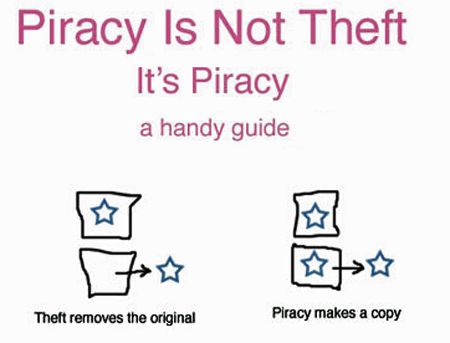 When I copy music from a CD onto my computer, it doesn't feel as if I'm taking someone else's stuff, because I'm not. As the cartoon says, theft removes the original, piracy makes a copy. Sure, I know the intellectual arguments: copying music without paying for it reduces musicians' royalty revenues, and thereby decreases the incentives for musical performance, excellence and innovation. But those intellectual arguments don't register in the primitive part of my brain, the part that tells me taking $1 from the guitar case of a street musician is wrong.
Evolutionary theory suggests that property rights come from creation or production – I own my nest because I've made it. This is another reason why laws against downloading feel wrong. I make something when I produce a mixed tape, burn a CD, re-arrange or re-mix music. Our animal brains tell us that when we produce something, we should get to keep it.If the fundamental basis of property rights is an evolutionary rule "don't take other people's nests," the attempt to re-interpret property rights as "don't copy other people's nests" is fraught with difficulties.
From an evolutionary point of view, copying a better nest design is a good idea. Working against people's innate tendencies is much harder than working with them. And that has implications for the way copyright laws are enforced. If people have no innate respect for copyright, what can be used to compel compliance? Tear-jerking ads of unemployed movie worker? Fear? (simple economics of crime: risk-neutral people will download as long as the marginal benefits are greater than or equal to the probability of getting caught times the fine if caught).
Following our instinctual urges is sometimes a very bad idea. We are hard-wired to love sugar and fat, but giving in to those cravings has undesirable consequences. Some amount of copyright protection is a good thing. What about the new copyright legislation introduced by Canada's conservative government this week? The bill makes a distinction between individual copying for private use and copying for commerical use. A law that allows people to legally reproduce, for their own use, music they have already paid for seems sensible.
More controversially, the new legislation would make it illegal to break digital locks. So, for example, if I buy DVDs in Europe and then convert them to a format that can be read by my Canadian DVD player, I would (probably) be violating the new law. That will be harder to live with.
But on the other hand, if the cost of buying a new CD is $15, the fine if I'm caught unlocking one is $5,000, and I can unlock a friend's for nothing – it's still worth doing as long as the probability of getting caught is less than 0.3% (0.003*5000=15).
I have not studied the new legislation carefully enough to have an informed opinion about it (though I came across a lot of useful tips for unlocking European DVDs in the reading I have done). I would be interested in WCIers' thoughts and comments.


 Worthwhile Canadian Initiative
A note on anti-piracy solutions: most realistic proposals have given up on ensuring the protection of digital content in every case, either by technical invulnerability or via total legislative enforcement. It simply can’t be done.
Instead, on the technical side, businesses seek to make piracy sufficiently inconvenient that most people will shell out instead of spend $hours breaking it themselves with instructions grabbed off the Internet. Locks that are good enough rather than perfect, because perfect can’t be done.
On the legislative side, lawmakers target the people who research and distribute ways to make such breaking faster and easier. The problem there is that once someone does find such way, everyone else can rapidly duplicate the process, so lawmakers seek to make it illegal for an individual to break his own digital locks. Again, breaking said lock is always possible given enough time and skill, but in practice very few individuals have the time or skill.
(there are other issues, dealing with for-profit pirates instead of the new generation of piracy-so-you-can-send-Microsoft-taunting-letters, but we already have older legislation that effectively deals with those. A pirate operating for profit necessarily generates a larger paper trail.)
The problems with this approach are international issues; on region-locking (say) one can always import a disk drive from New Zealand, where region locking is illegal, and use that to play anything. If one desired non-simlocked phones, import them from Singapore. And so on; all this is entirely legal. On the illegal side, there’s very little that the first world can do about a skilled pirate in Shanghai or Moscow distributing piracy methods or unprotected versions of media, so all we’ve done is limit the piracy of media the Chinese or Russians aren’t interested in consuming.
Here’s an alternative explanation: the ethical argument against stealing a bike is much simpler than the ethical argument against downloading music. Because the first is a rival and the second a non-rival good.
A. If I take a bike without paying, instead of leaving it alone, that directly harms the owner, who now can’t ride it home.
A’. If I download music without paying, instead of not downloading it, that harms no-one.
The ethical consequences are only parallel if my alternative action is paying.
B. If I take a bike without paying, instead of paying for it, that harms the owner, who loses $50.
B’. If I download music without paying, instead of paying for it, that harms the copyright owner, who loses $5.
So if you are following some consequentialist ethic (like Act Utilitarianism), whether your action of downloading without paying has bad consequences depends on how you frame the alternative action. Is it don’t download? Or is is download and pay?
Of course, an Act Utilitarian has great difficulty explaining the morality of paying for anything. A consistent Act Utilitarian, who got his head around the framing problem above, would reason like this:
“There are two separate questions: 1. Will I get more utility out of the bike than the owner? If so I should take it. 2. Will the owner get more utility out of the $50 than me? If so I should give him the $50 (or more, or less, until our Marginal Utilities are equalised)”
In other words, under Act Utilitarianism, it is very hard to justify paying for anything. You make transfers of money and transfers of goods, but there is little relation between the two.
The argument that if downloading for free is bad because it reduces the incentives to produce music (or that stealing bikes is bad because it reduces the incentive to produce bikes) is a Rule Utilitarian argument. It violates the Bygones are Bygones rule in economics. The music (the bike) has already been produced, so you can’t affect the production of that music (or bike) by not paying for it. (It’s a time consistency problem, in other words).
The first-best Rule Utilitarian decision rule for downloading music is complicated: If your Willingness To Pay for the music is above zero, then download it. Then send a cheque equal to your WTP to the producer. That way, the producer captures the whole area under the consumers’ demand curve, and will produce if and only if the (fixed) cost of producing the music is less than the total WTP. Which maximises total surplus.
(I taught this in ECON1000 a couple of times. Some got it. The whole topic certainly sparked their interest.)
Nick, how relevant is ethics for predicting and explaining people’s behaviour?
On the incentives – this NY Times article makes the point that for most of history, creating has been easier than replicating – copying a text by hand word for word. It was easier for people tell their own version of the story of King Arthur than exactly duplicate someone else’s story.
Why is the first best utilitarian rule to send a cheque equal to your WTP? Once the fixed cost of producing music has been covered, why should the producer capture the entire surplus?
I chuckled when Frances wrote: “Tear-jerking ads of unemployed movie worker?”. There used to be an ad that was run in Cineplex theatres about some movie stunt guy complaining about illegal pirating of his efforts in the movies where he appeared – and I was the captive audience who paid $13 to be repeatedly forced to sit through this “touching” plea. Gag. Made me want to go home, google his name and download his movies to see what kind of stunts he performed.
I always have a problem with industry making claims that they are losing billions of dollars of lost revenue directly related to the volume of illegal downloading. This, of course, assumes that the alternate is paying.
I would suggest a good portion of illegal downloads are for people whose only alternative is not downloading – ie a different segment of the market altogether. Students. Techies. A different sized economic pie that is being carved up/segmented here.
“The first-best Rule Utilitarian decision rule for downloading music is complicated: If your Willingness To Pay for the music is above zero, then download it. Then send a cheque equal to your WTP to the producer. That way, the producer captures the whole area under the consumers’ demand curve, and will produce if and only if the (fixed) cost of producing the music is less than the total WTP. Which maximises total surplus.”
And also generates incredibly high incomes for producers – perhaps there’s some connection that could be made between this post and the previous ones on the increasing share of high income earners?
It seems to me that the lack of an animal brain reaction to piracy is a considerable strike against copyright as a natural law. Presumably, the remaining case for copyright is that it encourages innovation. At what point does the duration of copyright begin to stifle innovation?
Frances: “Nick, how relevant is ethics for predicting and explaining people’s behaviour?”
I reckon it is. And if it weren’t, why do people spend so much time and money trying to influence people’s ethical views?
“Why is the first best utilitarian rule to send a cheque equal to your WTP? Once the fixed cost of producing music has been covered, why should the producer capture the entire surplus?”
OK. It isn’t necessarily, if the distribution of income matters. But this rule, and only this rule, will ensure that all music gets produced wherever the sum of consumers’ plus producers’ surplus is positive. If everybody sent a cheque that was less than their WTP, their would be some music, where the total cost was less than sum of WTP, but greater than sum of cheques.
Curses! there would be some music. People gonna think I’m illit., ilitt., can’t spell.
“Some amount of copyright protection is a good thing.”
A good post Frances (in my opinion), other than the unsupported assumption I quoted above. I know the argument too (copyright encourages innovation) but I’ve never seen much evidence to suggest it’s really true or, in particular, better than alternative means of encouraging innovation.
It seems to me that the benefit/cost from copyright would vary from industry to industry. With music in particular, I wonder whether there is really any gain at all from copyright.
My daughter pointed out to me recently that country music has become the most profitable type of music because the listeners are not computer savvy. They don’t download the music but go out and pay for it.
Rachel – love it. I pointed out to my 2001 students last term that if the only people who actually paid for music were people my age and parents of pre-teen girls then, yes, the music industry would produce Coldplay and Justin Bieber. There was stunned silence as the room experienced a collective “aha” moment.
Declan, Trevindor – the person who makes the strongest and most forceful case against copyright is David Levine. Because he practices what he preaches, you can read The Case Against Intellectual Monopoly here. If you less serious and more anecdotal version of the argument, there’s the documentary called something like RIP Remix a Manifesto. That can be downloaded from the National Film Board website. There’s a really great section in there that shows that Disney – who have pressed more than anyone else for the extension of intellectual property laws – actually borrowed a lot of the classic Disney images from other people’s work.
Nick – “I reckon it is. And if it weren’t, why do people spend so much time and money trying to influence people’s ethical views?” I guess this is why you studied philosophy as an undergrad and I studied economics, and we’ll have to agree to disagree. When I watch car ads on TV, I see people trying to persuade other people that a car will attract members of the opposite sex, increase their social status, enhance their masculinity, help them provide for and care for their families, make their kids love them, etc. Yes, some ads appeal to people’s already existing ethical views. But when was the last time you saw someone – other than an elementary school teacher, social activist/campaigner or preacher – try to actually change someone else’s ethical views?
You’ve slightly missed the point about anticircumvention (‘digital locks’) laws. Once a government makes it illegal to circumvent DRM, that government has outsourced the writing of copyright law to industry. It doesn’t matter if the law has carve outs to allow personal copying when industry can use a thin layer of DRM designed prevent all copying and, in the process, make it illegal to make any copies, regardless of the end users’ legal right to do so, because making any copy would involve breaking the law by breaking the DRM.
Banning circumvention means giving industry–rather than government–a free hand to unilaterally rewrite the terms of copyright law–from personal rights to copy to the effective duration of copyright protection. Outsourcing the law to private parties who have no regard for the public interest is not a good thing.
“Will I get more utility out of the bike than the owner? If so I should take [steal] it.” Your conclusion (on behalf of the act utilitarian) seems hasty, since (usually) I could just as well buy it from him.
Note that in order to rationalize getting it from him (whether by purchase or by theft or by his gift) I must be justified in believing that I will get more utility out of it, and what reason could I have for this belief? In practice, the best available reason will be that there is a sum of money such that, as compared with the status quo, I would prefer surrendering that sum and getting the bike while he would prefer receiving that sum and giving up the bike. So as a practical matter the act utilitarian will favor purchase over theft (usually).
Cumudgeon made the critical point about this copyright legislation.
Copyright in general is a good thing. Even the GPL (a software license requiring that source be made available) requires copyright. Richard Stallman has an intense reality distortion field around this.
Nancy White wrote “And I Copied It”, as her attack on downloading songs.
Frances: “I make something when I produce a mixed tape, burn a CD, re-arrange or re-mix music.”
I suddenly remembered what that reminded me of: John Locke’s theory of property rights. When I take some unowned natural resource, and mix by labour with it, it becomes my property. It’s the mix what does it.
Philo: but if I’m poorer than he is (unless he’s a “utility monster”), I would get higher marginal utility than him out of both the bike and the money. (Actually, in equilibrium, each person’s MU of a bike should equal their MU of the money they paid for the bike.). He can always go and buy himself another bike. So I should keep on taking everything he’s got, until our MUs of money are equalised.
I quite like this article:
http://www.antipope.org/charlie/blog-static/2010/04/why-content-is-a-public-good.html
Anyway, some of my own thoughts:
If we think about this in Rawlsian luck terms, then there can be no “desert” argument for copyright or other forms of intellectual property. Sure, you came up with that awesome guitar riff or Nobel-winning discovery. But you were born with certain genes and educated in a certain way that other people were not. You don’t “deserve” monetary gain for your ideas on that basis.
That just leaves the efficacy question. If there’s less innovation with copyright (or whatever), then I see no argument for it. Is that the case? Well, when I look at the internet, and the things that go on with P2P, Youtube and so forth, I see huge creativity fighting to get the shackles of copyright off them. I don’t have any quantitative evidence, but I wouldn’t be surprised if copyright on electronic goods is counterproductive (setting practicalities of things like DRM aside). And on medical patents at least, I see people like Joe Stiglitz making good arguments against them.
Also, what if copyright leads to a small increase in innovation compared to the alternative. Is that a good reason to have it? Maybe, but this should be weighed against the free flow of ideas. Perhaps a reasonable analog to that quandary could be free speech versus consequences of free speech. Racist speech tends to lead to more hate crime, but that is not a reason to ban racist speech. At least, if you subscribe to the American way of looking at these things, which as a British citizen I have to say I admire.
Thoughts?
And, if that doesn’t persuade people, what about protecting innovation but without copyright, such as some form of public voucher system?
The incentives and artists argument is simplistic. Do artists really hold back because they may lose some revenues to file sharing? If anything, file sharing makes the work of artists more well known than it otherwise would have been, thereby increasing the artist’s ability to make money by selling merchandise and extras, and by touring.
One could make an argument that big artists like Madonna may be losing some revenues due to file sharing but she also makes so much money I doubt she would even notice. Please name one example of an artist that has gone broke because of file sharing.
This is not about artists making money, though that is the preferred spin in the media; this is about huge corporations protecting their lucrative revenue streams. And given the inequality of incomes this system helps perpetuate, why should it be supported?
There are a lot of trade offs and non obvious consequences when messing with copyright legislation.
One point in Canada is that we have moral rights, which is why the geese in the Eaton’s Centre don’t have red ribbons at Christmas.
Given how broke most artists are it would be really hard to say which ones got pushed over the edge by copying.
My understanding of the history is that there was a point during the French Revolution where copyright got abolished. The result being no new books, since the existing popular ones could be reproduced cheaply.
I wasn’t looking for more arguments that copyright is worse than useless, I was looking for evidence that copyright actually helps (more than alternative means of encouraging innovation). Anyone have any? Would abandoning copyright for music altogether lead to losses in music invention so great that they more than offset the gains from greater, cheaper music distribution?
As for Nick and Philo discussing the merits of theft (of physical property, not intellectual property), the problem with theft is less the actual theft, than the retaliation and the defense mechanisms (as noted by Hobbes) that lead to a vicious circle (and a life that is nasty brutish & short) – that is why we accept coercion by the Leviathan (e.g. expropriation (otherwise known as theft) for a new highway) but not from anyone else. The Leviathan is so strong that retaliation and defense are impossible, thus enabling productive theft.
“Would abandoning copyright for music altogether lead to losses in music invention so great that they more than offset the gains from greater, cheaper music distribution?”
‘Zacly. Can anyone honestly argue there isn’t enough cultural content being created right now? Copyright is not a property right — it is and always was intended to foster innovation and creation. And d’ya honestly think that innovation and creativity is stultified at the moment? The copyright regime has to acknowledge the content rich environment in which it lives. Content’s cheap, except where you intend to store it and move it around. It’s time the copyright owners acknowledged the diminished value in their “property” instead of trying to bolster artificial monopolies created by a miscast legal regime.
That’s a bizarre way of looking at it. Most people would say that theft is wrong because you’re taking someone else’s stuff thus depriving them of using it.
Also, I’m not sure I’d describe things like eminent domain as “theft”. When was the last time a burglar left a cheque for what he took?
Declan: And, quoting Hobbes (from memory) “…there would be no industry, for the fruit thereof is uncertain.”
Marc: “Please name one example of an artist that has gone broke because of file sharing.”
But there’s a sample selection bias here. In equilibrium, there would be the same percentage of artists going broke with and without copyright. Without copyright, some people never become artists in the first place. We don’t see them.
“This is not about artists making money, though that is the preferred spin in the media; this is about huge corporations protecting their lucrative revenue streams. And given the inequality of incomes this system helps perpetuate, why should it be supported?”
Hey, our pension plans own shares in those “huge corporations”!
This brings me back towards the original topic of this post: are we hard-wired to respect and defend certain forms of property rights but not others?
A lot of people view theft from “huge corporations” differently from theft from a person. Even though theft from corporations is theft from people. And Schumpeter, IIRC, said that private property rights in farmland would persist long after other means of production had been nationalised. The farmers would fight to protect their land. Georg Simmel said that people would view a servant taking money much more harshly than a servant taking food.
Thoughtful post. here is a concern.
A property right is to possess or trade with an interest to take. A common right is to free or share with a responsibility to give. Apart from differences in behavior they entail, the first is a private and the second is a public phenomenon. The impact/feedback processes they induce are also differen. The first, is a privacy process of work/reward and the second is a publicity process of donation/grace. Biology and economics must differentiate the analysis of attributes/rights.
Here is another concern.
Rules can be reasonable or ethical. The first are formed from private reason as practical criteria to assist possession, consumption and trade. The second are formed from public ethics to assist free availability, common experience and share. Biology and economics must incorporate these points.
Here is another concern. (I have posted my comments seperately because the web page did not allow me to consolodate them in one).
Do I produce objects as proprietary or common? The production of the first is work in order to possess and trade the object to someone with that interest. The production of the second is donation or contribution in order to give it for free and share it as a duty with others. Operational systems should allow for the seperate although joint processes they specify.
Nick, the real issue here is whether there is a problem that needs to be fixed by the current desire to tighten copyright.
There are moral arguments that file sharing is bad and tantamount to theft, whether one agrees with them or not. But I have yet to see a compelling economic argument that there are gains to be had from the reforms, and I think the framing around incentives for artists just shows that economists have no idea what motivates human bahaviour (a similar problem to assumptions of rationality that have been countered by behavioural economic research).
Forget about empirical results and data for a moment cause we know those do not exist in favour of tightening. I’d be interested to hear a single anecdote about an artist who did not become an artist because of file sharing and insufficient copyright protection. I can think of lots of stories of artists who have done very well because of the internet and file sharing but none in the other direction.
“Most people would say that theft is wrong because you’re taking someone else’s stuff thus depriving them of using it.”
That’s true, they would. But when you follow up with ‘So what?’ they don’t have much of a reply, in my experience.
“I’m not sure I’d describe things like eminent domain as “theft”. When was the last time a burglar left a cheque for what he took?”
Well, it’s a stretch to call it theft, sure, but the point is, if the person in question was willing to sell for the price offerred, it wouldn’t be expropriation, so expropriation means taking something without permission. Don’t get me wrong, I’m not against expropriation (in the appropriate circumstances), I was just explaining why it is only tolerated from the government, not from anyone else.
If I was rewriting this post I would call it something along the lines of “Why copyright laws require Leviathan.” Thanks, Declan, for raising this point.
Social norms (what Nick Rowe thinks of as ethics) support laws preventing the theft of physical property – if I see someone I don’t know entering one of my neighbours’ houses I’ll stop and ask what they’re doing. Social norms don’t prevent the theft of intellectual property to nearly the same extent. As children, we’re told “copy that nice picture that Susie’s drawing” (and “don’t take the Twinkie from Susie’s lunch”)
Worth a separate post?
Maybe more than one. I’ve been following this with interest, and learning much. I don’t know much about this issue beyond ‘some copyright protection is necessary’ and ‘too much copyright protection is bad’.
And I think it’s a good idea to return to Marc’s question: what is the problem that the new legislation is supposed to solve?
Marc: “This is not about artists making money, though that is the preferred spin in the media; this is about huge corporations protecting their lucrative revenue streams. And given the inequality of incomes this system helps perpetuate, why should it be supported?”
Nick Rowe: “Hey, our pension plans own shares in those “huge corporations”!”
Ah! There is a good reason to reduce copyright protection for huge corporations: so that our pension plans will sell their shares. 😉
Okay, I asked Tony Clement – who is responding to questions on twitter – the question “What is the problem that C32 solves?”
His answer:
“Current law punishes consumers (format/time shifting not allowed) and fails to protect creators. Plus need to implement WIPO to def pirates”
The 140-character limit is clearly a constraint here. I can’t make anything of this answer; perhaps others here can.
“Current law punishes consumers (format/time shifting not allowed)
* Right now when you’re watching digital TV and hit ‘pause’ while you get yourself a cup of tea and then watch the recorded program you are in fact entering a legal gray zone. Is this a violation of copyright? The new law makes it clear that this is allowed (Rogers will be happy).
“and fails to protect creators.”
* translation: the film, TV, publishing and music industries are in serious trouble.
“Plus need to implement WIPO to def pirates”
* translation: we’re getting a lot of pressure to do this from the US, and have to do something to shut down the big digital piracy industries based in Montreal.
Worthwhile readings:
http://www.techdirt.com/articles/20100603/0311539672.shtml
http://www.againstmonopoly.org/index.php?perm=593056000000003034
Laurent
‘Hey, our pension plans own shares in those “huge corporations”!’
Well, if this is the concern (I know this is tongue in cheek, but still…), copyright has evolved from being a host of laws aimed at getting creators to create to a host of laws designed to create an asset class that benefits the owners of capital, and perhaps we should be clear about what the laws are for. Should they really be about creating assets that will give our pension plans something to own? Really?
This creation of an asset does benefit the creative class, in that the exploitability of the asset created allows artists to sell the rights to their works to the Disneys and Sonys of the world and profit from their creations. However I’d argue that the over-protection of the asset actually inhibits creation. There are a number of one-album wonders out there who are able to live off the avails of a productive 5 year spurt of creativity that, because of the ability of the Disneys and Sonys to relentlessly exploit the product, have essentially a lottery win on their hands and who are probably less motivated to continue to produce creatively.
@Frances:
Have you read any of Akerlof and Kranton’s papers on identity economics? That seems to nicely square the circle you’re facing vis-à-vis the importance of ethics.
Iron troll – yes, it’s great stuff, though I don’t know if they want to face up to all of their implications of their work. E.g., if
we’re happiest when what we’re doing fits with our identity, it might be a really good idea to have special courses helping people develop positive identities as burger-flippers (there could be courses in Spongebob Studies 1000). That’s what a lot of people end up doing with their lives. And over education is potentially really harmful. A bit “Brave new world.”
“That’s true, they would. But when you follow up with ‘So what?’ they don’t have much of a reply, in my experience.”
True, but then this could be a general point about all morality since there is no objective morality.
Anyway, I was just pointing out how bizarre this reason to be against theft is. If the problem for you with theft is “the retaliation and the defense mechanisms” and not the theft itself, then how does that preclude you from opposing, say, the perfect crime where there is no “retaliation” because no-one knows who did it?
Oops. For “how does that preclude”, substitute “doesn’t that preclude”.
Also, it is quite possible for retaliation in a similar form to occur without theft, and without, I would presume, what you would consider something wrong to have happened beforehand.
For instance, Bob could accuse me of stealing his car. But I never took his car. It is a false accusation. But Bob has a violent temper and he doesn’t believe me. So he retaliates.
So we had retaliation without any theft. Now obviously the retaliation is wrong, I hope we’re agreed on that point. But your reason for opposing theft was because of the retaliatory consequences of it. So if I had stolen Bob’s car, you would say I was wrong. But since I haven’t done that, but retaliation happened anyway, then the logic of your position would require you to condemn me because Bob retaliated against me, even though I didn’t steal anything.
I’m not sure what sort of morality that is, but it’s not one that fits in with my priors that’s for sure.
I am an “album oriented” person. I don’t like to download singles, rather I enjoy whole albums. In fact, I don’t really enjoy listening to artists who can only produce a single or two and not a whole albums worth of material. But, I admit, I’m in the minority here, and I can accept that.